
Studying Evolution with Digital Organisms
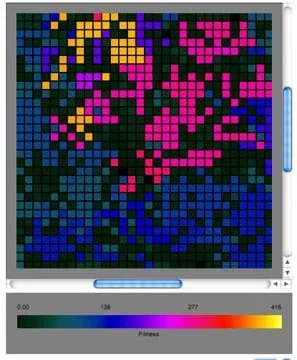 A virtual digital petri dish in the Avida-ED software application. Each grid represents a digital organism.Copyright 2011 Rob Pennock, Michigan State University
Students observe natural selection in action and investigate the underlying mechanism, including random mutation and differential fitness based on environmental characteristics. They do this through use of the free AVIDA-ED digital evolution software application.
Computer scientists and engineers work together to create software and hardware to model complex systems and create new technologies. The digital evolution software, Avida, was created by a group of computer scientists and software engineers interested in the experimental study of digital organisms in order to better understand how biological natural selection works and then to apply that knowledge to solving computational problems. Evolutionary computation methods can be applied to solve a wide range of engineering design problems.
After this activity, students should be able to:
- Explain how the random mutation of genetic information during reproduction leads to variation among individuals of a population.
- Relate the variation among individuals of a population to their differential fitness and explain how the nonrandom process of natural selection acts at the population level to increase or decrease the proportions of certain variations.
- Explain the role of the environment in the process of natural selection.
- Students will develop an understanding of the relationships among technologies and the connections between technology and other fields of study.
Grades K-12
Do you agree with this alignment? - Use computers and calculators to access, retrieve, organize, process, maintain, interpret, and evaluate data and information in order to communicate.
Grades 9-12
Do you agree with this alignment? - STEL-8N Use various approaches to communicate processes and procedures for using, maintaining, and assessing technological products and systems.
Grades 9-12
Do you agree with this alignment?
- B1.1E Describe a reason for a given conclusion using evidence from an investigation.
Grades 9-12
Do you agree with this alignment? - B5.1A Summarize the major concepts of natural selection (differential survival and reproduction of chance inherited variants, depending on environmental conditions).
Grades 9-12
Do you agree with this alignment? - B5.1e Explain how natural selection leads to organisms that are well suited for the environment (differential survival and reproduction of chance inherited variants, depending upon environmental conditions).
Grades 9-12
Do you agree with this alignment?
- HS-LS4-2 Construct an explanation based on evidence that the process of evolution primarily results from four factors: (1) the potential for a species to increase in number, (2) the heritable genetic variation of individuals in a species due to mutation and sexual reproduction, (3) competition for limited resources, and (4) the proliferation of those organisms that are better able to survive and reproduce in the environment.
Grades 9-12
This resource focuses on the following Three Dimensional Learning aspects of NGSS:
Science & Engineering Practices- Construct an explanation based on valid and reliable evidence obtained from a variety of sources (including students' own investigations, models, theories, simulations, peer review) and the assumption that theories and laws that describe the natural world operate today as they did in the past and will continue to do so in the future.Do you agree with this alignment?
Disciplinary Core Ideas- Natural selection occurs only if there is both (1) variation in the genetic information between organisms in a population and (2) variation in the expression of that genetic information—that is, trait variation—that leads to differences in performance among individuals.Do you agree with this alignment?
- Evolution is a consequence of the interaction of four factors: (1) the potential for a species to increase in number, (2) the genetic variation of individuals in a species due to mutation and sexual reproduction, (3) competition for an environment's limited supply of the resources that individuals need in order to survive and reproduce, and (4) the ensuing proliferation of those organisms that are better able to survive and reproduce in that environment.Do you agree with this alignment?
Crosscutting Concepts- Empirical evidence is required to differentiate between cause and correlation and make claims about specific causes and effects.Do you agree with this alignment?
Do you agree with this alignment? - Construct an explanation based on valid and reliable evidence obtained from a variety of sources (including students' own investigations, models, theories, simulations, peer review) and the assumption that theories and laws that describe the natural world operate today as they did in the past and will continue to do so in the future.
- HS-LS4-4 Construct an explanation based on evidence for how natural selection leads to adaptation of populations.
Grades 9-12
This resource focuses on the following Three Dimensional Learning aspects of NGSS:
Science & Engineering Practices- Construct an explanation based on valid and reliable evidence obtained from a variety of sources (including students' own investigations, models, theories, simulations, peer review) and the assumption that theories and laws that describe the natural world operate today as they did in the past and will continue to do so in the future.Do you agree with this alignment?
Disciplinary Core Ideas- Natural selection leads to adaptation, that is, to a population dominated by organisms that are anatomically, behaviorally, and physiologically well suited to survive and reproduce in a specific environment. That is, the differential survival and reproduction of organisms in a population that have an advantageous heritable trait leads to an increase in the proportion of individuals in future generations that have the trait and to a decrease in the proportion of individuals that do not.Do you agree with this alignment?
Crosscutting Concepts- Empirical evidence is required to differentiate between cause and correlation and make claims about specific causes and effects.Do you agree with this alignment?
- Scientific knowledge is based on the assumption that natural laws operate today as they did in the past and they will continue to do so in the future.Do you agree with this alignment?
Do you agree with this alignment? - Construct an explanation based on valid and reliable evidence obtained from a variety of sources (including students' own investigations, models, theories, simulations, peer review) and the assumption that theories and laws that describe the natural world operate today as they did in the past and will continue to do so in the future.
Each group needs:
- computer with the Avida-ED software, freely available at https://avida-ed.msu.edu/
- Introduction to Digital Evolution Handout & Tutorial (PDF)
A basic understanding of evolution by natural selection is required. While the concept of natural selection should have been introduced previously, this activity and the lesson's other associated activity explore how the process works (including variation, inheritance, and selection).
Yesterday, we were introduced to the Avida-ED software for studying evolution using digital organisms. Over the next few days you will use the software to observe and investigate the process of natural selection.
Background
All instructions are included on the Introduction to Digital Evolution Handout & Tutorial (PDF). Students may work on computers in pairs or individually, comparing their results to their neighbors' and working together on the discussion questions. The embedded discussion questions are not meant to be a formal assessment for grading, but rather to provide a basis for group and class discussion. The instructions and use of the software are fairly straightforward; it is in considering the discussion questions that students must think critically to develop an understanding of the process of natural selection. Thus, the instructor is advised to limit his/her input during this phase and let students investigate the process and propose their own explanations. Good times for class discussion (of the questions embedded in the handout) are after Part 1 and then again after Part 2. Alternatively, the instructor may wish to conduct group discussions after each section of Part 1 (1.3, 1.4 and 1.5) and Part 2 (2.1 and 2.2), before students move on to the next sections.
Before the Activity
- Teacher to review the activities on his/her own so that s/he can help direct students during class.
- Prepare enough computers with Avida-ED installed for each pair of students.
- Make copies of Introduction to Digital Evolution Handout & Tutorial (PDF), one per group.
With the Students
- Ask students the opening questions, as described in the Assessment section.
- With student pairs at computers that have Avida-ED installed, give each group a handout and direct them to follow its instructions. Students should begin with "1.3 Examining an organism," since the material up to that point will have been covered during the associated lesson.
- Circulate through the room to help students as they proceed through the sections of Part 1:
- 1.3 Examining an organism — Big idea: Digital organisms are defined by a series of commands including instructions for replication.
- 1.4 Growing an organism — Big idea: A digital organism reproduces asexually, but is not identical to its parent due to mutation.
- 1.5 Examining an evolved organism — Big idea: An offspring of a digital organism is assigned its parent's fitness value, but is not identical to its parent.
- Facilitate a class discussion using the handout questions for Part 1.
- Circulate through the room to help students as they proceed through the sections of Part 2, in which students explore the effects of the environmental resources on the fitness of organisms, which leads to selection.
- 2.1 Competing two organisms — Big idea: Digital organisms that obtain and use more energy can reproduce faster.
- 2.2 Changing the environmental resources — Big idea: Only functions that are rewarded are selected for in a population.
- Facilitate a class discussion using the handout questions for Part 2.
- Have students continue on with the experimental procedure (resulting in two data tables), data analysis (resulting in a graph) and concluding questions on the handout (referring to the data tables and graph).
- Conclude by asking students the opening questions again, as described in the Assessment section.
- avida-ed
- An educational version of the digital evolution software, Avida.
- digital evolution
- An instance of evolution wherein self-replicating digital organisms are subject to random mutation that is acted on by natural selection.
- digital organism
- A small self-replicating computer program.
- evolution
- The change in the genetic composition of a population from generation to generation.
- natural selection
- A process in which organisms with certain inherited characteristics are more likely to survive and reproduce than are organisms with other characteristics; the main driving force of evolution.
Pre-Activity Assessment
Opening Questions: Have students answer the following questions to the best of their abilities:
- Explain how new traits arise in a population. Give an example if possible.
- Explain how the process of natural selection causes a population to change over time.
- Explain how the characteristics of the environment influence individuals and populations over time resulting in evolution.
Activity Embedded Assessment
Misconceptions Alert: Carefully listen to student answers to the handout discussion questions and help them to replace misconceptions with correct explanations using data collected in Avida-ED. For example, below are the answers as well as common misconceptions to the pre/post assessment questions:
- Explain how new traits arise in a population. Give an example if possible.
Answer: New traits arise when random mutations change the genetic code in a way that creates a new phenotype. For example, a mutation may occur in the DNA of a bacterium that would make it resistant to a particular antibiotic. These mutations are often random replication errors made during reproduction.
Common misconception: Students often mistakenly think that the environment causes changes in the organisms. This often manifests as explanations that refer to organisms "needing" a particular trait. Additionally, they are often unclear about how a random mutation is linked to phenotypic changes that cause adaptive or non-adaptive traits.
- Explain how the process of natural selection causes a population to change over time.
Answer: Natural selection acts on genetic variation in a population. A variation that gives an organism an advantageous trait (an adaptive trait) increases its fitness and allows it to survive and reproduce more often that other organisms in its environment and thus tends to be passed on more often than other variations. Over many generations, this difference in reproductive success increases the proportion of adaptive traits in the population and decreases the proportion of less adaptive traits in the population.
Common misconception: Students often think that individuals change gradually over time rather than understanding that natural selection acts on individuals to cause a change in the frequency of traits in a population.
Teaching tip: A simple way to present the process of natural selection is with the acronym "VIST," which stands for variation, inheritance, selection, and time. Explicitly discussing the interaction between these four components (especially as they relate to individuals and populations) helps students to identify and replace many of their misconceptions.
- Explain how the characteristics of the environment influence individuals and populations over time resulting in evolution.
Answer: Whether a trait is adaptive and thus increases the fitness of an organism depends on the environment in which it lives. For example, a mutation in a bacterium that confers resistance to penicillin will only be "selected for" (increase in frequency in the population) if penicillin is present in the environment.
Common misconception: Students often believe that the environment directly causes adaptive traits to occur rather than recognizing that the appearance of adaptive traits is due to random mutation while the population level changes are due to natural selection. They also often miss the link between the environment and whether or not a trait is adaptive (that is, the same trait may be an advantage in one environment and a disadvantage in another).
Post-Activity Assessment
Questions Revisited: Have students answer (or revise their previous answers) to the three pre-activity assessment questions.
- Evolution of Digital Organisms
- Studying Evolution with Digital Organisms
- Engineering Digital Biodegraders for Biological Cleanup
Contributors
Wendy Johnson; Robert Pennock; Louise Mead
Supporting Program
Bio-Inspired Technology and Systems (BITS) RET, College of Engineering, Michigan State University
Acknowledgements
The contents of this digital library curriculum were developed through the Bio-Inspired Technology and Systems (BITS) RET program under National Science Foundation RET grant no EEG 0908810. However, these contents do not necessarily represent the policies of the NSF and you should not assume endorsement by the federal government.
Copyright
2013 by Regents of the University of Colorado; original © 2011 Michigan State University