
Solar Farm Cost-Benefit Analysis
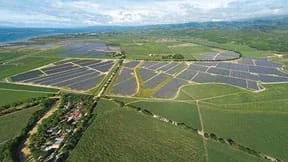 Solar panel farms produce energy, but require large amounts of land.Copyright 2015 Kanadaurlauber, Wikimedia Commons https://commons.wikimedia.org/wiki/File:San-Carlos-Solar-Energy-I-SaCaSol-I_Full-Area_1.jpg
A cost-benefit analysis is a good way to weigh the costs and the benefits and compare them to see if the decisions being made are sound and worthwhile. For a hypothetical solar farm design problem, students are given a solar cost-benefit analysis sheet to complete within groups. They weigh the expense and benefits of two types of solar panels (with different costs, wattage outputs and land impacts), consider the cost of using the acreage for solar (which removes it from ranching use), and explain why they consider the panel combination they propose to be best. If the costs outweigh the benefits, then a project is not worth doing. On the other hand, if the benefits outweigh the costs, then it is worth implementing the plan.
Over the years, various types of energy resources have been exploited to produce more electrical power for the increasing amount of people and electricity demand. In the beginning stages of product development, engineers use cost-benefit analyses to determine product viability. Mechanical engineers use cost-benefit analyses to make decisions about bringing to market new car designs by analyzing the production costs and whether people would buy them. Other engineers use cost-benefit analyses to make project decisions, such as whether the added expense of hiring three more people to produce code is justified by the gained work and its value to the project.
After this activity, students should be able to:
- Complete a cost-benefit analysis of a product or system.
- Analyze the costs and benefits of solar farms.
- Explain the consequences of solar farms on large plots of land.
- CCSS.Math.Content.HSS-ID.A Summarize, represent, and interpret data on a single count or measurement variable
Grades 9-12
Do you agree with this alignment?
- Students will develop an understanding of the cultural, social, economic, and political effects of technology.
Grades K-12
Do you agree with this alignment? - Students will develop an understanding of the effects of technology on the environment.
Grades K-12
Do you agree with this alignment? - Students will develop an understanding of the role of society in the development and use of technology.
Grades K-12
Do you agree with this alignment? - Students will develop an understanding of the attributes of design.
Grades K-12
Do you agree with this alignment? - Students will develop an understanding of engineering design.
Grades K-12
Do you agree with this alignment? - Students will develop an understanding of the role of troubleshooting, research and development, invention and innovation, and experimentation in problem solving.
Grades K-12
Do you agree with this alignment? - Students will develop an understanding of and be able to select and use agricultural and related biotechnologies.
Grades K-12
Do you agree with this alignment?
- HS-ESS3-2 Evaluate competing design solutions for developing, managing, and utilizing energy and mineral resources based on cost-benefit ratios.
Grades 9-12
This resource focuses on the following Three Dimensional Learning aspects of NGSS:
Science & Engineering Practices- Evaluate competing design solutions to a real-world problem based on scientific ideas and principles, empirical evidence, and logical arguments regarding relevant factors (e.g. economic, societal, environmental, ethical considerations).Do you agree with this alignment?
Disciplinary Core Ideas- All forms of energy production and other resource extraction have associated economic, social, environmental, and geopolitical costs and risks as well as benefits. New technologies and social regulations can change the balance of these factors.Do you agree with this alignment?
- When evaluating solutions it is important to take into account a range of constraints including cost, safety, reliability and aesthetics and to consider social, cultural and environmental impacts.Do you agree with this alignment?
Crosscutting Concepts- Analysis of costs and benefits is a critical aspect of decisions about technology.Do you agree with this alignment?
- Science and technology may raise ethical issues for which science, by itself, does not provide answers and solutions.Do you agree with this alignment?
- Science knowledge indicates what can happen in natural systems—not what should happen. The latter involves ethics, values, and human decisions about the use of knowledge.Do you agree with this alignment?
- Many decisions are not made using science alone, but rely on social and cultural contexts to resolve issues.Do you agree with this alignment?
Do you agree with this alignment? - Evaluate competing design solutions to a real-world problem based on scientific ideas and principles, empirical evidence, and logical arguments regarding relevant factors (e.g. economic, societal, environmental, ethical considerations).
- HS-ESS3-4 Evaluate or refine a technological solution that reduces impacts of human activities on natural systems.
Grades 9-12
This resource focuses on the following Three Dimensional Learning aspects of NGSS:
Science & Engineering Practices- Design or refine a solution to a complex real-world problem, based on scientific knowledge, student-generated sources of evidence, prioritized criteria, and tradeoff considerations.Do you agree with this alignment?
Disciplinary Core Ideas- Scientists and engineers can make major contributions by developing technologies that produce less pollution and waste and that preclude ecosystem degradation.Do you agree with this alignment?
- When evaluating solutions it is important to take into account a range of constraints including cost, safety, reliability and aesthetics and to consider social, cultural and environmental impacts.Do you agree with this alignment?
Crosscutting Concepts- Engineers continuously modify these technological systems by applying scientific knowledge and engineering design practices to increase benefits while decreasing costs and risks.Do you agree with this alignment?
- Feedback (negative or positive) can stabilize or destabilize a system.Do you agree with this alignment?
Do you agree with this alignment? - Design or refine a solution to a complex real-world problem, based on scientific knowledge, student-generated sources of evidence, prioritized criteria, and tradeoff considerations.
- NC.M1.A-CED.4 Solve for a quantity of interest in formulas used in science and mathematics using the same reasoning as in solving equations.
Grades 9-12
Do you agree with this alignment?
- EEn.2.2.1 Explain the consequences of human activities on the lithosphere (such as mining, deforestation, agriculture, overgrazing, urbanization, and land use) past and present.
Grades 9-12
Do you agree with this alignment?
Each group needs:
- Solar Farm Cost-Benefit Analysis Worksheet (PDF)
- pencils
- notebooks or lined paper
What if I told you an energy resource exists with enough energy to power the entire planet with little to no air pollution, would you purchase it? What if it did not cost very much money, but took up large amounts of land?
What do you know about solar farms? A solar farm is a plot of land that has a lot of solar panels spread out across its area. Often, solar farms are set up to supply energy for a business or resort.
Solar panels use energy from the sun to create electricity. The systems are called photovoltaic panels because they use semiconducting materials to convert photons (light) into electricity. Solar panels are considered dispatchable energy generators, which are electricity sources that can be turned on and off when needed. These forms of energy are easily inserted into the power grid as needed. Other forms of dispatchable energy include wind and natural gas. While not relied on for extended periods of time, they have the benefit of being able to produce electricity on short notice to supplement traditional means of electricity production.
One challenge of solar panel farms is the requirement for an area of land. In today’s engineering analysis exercise, we will perform a cost-benefit analysis for different solar farm scenarios that takes into consideration ecosystem disruption impacts.
Your engineering task: To design your own solar panel farm that meets the following constraints:
- You have at most 100 available plots to fill with solar panels (grid on worksheet).
- Currently, each plot is home to a family of sheep that supplies the local wool industry, which requires a $200 compensation to the rancher for each plot removed from raising sheep.
- You have at most $15,000 to spend.
- You must generate at least 400 watts of energy per day using any mix of two types of solar panels:
- The basic model costs $100 each and generates 7 watts of energy per day while occupying one plot, but it eliminates all plant growth due to the shade it energy, which displaces the sheep.
- The deluxe model costs $450 each and generates 13 watts of electricity per day while occupying two plots, but it is elevated so that plants can survive under it, which means the sheep can remain.
To set up systems that tap renewable energy, you must research the pros and cons of the possible ways you might go about it. Solar power is a good source of renewable energy, but it can take large plots of land that could alternatively be used for wildlife and/or livestock. What are other ways to increase the amount of electricity being generated in the world? (Before starting the activity, explore this topic with students. Possible answers: Identify the most effective energy resources for a given region and invest heavily in those; find and cultivate more non-renewable energy sources.)
The main goal of a cost-benefit analysis is to do a logical examination of the proposed projects and plans to ensure that the ideas and end products are worth the effort and money to make them possible. It is likely that you personally conduct informal cost-benefit analyses all the time. For example, when you consider buying something—say a new cell phone—you contemplate what it costs, if you have the money, its features, and how much you value those features, and then decide whether or not it is worth it for you to buy it. You do the same for all sorts of purchase and planning decisions. Would you buy a useless product? Would you use your monthly grocery budget to buy a new television? Of course not! For today’s cost-benefit analysis, your objective is to maximize energy production while minimizing land and cost.
Background
Solar panels are increasing in popularity because they are, on-balance, clean energy resources emitting no air pollution. (Technologies are evolving to reduce any emissions, pollution and waste that can occur during the manufacture of solar cells.) While they reduce the amount of greenhouse gases released during electricity generation (compared to the burning of fossil fuels), they take up valuable land and can be aesthetically unpleasing. Furthermore, habitat destruction is often an undesirable consequence during the construction of solar farms.
In this activity, student groups each design a hypothetical solar farm that generates power, while considering the impacts to the local ecosystem. In determining the best plan for their solar farms, they compare two types of solar panels. They are required to generate 400 watts of electricity and consider the trade-offs for making the land also available for sheep ranching. The basic solar panel model ($100) makes the land unsuitable for sheep, which results in a $200 payment to the rancher. The deluxe solar panel ($450) is compatible with the sheep due to its height above the ground, which is enough for the sheep to eat and live under. The deluxe are more expensive than the basic, but offer almost double the amount of wattage. With these known constraints, students plot a solar farm that is able to generate the required wattage (400 watts daily). This activity requires them to consider the costs and benefits of solar farms in a relevant and meaningful way.
Before the Activity
- Make copies of the Solar Farm Cost-Benefit Analysis Worksheet (PDF).
With the Students
- Conduct the pre-activity discussion using the questions provided in the Assessment section.
- Present to the class the Introduction/Motivation content.
- Divide the class into groups of four students each and have groups sit together at tables.
- Give each team a worksheet. Have students begin the activity by brainstorming in their groups ideas on which solar panels to buy and why.
- Expect students to come up with a system in order to find the optimal solution for generating energy for the lowest cost. (More than one solution may exist.)
- Suggest that students make some educated guesses as to how much of each solar panel they think would be needed in order to meet the requirement to generate 400 watts of energy each day.
- After teams have worked for some time, go around and ask each group questions to give students a chance explain their logic and reasoning, or, as needed, to help them find a workable solution that meets the constraints.
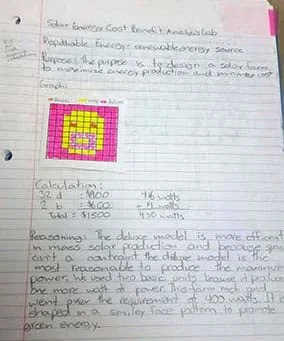 An example student write-up shows his/her final cost-benefit analysis to create a viable solar farm design that meets the project constraints.Copyright 2016 Hannah Brooks, RET Program, North Carolina State University
- To conclude, ask teams to each explain why they think their solar farm designs are the best by writing summaries in their notebooks and then sharing with another team. Grade students’ answers to the worksheet’s concluding analysis questions.
- cost-benefit analysis
- A systematic approach to estimating the strengths and weaknesses of a plan, decision, action or purchase to determine if it is sound and worth pursuing: Do the benefits outweigh the costs, and by how much?
- dispatchable generation
- Sources of electricity that can be turned on and off when needed.
- photon
- Light in the form of a wave. A tiny bundle of electromagnetic radiation.
- photovoltaic panel
- A device that converts light into electricity by causing current to flow.
- solar energy
- Radiant light and heat from the sun that is harnessed by technology as a renewable energy source.
Pre-Activity Assessment
Prior Knowledge: Before starting the activity, ask students the following questions:
- What is a solar panel? (Expected answers: A flat blue/black device/object seen on the roofs of houses, technology that generates electricity or heat from the energy of the sun.)
- What else do you know about solar panels? What are some other characteristics and requirements of solar panels? (Expected answers: Some consider them to be ugly, they take up a lot of land or surface area, and they are expensive.)
- How are solar panels helpful? (Expected answers: They generate electricity in a dispatchable way; they do not produce waste or pollution.)
- How are solar panels better than traditional types of electricity generation? (Expected answers: During their long lives, solar cells do not produce carbon dioxide or pollution in order to generate electricity.)
- How do you think solar panels are produced? What consequences may result from the process? (Students may not know, but manufacturing typically uses electricity from burning fossil fuels and results in some waste and pollution, although technologies are getting better at being “clean.”)
- How are solar panels worse than traditional types of electricity generation? (Answer: They require a dedicated amount of land or surface area—although big power plants take up land, too.)
- Why is it important to pay attention to where you put electricity generation systems? What problems occur when you put solar panels on large plots of land? (Answers: Not every location receives the same sunlight and wind patterns; we must consider any environmental harm such as if forests are destroyed.)
Activity Embedded Assessment
Panel Selection: As students work through the activity, walk around and listen to group conversations. Ask each group: Why do you think your idea is the best? (Possible student answers: Because we are protecting the sheep from leaving the land; we have strategically placed the panels to maximize the electricity generation.)
Post-Activity Assessment
Final Products: Have students explain why they think their team’s solar farm design is the best by writing summaries that they later share with other teams. While no right answer exists, expect students to be able to argue their points. Once everyone is finished, look at each group’s solar farm setup. Have students gained an understanding about why solar panels cannot be placed just anywhere? Is their reasoning sound? As a summative assessment, grade students’ answers to the worksheet’s concluding analysis questions. Refer to the Solar Farm Cost-Benefit Analysis Answer Key (PDF).
- What are some other impacts that solar farms might have on ecosystems?
- Brainstorm some potential design solutions to decrease reliance on open land for solar panels.
- Why are dispatchable energy sources beneficial as components of the electrical grid system?
- Consider your final product, which is a solar farm design. If you were real-world engineers, how would you go about conducting a comprehensive cost-benefit analysis for your final design? What specific information would you need?
Contributors
Hannah Brooks; Dale Gaddis; Shay Marceau; Ashley Martin; Lazar Trifunovic
Supporting Program
RET Program, College of Engineering, North Carolina State University, and CORE Lab, University of North Carolina at Charlotte
Acknowledgements
This curricular unit was developed based upon work supported by the National Science Foundation under grant no. EEC 1542377—Grand Challenges for Engineering Focused RET with Stratified Teams, a collaboration of the College of Engineering at North Carolina State University, and the Control Optimization for Renewable Energies (CORE) Lab at the University of North Carolina at Charlotte. Any opinions, findings, and conclusions or recommendations expressed in this material are those of the authors and do not necessarily reflect the views of the National Science Foundation.
Copyright
2017 by Regents of the University of Colorado; original © 2016 North Carolina State University