
Just Like Kidneys: Semipermeable Membrane Prototypes
Using ordinary household materials, student “biomedical engineering” teams design prototype models that demonstrate semipermeability under the hypothetical scenario that they are creating a teaching tool for medical students. Working within material constraints, each model consists of two layers of a medium separated by material acting as the membrane. The competing groups must each demonstrate how water (or another substance) passes through the first layer of the medium, through the membrane, and into the second layer of the medium. After a few test/evaluate/redesign cycles, teams present their best prototypes to the rest of the class. Then student teams collaborate as a class to create one optimal design that reflects what they learned from the group design successes and failures. A pre/post-quiz, worksheet and rubric are provided.
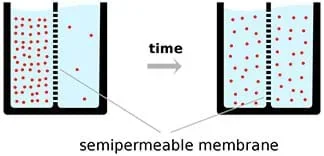 Over time, certain molecules pass through semipermeable membranes while others are unable to.Copyright 2009 Quasar Jarosz, Wikimedia Commons (public domain) https://commons.wikimedia.org/wiki/File:Diffusion.en.svg
Creating models and prototypes is an essential and iterative step in the engineering design process. Engineers build, use and revise models to explore and demonstrate how things work. This is especially helpful for processes that are too large or too small to see. Models and prototypes also enable cost saving because they are a good way to uncover any potential problems before spending for full-size construction or fabrication. Kidney dialysis is a good example of engineering technology in the medical field.
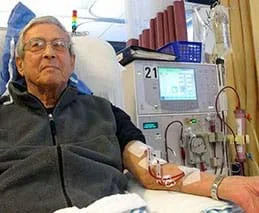 A man receiving dialysis treatment.Copyright 2012 Anna Frodesiak, Wikimedia Commons, CC BY SA-1.0 (+ model consent) https://commons.wikimedia.org/wiki/File:Patient_receiving_dialysis_03.jpg
After this activity, students should be able to:
- Define diffusion, osmosis and semipermeable.
- Explain the importance of a semipermeable membrane.
- Follow the steps of the engineering design process as they create prototypes.
- Discuss and compare design successes and failures to come up with an optimal design.
- Students will develop an understanding of the attributes of design.
Grades K-12
Do you agree with this alignment? - Students will develop an understanding of engineering design.
Grades K-12
Do you agree with this alignment? - Students will develop an understanding of the role of troubleshooting, research and development, invention and innovation, and experimentation in problem solving.
Grades K-12
Do you agree with this alignment? - Students will develop abilities to apply the design process.
Grades K-12
Do you agree with this alignment? - Students will develop abilities to assess the impact of products and systems.
Grades K-12
Do you agree with this alignment? - Students will develop an understanding of the relationships among technologies and the connections between technology and other fields of study.
Grades K-12
Do you agree with this alignment? - Advances and innovations in medical technologies are used to improve healthcare.
Grades 6-8
Do you agree with this alignment? - STEL-3G Explain how knowledge gained from other content areas affects the development of technological products and systems.
Grades 6-8
Do you agree with this alignment?
- MS-ETS1-1 Define the criteria and constraints of a design problem with sufficient precision to ensure a successful solution, taking into account relevant scientific principles and potential impacts on people and the natural environment that may limit possible solutions.
Grades 6-8
This resource focuses on the following Three Dimensional Learning aspects of NGSS:
Science & Engineering Practices- Define a design problem that can be solved through the development of an object, tool, process or system and includes multiple criteria and constraints, including scientific knowledge that may limit possible solutions.Do you agree with this alignment?
Disciplinary Core Ideas- The more precisely a design task's criteria and constraints can be defined, the more likely it is that the designed solution will be successful. Specification of constraints includes consideration of scientific principles and other relevant knowledge that is likely to limit possible solutions.Do you agree with this alignment?
Crosscutting Concepts- The uses of technologies and any limitations on their use are driven by individual or societal needs, desires, and values; by the findings of scientific research; and by differences in such factors as climate, natural resources, and economic conditions.Do you agree with this alignment?
- All human activity draws on natural resources and has both short and long-term consequences, positive as well as negative, for the health of people and the natural environment.Do you agree with this alignment?
Do you agree with this alignment? - Define a design problem that can be solved through the development of an object, tool, process or system and includes multiple criteria and constraints, including scientific knowledge that may limit possible solutions.
- MS-ETS1-2 Evaluate competing design solutions using a systematic process to determine how well they meet the criteria and constraints of the problem.
Grades 6-8
This resource focuses on the following Three Dimensional Learning aspects of NGSS:
Science & Engineering Practices- Evaluate competing design solutions based on jointly developed and agreed-upon design criteria.Do you agree with this alignment?
Disciplinary Core Ideas- There are systematic processes for evaluating solutions with respect to how well they meet the criteria and constraints of a problem.Do you agree with this alignment?
Do you agree with this alignment? - Evaluate competing design solutions based on jointly developed and agreed-upon design criteria.
- MS-ETS1-3 Analyze data from tests to determine similarities and differences among several design solutions to identify the best characteristics of each that can be combined into a new solution to better meet the criteria for success.
Grades 6-8
This resource focuses on the following Three Dimensional Learning aspects of NGSS:
Science & Engineering Practices- Analyze and interpret data to determine similarities and differences in findings.Do you agree with this alignment?
Disciplinary Core Ideas- There are systematic processes for evaluating solutions with respect to how well they meet the criteria and constraints of a problem.Do you agree with this alignment?
- Sometimes parts of different solutions can be combined to create a solution that is better than any of its predecessors.Do you agree with this alignment?
- Although one design may not perform the best across all tests, identifying the characteristics of the design that performed the best in each test can provide useful information for the redesign process—that is, some of the characteristics may be incorporated into the new design.Do you agree with this alignment?
Do you agree with this alignment? - Analyze and interpret data to determine similarities and differences in findings.
- MS-ETS1-4 Develop a model to generate data for iterative testing and modification of a proposed object, tool, or process such that an optimal design can be achieved.
Grades 6-8
This resource focuses on the following Three Dimensional Learning aspects of NGSS:
Science & Engineering Practices- Develop a model to generate data to test ideas about designed systems, including those representing inputs and outputs.Do you agree with this alignment?
Disciplinary Core Ideas- Models of all kinds are important for testing solutions.Do you agree with this alignment?
- The iterative process of testing the most promising solutions and modifying what is proposed on the basis of the test results leads to greater refinement and ultimately to an optimal solution.Do you agree with this alignment?
Do you agree with this alignment? - Develop a model to generate data to test ideas about designed systems, including those representing inputs and outputs.
- MS-LS1-2 Develop and use a model to describe the function of a cell as a whole and ways parts of cells contribute to the function.
Grades 6-8
This resource focuses on the following Three Dimensional Learning aspects of NGSS:
Science & Engineering Practices- Develop and use a model to describe phenomena.Do you agree with this alignment?
Disciplinary Core Ideas- Within cells, special structures are responsible for particular functions, and the cell membrane forms the boundary that controls what enters and leaves the cell.Do you agree with this alignment?
Crosscutting Concepts- Complex and microscopic structures and systems can be visualized, modeled, and used to describe how their function depends on the relationships among its parts, therefore complex natural structures/systems can be analyzed to determine how they function.Do you agree with this alignment?
Do you agree with this alignment? - Develop and use a model to describe phenomena.
- 6.1.1 Construct a model to represent concepts, features, or phenomena in the real world (e.g., solar system, earth's interior)
Grade 6
Do you agree with this alignment? - 6.6.2 Design a product or solution to a problem given constraints (e.g., limits of time, costs, materials and environmental factors)
Grade 6
Do you agree with this alignment? - 7.1.1 Explain how models can be used to illustrate scientific principles (e.g., osmosis, cell division)
Grade 7
Do you agree with this alignment?
Each group needs:
- Semipermeable Membranes Pre/Post-Quiz (PDF), two per student
- Semipermeable Membranes Worksheet (PDF), one per student
- Semipermeable Membranes Project Rubric (PDF), one per group
- 3 materials from which to build and refine its semipermeable membrane prototype/model, groups choose from teacher-provided supplies, such as those suggested below
- items for testing permeability: ring stand, pipette 3-4 clothes pins
- timer, to count seconds
To share with the entire class:
- an assortment of possible prototype-building materials, from which each group chooses three; suggested materials: sugar cubes, newspaper, copy paper, magazine paper, cardboard, paper plates, paper towel squares, cotton fabric squares (~1-foot square); consider sourcing many items from recycling bins (paper, newspaper, magazine paper, cardboard); consider getting fabric scraps donated from quilters, sewers, parents, or buy from fabric store bargain bin
- assorted tools for construction/fabrication: scissors, craft knives, tape, cotton string (2-foot lengths)
- items for testing permeability: tap water, liquid food coloring
- Semipermeable Membranes Pre/Post-Quiz (docx)
- Semipermeable Membranes Pre/Post-Quiz (pdf)
- Semipermeable Membranes Pre/Post-Quiz Answer Key (docx)
- Semipermeable Membranes Pre/Post-Quiz Answer Key (pdf)
- Semipermeable Membranes Worksheet (docx)
- Semipermeable Membranes Worksheet (pdf)
- Semipermeable Membranes Project Rubric (docx)
- Semipermeable Membranes Project Rubric (pdf)
Students must know about the mechanisms cells use to maintain homeostasis. One component of homeostasis is the diffusion of materials across a semipermeable membrane. It is helpful if students are familiar with the steps of the engineering design process.
Do you know of anyone who has had a medical treatment called dialysis? What do you know about it? (See what students know.) During dialysis, waste is filtered out of the blood of people whose kidneys no longer perform this function. How does dialysis work? Blood cells are too large to pass through a semipermeable membrane, while waste in the blood passes through easily. So, semipermeable membranes are used as the filter in dialysis treatments.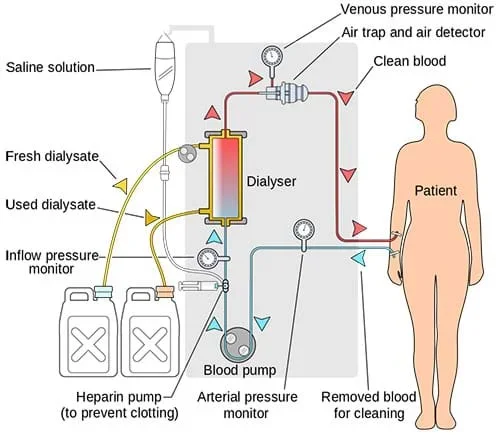 Waste passes through semipermeable membranes in the dialyzer and gets removed from the blood.Copyright 2008 Yassine Mrabet, Wikimedia Commons CC BY-SA 3.0 https://commons.wikimedia.org/wiki/File:Hemodialysis-en.svg
(Present to the class the following hypothetical scenario as the context for the design project.) For this engineering challenge, your biomedical engineering team designs and creates a model that demonstrates semipermeability for use as a teaching tool for medical students who need to understand the concept as it applies to the human body. Your team may choose three of the materials that I have provided for you at the front table to develop your prototype. Use those materials to make a prototype that is composed of two layers of a medium separated by material acting as the membrane, so that water droplets pass through the first layer, through the membrane, and into the second layer.
You will compete against other companies (student teams) to create and refine the best semipermeable membrane demonstration prototype, which will be tested by both the number of drops of water it takes to reach the second layer of medium and how fast it permeates the membrane.
Then we’ll pool our best ideas to make an even better prototype. The winning prototype will be shared at a national medical conference and be developed as a marketable product with the potential for a good future income for you—its engineering inventors.
Background
In the human body, semipermeable membranes are thin tissue sheets that separate two areas of the body. They permit some particles to pass freely though while holding others back, which means they serve as filters. Hemodialysis—or kidney dialysis—is a medical treatment that mimics the kidneys by using semipermeable membranes to filter out waste. In the dialysis process, waste-containing blood is pumped from the patient and through a dialyzer that contains semipermeable membranes. Waste in the blood passes through the membranes into the dialysate—which is a solution that contains sodium, potassium, calcium, magnesium, and other electrolytes—that flows in the opposite direction of the blood. Then, the “clean” blood is returned to the body.
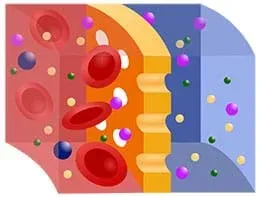 In dialysis treatment, the big blood cells cannot pass through the semipermeable membrane.Copyright 2013 Freemesm, Wikimedia Commons, CC BY SA-3.0
https://commons.wikimedia.org/wiki/File:Semipermeable_membrane_(svg).svg
In dialysis treatment, the big blood cells cannot pass through the semipermeable membrane.Copyright 2013 Freemesm, Wikimedia Commons, CC BY SA-3.0
https://commons.wikimedia.org/wiki/File:Semipermeable_membrane_(svg).svg
Diffusion is when particles spread out evenly throughout a solution; the particles move from areas of high concentration to fill in areas of low concentration until homeostasis is achieved. Osmosis is similar. In osmosis, water moves from areas where particles are at low concentration to areas where particles are at high concentration. When diffusion and osmosis are combined with a semipermeable membrane, dialysis is possible. Waste passes through the semipermeable membrane into the dialysate, which has a low concentration of waste.
Engineers follow the steps of the engineering design process to guide them as they solve problems. The basic steps are:
- Identify the needs and constraints of the problem.
- Research the problem.
- Develop possible solutions.
- Choose one promising solution.
- Build a prototype.
- Test and evaluate the prototype.
- Redesign the prototype to improve its results.
The design process is iterative, meaning that steps are repeated multiple times as engineers evolve their ideas and improve their designs. To explore and demonstrate different ideas, many prototypes may be created, revised and discarded as engineers work towards developing the best solution. Often, engineers design and create prototypes to test a solution on a small scale, which enables revisions to be made quickly and less expensively than working at full scale.
Teacher Notes: During this open-ended design project, encourage students to freely brainstorm, create and experiment with possible solutions. The aim is to make a semipermeable membrane prototype that does not immediately let water pass through, but also does not hold back the water for a long period of time, which would not meet the challenge of demonstrating permeability.
As an example, one possible “optimal” solution, given the suggested materials and tools, might be making a prototype of newspaper, fabric and paper that permits water to pass through (demonstrating permeability), but not immediately upon placing a drop on the membrane.
For a testing setup, have students use clothes pins to place their membrane prototypes on top of a ring held up by the stand, and then use a pipette to drop colored water onto their membranes—counting drops and timing the permeability.
Expect most teams to avoid choosing sugar cubes, although they could potentially be useful by making a saturated solution in the membrane that prevented water from going through. While sugar might be a less-desirable material, a team might need to consider it if its members did not come up with an idea quick enough to get the “good stuff” from the first-come, first-served table of available materials.
Before the Activity
- Make copies of the Semipermeable Membranes Pre/Post-Quiz (PDF), two per student; Semipermeable Membranes Worksheet (PDF), one per student; and the Semipermeable Membranes Project Rubric (PDF), one per group.
- Gather tools and materials, as suggested in the Materials List. For the activity, give teams the opportunity to choose their construction/fabrication materials—three per group—to create their prototypes. Place the materials at the front of the classroom or in a central location that is accessible for all students. As a project constraint, make the materials available in a first-come, first served basis. The worksheet also lists the available materials so make it match what you supply before making copies.
With the Students
- Administer the pre-quiz, as described in the Assessment section.
- Present the Introduction/Motivation content to the class, which includes the design challenge. Discuss semipermeability and permeability as it relates to membranes and medicine.
- Divide the class into groups—such as pairs. Hand out the worksheets, which includes a recap of the engineering design challenge.
- Give teams time to read through the worksheet and ask any questions. Provide clarifying instructions and have students get to work.
- Have students apply their knowledge of semipermeability and the list of available materials to brainstorm which three materials their groups choose to use to create semipermeable membrane demonstration prototypes.
- After brainstorming, expect groups to have made a plan and decided which three materials they will use. Have groups obtain their materials on a first come, first served basis. Remind students that the limitation on materials serves as one of the project constraints and that real-world engineers work within constraints as they go through the engineering design process.
- After groups obtain their materials, have them build their prototypes. Remind students to include a drawing of the finished prototype on the worksheet. As students work, ask them: Why do engineers create prototypes? Remind students that this is part of the engineering design process and that engineers learn a lot from the successes and failures of their prototypes. That’s how they end up with final solutions that work.
- Have each group test its prototype against two criteria: 1) how many drops of water it takes to permeate (go through) the membrane and 2) how long it takes for the water to reach the second layer of material. Record results in the worksheet test table.
- After at least two trials, have teams discuss their results with their group members, deciding as a group how to redesign their membranes so they work better. This is the time to troubleshoot and experiment. Remind students to complete the worksheet by listing what they want to keep and what they want to change in the next prototype. Also make sure they make a drawing of the revamped design.
- Have teams test their redesigned membranes and discuss any changes in the results (such as more/less water drops, longer/shorter time).
- Have groups make any desired changes to their prototypes one more time (another “design iteration”) before final presentations. Inform students that this is the last cycle to make improvements; they will not get another chance to test their final designs before presenting them to the class.
- Have students present their designs and test the final prototype designs in front of the class. To determine the best prototype, drop water from above each model, counting and recording the number of drops it takes to permeate the membrane, as well timing and recording as how long it takes to permeate the membrane. Which design is the winner?
- After all designs have been tested, direct all groups to work together as a class to answer the worksheet analysis questions. This is the time to discuss and compare design successes and failures towards coming up with the optimal design.
- As a class, have students create a new prototype and test it. Have students make drawings and record test results on their worksheets. Was an improved design achieved?
- Direct students to clean all workspaces and put away all materials.
- Administer the post-quiz.
- concentration gradient
- The direction in which molecules move from high to low concentration.
- diffusion
- The movement of molecules from high to low concentration.
- homeostasis
- Maintenance of a stable internal environment.
- osmosis
- The diffusion of water molecules.
- semipermeable membrane
- A membrane that only permits certain materials to pass through.
Pre-Activity Assessment
Pre-Quiz: Prior to the activity, have students complete the three-question, short answer Semipermeable Membranes Pre/Post-Quiz (PDF) to assess students’ base knowledge of semipermeable membranes, diffusion, osmosis, and the steps of the engineering design process. Administer the same quiz at activity end to gauge student knowledge gains.
Activity Embedded Assessment
Worksheet: Have students use the Semipermeable Membranes Worksheet (PDF) to guide them through the activity. The worksheet prompts each step of the design/build/test process for creating the prototypes.
Teacher Observations: While students are working on the activity, observe their progress and grade them according to the Semipermeable Membranes Project Rubric (PDF).
Team Presentations: Have each group demonstrate its final prototype design to the rest of the class for testing. Students’ final prototypes reveal their depth of effort and comprehension of the scientific concepts and project objectives.
Post-Activity Assessment
Post-Quiz: After students have built, tested, and redesigned their prototypes, as well as worked as a class to create an optimal design, administer the Semipermeable Membranes Pre/Post-Quiz (PDF) again. Compare students’ pre/post-quiz scores to gauge knowledge gains.
Use caution when working with craft knives and scissors.
- Consider making available some other membrane examples such as dialysis tubing (Visking tubing) and/or various types of sausage casings. Then have students compare their own semipermeable membranes to these real-world semipermeable membranes by conducting the water drops and timing tests and discussing how they are similar/different from their own.
- Consider adding a budget requirement. Assign costs to building materials—such as $2 per five sugar cubes, $5 per cardboard piece—and give each team a maximum of $20 to spend. Then eliminate the three-material limit and permit students to “purchase” any mix of materials. Remind students that incorporating cost considerations reflects the real-world of engineering in which engineers are often constrained by a budget.
- For lower grades, show students a few prototype designs and have them test and discuss how well each works.
- For higher grades, have students brainstorm and draw prototype designs to build without being given materials.
"Dialysis & Hemodialysis” Rockwell Medical. (information and description) http://www.rockwellmed.com/therapeutic-kidney-disease-dialysis-hemodialysis.htm
“Semipermeable Membrane.” National Center for Biotechnology Information, U.S. National Library of Medicine, Bethesda, MD. PubMed Health. (definitions and terms) https://www.ncbi.nlm.nih.gov/pubmedhealth/PMHT0022149/
Contributors
Kelsey Mongeon; Jasmine Nitschke
Supporting Program
RET Program, College of Engineering, North Dakota State University Fargo
Acknowledgements
This curriculum was developed in the College of Engineering’s Research Experience for Teachers: Engineering in Precision Agriculture for Rural STEM Educators program supported by the National Science Foundation under grant no. EEC 1542370. Any opinions, findings, and conclusions or recommendations expressed in this material are those of the author(s) and do not necessarily reflect the views of the National Science Foundation.
Copyright
2017 by Regents of the University of Colorado; original © 2016 North Dakota State University