
Rocky-to-Sandy Beach: A Weathering Model
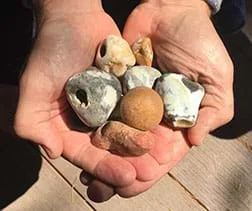 A handful of “sand” from Brighton Beach in the UK.
Given a hypothetical civil engineering scenario, student pairs are tasked to apply their knowledge of the rock cycle, rock types, rock weathering and the engineering design process to model a potential method to create a sandy beach from three rocky island shorelines. For their abrasion weathering models, they use wide-mouth lidded jars and three types of candies that serve as the testing “rocks.” They simulate both low- and high-energy weathering environments. After completing the simple weathering techniques and analyzing their observations of the results, they conclude by recommending to the island developer which rocky shoreline would be the easiest, simplest, and most cost-effective from which to create a sandy beach. A worksheet and pre/post quiz are provided.
Civil engineers follow the steps of the engineering design process when tasked to determine the most suitable areas to develop roads, neighborhoods and communities. Construction challenges may arise due to the unique geological characteristics of an area, such as steep terrain, rivers, hard-packed dirt (clay or rock) or especially soft and unstable ground. Even with challenging terrain, other specific environmental features may be highly desirable, such as mountain communities and beach resorts. In all these scenarios (and more), engineers add to their scientific and mathematical knowledge a solid understanding of the engineering design process, which guides them to logically determine the most suitable and cost-effective developmental approach.
After this activity, students should be able to:
- Follow the steps of the engineering design process to determine which shoreline would make the best beach (in the hypothetical scenario).
- Explain how high- vs. low-energy environmental conditions affect the weathering of rocks.
- Demonstrate how abrasion weathering is an effective method for the creation of beaches, either artificially or naturally.
- Design involves a set of steps, which can be performed in different sequences and repeated as needed.
Grades 6-8
Do you agree with this alignment? - STEL-4Q Critue whether existing and proposed technologies use resources sustainably.
Grades 9-12
Do you agree with this alignment?
- MS-ESS2-1 Develop a model to describe the cycling of Earth's materials and the flow of energy that drives this process.
Grades 6-8
This resource focuses on the following Three Dimensional Learning aspects of NGSS:
Science & Engineering Practices- Develop and use a model to describe phenomena.Do you agree with this alignment?
Disciplinary Core Ideas- All Earth processes are the result of energy flowing and matter cycling within and among the planet's systems. This energy is derived from the sun and Earth's hot interior. The energy that flows and matter that cycles produce chemical and physical changes in Earth's materials and living organisms.Do you agree with this alignment?
Crosscutting Concepts- Explanations of stability and change in natural or designed systems can be constructed by examining the changes over time and processes at different scales, including the atomic scale.Do you agree with this alignment?
Do you agree with this alignment? - Develop and use a model to describe phenomena.
- 9-10.3.3 Identify the Law of Conservation of Matter in physical and chemical changes
Grades 9-10
Do you agree with this alignment?
Each group needs:
- 3 types of hard candy, to serve as model “rocks”:
- Jolly Rancher hard candies, 3-4 pieces
- M&M’s® candies, 10-12 pieces
- sugar cubes, 4 cubes
- 1 mason jar with lid, to serve as a weathering vessel, or any semi-rigid, sealable wide-mouthed transparent container (glass or plastic), such from a set of 12 pint-sized, glass mason jars with lids for $8.69 from Target, or other containers available in school labs; okay if not the same for all groups
- timer, to measure two-minute increments
- Pre/Post Quiz (PDF), 2 per student
- Rocky Beach Worksheet (PDF)
Students should have previous knowledge of the following topics. Suggestions for assessing their prior knowledge are provided.
- The three main rock types—ask questions such as: From where to these types of rocks come?
- Rock cycle—ask students: What is the rock cycle? How does weathering and the erosion of weathered materials play a large part in the cycling of the Earth’s materials?
- Weathering—ask questions such as: What are the different types of weathering? What are the various types of mechanical weathering? Who can explain how abrasion weathering occurs?
- Engineering design process—ask students: What are the steps in this cyclical process? What do we mean by cyclical and iteration? What happens if we fail?
(Present to the class the following hypothetical scenario.)
An island exists in a tropical region of the Pacific Ocean. The island has nutrient-rich soil, tropical plant life, abundant wildlife, and pristine views in all directions. From the perspective of beachgoers, the island is perfect in every way, but one: no beaches! The island has three shorelines composed of rocks and boulders. Each shoreline is composed of a different rock type.
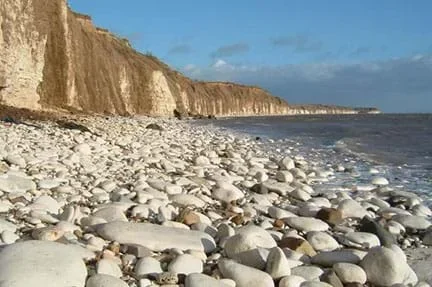 A rocky beach.Copyright 2009 Paul Allison, Wikimedia Commons CC BY-SA 2.0 https://commons.wikimedia.org/wiki/File:Chalk_Pebble_beach_at_Sewerby,_Near_Bridlington._-_geograph.org.uk_-_75.jpg https://creativecommons.org/licenses/by-sa/2.0/
The owner of the island hired a developing company to build a beautiful resort property on one shoreline—but which one? The developer’s main goal for the resort is to provide beautiful sandy beaches. As civil engineers, your task is to create the beautiful beaches from the existing rock material. In order to be environmentally responsible, engineers take into consideration the potential for displacing a variety of tidal zone species and so make any effort possible to rehome organisms prior to construction. Again, to consider the potential ecosystem impact of this project, the engineers must consider that the island is a great distance from the mainland and resources are limited and expensive. Before your team creates the beach, you need to determine which shoreline is the easiest, simplest, and least expensive to transform into a beautiful, sandy beach.
If your “civil engineering firm” (your group) is able to complete the project on time and under budget, it receives a bonus of $1,000,000 and unlimited use of the resort. Let’s get started!
Background
The three main types of rocks are igneous, metamorphic and sedimentary. Sedimentary rocks form when sediments (pieces of broken rocks) get deposited on the bottom of lakes or seas and eventually cement together to form one rock. Igneous rocks form when magma cools and solidifies. When other rocks are heated or subject to great pressure, metamorphic rocks form. Over long periods of time, rocks change and transition though the three rock types—a process called the rock cycle.
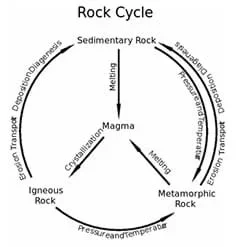 The rock cycle.Copyright 2009 Chd, German Wikipedia via Wikimedia Commons CC BY-SA 3.0 https://commons.wikimedia.org/wiki/File:Rock_cycle.svg
Weathering and the erosion of weathered materials play a large part in the cycling of the Earth’s materials. Weathering breaks down igneous and metamorphic rocks into sedimentary rocks, which then erode away and may go through the rock cycle to become a different kind of rock.
The three types of weathering are chemical, biological and mechanical weathering. Chemical weathering occurs when rocks react with acidic chemicals in rainwater, such as carbon dioxide. Biological weathering occurs when plants or animals break down the rocks. For example, plant roots work their way into rocks and exert outward forces on rock interiors, causing rocks to fracture and break. Mechanical weathering occurs when physical changes happen to the rock. The three types of mechanical weathering are abrasion, ice wedging, and thermal expansion and contraction. Abrasion weathering is caused by friction when rocks rub against each other, causing the rocks to break into smaller rocks. In this activity, students are simulating abrasion weathering to weather their “rocks” when they shake their containers. Another type of mechanical weathering, ice wedging, causes larger rocks to split when the expansion of water exerts outward forces on rock interiors; this occurs during liquid-to-solid phase change. Lastly, thermal expansion and contraction causes cracks to form and pieces of rock to break off after rock is heated and cooled many times.
Abrasion weathering plays a large role in the creation of beaches. Beach rocks around the world come in a variety of sizes, ranging from large boulders to “sugar sand.” Beach enthusiasts tend to prefer beaches with fine grain sand because they are more comfortable to walk and lay upon. Every grain of sand, regardless of grain size, started its journey to the beach as larger rocks and boulders. For fine grain sand, such as the much-desired “sugar sand,” to reach its perfect size and shape, it undergoes a lengthy process of abrasion weathering. Under normal environmental conditions, the weathering of rock and boulders to the size sand grains might take hundreds of thousands of years, if not longer, depending on the energy of the environment.
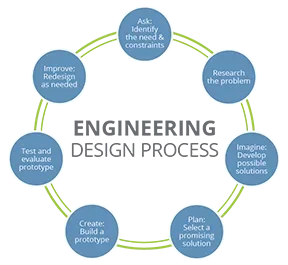 The steps of the engineering design process.Copyright 2014 TeachEngineering.org. All rights reserved. https://www.teachengineering.org/k12engineering/designprocess
Engineers follow the steps of the engineering design process to guide them as they solve problems. The design process usually begins by identifying and researching a problem. The design process is iterative, meaning that engineers improve their ideas and designs many times as they work towards solutions.
Activity Overview
To find a solution to the engineering challenge presented as a hypothetical scenario, student pairs conduct research in the form of three trials to test three “rock” types (candy) in a mechanical weathering model (shaken in jar, gently, rigorously). Before testing, they write down pre-weathering observations about each rock (candy) type. To test, they put one rock type in the weathering vessel. Then they conduct gentle artificial weathering to candy #1 for two minutes and record their observations. Then they conduct rigorous artificial weathering to the same candies for two minutes and again record their observations. They repeat this general experimental procedure for each of three “rock” types. Ultimately, student pairs make recommendations of which “rock” type would be easiest to artificially weather—break down into “sand”—based upon their research results.
Before the Activity
- Gather materials and make copies of the quiz and worksheet.
- Determine the size and type of three candies to provide as “rocks” for student research—based on the size of the weathering vessel and the candy types that are readily available. The suggested candies are examples of soft, medium and hard candy types; it is helpful for clear experimental outcomes to choose candies that have varying harnesses. For example, Jolly Rancher candies are quite hard while sugar cubes are relatively fragile. If using different candies than those listed in the Materials List, alter the worksheet data collection table accordingly.
With the Students
- (optional) Administer the pre-activity quiz.
- Present to the class the Introduction/Motivation content. Students may also benefit from a quick topic review using questions provided in the Pre-Requisite Knowledge section.
- Divide the class into student pairs. Distribute the jars and worksheets. Distribute the “rocks” to each group. Either hand out all three candy types at once or have groups obtain the next “rock” type as they are ready to begin each weathering trial. Remind the “junior engineers” not to eat their materials (never eat lab materials!).
- Direct students to conduct their research, guided by the worksheet. They begin by first recording in the worksheet table their pre-weathering observations of the first “rock” type, such as its size, shape and texture.
- Students deposit the first “rock” type into the weathering vessel and gently weather them by turning the vessel upside down then right side up—for two minutes. Note: Once done, make sure students leave these “rocks” in the weathering vessel, ready for the next step.
- Have students record post-gentle weathering observations, such as the grain size, shape and texture.
- With the same rocks in the same container, have students simulate rigorous weathering by shaking the vessel vigorously for two minutes.
- Have student’s record post-rigorous weathering observations, such as the grain size, shape and texture.
- Next, moving along with the steps of the engineering design process, students discuss with their partners any changes that could be made to improve upon the existing “weathering” model. This is the improve/redesign step of the engineering design process. Have them jot notes below the worksheet table of improvement ideas that could be applied to future weathering models.
- Repeat the testing steps for each of the remaining rocks types, recording observations in the worksheet’s data table.
- As student pairs proceed through the activity, make your way around the room, asking questions pertaining to the engineering design process. Example questions: What step of the engineering design process are you at now? How could this weathering model be improved?
- Once the testing is done, have students examine their written observations from each of the three trials to determine which of the “rock” types would be easiest to weather into beach sand.
- Have students complete the worksheet analysis questions, making their recommendations with explanations, as well as describing their ideas for a different method to artificially weather the rocks.
- Administer the post-activity quiz.
- civil engineer
- A type of engineer that deals with the planning, design, construction, operating and maintenance of physically and naturally built structures and infrastructures.
- igneous rock
- Rock formed from the cooling of magma or lava.
- metamorphic rock
- Rock formed from extreme heat or pressure.
- sedimentary rock
- Rock formed from sediment that has gone through compaction and cementing processes.
- weathering
- The breaking down of rock into smaller particles by mechanical, biological and/or chemical means.
Pre-Activity Assessment
Pre-Quiz: Administer the seven-question Pre/Post-Quiz (PDF), which asks students to provide short answers about the engineering design process, failure, three main rock types, mechanical weathering types, and abrasion. At activity end, students take the same quiz again, enabling a pre/post-activity assessment of learning gains. Alternatively, just use the quiz as a post-activity assessment.
Activity Embedded Assessment
Worksheet: Student pairs conduct their engineering challenge research and analysis, guided by the Rocky Beach Worksheet (PDF). Review their data observations and answers to gauge their comprehension of the activity concepts.
Post-Activity Assessment
Post-Quiz: Administer the seven-question Pre/Post-Quiz (PDF). Compare students’ before/after-activity quiz scores in order to make a pre/post-activity assessment of learning gains.
When choosing candies to represent “rocks,” be aware of possible food allergies.
Remind the “junior engineers” that they are not permitted eat their materials because they are part of a research experiment. Instead, set aside some candy for a post-activity treat.
If students’ “rocks” are not visibly breaking, remind them of the improve/redesign step of engineering design process; ask them how they could improve the weathering model.
For the weathering vessels, it is not necessary that the jars be the same across all groups. In fact, if one has a glass jar and another has plastic, or they use containers of different sizes/shapes, facilitate a discussion about experimental methodology and the advantages/disadvantages of each container.
- For lower grades, focus on the weathering of just one rock type. Also, spend more time evaluating and choosing weathering vessels.
- For higher grades, have students design their own models for artificial weathering. Give student extra supplies (dowels, different-shaped jars, fabric, etc.) to build their models. Implement a cost-effective requirement by giving students a budget and having them “buy” their supplies. Or, implement a cost analysis for their weathering models by assigning an “energy cost” per each two minutes of weathering and having students compare the costs to weather each “rock” into fine sand. As a class, compare and contrast the results achieved with various methods.
"KS3 Bitesize Science - The rock cycle: Revision, Print." KS3 Bitesize. BBC, 2014. Accessed May 19, 2017. http://www.bbc.co.uk/bitesize/ks3/science/environment_earth_universe/rock_cycle/revision/1/
Contributors
Michael Herbst; Wyatt Whiteaker
Supporting Program
RET Program, College of Engineering, North Dakota State University Fargo
Acknowledgements
This curriculum was developed in the College of Engineering’s Research Experience for Teachers: Engineering in Precision Agriculture for Rural STEM Educators program supported by the National Science Foundation under grant no. EEC 1542370. Any opinions, findings, and conclusions or recommendations expressed in this material are those of the author(s) and do not necessarily reflect the views of the National Science Foundation.
Special thanks to Alan Kallmeyer and Bradley Bowen.
Copyright
2017 by Regents of the University of Colorado; original © 2016 North Dakota State University