
Cooler Design Challenge
Students learn and apply concepts in thermodynamics and energy—mainly convection, conduction, and radiation— to solve a challenge. This is accomplished by splitting students into teams and having them follow the engineering design process to design and build a small insulated box, with the goal of keeping an ice cube and a Popsicle from melting. Students are given a short traditional lecture to help familiarize them with the basic rules of thermodynamics and an introduction to materials science while they continue to monitor the ice within their team’s box.
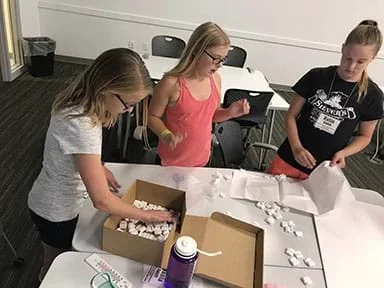 Students create a cooler using recycled materials and shoeboxes. Their challenge: to keep ice and popsicles from melting.Copyright 2018 Laurie Salander, North Dakota State University Fargo
Students follow the engineering design process while building and designing their team’s cooler. This allows students to play the role of engineers who are using design-thinking to approach a problem to help improve insulating technology. Engineering applications that use thermal dynamics range from insulating the walls of a house to keeping hot chocolate warm inside a mug. Just like engineers, students have time to iterate and retest their designs more than once.
After this activity, students should be able to:
- Explain the background concepts to materials and thermodynamics.
- Describe the concepts of convection, conduction, and radiation in everyday life.
- Recognize and list common insulators and conductors.
- Explain the steps in the engineering design process.
- Explain why engineers re-design and re-test their designs many times.
- CCSS.Math.Content.6.SP.B.4 Display numerical data in plots on a number line, including dot plots, histograms, and box plots.
Grade 6
Do you agree with this alignment? - CCSS.Math.Content.7.RP.A Analyze proportional relationships and use them to solve real-world and mathematical problems.
Grade 7
Do you agree with this alignment? - CCSS.Math.Practice.MP4 Model with mathematics.
Grades K-12
Do you agree with this alignment?
- Students will develop an understanding of the attributes of design.
Grades K-12
Do you agree with this alignment? - Students will develop an understanding of engineering design.
Grades K-12
Do you agree with this alignment? - Students will develop an understanding of the role of troubleshooting, research and development, invention and innovation, and experimentation in problem solving.
Grades K-12
Do you agree with this alignment?
- MS-ETS1-1 Define the criteria and constraints of a design problem with sufficient precision to ensure a successful solution, taking into account relevant scientific principles and potential impacts on people and the natural environment that may limit possible solutions.
Grades 6-8
This resource focuses on the following Three Dimensional Learning aspects of NGSS:
Science & Engineering Practices- Define a design problem that can be solved through the development of an object, tool, process or system and includes multiple criteria and constraints, including scientific knowledge that may limit possible solutions.Do you agree with this alignment?
Disciplinary Core Ideas- The more precisely a design task's criteria and constraints can be defined, the more likely it is that the designed solution will be successful. Specification of constraints includes consideration of scientific principles and other relevant knowledge that is likely to limit possible solutions.Do you agree with this alignment?
Crosscutting Concepts- The uses of technologies and any limitations on their use are driven by individual or societal needs, desires, and values; by the findings of scientific research; and by differences in such factors as climate, natural resources, and economic conditions.Do you agree with this alignment?
- All human activity draws on natural resources and has both short and long-term consequences, positive as well as negative, for the health of people and the natural environment.Do you agree with this alignment?
Do you agree with this alignment? - Define a design problem that can be solved through the development of an object, tool, process or system and includes multiple criteria and constraints, including scientific knowledge that may limit possible solutions.
- MS-ETS1-2 Evaluate competing design solutions using a systematic process to determine how well they meet the criteria and constraints of the problem.
Grades 6-8
This resource focuses on the following Three Dimensional Learning aspects of NGSS:
Science & Engineering Practices- Evaluate competing design solutions based on jointly developed and agreed-upon design criteria.Do you agree with this alignment?
Disciplinary Core Ideas- There are systematic processes for evaluating solutions with respect to how well they meet the criteria and constraints of a problem.Do you agree with this alignment?
Do you agree with this alignment? - Evaluate competing design solutions based on jointly developed and agreed-upon design criteria.
- MS-ETS1-3 Analyze data from tests to determine similarities and differences among several design solutions to identify the best characteristics of each that can be combined into a new solution to better meet the criteria for success.
Grades 6-8
This resource focuses on the following Three Dimensional Learning aspects of NGSS:
Science & Engineering Practices- Analyze and interpret data to determine similarities and differences in findings.Do you agree with this alignment?
Disciplinary Core Ideas- There are systematic processes for evaluating solutions with respect to how well they meet the criteria and constraints of a problem.Do you agree with this alignment?
- Sometimes parts of different solutions can be combined to create a solution that is better than any of its predecessors.Do you agree with this alignment?
- Although one design may not perform the best across all tests, identifying the characteristics of the design that performed the best in each test can provide useful information for the redesign process—that is, some of the characteristics may be incorporated into the new design.Do you agree with this alignment?
Do you agree with this alignment? - Analyze and interpret data to determine similarities and differences in findings.
- MS-ETS1-4 Develop a model to generate data for iterative testing and modification of a proposed object, tool, or process such that an optimal design can be achieved.
Grades 6-8
This resource focuses on the following Three Dimensional Learning aspects of NGSS:
Science & Engineering Practices- Develop a model to generate data to test ideas about designed systems, including those representing inputs and outputs.Do you agree with this alignment?
Disciplinary Core Ideas- Models of all kinds are important for testing solutions.Do you agree with this alignment?
- The iterative process of testing the most promising solutions and modifying what is proposed on the basis of the test results leads to greater refinement and ultimately to an optimal solution.Do you agree with this alignment?
Do you agree with this alignment? - Develop a model to generate data to test ideas about designed systems, including those representing inputs and outputs.
- DCI.PS3.A.6-8.1 The term "heat" as used in everyday language refers both to thermal energy (the motion of atoms or molecules within a substance) and the transfer of that thermal energy from one object to another. In science, heat is used only for this second meaning; it refers to the energy transferred due to the temperature difference between two objects.
Grades 6-8
Do you agree with this alignment? - CCC.5.6-8.6 Energy may take different forms (e.g. energy in fields, thermal energy, energy of motion).
Grades 6-8
Do you agree with this alignment?
- 6.SP.4 Display numerical data in plots on a number line, including dot plots, histograms, and box plots.
Grade 6
Do you agree with this alignment? - MP.4 Model with mathematics.
Grades K-12
Do you agree with this alignment? - Analyze proportional relationships and use them to solve real-world and mathematical problems.
Grade 7
Do you agree with this alignment?
- 8.3.5 Identify when heat can be transferred by conduction, convection, or radiation.
Grade 8
Do you agree with this alignment?
Each group needs:
- a cardboard shoe box (each group should use boxes that are roughly the same size)
- bubble wrap
- masking tape
- duct tape
- aluminum foil
- X-Acto knives. 2 pair, or similar pen knives
- scissors, 2 pair
- heat lamp, available on Amazon (a blow dryer also works, but this may extend testing time if there is only one available)
- thermometers, 1 for internal and 1 for external readings, available on Amazon
- foam core (of a few different thicknesses)
- Styrofoam bowls
- ice (30 grams per student group)
- Popsicles (at least 1 per student group; teachers can make a preference on whether or not students can eat them following the experiment)
- packing peanuts
- colored pencils
- Cooler Design and Data Sheet (PDF)
To share with the entire class:
- digital scale
- Cooler Design Challenge PowerPoint Presentation (pptx)
- Cooler Design Challenge PowerPoint Presentation (pdf)
- Post-Activity Assessment (docx)
- Post-Activity Assessment (pdf)
- Post-Activity Assessment Sample Answers (docx)
- Post-Activity Assessment Sample Answers (pdf)
- Cooler Design and Data Sheet (docx)
- Cooler Design and Data Sheet (pdf)
A general understanding of heat as an energy source.
Imagine for a minute that you’re going on a car camping trip with friends. You made your checklist and you have everything you need: tent, food and drink, firewood, and ice. However, you realize that you forgot an important item for the weekend: a cooler! Since it’s a busy weekend to go camping, all of the stores near you are sold out of coolers—what can you do? At this moment, it is time to remove your camping hat for a moment and put in your thinking cap. You rummage through your house and find a number of supplies that could help you solve this problem, including some material that may help you build a do-it-yourself cooler for the weekend. The question is, are you supplies adequate enough to build a cooler that will keep the ice from melting and your food supplies from spoiling?
Proper insulation is a key aspect in several different engineering applications, from the walls of your house to keeping the coffee in your mug warm. In order to find the best way to keep things warm or cool, engineers must design and test different materials to discover which insulators work best. Your challenge: to design a cooler that can keep ice cubes and a Popsicle in a solid state for the longest period of time. Your constraints are limited supplies to construct the cooler and each stage of the engineering design process as well as working under the clock!
Background
When atoms or molecules move within a substance, kinetic energy can transform into thermal energy, which is energy related to temperature change. Heating is the transfer of thermal energy is from one object to another, where thermal energy moves from a warmer object to a cooler object. For example, a hot cup of coffee transfers thermal energy to the cooler air surrounding it.
Thermal energy moves in three ways: via radiation, convection, and conduction. Radiation is a method of heat transfer that does not rely upon any contact between the heat source and the heated object, opposed to conduction and convection. Roasting a marshmallow over a fire is an example of using radiant heat. Convection is the transfer of heat from one place to another by the movement of heated fluids, such as air or water, which carry thermal energy away from the source. Steaming vegetables in a pot is an example of convection. Conduction is the movement of heat from one solid to another one, which have different temperatures when they are touching each other, such as cooking a pancake or eggs on a hot griddle.
Before the activity:
- Gather the materials for the students to use to construct the cooler.
- Place the supplies on a table for students to inspect.
- Make copies of the Cooler Design and Data Sheet (PDF) for students to record their data.
- Gather colored pencils for groups to graph their data.
With Students:
Day 1:
- Share the Cooler Design Challenge PowerPoint Presentation (PPTX) with students to start the challenge and present slides 1 through 4.
- Have students write or draw what they believe the engineering design process looks like as a Pre-Activity Assessment.
- Finish presenting the Cooler Design Challenge PowerPoint Presentation (PPTX); note that Slide 5 reviews the engineering design process from the Pre-Activity Assessment.
- Hand out the Cooler Design and Data Sheet (PDF) to students.
- Explain the challenge to the class: “You have been presented with a challenge to design a cooler that can keep ice cubes and a Popsicle in a solid state the longest. Your constraints are limited supplies to construct the cooler, and each stage of the engineering design process will be timed.”
- Split students into groups of two or three.
- Allow students to walk around the table of supplies and start their brainstorming process. Allow them five minutes to draw and label their ideas on the Cooler Design Data Sheet (PDF).
- Send one person from the group to collect the supplies.
- Students will need to start testing their materials with the heat gun or blow dryer on one side of their material, while another student reads the temperature on the opposite side. Allow roughly for five minutes of testing for each side of the material.
- After the students test all of their materials, they can start to construct their cooler design or replace old materials for new materials.
Day 2:
- Once each group builds a design, have students place a Popsicle and 30 grams of ice in the cooler. Place the internal thermometer inside the cooler and tape the cooler shut. The outside thermometer should be taped to the top of the cooler for an external temperature reading to compare thermal measurements.
- Student will test their designs for 30 minutes. Start the timer and set it for five minute intervals with the heat gun facing their cooler. Students will test their design and see if it holds up.
- Remind students to record results of both thermometers reading in the Cooler Design and Data Sheet (PDF).
- After 30 minutes of testing, open the cooler and observe the Popsicle, students will record observations both qualitative and quantitative.
- Have students remove the ice out of cooler and re-measure the amount of grams of ice remaining.
- Ask students to analyze all their data and present the class with the Investigating Questions to direct their analysis.
- Tell students to revisit the engineering design process and communicate their results; revisit asking or identifying a problem; discuss if there are any changes that need to be made to improve the functioning of their cooler to keep the ice cold longer.
- Have students communicate their results through the Post-Activity Assessment (PDF). Students can make a presentation to share their design, testing, results, and how they altered their design to make it more thermally efficient.
- absorb
- In physics, to transform radiant energy into a different form usually with a resulting rise in temperature.
- conduction
- The process by which heat or electricity is directly transmitted through a substance when there is a difference of temperature or of electrical potential without movement of the material.
- conductor
- A material or an object that allows heat, electricity, light, and/or sound pass easily through it.
- convection
- The movement caused within a fluid by the tendency of hotter and, therefore, less dense material to rise and colder, denser material to sink under the influence of gravity, which consequently results in transfer of heat.
- insulator
- A material or an object that does not easily allow heat, electricity, light, or sound to pass through it.
- radiant energy
- Energy (as heat waves, light waves, radio waves, x-rays) transmitted in the form of electromagnetic waves.
- radiation
- The emission of energy as electromagnetic waves or as moving subatomic particles, especially high-energy particles that cause ionization.
- r-value
- A measurement of how well certain building insulation materials can resist heat. The higher the R-value, the greater the insulation performance; R-value is expressed as rate of heat loss per hour per square foot per inch of thickness of material per degree Fahrenheit.
Pre-Activity Assessment
Engineering Design Process: Ask students to write or draw the steps of the engineering design process before slide 5 in the Cooler Design Challenge PowerPoint Presentation (PPTX).
Activity Embedded Assessment
Cooler Design Assessment: Ensure that students are documenting their process of design by:
- photos/videos of construction of cooler
- graphing data pertaining to the temperature testing of materials
Post-Activity Assessment
Communication of Results: Students can create a presentation showing the Engineering Design Process steps they used in their challenge and share their evidence.
Post-Assessment: Have students complete the Post-Activity Assessment (PDF).
- When students start testing with heat lamps, students should make sure to point them away from students and towards materials only.
- X-Acto knife covers should be placed on knives when not in use; knives are used for cutting materials only (demonstrate the proper way to use an X-Acto knife while cutting materials).
- If students are struggling with figuring out how to get started on creating a cooler, have them reflect on what they know about an average cooler including size, shape, or thickness.
- Images of ideas are included in Figure 1.
- Materials: if your budget does not allow for buying a lot of extra materials, have student supplement the project with recycled materials such as leftover packing peanuts, bubble wrap, recycled cardboard, or milk cartons from lunch. Let your students discover if a material could be a conductor or an insulator.
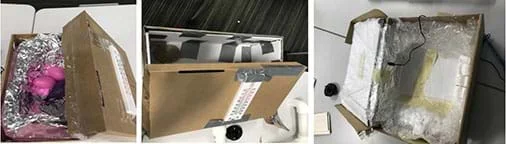 Figure 1. Examples of cooler designsCopyright 2018 Laurie Salander, North Dakota State University Fargo
Contributors
Laurie Salander
Supporting Program
RET Program, College of Engineering, North Dakota State University Fargo
Acknowledgements
This curriculum was developed in the College of Engineering’s Research Experience for Teachers: Engineering in Precision Agriculture for Rural STEM Educators program supported by the National Science Foundation under grant no. EEC 1542370. However, these contents do not necessarily represent the policies of the NSF, and you should not assume endorsement by the federal government.
Special thanks to Alan Kallmeyer and Bradley Bowen.
Copyright
2019 by Regents of the University of Colorado; original © 2018 North Dakota State University