
Design and Test a Ping-Pong Paddle
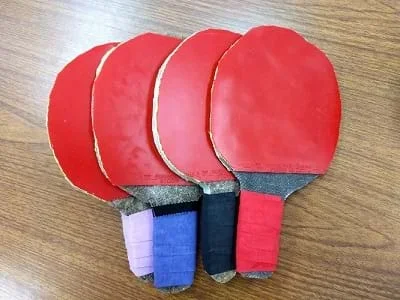 Ping-pong paddles made with biocomposite materials.Copyright 2018 Kelsey Mongeon North Dakota State University RET
Emphasizing the design, build, and test steps of the engineering design process, groups create a ping-pong paddle. After building their paddle, students conduct tests and compare their design to a store-bought paddle and use a Venn diagram to organize their information. Based on their results, students write product reviews for their paddle. This project allows students to build and test a design, iterate upon that design as well as explore how data analysis of a product works.
In this activity, students are shown how materials scientists, materials engineers, and mechanical engineers work together to help innovate the ping-pong paddle for the 2020 Olympic Games in Tokyo. Like engineers, students collaborate to study, design, build, and test ping-pong paddles made out of different materials. After testing, students analyze results and redesign their prototype to create the most control-friendly and durable ping-pong paddle. Throughout the project, students learn to document like an engineer and record their findings in a modified engineering notebook. Students also learn the importance of communicating with other engineers, which allows progress to continue.
After this activity, students should be able to:
- Explain the engineering design process.
- Compare designs of ping-pong paddles.
- Think and outline design iteration suggestions.
- Write product reviews of paddles.
- Students will develop an understanding of the attributes of design.
Grades K-12
Do you agree with this alignment? - Students will develop an understanding of engineering design.
Grades K-12
Do you agree with this alignment? - Students will develop an understanding of the role of troubleshooting, research and development, invention and innovation, and experimentation in problem solving.
Grades K-12
Do you agree with this alignment? - Students will develop abilities to apply the design process.
Grades K-12
Do you agree with this alignment? - STEL-7Q Apply the technology and engineering design process.
Grades 6-8
Do you agree with this alignment?
- MS-ETS1-1 Define the criteria and constraints of a design problem with sufficient precision to ensure a successful solution, taking into account relevant scientific principles and potential impacts on people and the natural environment that may limit possible solutions.
Grades 6-8
This resource focuses on the following Three Dimensional Learning aspects of NGSS:
Science & Engineering Practices- Define a design problem that can be solved through the development of an object, tool, process or system and includes multiple criteria and constraints, including scientific knowledge that may limit possible solutions.Do you agree with this alignment?
Disciplinary Core Ideas- The more precisely a design task's criteria and constraints can be defined, the more likely it is that the designed solution will be successful. Specification of constraints includes consideration of scientific principles and other relevant knowledge that is likely to limit possible solutions.Do you agree with this alignment?
Crosscutting Concepts- The uses of technologies and any limitations on their use are driven by individual or societal needs, desires, and values; by the findings of scientific research; and by differences in such factors as climate, natural resources, and economic conditions.Do you agree with this alignment?
- All human activity draws on natural resources and has both short and long-term consequences, positive as well as negative, for the health of people and the natural environment.Do you agree with this alignment?
Do you agree with this alignment? - Define a design problem that can be solved through the development of an object, tool, process or system and includes multiple criteria and constraints, including scientific knowledge that may limit possible solutions.
- MS-ETS1-2 Evaluate competing design solutions using a systematic process to determine how well they meet the criteria and constraints of the problem.
Grades 6-8
This resource focuses on the following Three Dimensional Learning aspects of NGSS:
Science & Engineering Practices- Evaluate competing design solutions based on jointly developed and agreed-upon design criteria.Do you agree with this alignment?
Disciplinary Core Ideas- There are systematic processes for evaluating solutions with respect to how well they meet the criteria and constraints of a problem.Do you agree with this alignment?
Do you agree with this alignment? - Evaluate competing design solutions based on jointly developed and agreed-upon design criteria.
- MS-ETS1-4 Develop a model to generate data for iterative testing and modification of a proposed object, tool, or process such that an optimal design can be achieved.
Grades 6-8
This resource focuses on the following Three Dimensional Learning aspects of NGSS:
Science & Engineering Practices- Develop a model to generate data to test ideas about designed systems, including those representing inputs and outputs.Do you agree with this alignment?
Disciplinary Core Ideas- Models of all kinds are important for testing solutions.Do you agree with this alignment?
- The iterative process of testing the most promising solutions and modifying what is proposed on the basis of the test results leads to greater refinement and ultimately to an optimal solution.Do you agree with this alignment?
Do you agree with this alignment? - Develop a model to generate data to test ideas about designed systems, including those representing inputs and outputs.
- 6.6.2 Design a product or solution to a problem given constraints (e.g., limits of time, costs, materials and environmental factors)
Grade 6
Do you agree with this alignment? - 8.2.2 Use evidence to generate descriptions, explanations, predictions, and models
Grade 8
Do you agree with this alignment?
Each group needs:
- Design Challenge Handout (PDF), one per student
- Paddle Testing Handout (PDF), one per student
- meter stick
- store-bought ping-pong paddle, also available on Amazon
- ping-pong ball
- materials to build ping-pong paddle
- Paddle Core Template (PDF)
- core materials
- 3 mm (or ⅛ inch) thick sheets of balsa wood; the sheet size depends on the class size and the number of paddles to be made; (e.g.(the class could make 9 paddles from three 20 cm x 60 cm (8 in x 24 in) sheets of balsa wood)
- cardboard; approximate the size of the cardboard to match the size of the balsa wood.
- coating materials
- flour and water paste
- wood glue
- clear shellac finisher, available online
- polyurethane clear finish, available online
- Covering materials
- paddle rubber sets, available online
- foam roll, available online
- shelf liner, available online
- neoprene rubber, available online
- paddle grips tape, available online
To share with the entire class:
- ping-pong tables or table tennis nets
- hot glue gun and glue sticks
- disposable cups or bowls (one per student; used to hold coating material)
- foam brushes (one per student; size does not matter)
- camera (to document design process)
- Design Challenge Handout (docx)
- Design Challenge Handout (pdf)
- Materials Price List (docx)
- Materials Price List (pdf)
- Paddle Testing Handout (docx)
- Paddle Testing Handout (pdf)
- Paddle Template (jpeg)
- Paddle Template (pdf)
- Ping-Pong Paddle Design PowerPoint (pptx)
- Ping-Pong Paddle Design PowerPoint (pdf)
- Pre/Post-Assessment (docx)
- Pre/Post-Assessment (pdf)
- Pre/Post Assessment Answer Key (docx)
- Pre/Post Assessment Answer Key (pdf)
- Sample Test Data (docx)
- Sample Test Data (pdf)
A basic understanding of the engineering design process; this can also be introduced and throughout the activity.
Sporting equipment is ever-changing to aid athletes to perform better, faster, and stronger. Have you ever considered why sporting equipment is made from different materials? For example, baseball bats are made from several types of materials, each having its own set of advantages and disadvantages. Some baseball bats are composed of aluminum and other materials to lessen the weight and increase the bat speed for younger players and softball players. Wooden bats are allowed in Major League Baseball, because professional players do not need the advantage provided by the aluminum bats.
You have been tasked with creating a new ping-pong paddle design for the 2020 Olympics. You and your group need to study the materials and determine which ones will create the most effective paddle design. After creating your prototype, your group will perform several tests to compare your paddle to a store-bought paddle for ball control, comfort, and durability. After comparing your design to a store-bought paddle, you will have the opportunity to redesign your paddle. Your paddle must have a core, a coating to make the core sturdy, and a covering over the blade.
Note: before this explanation, you can show the video embedded in the Ping-Pong Paddle Design PowerPoint (PPTX) as an introduction: Top 10 Craziest Table Tennis Shots of 2017! - https://www.youtube.com/watch?v=EgI_hyPTrtA.
Background
Table tennis, also known as ping-pong, goes as far back as the 1880s and was a parlor game played outside. It transitioned into an indoor sport in the winter and has remained that way ever since. In 1901, English inventor E.C. Goode designed the modern version of the ping-pong paddle by fixing a sheet of pimpled, or stippled, rubber to a wooden blade. As times changed and as technology advanced, players needed a paddle that adapt to the rigors of a changing game. Today’s current design is similar to E.C. Goode’s original invention and follows guidelines set by the International Table Tennis Federation. These guidelines state the paddle can be any size or shape as long as the blade is flat and rigid. Guidelines also state that 85 percent of the blade (by thickness) must be natural wood. For this challenge, you will investigate what sort of enhancements you can make to the paddle while staying within Federation guidelines.
Before the Activity
- Set up the Ping-Pong Paddle Design PowerPoint (PPTX) with teacher notes for the activity.
- Cut out paddle cores from balsa wood and cardboard.
- Set up a station where students can gather materials.
- Optional: choose to have two balsa wood and cardboard examples coated with different materials found on slide 11 of the Ping-Pong Paddle Design PowerPoint (PPTX) before the activity, similar to evaluating a paint swatch.
With the Students
Day 1
- Divide students into groups of two.
- Give students five minutes to work on the Pre/Post-Assessment (PDF).
- Go through the Ping-Pong Paddle Design PowerPoint (PPTX). (Teacher notes are included in the PowerPoint.)
- Distribute copies of the Design Challenge Handout (PDF), the Paddle Testing Handout (PDF), and the Paddle Core Template (PDF) to each group. Have students follow along and take notes in the research portion of the handout. (Students may also research on their own.)
- Have groups brainstorm on which materials will make the most effective paddles and allow them to gather their materials. Students should record their ideas on the Design Challenge Handout (PDF).
- Allow students time to assemble the paddles (students should take approximately 25 minutes to coat the cores of the paddle). Day 1 assembly includes coating the core material. Refer to the notes in the Ping-Pong Paddle Design PowerPoint (PPTX) for more information.
- Allow the paddles to dry overnight.
Day 2
- Have students apply covering materials to the dry blades using hot glue. Once the glue dries, students can begin testing. Instruct students to take photos of their finished product; these will be used in the data collection portion below.
- Distribute the Paddle Testing Handout (PDF).
- Have each group test their ping-pong paddles based on the criteria below. Instruct students to complete each test three times and to record their data in the table on the Paddle Testing Handout (PDF). (Refer to the Sample Test Data (PDF) for examples on testing information.)
- Test for control: have students volley a ball up and down for 30 seconds and count the number of times they can hit the ball.
- Test for energy absorbed by paddle: have students place the paddle on the ground and drop a ping pong ball from 1 m (~3 ft) above the paddle and have them record the height of the bounce.
- Test for paddle wear: after tests 1 & 2, compare photos from before testing began to after testing.
- Test for comfort: have students hold several different paddle examples and compare grip comfort.
- Instruct students to repeat each test for the store-bought paddle.
- In the product review section of the Paddle Testing Handout (PDF), have students complete the Venn diagram so they can compare and contrast their design with a store-bought paddle. This is the template students will use for writing product reviews.
- After students have compared and contrasted their designs, instruct them to write a product review that comparing the two paddles. The intent of the product review is to inform customers which paddle the designers think is best.
- Have students suggest product redesign options for their ping-pong paddles. If time allows and if there are enough leftover materials remaining students can iterate on their designs.
- Optional: Have students complete the Activity Extension on the Paddle Testing Handout (PDF). Administer the Pre/Post-Assessment (PDF) worksheet again.
- blade
- Flat portion of the ping-pong paddle.
- core
- Innermost layer of a ping-pong paddle.
- engineering design process
- A series of steps that engineers follow to solve a problem.
- pip
- Raised dots on the rubber on the blade of the ping-pong paddle.
Pre-Activity Assessment
Pre-Assessment: Have students take the Pre/Post-Assessment (PDF) to assess student knowledge of the engineering design process.
Activity Embedded Assessment
Design Challenge Handout: Students use the Design Challenge Handout (PDF) on Day 1 to record the research, brainstorm, and build phases of the engineering design process.
Paddle Testing Handout: Students use the Paddle Testing Handout (PDF) on Day 2 to record the test, analysis, and redesign phases of the engineering design process.
Post-Activity Assessment
Post-Assessment: Have students re-take the Pre/Post-Assessment (PDF).
- Use shellac and polyurethane in a well-ventilated area.
- Use caution when using the hot glue gun.
- Cover tables with plastic or paper to protect surfaces from shellac and polyurethane.
- Provide gloves as an extra precaution.
- Students can be given a budget and materials price list. (See Materials Price List (PDF))
- For lower grades, give the students a script for writing the product reviews. “I give this paddle ___ stars.” Full sentence stems can be found on the Paddle Testing Handout (PDF).
- For higher grades, give students the task of creating a ping-pong paddle of a certain area. Give them all materials, but no template for the paddle and blade. (Standards: CCSS.Math.7.G.B.4 - Know the formulas for the area and circumference of a circle and use them to solve problems; give an informal derivation of the relationship between the circumference and area of a circle.)
Contributors
Kelsey Mongeon; Michelle Kuhlman
Supporting Program
RET Program, College of Engineering, North Dakota State University Fargo
Acknowledgements
This curriculum was developed in the College of Engineering’s Research Experience for Teachers: Engineering in Precision Agriculture for Rural STEM Educators program supported by the National Science Foundation under grant no. EEC 1542370. Any opinions, findings, and conclusions or recommendations expressed in this material are those of the author(s) and do not necessarily reflect the views of the National Science Foundation.
Special thanks to Alan Kallmeyer and Bradley Bowen.
Copyright
2019 by Regents of the University of Colorado; original © 2018 North Dakota State University