
Biomimicry: Echolocation in Robotics
Legacy Curriculum
Hey there! This curriculum is no longer being curated or supported. It may contain materials that are no longer available or outdated information. Please use this document for reference.
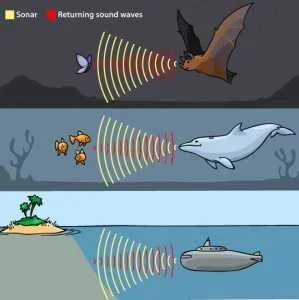 Engineers are inspired by nature, such as the echolocation abilities of bats and marine animals.Copyright ASU Ask a Biologist {PD} http://askabiologist.asu.edu/echolocation
Students use ultrasonic sensors and LEGO© MINDSTORMS© EV3 robots to emulate how bats use echolocation to detect obstacles. They measure the robot's reaction times as it senses objects at two distances and with different sensor threshold values, and again after making adjustments to optimize its effectiveness. Like engineers, they gather and graph data to analyze a given design (from the tutorial) and make modifications to the sensor placement and/or threshold values in order to improve the robot's performance (iterative design). Students see how problem solving with biomimicry design is directly related to understanding and making observations of nature.
For many engineers, nature can provide inspiration and ideas for solving problems efficiently. In addition, the evaluation of designs and the numerous iterations of redesign are important components to creating good engineering solutions. Using data analysis to determine adjustments to improve a design occurs continuously throughout the alpha design process, and then even in beta design processes, threshold values are adjusted to maximize efficiency. Biomimicry examples include adhesives inspired by gecko feet, tumbleweeds that inspired a futuristic Mars Lander, and fabric fasteners, such as Velcro©, inspired by the clinging hooks of plant seeds.
After this activity, students should be able to:
- Describe how a bat or submarine uses sonar to avoid obstacles and/or detect prey.
- Create prototypes to model how sonar works.
- Evaluate prototype strengths and weaknesses and use this information to redesign better versions.
- CCSS.Math.Content.6.RP.A.3d Use ratio reasoning to convert measurement units; manipulate and transform units appropriately when multiplying or dividing quantities.
Grade 6
Do you agree with this alignment? - CCSS.Math.Content.6.SP.B.5 Summarize numerical data sets in relation to their context, such as by:
Grade 6
Do you agree with this alignment? - CCSS.Math.Content.8.SP.A.1 Construct and interpret scatter plots for bivariate measurement data to investigate patterns of association between two quantities. Describe patterns such as clustering, outliers, positive or negative association, linear association, and nonlinear association.
Grade 8
Do you agree with this alignment? - CCSS.Math.Practice.MP5 Use appropriate tools strategically.
Grades K-12
Do you agree with this alignment?
- Modeling, testing, evaluating, and modifying are used to transform ideas into practical solutions.
Grades 6-8
Do you agree with this alignment? - STEL-7J Evaluate designs based on criteria, constraints, and standards.
Grades 3-5
Do you agree with this alignment? - STEL-7R Refine design solutions to address criteria and constraints.
Grades 6-8
Do you agree with this alignment?
- 6.RP.3.d Use ratio reasoning to convert measurement units; manipulate and transform units appropriately when multiplying or dividing quantities.
Grade 6
Do you agree with this alignment? - 8.SP.1 Construct and interpret scatter plots for bivariate measurement data to investigate patterns of association between two quantities. Describe patterns such as clustering, outliers, positive or negative association, linear association, and nonlinear association.
Grade 8
Do you agree with this alignment? - MP.4 Model with mathematics.
Grades -1-12
Do you agree with this alignment? - MP.5 Use appropriate tools strategically.
Grades K-12
Do you agree with this alignment?
- MS-ETS1-4 Develop a model to generate data for iterative testing and modification of a proposed object, tool, or process such that an optimal design can be achieved.
Grades 6-8
Do you agree with this alignment?
- MS-ETS1-4 Develop a model to generate data for iterative testing and modification of a proposed object, tool, or process such that an optimal design can be achieved.
Grades 6-8
This resource focuses on the following Three Dimensional Learning aspects of NGSS:
Science & Engineering Practices- Develop a model to generate data to test ideas about designed systems, including those representing inputs and outputs.Do you agree with this alignment?
Disciplinary Core Ideas- Models of all kinds are important for testing solutions.Do you agree with this alignment?
- The iterative process of testing the most promising solutions and modifying what is proposed on the basis of the test results leads to greater refinement and ultimately to an optimal solution.Do you agree with this alignment?
Do you agree with this alignment? - Develop a model to generate data to test ideas about designed systems, including those representing inputs and outputs.
Each group needs:
- LEGO MINDSTORMS EV3 robot, such as EV3 Core Set (5003400) at https://education.lego.com/en-us/products/lego-mindstorms-education-ev3-core-set/5003400#lego-mindstorms-education-ev3 (Note: If not enough robots are available for one per group, share the robots you have among several groups, or use one robot for the class, sharing data with everyone.)
- 2 "objects" found in the classroom, for the robot to sense at the 100 and 200 cm locations (perhaps bottles or boxes)
- stopwatch
- Pre-Activity Echolocation Worksheet (PDF), one per student
- Echolocation Activity Datasheet (PDF), one per student
- Post-Activity Echolocation Worksheet (PDF), one per student
- echolocation_program_10.ev3 (EV3)
- echolocation_program_25.ev3 (EV3)
- echolocation_program_50.ev3 (EV3)
- echolocation_program_75.ev3 (EV3)
- echolocation_program_90.ev3 (EV3)
Note: This activity can also be conducted with the older (and no longer sold) LEGO MINDSTORMS NXT set instead of EV3; see below for those supplies:
- LEGO MINDSTORMS NXT robot, such as NXT Base Set
- echolocation_program_10.rbt (RBT)
- echolocation_program_25.rbt (RBT)
- echolocation_program_50.rbt (RBT)
- echolocation_program_75.rbt (RBT)
- echolocation_program_90.rbt (RBT)
To share with the entire class:
- ruler, marked in cm and inches
- masking tape, to mark off the robot course
- echolocation_program_10.ev3
- echolocation_program_25.ev3
- echolocation_program_50.ev3
- echolocation_program_75.ev3
- echolocation_program_90.ev3
- echolocation_program_10.rbt
- echolocation_program_25.rbt
- echolocation_program_50.rbt
- echolocation_program_75.rbt
- echolocation_program_90.rbt
- Pre-Activity Echolocation Worksheet (doc)
- Pre-Activity Echolocation Worksheet (pdf)
- Pre-Activity Echolocation Worksheet Answers (doc)
- Pre-Activity Echolocation Worksheet Answers (pdf)
- Echolocation Activity Datasheet (doc)
- Echolocation Activity Datasheet (pdf)
- Echolocation Activity Datasheet Example Answers (doc)
- Echolocation Activity Datasheet Example Answers (pdf)
- Post-Activity Echolocation Worksheet (doc)
- Post-Activity Echolocation Worksheet (pdf)
- Post-Activity Echolocation Worksheet Answers (doc)
- Post-Activity Echolocation Worksheet Answers (pdf)
Familiarity with basic mathematical skills, including multiplication and division.
Have you ever considered how someone came up with the concept of the helicopter? How a bat can see without any light? How a submarine can track enemy ships on radar? All of these design ideas originally came from observing nature. A dragonfly can still outmaneuver our best helicopters. Similarly a sub and bat share the same capabilities in using sonar or echolocation to detect objects in their sensory ranges
Biomimicry is the study and emulation of nature to perform tasks or solve problems. Engineers know that nature has had roughly 3.6 billion years to adjust, evaluate and fine tune the wide range of amazing functions and capabilities se see in plants and animals. By examining these time-tested models, engineers are inspired to design creative solutions to new problems.
A problem, such as the avoidance of obstacles, can be done well with the use of echolocation. Echolocation is an elegant solution for bats who hunt for food (insects) at dusk and at night when the amount of light is inadequate to see well enough to avoid obstacles.
In our activity today, similarly to bats, our LEGO EV3 robot is fitted with an ultrasonic sensor as its main means of detecting the world around it. The ultrasonic sensor can detect objects in its "field of vision" so that the robot can avoid them.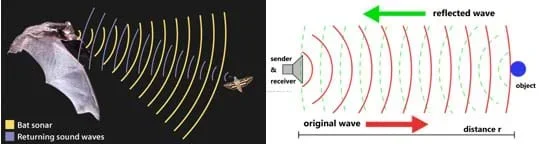 A bat's echolocation system is the basis for the principle of sonar or radar for distance measurement.Copyright (left) ASU Ask a Biologist {PD}, (right) Georg Wiora, Wikimedia Commons {PD} http://askabiologist.asu.edu/echolocation http://commons.wikimedia.org/wiki/File:Sonar_Principle_EN.svg
Close your eyes for a moment and imagine. (Have students close their eyes and prepare to imagine the following scene you describe to them.) You are in a large open canyon. You yell "hello" very loudly, and then stand there silently waiting. After a few seconds of waiting, you hear "hello...hello...hello" come back as your voice echoes (reflects) off the distant canyon walls and back to your ears.
This same idea occurs with the echolocation ability of bats. Bats emit high-pitched frequencies that travel across areas, bounce off obstacles (surfaces) and return to their ears. The amount of time that it takes for the first "hello" to reach you is half the time that it took to reflect off the obstacle. Thus, we can determine the distance by taking the time and halving it.
Biomimicry can be seen in the engineering design decisions that went into making the ultrasonic sensor. The sensor, like a bat's echolocation system, emits a high-pitched frequency and detects when the reflected sound is received back, so that the distance to an object can be determined.
Background
The correlation between new technology and how it is developed is often lost on students. Experiencing an iterative design process, like that typically used by engineers, helps to develop students' abilities to critique their own work and improve upon it. By tying technology to nature, students can draw upon their existing knowledge bases to understand how things work or how already-developed ideas may be improved upon.
Before the Activity
- Gather materials and make copies of the Pre-Activity Worksheet (PDF), Echolocation Activity Datasheet (PDF) and Post-Activity Worksheet (PDF); one each per student.
- Provide enough space to run the experiment—a length of about 200 cm (~ 6 feet, 6 inches). Measure and make marks at the start location, at 100 cm and at 200 cm.
- Build the EV3 robot according to the EV3 5-Minute Bot; refer to the internet link in the Additional Multimedia Support section.
- Download the five EV3 robot program files (see the Attachments section) and load them on to the EV3 brick. These programs have thresholds set for the ultrasonic sensor in order to run the activity. Note that the numbers in the file names (10, 25, 50, 75 and 90) indicate the threshold value set for the sensor.
- Make sure the batteries are fully charged.
With the Students
- Before conducting the activity, give students 10 minutes to complete the Pre-Activity Worksheet.
- Present the Introduction/Motivation section.
- For clarification of how the ultrasonic sensor works, have students attach to the EV3 brick an ultrasonic sensor via cable. Use the view command with the ultrasonic sensor on the EV3 brick to see how the sensor detects the environment around it. Have students measure the distance to three objects of their choosing using the sensor in this way. (Allocate no more than five minutes for this.)
- Have students mount an ultrasonic sensor to the already-built "five-minute bot" in three different positions. Have one-third of the groups mount their sensors near the rear, middle and front of the robot, respectively.
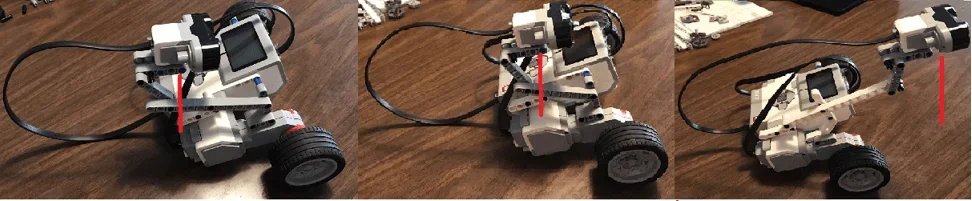 Various ultrasonic sensor placements (left to right): rear, middle front.Copyright 2012 James Muldoon, Polytechnic Institute of NYU
 - Place an object at the 100 cm mark. Make sure the robot threshold is set for 10 cm. Time how long it takes the robot to react to the obstacle (when it stops). Record the time on the datasheet. Repeat the process for thresholds at 25 cm, 50 cm, 75 cm and 90 cm.
- Place an object at the 200 cm mark. Make sure the robot threshold is set for 10 cm. Time how long it takes the robot to react to the obstacle (when it stops). Record the time on the datasheet. Repeat the process for thresholds at 25 cm, 50 cm, 75 cm and 90 cm.
- Have students graph the results on the threshold distance vs. reaction time grid on the datasheet. Have students share their results for each of the differently mounted robots.
- Direct students to examine the data collected from the previous steps to make inferences about redesigning the robot to optimize its abilities to avoid the obstacle. What do their analyses suggest might be improvements to make? Variables might include the location of the ultrasonic sensor on the robot and/or adjusting the robot thresholds.
- After making redesign adjustments, run steps 5 and 6 again with the redesigned robot and sensor set-up. Record data on the datasheet.
- Graph the data on the datasheet.
- Have students look at the new data and answer the datasheet evaluation questions about whether or not their adjustments improved or made the robot worse in reacting to the obstacle.
- Distribute the Post-Activity Worksheet and give students 10 minutes to complete it.
- As a class, review the Post-Activity Worksheet. Specifically focus on students' justifications of their redesign choices and how they relate to the data collected.
- Conclude with a class discussion prompted by questions in the Assessment section.
- biomimicry
- Looking to nature for inspiration to solve human problems.
- echolocation
- A physiological process for locating distant or invisible objects (as prey) by sound waves reflected back to the emitter (as a bat) from the objects.
- radar
- A device or system consisting usually of a synchronized radio transmitter and receiver that emits radio waves and processes their reflections for display. Radar is used especially for detecting and locating objects (such as aircraft) or surface features (such as of a planet).
- sonar
- A method or device for detecting and locating objects especially underwater by means of sound waves sent out to be reflected by the objects. Also, a device for detecting the presence of a vessel (such as a submarine) by the sound it emits in water.
Pre-Activity Assessment
Pre-Activity Worksheet: Before starting the activity, administer the Pre-Activity Echolocation Worksheet (PDF) to evaluate students' baseline knowledge of biomimicry, and their dispositions towards engineering design practices.
Activity Embedded Assessment
Activity Datasheet: During the activity, have students fill in the portions of the Echolocation Activity Datasheet (PDF) as it correlates to the steps they are working on. Using the blank data tables and grids for data recording and graphing saves them time and makes an easily readable set of data for evaluation in the redesign. Review their data, graphs and answers to gauge their mastery of the subject matter.
Post-Activity Assessment
Post-Activity Worksheet: At activity end, administer the Post-Activity Echolocation Worksheet (PDF) to evaluate students' comprehension of the concepts. As a class, review students' justifications of their redesign choices and how they relate to the data collected. Compare the pre- and post-assessments to gain insight into any changes in students' understanding.
Concluding Class Discussion: As a class, discuss how what students learned in the activity relates to the engineering approach to invention and problem solving. Ask the students:
- Besides bats, where else in nature might we see this echolocation concept? (Answer: Echolocation is also seen in marine animals, such as whales and dolphins.)
- Besides our robot's ultrasonic sensor (designed by engineers!) what are some additional examples in which engineers have used the echolocation concept to design devices that help people? (Possible answers: Engineers have applied the echolocation concept to many other purposes, such as active sonar for underwater navigation by boats and submarines [using sound waves], radar for aircraft and weather detection [using electromagnetic waves], medical ultrasound, and seismic surveys to map underground rock and earth structures.)
- Besides echolocation, what other biomimicry examples can you think of? (Possible ideas: Adhesives inspired by gecko feet, tumbleweeds that inspired a futuristic Mars Lander, and fabric fasteners, such as Velcro©, inspired by the clinging hooks of plant seeds. Follow the link in the Additional Multimedia section for many more ideas generated from plants and animals.)
- What is the value gained by what engineers call "iterative" design? (Answer: When engineers design, it is often called iterative design because original designs are analyzed and improved over and over until solutions are achieved that best meet the design criteria. This is similar to how nature progressed through natural selection to evolve the most successful plant and animal designs for given environments.)
Assign students to conduct in-depth research and report back to the class (or write short papers) on the topics covered in the concluding discussion: What other animals use echolocation? What are real-world engineering examples of the use of the echolocation concept? What other designs in our everyday lives have their inspiration from nature? What current technologies used biomimicry for their designs?
- For upper grades, 9-12: Given the speed of sound at sea level is 340.29 meters per second, find the theoretical amount of time it takes the robot to react to the object using simple unit cancelling and conversion. Do this in conjunction with the initial data gathering and analysis, and plot it on the same graph to give a better sense of value to the data.
To prepare the EV3 robot for the activity, follow the YouTube video, EV3 5-Minute Bot, which provides excellent guidance through the building process: https://www.youtube.com/watch?v=dGD15ywJiRM
For a long list of example engineering inventions inspired by animals and plants, see the Procedure-Background section of the Biomimicry: Natural Designs activity.
Animal echolocation. Last updated January 29, 2013. Wikipedia: The Free Encyclopedia. Accessed February 19, 2013. http://en.wikipedia.org/wiki/Animal_echolocation
Dictionary. Miriam Webster Online. (Source of definitions for echolocation, radar, sonar) http://www.merriam-webster.com/dictionary/
Hagen, Elizabeth. Bats: What is Echolocation? Last updated November 4, 2009. Ask a Biologist, School of Life Sciences, Arizona State University. Accessed February 11, 2013. http://askabiologist.asu.edu/echolocation
Sonar. Last updated February 18, 2013. Wikipedia: The Free Encyclopedia. Accessed February 19, 2013. http://en.wikipedia.org/wiki/Sonar
Contributors
James Muldoon
Supporting Program
AMPS GK-12 Program, Polytechnic Institute of New York University
Acknowledgements
This activity was developed by the Applying Mechatronics to Promote Science (AMPS) Program funded by National Science Foundation GK-12 grant no. 0741714. However, these contents do not necessarily represent the policies of the NSF and you should not assume endorsement by the federal government.
Copyright
2013 by Regents of the University of Colorado; original © 2012 Polytechnic Institute of New York University