
Building Our Bridge to Fun!
Legacy Curriculum
Hey there! This curriculum is no longer being curated or supported. It may contain materials that are no longer available or outdated information. Please use this document for reference.
Students identify different bridge designs and construction materials used in modern day engineering. They work in construction teams to create paper bridges and spaghetti bridges based on existing bridge designs. Students progressively realize the importance of the structural elements in each bridge. They also measure vertical displacements under the center of the spaghetti bridge span when a load is applied. Vertical deflection is measured using a LEGO® MINDSTORMS® EV3 intelligent brick and ultrasonic sensor. As they work, students experience tension and compression forces acting on structural elements of the two bridge prototypes. In conclusion, students discuss the material properties of paper and spaghetti and compare bridge designs with performance outcomes.
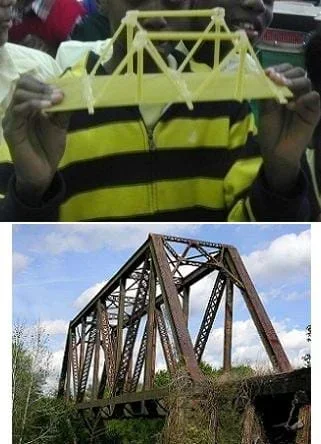 Students work as civil engineers to create and test bridges for performance to learn about design, forces and material properties.Copyright 2012 Eduardo Suescun, Polytechnic Institute of NYU (left); Harvey Henkelmann, Wikimedia Commons http://commons.wikimedia.org/wiki/File:LittleManateeRiver.jpg (right)
Civil engineers design and construct bridges to meet transportation needs related to traffic, commuting time and over-passing. A range of bridge designs exist, and the choice of which type of bridge to construct depends on space, bridge span, availability and cost of materials, and the budget. Each bridge type has its own structural design depending on service loads, expected traffic, weather, geographical position and seismic activity. Civil engineers take into account the stresses and deformations in all the structural elements of the bridge during the design process. Material selection is another aspect of the design process. The most common materials utilized in bridge construction include steel, concrete, wood and bricks. In this activity, students work as civil engineers to design, construct and test their bridge prototypes. Two different construction materials are used and compared. Students also use mechatronic tools, specifically an ultrasonic sensor, to measure vertical displacement under the center of a bridge span when loaded, mimicking the instrumentation and testing performed in real-world civil engineering projects.
After this activity, students should be able to:
- Explain the need for bridges in our communities.
- Identify materials used for bridges construction and explain the properties of these materials.
- Identify the structural elements of bridges.
- Identify the forces acting on bridges.
- Build model bridges and explain the difference between rigid and non-rigid materials used in bridge construction.
- CCSS.Math.Content.5.G.A.2 Represent real world and mathematical problems by graphing points in the first quadrant of the coordinate plane, and interpret coordinate values of points in the context of the situation.
Grade 5
Do you agree with this alignment?
- STEL-7H Illustrate that there are multiple approaches to design.
Grades 3-5
Do you agree with this alignment?
- 3-5-ETS1-1 Define a simple design problem reflecting a need or a want that includes specified criteria for success and constraints on materials, time, or cost.
Grades 3-5
Do you agree with this alignment? - 3-5-ETS1-2 Generate and compare multiple possible solutions to a problem based on how well each is likely to meet the criteria and constraints of the problem.
Grades 3-5
Do you agree with this alignment? - 3-5-ETS1-3 Plan and carry out fair tests in which variables are controlled and failure points are considered to identify aspects of a model or prototype that can be improved.
Grades 3-5
Do you agree with this alignment? - MS-ETS1-2 Evaluate competing design solutions using a systematic process to determine how well they meet the criteria and constraints of the problem.
Grades 6-8
Do you agree with this alignment?
- 3-5-ETS1-1 Define a simple design problem reflecting a need or a want that includes specified criteria for success and constraints on materials, time, or cost.
Grades 3-5
This resource focuses on the following Three Dimensional Learning aspects of NGSS:
Science & Engineering Practices- Define a simple design problem that can be solved through the development of an object, tool, process, or system and includes several criteria for success and constraints on materials, time, or cost.Do you agree with this alignment?
Disciplinary Core Ideas- Possible solutions to a problem are limited by available materials and resources (constraints). The success of a designed solution is determined by considering the desired features of a solution (criteria). Different proposals for solutions can be compared on the basis of how well each one meets the specified criteria for success or how well each takes the constraints into account.Do you agree with this alignment?
Crosscutting Concepts- People's needs and wants change over time, as do their demands for new and improved technologies.Do you agree with this alignment?
Do you agree with this alignment? - Define a simple design problem that can be solved through the development of an object, tool, process, or system and includes several criteria for success and constraints on materials, time, or cost.
- 3-5-ETS1-2 Generate and compare multiple possible solutions to a problem based on how well each is likely to meet the criteria and constraints of the problem.
Grades 3-5
This resource focuses on the following Three Dimensional Learning aspects of NGSS:
Science & Engineering Practices- Generate and compare multiple solutions to a problem based on how well they meet the criteria and constraints of the design problem.Do you agree with this alignment?
Disciplinary Core Ideas- Research on a problem should be carried out before beginning to design a solution. Testing a solution involves investigating how well it performs under a range of likely conditions.Do you agree with this alignment?
- At whatever stage, communicating with peers about proposed solutions is an important part of the design process, and shared ideas can lead to improved designs.Do you agree with this alignment?
Crosscutting Concepts- Engineers improve existing technologies or develop new ones to increase their benefits, to decrease known risks, and to meet societal demands.Do you agree with this alignment?
Do you agree with this alignment? - Generate and compare multiple solutions to a problem based on how well they meet the criteria and constraints of the design problem.
- 3-5-ETS1-3 Plan and carry out fair tests in which variables are controlled and failure points are considered to identify aspects of a model or prototype that can be improved.
Grades 3-5
This resource focuses on the following Three Dimensional Learning aspects of NGSS:
Science & Engineering Practices- Plan and conduct an investigation collaboratively to produce data to serve as the basis for evidence, using fair tests in which variables are controlled and the number of trials considered.Do you agree with this alignment?
Disciplinary Core Ideas- Tests are often designed to identify failure points or difficulties, which suggest the elements of the design that need to be improved.Do you agree with this alignment?
- Different solutions need to be tested in order to determine which of them best solves the problem, given the criteria and the constraints.Do you agree with this alignment?
Do you agree with this alignment? - Plan and conduct an investigation collaboratively to produce data to serve as the basis for evidence, using fair tests in which variables are controlled and the number of trials considered.
- MS-ETS1-2 Evaluate competing design solutions using a systematic process to determine how well they meet the criteria and constraints of the problem.
Grades 6-8
This resource focuses on the following Three Dimensional Learning aspects of NGSS:
Science & Engineering Practices- Evaluate competing design solutions based on jointly developed and agreed-upon design criteria.Do you agree with this alignment?
Disciplinary Core Ideas- There are systematic processes for evaluating solutions with respect to how well they meet the criteria and constraints of a problem.Do you agree with this alignment?
Do you agree with this alignment? - Evaluate competing design solutions based on jointly developed and agreed-upon design criteria.
Each group needs:
- LEGO MINDSTORMS EV3 robot, such as EV3 Core Set (5003400) at https://education.lego.com/en-us/products/lego-mindstorms-education-ev3-core-set/5003400#lego-mindstorms-education-ev3
- 1 LEGO MINDSTORMS Ultrasonic Sensor, available at https://education.lego.com/en-us/products/lego-mindstorms-education-ev3-ultrasonic-sensor/45504
- 10 - 15 sheets of blank paper
- 1 pound (~450 g) of regular, thick spaghetti (raw, uncooked)
- glue gun
- 1 package of glue sticks
- scissors
- colors, markers or crayons
- Building Our Bridge to Fun Pre-Assessment (PDF)
- Building Our Bridge to Fun Post-Assessment (PDF)
To share with the entire class:
- For intro demo: flexible rulers, one per student (alternative: sponges)
- For intro demo: small bag of gravel, such as a 28-oz (~0.8 kg) bag available at pet stores
- For intro demo: 4-pack of Play-Doh®, available at Target®, Walmart® or Amazon.com®
- Building Our Bridge to Fun Presentation (ppt) (PPT)
- Paper Bridges: Strength through Form, an Illustrated Teacher's Manual, available at https://www.amazon.com/Paper-bridges-Strength-illustrated-teachers/dp/B0006QX0PK
- LEGO MINDSTORMS Education EV3 Software 1.2.1, free online, you have to register a LEGO account first; at https://www.lego.com/en-us/mindstorms/downloads/download-software
- computer, loaded with EV3 1.2.1 software
- 4 standard mass sets to use as weights, such as a student standard mass set at https://www.enasco.com/p/Student-Standard-Mass-Set%2BTB17619?searchText=student+standard+mass+set; the ideal combined weight is ~600 grams
Note: This activity can also be conducted with the older (and no longer sold) LEGO MINDSTORMS NXT set instead of EV3; see below for those supplies:
- LEGO MINDSTORMS NXT Base Set
- LEGO MINDSTORMS Education NXT Software 2.1
- computer, loaded with NXT 2.1 software
- Building Our Bridge to Fun Presentation (pptx)
- Building Our Bridge to Fun Presentation (pdf)
- Building Our Bridge to Fun Pre-Assessment (pdf)
- Building Our Bridge to Fun Pre-Assessment (doc)
- Building Our Bridge to Fun Pre-Assessment Answer Key (pdf)
- Building Our Bridge to Fun Pre-Assessment Answer Key (doc)
- Building Our Bridge to Fun Post-Assessment (pdf)
- Building Our Bridge to Fun Post-Assessment (doc)
- Building Our Bridge to Fun Post-Assessment Answer Key (pdf)
- Building Our Bridge to Fun Post-Assessment Answer Key (doc)
Who has traveled across a bridge? Why do you think that bridge was there? (Listen to student answers. Expect answers to include that the bridge enabled them to cross over water or another road.) Great! It sounds like you already have some experience with or prior knowledge about bridges! Today we will learn about the use of and need for bridges, identify the main forces acting on bridges, build two types of bridges made of two different materials, and learn how to use a LEGO EV3 intelligent brick and an ultrasonic sensor to gather data.
How would you define a bridge? Why do we need bridges? (Call on students and let them share ideas with the class.) A bridge is a structure that provides passage over a river, road or any other obstacle. In our communities, we have a definite need for bridges! Bridges are important to shorten travel time or connect two places divided by obstacles. What type of materials do you think are used in constructing bridges? (Call on students and let them share ideas with the class. If desired, create a list of student-generated ideas on the board.) Materials such as concrete, wood, steel, stone and bricks are used as construction materials, and their performance and behavior depends on the way that loads are applied. What would be an example of a load? (Listen to student ideas. If desired, create a list of student-generated ideas on the board.) Loads might include cars and trucks, rain and snowfall, and even people, crossing the bridge. A load on a structure is the sum of all the forces acting on that structure from any object that has weight, or other external forces, such as wind. Remember that weight is actually a downward force caused by gravity. When you stand on a bridge, your weight acts as a downward force, pushing on the bridge.
(Hand out to each student a ruler, a small scoop of Play-Doh, and a handful of gravel.) With each of these three objects, try to stretch the object, bend the object, twist the object, and try to compress or squeeze the object. Notice what happens when you apply each of these forces to the objects. What do you notice when you apply these forces to these objects? (Expect students to notice that they are able to fold, bend and twist the rulers, but nothing happens to the ruler when they try to stretch it or squeeze it. Regardless of the type of force applied to the gravel, expect students observe that they cannot change or manipulate this object. Expect students to realize that they can manipulate the shape of the Play-Doh with all the forces: stretch it, bend it, fold it, twist it and compress it.)
To describe what happens to these objects when we manipulate them with our hands, we need to first learn some vocabulary terms that we can use to describe the forces we are applying:
 What forces must a bridge withstand?Copyright NYC Department of Education http://schools.nyc.gov/SchoolPortals/23/K647/default.htm
- A tension force is a pulling force, usually applied by a string, cable or chain, on another object.
- A compression force is a pushing force that acts to shorten the thing that it is acting on. Opposite to tension.
- The loads that engineers consider in designing bridges include the weight of the bridge, traffic weight, forces from wind, the weight of snow, and dynamic forces, otherwise known as forces of motion, due to earthquakes and vibrations.
Materials behave differently depending on what the material is made of, known as the material composition, and the type of force applied to the material. Using your ruler, let's go through a simple example of tension and compression. By bending the ruler down in one direction, the upper half of the ruler is considered to be under compression and the lower half is under tension. (This is also easy to demonstrate by using a sponge. When bending the top half of the sponge downwards, notice how the holes or divots on one side of the sponge close, while the holes or divots on the opposite side stretch open more than their normal state.)
Now that you're thinking about bridges and forces, let's go through a presentation in which you'll learn about several types of bridges. We'll focus on their performance and shapes. As you look at the various pictures of bridges, noticed the materials used. Throughout the presentation, remember that each bridge design must take three things into account: 1) the main need or purpose of the structure, 2) the dimensions, including the required length, and 3) the materials available or required. (Show the class the Building Our Bridge to Fun Presentation (PPT).)
Background
The teacher should have a basic understanding of types of bridges and loads applied. For additional information to support the introduction of these concepts, visit http://www.pbs.org/wgbh/buildingbig/bridge/index.html.
The LEGO MINDSTORMS EV3 Intelligent Brick, the LEGO MINDSTORMS EV3 software 1.2.1, and the LEGO MINDSTORMS ultrasonic sensor are used to measure the deflection of the beam due to loading. Teachers must have a basic understanding in using and programing the LEGO MINDSTORMS EV3 software. A basic introduction of the LEGO MINDSTORMS parts, sensors and software is available at https://www.lego.com/en-us/themes/mindstorms. Teachers should familiarize themselves with the various LEGO MINDSTORMS EV3 robots and projects at https://ev3lessons.com/en/.
The hands-on activity focuses heavily on the comparison between construction materials. Make sure to emphasize to students the importance of choosing the best construction materials in designing bridges. Materials such as concrete, stone and bricks behave better in compression rather than in tension conditions, while steel works well in tension conditions. Engineers often combine materials in order to address both compression and tension bridge requirements. In the activity, paper and spaghetti bridges are compared before, during and after construction. Students make initial predictions about the anticipated resistance, failure and excessive displacements of bridge structural members using these materials.
Before the Activity
- Gather materials.
- Make copies of the Building Our Bridge to Fun Pre-Assessment (PDF) and Building Our Bridge to Fun Post-Assessment (PDF).
- Be ready to show the class the PowerPoint presentation.
With the Students
- Administer the pre-activity assessment.
 Figure 1: An example model bridge made of paper, designed and created by fifth-grade students.Copyright 2012 Eduardo Suescun, Polytechnic Institute of NYU
 - Present to the class the Introduction/Motivation information and the PowerPoint presentation.
- Write the following terms on the board and ask students to think about what they mean: bridge, loads and displacement, tension and compression force, span, beam, and columns.
- Remind students how a conventional bridge works in terms of loads and stresses.
- Divide the class into groups of five students each.
- Using the Three-span Beam Bridge instructions and template from the Paper Bridges: Strength Through Form, an Illustrated Teacher's Manual as a guide, instruct students on how to design and build a paper bridge. Student teams may use sheets of paper, glue and scissors to construct the bridge. As time permits, encourage them to decorate the bridge. Refer to Figure 1 as an example.
 Figure 2: Common types of modern bridge designs and how the load/weight is divided on the bridge (see arrows). Left to right: beam bridge, arc bridge, cantilever bridge, suspended bridge, cable-stayed bridge, tied-arch bridge.Copyright 2011 KVDP, Wikimedia Commons http://commons.wikimedia.org/wiki/File:Types_of_bridges.JPG
 - Direct student teams to design and build model bridges using spaghetti, scissors and hot glue. Make the spaghetti bridge have approximately the same dimensions as the paper bridge. The recommended design for the spaghetti bridge is a simple truss bridge, but students can explore other bridge designs if desired. For guidance in the design and construction of the spaghetti bridge, encourage students to refer to their paper bridges or images of different bridges shown in the PowerPoint presentation, as well as the bridge designs in Figure 2. Teams may use as little or as much of the pound of spaghetti as they wish for the bridge construction. Once construction is done and as time permits, encourage students to decorate their bridges as they wish.
- Write the code for measuring the deflection of the beam due to loading, as shown in Figure 3, and download this code to the LEGO MINDSTORMS EV3 brick.
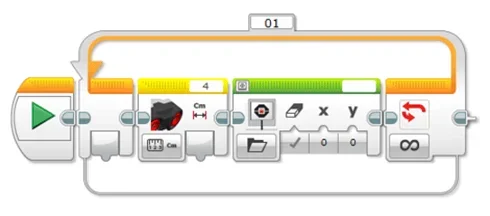 Figure 3: LEGO MINDSTORMS EV3 code to detect and track the deflection of the bridge span.Copyright 2017 University of Colorado Boulder
 - For measuring the deflection of the spaghetti bridge beams, create an experimental set-up, as shown in Figure 4. Before adding any weight to a bridge, use the ultrasonic sensor to measure the distance to the bridge. This is the initial measurement corresponding to zero displacement. Then apply a load by placing known weights on the center of the span. Immediately, the deflection value appears on the LEGO EV3 screen.
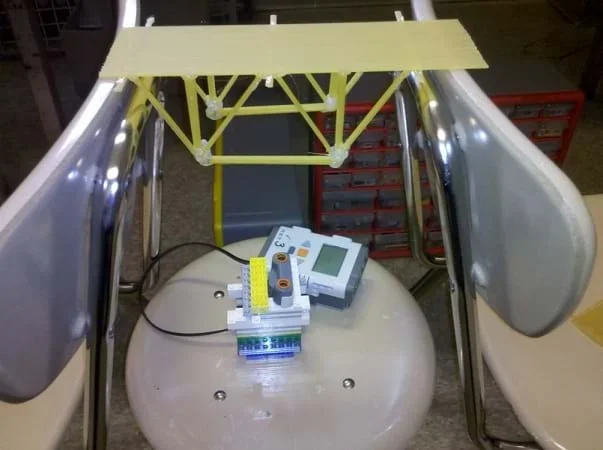 Figure 4: The experimental set-up.Copyright 2014 Eduardo Suescun, Polytechnic Institute of NYU
 - Begin collecting data measurements with a relatively small load on the bridge, such that only a slight deflection is visible. The amount of weight required to cause this slight deflection will vary for each bridge. Have each group create a table similar to the one shown in Figure 5 to record data measurements. Using the ultrasonic sensor, measure and record the bridge's deflection in centimeters. The deflection is found by subtracting the new measurement given by the ultrasonic sensor from the initial measurement. Double the weight on the bridge and measure the new deflection with the ultrasonic sensor. Repeat this process until all of the weight is placed on the bridge or until the bridge collapses.
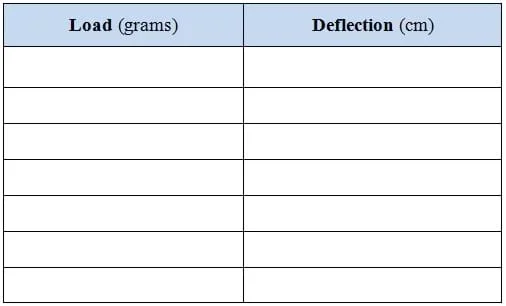 Figure 5: Example data collection table.
 - Once students finish data collection for their spaghetti bridges, have each groups repeat step 10 with their paper bridges, remembering to take initial ultrasonic readings first, before they start to add weight. In this case, expect them to find that no deflection takes place until a sudden collapse occurs.
- After all data has been collected, have the students create a line graph of load vs. deflection both the spaghetti bridges and the paper bridges.
- Bring the class together for a discussion to review testing results and conclusions. Have each group share its highest load value for each model bridge in grams and the corresponding deflection value in centimeters. Ask students if they can see why some group's bridges had the best performance, based on the bridge's appearance and design. Why were some bridges more successful than others? Examine the designs and construction details with an eye towards their ability to handle tension and compression forces.
- Administer the post-activity assessment.
- beam
- The structural part of a bridge that is long, rigid, slender and horizontal. It is where the bridge spans and roadways rest on.
- bridge span
- A structural measurement between two columns; usually there is an equal distance of roadway between any two columns.
- civil engineer
- A person who applies her/his understanding of science and math to design projects such as highways, buildings, bridges and all types of structures for the benefit of humanity and our world.
- column
- The structural part of a bridge that is long, rigid and vertically oriented. It is what beams and bridge spans rest on.
- compression force
- A pushing force that acts to shorten or compress an object.
- load
- The forces acting on a structure caused by the weight of other objects and/or other external forces.
- tension force
- A pulling force that acts to lengthen an object.
- truss
- The structural frame that comprises a set of triangles made of straight members and joints. A truss is typically made of steel or wood. Structural trusses distribute tension and compression forces along the bridge.
- ultrasonic sensor
- A sensor that can detect the proximity of an object by using two (transmitter-receiver) ultrasonic signals.
Pre-Activity Assessment
Pre-Test: Before starting the activity, administer the Building Our Bridge to Fun Pre-Assessment (PDF) with questions that cover forces, stresses, construction materials and bridge types. Review students' answers to gauge their prior knowledge of bridges, materials and forces.
Activity Embedded Assessment
Questioning: During the activity, ask individual students questions to assess their understanding of the important concepts. Example questions:
- What part of the bridge does the traffic load act on? (Answer: That force goes directly to the bridge span.)
- Where on the bridge is the load due to the weight of the bridge span and traffic applied? (Answer: The load from the weight of the bridge span and traffic acts on the bridge columns.)
Post-Activity Assessment
Post-Test: At activity end, have students complete the Building Our Bridge to Fun Post-Assessment (PDF). Review their answers and compare with the pre-assessment answers, looking for improvements in their understanding of bridges, construction materials and loads.
- Remind students of scissors and hot glue safety guidelines. As necessary, engage another adult to supervise glue gun use.
For younger students (second and third grade), use less technical vocabulary.
Salvadori, Mario. Paper Bridges: Strength Through Form, an Illustrated Teacher's Manual. LEGO Education North America. http://www.legoeducation.us/eng/product/paper_bridges_strength_through_form_an_illustrated_teacher_s_manual/637
Contributors
Eduardo Suescun
Supporting Program
AMPS GK-12 Program, Polytechnic Institute of New York University
Acknowledgements
This activity was developed by the Applying Mechatronics to Promote Science (AMPS) Program funded by National Science Foundation GK-12 grant no. 0741714. However, these contents do not necessarily represent the policies of the NSF, and you should not assume endorsement by the federal government.
Copyright
2013 by Regents of the University of Colorado; original © 2012 Polytechnic Institute of New York University