
Capillary Action in Sand
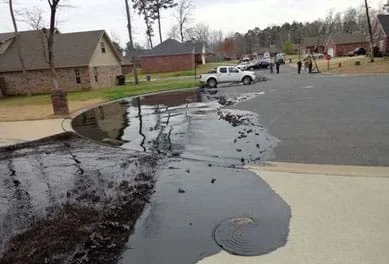 Student teams design experiments to determine the best sand type to use to clean up an oil spill.Copyright 2013 US Environmental Protection Agency, Wikimedia Commons https://commons.wikimedia.org/wiki/File:EPAoilspillsubdivision2.JPG
As part of a (hypothetical) challenge to help a city find the most affordable and environmentally friendly way to clean up an oil spill, students design and conduct controlled experiments to quantify capillary action in sand. Like engineers and entrepreneurs, student teams use affordable materials to design and construct models to measure the rate of capillary action in four types of sand: coarse, medium, fine and mixed. After observing and learning from a teacher-conducted capillary tube demonstration, teams are given a selection of possible materials and a budget to work within as they design their own experimental setups. After the construction of their designs, they take measurements to quantify the rate of capillary action, create graphs to analyze the data, and make concluding recommendations. Groups compare data and discuss as a class the pros and cons of their designs. Pre- and post-evaluations and two worksheets are provided.
The study of capillary action in soil provides essential information to civil and geotechnical engineers. For example, understanding the soil properties in a given area enables engineers to specify materials and locations for construction projects to prevent any potential water damage. Geotechnical engineers extract crude oil using the process of capillary action. This activity provides an opportunity for students to think like engineers as they design and create models to analyze the upward movement of water in different mediums. Like real engineers, student teams are given budget limitations and must select the best affordable materials to solve a real-world problem and assess the performance of their designs to deliver solid recommendations.
After this activity, students should be able to:
- Explain and illustrate the process of capillary action on the particle level.
- Design a controlled experiment to quantify capillary action.
- Design and construct a model that shows capillary action in soil.
- STEL-1J Develop innovative products and systems that solve problems and extend capabilities based on individual or collective needs and wants.
Grades 6-8
Do you agree with this alignment?
- MS-ETS1-2 Evaluate competing design solutions using a systematic process to determine how well they meet the criteria and constraints of the problem.
Grades 6-8
Do you agree with this alignment?
- MS-ETS1-2 Evaluate competing design solutions using a systematic process to determine how well they meet the criteria and constraints of the problem.
Grades 6-8
This resource focuses on the following Three Dimensional Learning aspects of NGSS:
Science & Engineering Practices- Evaluate competing design solutions based on jointly developed and agreed-upon design criteria.Do you agree with this alignment?
Disciplinary Core Ideas- There are systematic processes for evaluating solutions with respect to how well they meet the criteria and constraints of a problem.Do you agree with this alignment?
Do you agree with this alignment? - Evaluate competing design solutions based on jointly developed and agreed-upon design criteria.
- SEP.4.6-8.5 Develop a model to generate data to test ideas about designed systems, including those representing inputs and outputs.
Grades 6-8
Do you agree with this alignment?
Each group needs:
- colored pencils
- $300 in play money; download free PDFs of printable play money at http://www.printableplaymoney.net/ and then print as needed; recommended to get denominations of $10s, $20s and $50s
- assorted building and construction materials from which teams may choose as they sketch and then build their designs; as listed in Table 1 on the Design Challenge & Experiment Worksheet (PDF), such as glues, tapes, string, sponges, cotton pads, wire mesh, plastic and Styrofoam cups, drinking straws, pipe cleaners popsicle sticks, various sizes of plastic water bottles, plastic food containers, each assigned a “cost”
- 200 ml each of four types of sand: coarse, medium, fine and mixed; such as available at Carolina
- six 250-ml beakers, one for each of the 4 sand samples and 2 for water
- timer
- 250-ml graduated cylinder
- Activity Pre-Evaluation (PDF), Demo Worksheet (PDF), Design Challenge & Experiment Worksheet (PDF) and Activity Post-Evaluation (PDF), one each per student
- (optional) calculator
To share with the entire class:
- permanent marker
- capillary tube demonstrator; such as the scientific capillary tube set (three 15-cm tubes, large tube for reservoir, all mounted on a stand) for $10 from Frey Scientific at: https://store.schoolspecialty.com/OA_HTML/ibeCCtpItmDspRte.jsp?minisite=10029&item=36424
- needle tool, to make holes in plastic containers; such as the Kemper Tools professional needle tool for $5 at https://www.amazon.com/Kemper-Tools-Professional-Needle-Tool/dp/B0023ATIM6/ref=sr_1_1?ie=UTF8&qid=1516677742&sr=8-1&keywords=Kemper+Tools+professional+needle+tool
- hand-held hole puncher, to punch holes in plastic containers; available for $2.35 at https://www.amazon.com/Swingline-1-Hole-Punch-Sheets-A7074005/dp/B00006IBK9
- 25-cm long metric printable paper ruler; such as those available for free PDF download at http://www.vendian.org/mncharity/dir3/paper_rulers/ and then print as needed
- 20-inch stainless steel metric ruler; such as the double-sided stainless steel metric ruler measuring tool by uxcell (20-inch, 50 cm) at https://www.amazon.com/uxcell-Measuring-0-5mm-Accuracy-Straight/dp/B01E64BD3S/ref=sr_1_5?ie=UTF8&qid=1515024940&sr=8-5&keywords=20+inch+stainless+steel+metric+ruler
- brightly colored liquid food dye/coloring, such as red
- Activity Pre-Evaluation (docx)
- Activity Pre-Evaluation (pdf)
- Activity Pre-Evaluation Answer Key (docx)
- Activity Pre-Evaluation Answer Key (pdf)
- Demo Worksheet (docx)
- Demo Worksheet (pdf)
- Demo Worksheet Example Answers (docx)
- Demo Worksheet Example Answers (pdf)
- Design Challenge & Experiment Worksheet (docx)
- Design Challenge & Experiment Worksheet (pdf)
- Design Challenge & Experiment Worksheet Example Answers (docx)
- Design Challenge & Experiment Worksheet Example Answers (pdf)
- Activity Post-Evaluation (docx)
- Activity Post-Evaluation (pdf)
- Activity Post-Evaluation Answer Key (docx)
- Activity Post-Evaluation Answer Key (pdf)
Students should have a conceptual understanding of atoms, elements, molecules, particles and bonding, as well as different types of sand (such as coarse, medium and fine), and saturation in a medium.
Capillary action is the upward movement of water through narrow spaces in a medium such as soil. An example of this can be observed within soil particles above the groundwater. Underground water rises upward through capillary forces.
The process of capillary action serves many important life functions in animals and plants. In plants, capillary action is the force that drives water to move upwards from the roots to the leaves. In animals, capillary action is essential in transporting fluids within the body system and it facilitates the drainage of tear fluids in the eyes.
You may not be aware of the many real-world engineering applications of capillary action. Can you think of any? Examples include the use of the paper towels, sponges and the tips of fountain pens, as well as chromatography, which is the chemical separation of mixtures into their constituents by how they absorb differently into materials like silica, filter paper and gels.
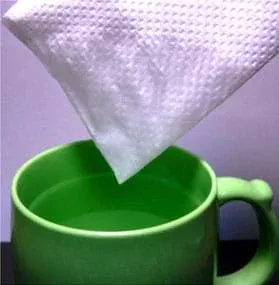 A paper towel soaks up water due to capillary action.Copyright 2006 Stanley, Wikimedia Commons https://commons.wikimedia.org/wiki/File:Capillary_papertowel.PNG
Civil and geotechnical engineers study capillary action in soil to accurately assess the soil in different areas. This information helps engineers to select the best suitable building materials and locations for the construction of buildings so as to minimize the risk of water damage. In agricultural engineering, understanding the process of capillary action in soil enables engineers to design more efficient irrigation systems, especially in areas where water is scarce and droughts occur.
At the molecular level, capillary action is controlled by the cohesive and adhesive forces of molecules. Cohesion is the attraction between like molecules. An example of this is hydrogen bonding between water molecules. Adhesion is the process of particles being attracted to the surface. A good way to remember adhesion is to think about adhesive tape—the adhesion takes place at the point of contact between the tape and the skin. When soil is mixed with water, cohesion is the intermolecular force between water molecules via hydrogen bonding. Adhesion is the intermolecular force between water and soil molecules.
When water moves upward through soil due to capillary action, the cohesive forces between the water molecules are weaker than the adhesive force between the water and the soil molecules. The water molecules attracted to the soil move upwards through the adhesive force, and this in turn drives the movement of water molecules that are hydrogen bonded.
Before the Activity
- Make copies of the Activity Pre-Evaluation (PDF), Demo Worksheet (PDF) and Design Challenge & Experiment Worksheet (PDF) and Activity Post-Evaluation (PDF), one each per student.
- Gather materials and keep them organized and labeled. If the supply of construction/building materials that you make available to the teams varies from the Table 1 listing on the Design Challenge & Experiment Worksheet (PDF), alter the Table 1 inventory list to match the available materials.
- Set up for the class demonstration.
With the Students: Pre-Evaluation
- Administer the pre-evaluation, directing students to work independently to answer the questions.
- As a class, discuss the pre-evaluation answers to clarify any misconceptions.
With the Students: Demo—Making Observation and Inferences
- Present to the class the Introduction/Motivation content.
- Divide the class into groups of four students each. Hand out the demo worksheet.
- Introduce the demo as a model to investigate the behavior of water. Then give students a few minutes to write on their worksheets their predictions/hypotheses for what they think will happen when water is added to the model (question #1).
- Tell students to closely observe as you demonstrate capillary action with the capillary tube demonstrator using the following steps:
- Pour 50 ml of water into a beaker.
- Add 5 drops of brightly colored food dye (red works well) into the beaker.
- Add the dyed water into the capillary tube demonstrator to show the movement of water in the tubes.
- Make sure students notice how water travels through tubes of different diameters—the narrower the tube, the higher the water travels.
- Introduce the concept of capillary action in sand and how it works on the molecular level. Explain that the small empty spaces that exist between soil particles permit water to move through. Go over any new vocabulary terms. Discuss some real-world applications of capillary action.
- Have students complete the demo worksheet by answering questions #2-5.
- As a class, go over the demo worksheet answers, and clarify any additional student questions.
With the Students: Oil Cleanup Design Challenge & Experiment
- Hand out the design challenge worksheet and introduce the design challenge to the class. Ask one student to read aloud the first paragraph on the worksheet—which is the hypothetical scenario that sets the stage for the design challenge: to help the cleanup of a 500-gallon oil spill from a highway truck accident by conducting an experiment to determine the best sand to use for the cleanup process. Tell students to work in their teams and use the worksheet to guide them.
- Assign one student to be the store manager to facilitate the selling and returning of the materials listed in Table 1 of the design challenge worksheet. Periodically, lower the price on some items to motivate students to use certain materials to make progress in their setups and/or take chances in their designs. Circulate the classroom, checking for progress in each group as students work together to sketch a design of a test setup that uses materials purchased within the $300 budget, construct the testing setup, conduct a controlled experiment to test various sand types, collect/record/graph/analyze data, and make a recommendation.
- Have teams present their findings and compare the pros and cons of their designs; engineers would call this “evaluate competing design solutions.” Expect students to use cups, soda bottles or food containers to test capillary action in sand, and create either individual sponge- or cotton-based chambers or multiple interconnected capillary chambers as a means to introduce water into the system. As a result of their hands-on experiences, expect students to ultimately conclude that mixed sand has the highest capillary action and is therefore the best for oil clean up.
- Collect materials and direct students to clean up.
- Conclude by administering the post-evaluation to gauge individual student comprehension.
- Lead a class discussion that facilitates student sharing, comparing and considering their answers to the worksheet questions.
- adhesion
- The force of attraction in the contact area between unlike molecules causing them to cling to one another. Particle attraction to the surface.
- capillary action
- The ability of a liquid to rise through narrow spaces within a medium, such as soil.
- cohesion
- The force of attraction between like molecules. Example: hydrogen bonds between water molecules.
- groundwater
- Water that is beneath the Earth’s surface in soil pore spaces and in the fractures and permeable layers of rock and soil. The source of water in springs and wells.
- saturation
- The condition in which the space in a medium is completely full.
Pre-Activity Assessment
Pre-Evaluation: Administer the four-question Activity Pre-Evaluation (PDF) to assess students' prior knowledge about water and its behavior at the molecular level. Working independently, students define five words (atom, element, molecule, particle, bonding) and answer three questions. As a class, discuss the answers to clarify any misconceptions.
Activity Embedded Assessment
Design Challenge & Experiment: Students groups each design a controlled experiment to solve a real-world problem: which sand type is best for oil spill cleanup? As students work through the activity, have them complete Design Challenge Worksheet (PDF), which guides them through design sketching; materials cost budgeting; and data collection, graphing and analysis; and conclusion/recommendation. Review their worksheets to gauge their engagement and understanding.
Post-Activity Assessment
Post-Evaluation: Administer the five-question Activity Post-Evaluation (PDF) to individually assess students’ conceptual understanding of the capillary action of water in different mediums. Review their answers to gauge their depth of comprehension.
Be careful when using sharp objects to cut plastic, such as the needle tool.
- For lower grades, do more of a demonstration by having the teacher record data and the students just analyze.
- For higher grades, increase the number and complexity of design materials and have students program sensors using Arduinos to quantify capillary action.
Download PDFs of printable play money at http://www.printableplaymoney.net/.
Download PDFs of printable paper rulers at http://www.vendian.org/mncharity/dir3/paper_rulers/.
Touchette, Beth. “Capillary Action Experiment.” Updated February 14, 2014. Education.com, Inc. Accessed August 10, 2015. http://www.education.com/science-fair/article/capillary-action/
Vancleave, Janice. “How Paper Absorbs Water.” Posted September 30, 2011. Vancleave’s Science Fun: Your Guide to Science Projects, Fun Experiments and Science Research. Accessed August 10, 2015. http://scienceprojectideasforkids.com/2011/paper-absorbs-water/
Contributors
Yaqi Xiong
Supporting Program
SMARTER RET Program, School of Engineering, Polytechnic Institute of New York University
Acknowledgements
This activity was developed by the Science and Mechatronics Aided Research for Teachers with an Entrepreneurial ExpeRience (SMARTER): A Research Experience for Teachers (RET) Program in the School of Engineering funded by National Science Foundation RET grant no. 1132482. However, these contents do not necessarily represent the policies of the NSF, and you should not assume endorsement by the federal government.
Copyright
2016 by Regents of the University of Colorado; original © 2015 Polytechnic Institute of New York University