
The Car with a Lot of Potential
Legacy Curriculum
Hey there! This curriculum is no longer being curated or supported. It may contain materials that are no longer available or outdated information. Please use this document for reference.
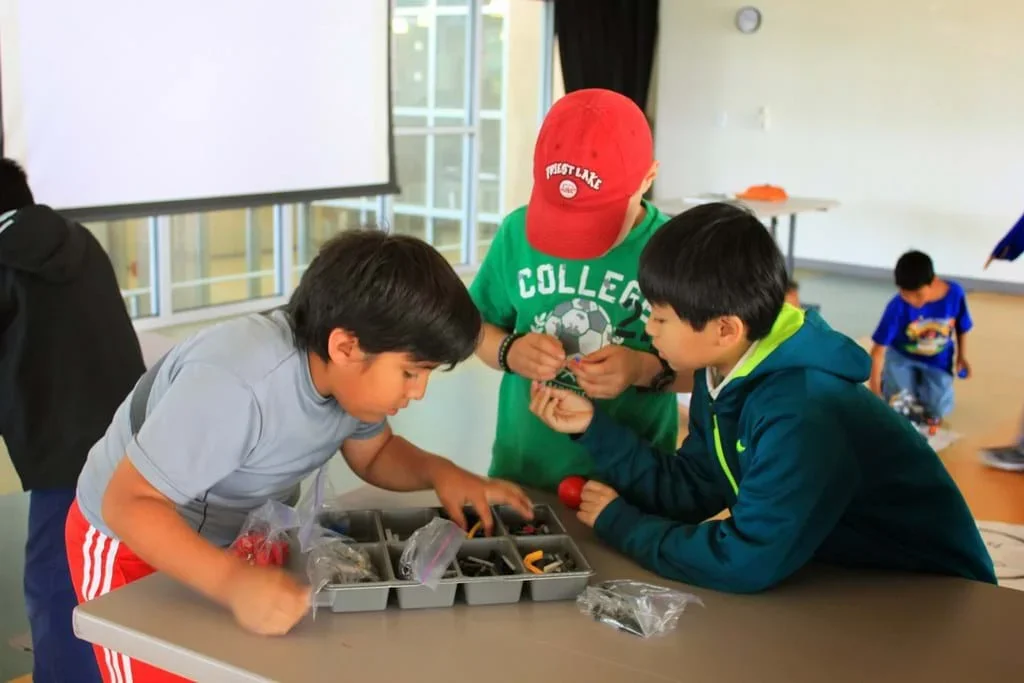 Student thinking about gears in motionCopyright flickr.com 2014. CC BY-SA 2.0 https://www.flickr.com/photos/sanjoselibrary/14308844895
Working in teams of three, students perform quantitative observational experiments on the motion of LEGO® MINDSTORMS® robotic vehicles powered by the stored potential energy of rubber bands. They experiment with different vehicle modifications (such as wheel type, payload, rubber band type and lubrication) and monitor the effects on vehicle performance. The main point of the activity, however, is for students to understand that through the manipulation of mechanics, a rubber band can be used in a rather non-traditional configuration to power a vehicle. In addition, this activity reinforces the idea that elastic energy can be stored as potential energy.
Mechanical engineering applications—such as wind turbines, electric stoves and television screens—typically require the manipulation and transference of energy. This activity provides students with an example of the application of the elastic energy of a rubber band to a non-ideal mechanical setup, mimicking real-world challenges to design efficient engines with aerodynamic designs. Students test designs and tabulate observations based on varied experimental parameters.
After this activity, students should be able to:
- Test the effects of altering the number of turns of a rubber band on the motion of a model vehicle, reinforced with quantitative results.
- Test the effectiveness of varying one or more of the following on vehicle motion: wheel type, payload weight, rubber band type and lubrication.
- Report on the conclusions and collaborate with other groups to optimize vehicle parameters.
- CCSS.Math.Content.4.MD.B Represent and interpret data.
Grade 4
Do you agree with this alignment?
- Students will develop an understanding of the attributes of design.
Grades K-12
Do you agree with this alignment? - Students will develop an understanding of engineering design.
Grades K-12
Do you agree with this alignment?
- Represent and interpret data.
Grade 4
Do you agree with this alignment?
- 3-5-ETS1-3 Plan and carry out fair tests in which variables are controlled and failure points are considered to identify aspects of a model or prototype that can be improved.
Grades 3-5
Do you agree with this alignment? - 4-PS3-4 Apply scientific ideas to design, test, and refine a device that converts energy from one form to another.
Grade 4
Do you agree with this alignment?
- 3-5-ETS1-3 Plan and carry out fair tests in which variables are controlled and failure points are considered to identify aspects of a model or prototype that can be improved.
Grades 3-5
This resource focuses on the following Three Dimensional Learning aspects of NGSS:
Science & Engineering Practices- Plan and conduct an investigation collaboratively to produce data to serve as the basis for evidence, using fair tests in which variables are controlled and the number of trials considered.Do you agree with this alignment?
Disciplinary Core Ideas- Tests are often designed to identify failure points or difficulties, which suggest the elements of the design that need to be improved.Do you agree with this alignment?
- Different solutions need to be tested in order to determine which of them best solves the problem, given the criteria and the constraints.Do you agree with this alignment?
Do you agree with this alignment? - Plan and conduct an investigation collaboratively to produce data to serve as the basis for evidence, using fair tests in which variables are controlled and the number of trials considered.
- 4-PS3-4 Apply scientific ideas to design, test, and refine a device that converts energy from one form to another.
Grade 4
This resource focuses on the following Three Dimensional Learning aspects of NGSS:
Science & Engineering Practices- Apply scientific ideas to solve design problems.Do you agree with this alignment?
Disciplinary Core Ideas- Possible solutions to a problem are limited by available materials and resources (constraints). The success of a designed solution is determined by considering the desired features of a solution (criteria). Different proposals for solutions can be compared on the basis of how well each one meets the specified criteria for success or how well each takes the constraints into account.Do you agree with this alignment?
- Energy can also be transferred from place to place by electric currents, which can then be used locally to produce motion, sound, heat, or light. The currents may have been produced to begin with by transforming the energy of motion into electrical energy.Do you agree with this alignment?
- The expression "produce energy" typically refers to the conversion of stored energy into a desired form for practical use.Do you agree with this alignment?
Crosscutting Concepts- Science affects everyday life.Do you agree with this alignment?
- Energy can be transferred in various ways and between objects.Do you agree with this alignment?
- Engineers improve existing technologies or develop new ones.Do you agree with this alignment?
- Most scientists and engineers work in teams.Do you agree with this alignment?
Do you agree with this alignment? - Apply scientific ideas to solve design problems.
Each group needs:
- LEGO MINDSTORMS EV3 robot, such as EV3 Core Set (5003400) at https://education.lego.com/en-us/products/lego-mindstorms-education-EV3-core-set-/5003400
- LEGO MINDSTORMS Education EV3 Software 1.2.1, free online, you have to register a LEGO account first at https://www.lego.com/en-us/mindstorms/downloads/download-software
- computer, loaded with EV3 1.2.1 software
- 1 rubber band (3-inch diameter)
- 1 rubber band vehicle, pre-built for each group (refer to the Vehicle Building Instructions (PDF))
- stopwatch or timer
- Data Collection Worksheet (PDF), one per student
- Vehicle Building Instructions (PDF)
- (optional) talcum powder
Alternative: LEGO MINDSTORMS NXT Set:
Note: This activity can also be conducted with the older (and no longer sold) LEGO MINDSTORMS NXT set instead of EV3; see below for those supplies:
- LEGO MINDSTORMS NXT robot, such as the NXT Base Set
- LEGO MINDSTORMS Education NXT Software 2.1
- computer, loaded with NXT 2.1 software
 Wind-driven vehicle on a beach.Copyright pikrepo.com 2020. Free for commercial use. https://www.pikrepo.com/nefoe/white-red-and-blue-sailboat-on-beach-during-daytime
Scientists and engineers rely on energy storage and conversion to make their devices work. For example, solar panels convert the sun's light into electricity. Using natural gasoline is an example of the conversion of chemical energy to mechanical energy in order to power vehicles to get people to the places they want to go. When rubber bands are stretched, the mechanical energy used to make the rubber band longer is converted to elastic potential energy in the rubber band. This energy is released when the rubber band is no longer stretched, or allowed to relax. This activity demonstrates the conversion of rubber's potential energy into mechanical motion with a simple LEGO model car.
This neat trick is no magic, but rather the mechanical engineer's ability to convert energy. Today, you learn how to convert such energy.
Background
Energy conversions are happening around us every day. Begin the activity by introducing common examples of the different types of energy; such as kinetic, potential, electrical, thermal, elastic, etc. For example, an electric heater converts electrical energy to thermal energy. A roller coaster car that starts at rest and drops converts potential energy to kinetic energy. An electrical stove is an example of the conversion from electrical to thermal energy. An electric car is an example of the conversion of electrical energy to kinetic energy. Many other different devices convert energy to work, such as computers, trains, space ships and electronic music players. Finally, an example of the conversion of elastic energy to kinetic energy is the use of a rubber band as the source.
A rubber band stores its energy by increasing its elastic potential energy when stretched or twisted (see Figure 4 to notice that when the gears are turned, the rubber is twisted, increasing the potential energy in the car). When the car releases, the potential energy is converted into motion, and you see the car move forward. To repeat the car movement, all you have to do is retwist the rubber band.
Before the Activity
- Gather materials and make copies of the Data Collection Worksheet (PDF).
- Construct a LEGO rubber band model car for each group, following the Vehicle Building Instructions (PDF).
- For each model car, make sure that the wheels are able to wind up the rubber band and that the potential energy is properly and fully released. It may help to lightly coat the rubber band in talcum powder to keep it from not sticking to itself upon winding.
With the Students
A teacher-guided experiment whereby students change their model car designs.
- Inform students on the theory of the rubber band vehicle and its operation, as follows: "In a LEGO car, the elastic rubber band is the 'fuel' for the car. To pump 'fuel' into the car, you twist the rubber band, which adds elastic potential energy to the car's movement capability. When you release the car, the energy is converted to kinetic energy, making the car move forward."
- Let students to experiment with the operation of the vehicle on the floor or at their desks, as shown in Figure 1.
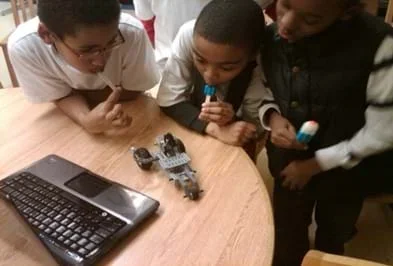 Figure 1. Students test their LEGO vehicle prior to starting the experiments.Copyright 2010 Polytechnic Institute of NYU
 - With students, compare the rubber band to a car's engine. For example, with more gasoline (chemical energy), a regular car goes farther (mechanical energy). Similarly, with a rubber band tightly twisted (elastic potential energy), the LEGO car can go farther (mechanical energy). Given the same amount of gasoline, a real car with better engine efficiency than its counterpart goes farther. Similarly, given the same number of twists, a LEGO car with a good design goes farther than a car with a poor design.
- Direct students to test the effect of changing their cars' designs by changing variables (shape, axle length, car length, wheel placement, etc.). See Figures 2 and 3 for a modified vehicle design. Mention that in life, engineers consider tradeoffs in designing cars. For example, suburban/passenger vans require more supporting material. More material means more weight and, on average, results in slower cars. While testing, suggest that students to use meter sticks or tape measures to evaluate the distance that their modified vehicles travel.
- Tell students to be sure to twist their rubber bands the same amount every time so this becomes a valid measurement of the distance the car travels and an indicator of the car's performance.
- Give students ideas for modifications:
- altered wheel configurations (Figure 2)
- lubrication (talcum powder) coating on the rubber band
- different types of rubber bands (engine)
- additional payload (Figure 3)
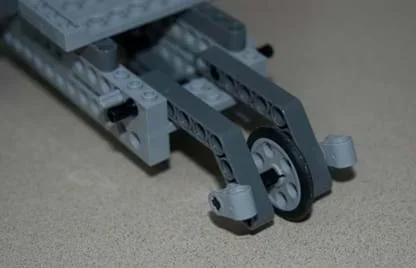 Figure 2. Wheel configuration is one design variable that students may change to test its effect on vehicle performance.Copyright 2010 Polytechnic Institute of NYU
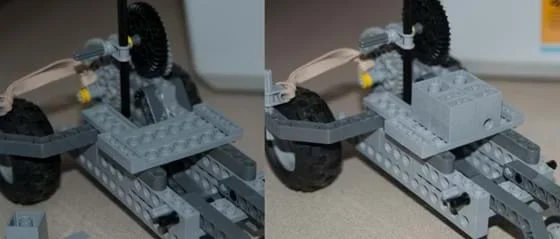 Figure 3. An example of how to alter a vehicle to accommodate payload by the addition of LEGO bricks (right). This is expected to ultimately affect the distance travelled by the car.Copyright 2010 Polytechnic Institute of NYU
- Remind students to consider the potential energy meter that is built into the vehicle when designing experiments. The potential meter indicates that more elastic potential energy exists in the car with more twists in the rubber band, as illustrated in Figure 4. Ideally, carry out each experiment under the same conditions (that is, the same potential energy or same number of rubber band twists). Students can use the meter to ensure that the rubber band is wound approximately the same number of times every time they conduct a test comparing car designs.
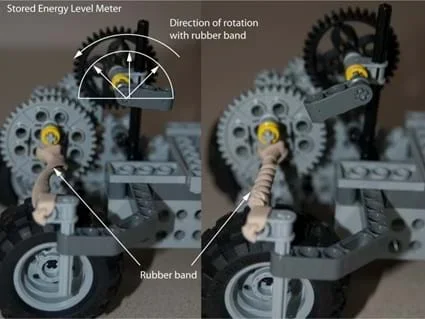 Figure 4. Using the potential energy meter to verify rubber band turns are the same during vehicle redesign tests.Copyright 2010 Polytechnic Institute of NYU
 - Tabulate the results of group test iterations and incorporate the findings from all groups into an "optimized" car to determine if the distance traveled by the vehicle is enhanced. For example, if students are familiar with gear ratios, the distance of the car can be compared against the gear ratio of the car design. Alternatively, students can compare the distance traveled of their car against the weight of the car. Encourage the groups to work with other groups to collectively optimize the vehicles performance based on their collected data.
- As a class, discuss why certain modifications worked and others did not. Pick out keywords from the discussion and write them on the classroom board. Ask students to summarize the key findings from the optimized vehicles into paragraphs. After a few minutes, have a few students read their summary paragraphs to the class.
- thermal energy
- Energy from a heat source.
- electrical energy
- Energy from electricity.
- kinetic energy
- Energy from the motion of an object.
- potential energy
- Stored energy within an object.
Pre-Activity Embedded Assessment
Prediction: Ask students to consider modern cars with respect to variables such as wheel type, lubrication, tires and engine. Ask students how they think changing these variables may improve or hinder a vehicle's performance. Ask them if they can think of other variables that can be changed. Discuss as a class.
Activity Embedded Assessment
Energy Storage Demonstration: Ask students to consider modern cars and what happens when you push the engine too far. Ask students to share their thoughts with the class. Then, in similar fashion, wind the rubber band car up until the point of failure. Ensure that the students witness the structural failures that ensue, reinforcing the point of energy storage limits of certain mechanical designs.
Ask students, what are the effects of altering the number of turns? How do changes in the designs of their cars affect the vehicles' motions? Restate the importance of experimental consistency and how this is established between sequential trials using the on-board potential energy gauge. Scientific experiments need to be repeatable, which is a guiding principle of the scientific method.
Post-Activity Assessment
Modification Keyword Summary: As a class, discuss why certain modifications worked and others did not. Pick out keywords from the discussion and write them on the classroom board. Ask students to summarize the key findings from the optimized vehicles into paragraphs. After a few minutes, have a few students read their summary paragraphs to the class. Compare student observations to gauge their depth of understanding of potential energy.
Graphing: As a class, graph the distance traveled at the different gear ratios for all the groups.
Lightly coating the rubber band in talcum powder helps it not stick to itself upon winding.
Contributors
Carlo Yuvienco; Paul Phamduy
Supporting Program
AMPS GK-12 Program, Polytechnic Institute of New York University
Acknowledgements
This activity was developed by the Applying Mechatronics to Promote Science (AMPS) Program funded by National Science Foundation GK-12 grant no. 0741714. However, these contents do not necessarily represent the policies of the National Science Foundation, and you should not assume endorsement by the federal government.
Copyright
2013 by Regents of the University of Colorado; original © 2010 Polytechnic Institute of New York University