
Determining Concentration
Legacy Curriculum
Hey there! This curriculum is no longer being curated or supported. It may contain materials that are no longer available or outdated information. Please use this document for reference.
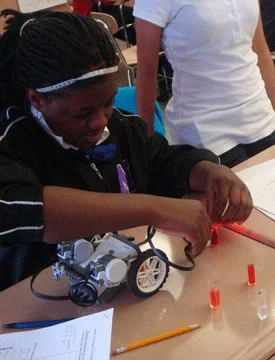 Students use color sensors to measure the percent of light reflected from a solution.Copyright 2013 Jasmin Hume, Polytechnic Institute of NYU
Students quantify the percent of light reflected from solutions containing varying concentrations of red dye using LEGO© MINDSTORMS© EV3 bricks and color sensors. They begin by analyzing a set of standard solutions with known concentrations of food coloring, and plot data to graphically determine the relationship between percent reflected light and dye concentration. Then they identify dye concentrations for two unknown solution samples based on how much light they reflect. Students gain an understanding of light scattering applications and how to determine properties of unknown samples based on a set of standard samples.
Many types of engineers, such as chemical, biomedical and environmental engineers, often need to know information about solution properties (such as concentration) that is difficult to determine from visual observation alone. Regulating the concentration of various chemical compounds, whether soluble or insoluble, is important to chemical engineers working on large-scale production of medicines, food, oil and gas, and virtually every liquid you can think of. In another example, biosensors (designed by biomedical engineers) must be highly sensitive in order to produce accurate measurements of low biomolecule concentrations in biological fluids, such as blood and saliva. The technique of measuring concentration in a liquid using reflected light or light scattering is widespread in engineering industry applications, as it provides quick, convenient and fairly accurate concentration measurements in a process that can be automated with the help of robotics.
After this activity, students should be able to:
- Explain how light reflection can be used to measure the concentration of a solution.
- Draw an approximate linear regression through a given set of data.
- Calculate percent change and percent error.
- Use a set of standard solutions to determine information about the concentration of unknown solutions.
- CCSS.Math.Content.5.G.A.2 Represent real world and mathematical problems by graphing points in the first quadrant of the coordinate plane, and interpret coordinate values of points in the context of the situation.
Grade 5
Do you agree with this alignment? - CCSS.Math.Content.5.OA.A.1 Use parentheses, brackets, or braces in numerical expressions, and evaluate expressions with these symbols.
Grade 5
Do you agree with this alignment? - CCSS.Math.Content.6.NS.B.2 Fluently divide multi-digit numbers using the standard algorithm.
Grade 6
Do you agree with this alignment? - CCSS.Math.Content.6.NS.B.3 Fluently add, subtract, multiply, and divide multi-digit decimals using the standard algorithm for each operation.
Grade 6
Do you agree with this alignment? - CCSS.Math.Content.6.RP.A.3c Find a percent of a quantity as a rate per 100 (e.g., 30% of a quantity means 30/100 times the quantity); solve problems involving finding the whole, given a part and the percent.
Grade 6
Do you agree with this alignment?
- New products and systems can be developed to solve problems or to help do things that could not be done without the help of technology.
Grades 6-8
Do you agree with this alignment?
- 5.G.2 Represent real world and mathematical problems by graphing points in the first quadrant of the coordinate plane, and interpret coordinate values of points in the context of the situation.
Grade 5
Do you agree with this alignment? - 5.OA.1 Use parentheses, brackets, or braces in numerical expressions, and evaluate expressions with these symbols.
Grade 5
Do you agree with this alignment? - 6.NS.2 Fluently divide multi-digit numbers using the standard algorithm.
Grade 6
Do you agree with this alignment? - 6.NS.3 Fluently add, subtract, multiply, and divide multi-digit decimals using the standard algorithm for each operation.
Grade 6
Do you agree with this alignment? - 6.RP.3.c Find a percent of a quantity as a rate per 100 (e.g., 30% of a quantity means 30/100 times the quantity); solve problems involving finding the whole, given a part and the percent.
Grade 6
Do you agree with this alignment?
- MS-PS4-2 Develop and use a model to describe that waves are reflected, absorbed, or transmitted through various materials.
Grades 6-8
Do you agree with this alignment?
- MS-PS4-2 Develop and use a model to describe that waves are reflected, absorbed, or transmitted through various materials.
Grades 6-8
This resource focuses on the following Three Dimensional Learning aspects of NGSS:
Science & Engineering Practices- Develop and use a model to describe phenomena.Do you agree with this alignment?
Disciplinary Core Ideas- A sound wave needs a medium through which it is transmitted.Do you agree with this alignment?
- When light shines on an object, it is reflected, absorbed, or transmitted through the object, depending on the object's material and the frequency (color) of the light.Do you agree with this alignment?
- The path that light travels can be traced as straight lines, except at surfaces between different transparent materials (e.g., air and water, air and glass) where the light path bends.Do you agree with this alignment?
- A wave model of light is useful for explaining brightness, color, and the frequency-dependent bending of light at a surface between media.Do you agree with this alignment?
- However, because light can travel through space, it cannot be a matter wave, like sound or water waves.Do you agree with this alignment?
Crosscutting Concepts- Structures can be designed to serve particular functions by taking into account properties of different materials, and how materials can be shaped and used.Do you agree with this alignment?
Do you agree with this alignment? - Develop and use a model to describe phenomena.
Each group needs:
- LEGO MINDSTORMS Education EV3 Core Set (includes color sensor) available at https://education.lego.com/en-us/products/lego-mindstorms-education-ev3-core-set/5003400#lego-mindstorms-education-ev3. If not enough LEGO bricks and sensors are available for each group, conduct the data gathering portion of the activity as a class demonstration, sharing the reflected light data with the class, so students can complete the rest of the activity
- 9 plastic cuvettes, labeled A-G and 1-2, a pack of 100 available at https://www.universalmedicalinc.com/brandtech-brand-polystyrene-spectrophotometry-cuvettes.html?
- ruler
- Pre-Activity Assessment (PDF), one per student.
- Determining Concentration Worksheet (PDF), one per student
- Post- Activity Assessment (PDF), one per student
To share with the entire class:
- red liquid food coloring
- water
- 9 containers, to hold 20 ml of liquid each
- masking tape/pen or wax pencil, to label 9 containers
Note: This activity can also be conducted with the older (and no longer sold) LEGO MINDSTORMS NXT set instead of EV3; see below for those supplies:
- LEGO MINDSTORMS Education NXT Base Set (includes light sensor)
- Pre-Activity Assessment (docx)
- Pre-Activity Assessment (pdf)
- Pre-Activity Assessment Answers (doxc)
- Pre-Activity Assessment Answers (pdf)
- Post-Activity Assessment (docx)
- Post-Activity Assessment (pdf)
- Post-Activity Assessment Answers (docx)
- Post-Activity Assessment Answers (pdf)
- Determining Concentration Worksheet (docx)
- Determining Concentration Worksheet (pdf)
- Determining Concentration Worksheet Answers (docx)
- Determining Concentration Worksheet Answers (pdf)
Ability to calculate the percent difference between two numbers, and plot data on Cartesian graphs.
Have you ever made Kool-Aid or another flavored drink mix powder, such as lemonade or a sports drink? If so, you already know that you can change the strength or concentration of a solution (your drink) by adding more or less water. If you want a strong Kool-Aid drink (one that has deep color and flavor) you dissolve a lot of the powder in your glass of water, right? What about if you're in the mood for a drink that is more watered-down with just a hint of Kool-Aid sweetness? Well, then you only add a small amount of the powder to your glass of water. So in making a Kool-Aid drink to your liking, you are actually adjusting concentration, with more powder (per volume liquid) making the drink more concentrated, and less powder (per volume liquid) making the drink less concentrated. The opposite of concentrating is diluting, or in this example, adding more water.
Can you think of two ways you can approximate the concentration of a Kool-Aid drink? (Answers: Tasting it and making observations about the color. The more concentrated the drink, the more intense the flavor and the darker the color.)
Scientists and engineers have another accurate and straightforward way to study concentration using light—something you will get to experience today! In this activity you will study the concentration of red dye in different solution samples based on how much light they reflect. In order to do this, we will use liquid solutions that are transparent, or allow light to pass through them. The more light that a solution is able to reflect, the more concentrated it is! We'll evaluate a set of standard solutions with known concentrations of red dye and put your math and science skills to work in order to determine the dye concentrations for two unknown solutions.
Background
When light is shone on a solution, any particles or small molecules in the sample disrupt the light's originally straight path of travel. As a result, the light "scatters," meaning it bounces off the particles and travels in all directions. The higher the concentration of particles in a sample, the more light scatters.
Before the Activity
- Gather materials and make copies of the Pre-Activity Assessment (PDF), Determining Concentration Worksheet (PDF), Post-Activity Assessment (PDF), one each per student.
- Prepare seven standard solutions (see A-G below) and two solutions for "unknown" samples (see 1 and 2 below). Begin by pouring 20 ml of water into each of the nine containers. Label the containers (A-G and 1-2) and prepare each of the solutions as follows:
A. Add 50 drops red food coloring to 20 ml water
B. Add 30 drops red food coloring to 20 ml water
C. Add 20 drops red food coloring to 20 ml water
D. Add 10 drops red food coloring to 20 ml water
E. Add 5 drops red food coloring to 20 ml water
F. Add 1 drop red food coloring to 20 ml water
G. 20 ml water
1. Add 15 drops red food coloring to 20 ml water
2. Add 40 drops red food coloring to 20 ml water
- Organize 9 cuvettes for each student group. Add approximately 2 ml of each solution to the cuvettes. Each group of students should have a complete set of solutions (A-G and 1-2), one solution in each cuvette (see Figure 1).
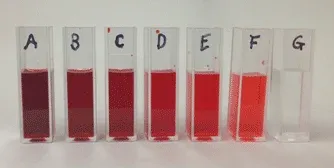 Figure 1. Standard solutions made of varying amounts of red food coloring and water.Copyright 2013 Jasmin Hume, Polytechnic Institute of NYU
 - Prepare for each group one EV3 brick, equipped with a color sensor and a cable to connect the sensor to the brick.
With the Students
- Administer the pre-activity assessment.
- Present the Introduction/Motivation information to students.
- Divide the class into groups of four students each.
- Distribute to each group one EV3 brick with the color sensor and cable, a set of 9 solutions and worksheets (one per student).
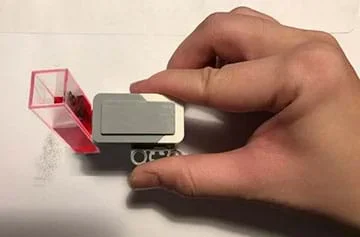 Figure 2. To measure reflected light of a solution, position the color sensor on a flat surface directly in front of the solution sample, with the clear side of the cuvette facing the color sensor.Copyright 2017 University of Colorado BoulderExplain and demonstrate the correct set-up for taking "Reflected Light (%)" measurements (the values that students need to record as data in their worksheet tables). Have students position their color sensors and cuvettes on a desk or table (see Figure 2), making sure that nothing is behind the cuvettes (including their hands). If students want to hold the cuvettes while taking the measurements, they may do so by pinching them at the top, so as to prevent any interference from their hands. Remind students that:
- It is important to perform the measurements for all solution samples in exactly the same manner to reduce experimental error.
- If student hands are behind or beside the cuvettes when measurements are taken, the light may reflect off their hands and give inaccurate light value readings.
- Avoid taking measurements in direct sunlight, since ambient light will affect the values.
- Guide students through the following steps to operate their EV3 bricks:
- Turn on the EV3 brick by pressing the center button. After you press the button, the Brick Status Light should turn red and the Starting screen should display. When the light changes to green, your EV3 Brick is ready.
- Press the right brick button twice to get to the "Brick App" tab. You will see the first app named "Port View" which is highlighted by default. Press the center button to enter the port view.
- Press the right brick button twice to see the Port 3 value which should display "3: COL-REFLECT" and then a percentage value. Thus the amount of reflected light (expressed in percent) appears on the EV3 display screen.
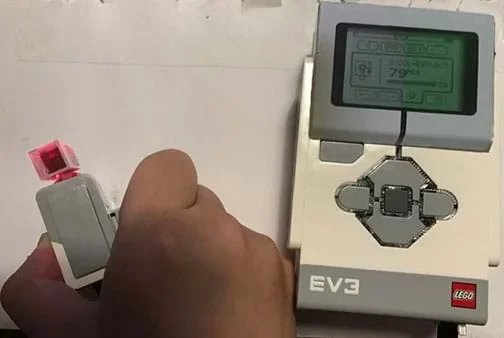 Figure 3. The reflectance value appears on the display panel of the LEGO EV3 brick.Copyright 2017 University of Colorado Boulder
- Direct students to record in the worksheet table the reflected light value that is displayed when the sensor is held up against each solution sample, as shown in Figure 3.
- Give students time to measure and record reflected light values for all standard solutions and both unknown solutions.
- After students have collected and recorded data for all samples, direct them to plot their data points on the grid provided on their worksheets. Put reflected light values on the y-axis, and concentration on the x-axis.
- Have students use a ruler to draw a straight line through as many of the plotted points for the standard solutions as they can. Explain that in order to draw a line that best fits the data, they should look at all data points and line up the ruler such that some of the points fall above the line, and some below. Then draw a single line that that passes through the middle of the points.
- Next, guide students through determining the concentration values for the unknown solutions by using the line plotted for the standard solutions. Direct students to:
- Locate the reflected light value for Unknown 1 on the y-axis.
- Match the value on the y-axis to its position on the standard solutions line, and record the corresponding concentration.
- Repeat for Unknown 2 and record both concentration values in the worksheet table.
- Give students time to complete the following on their worksheets:
- Determine the percent change (using the equation provided) between the reflected light value of Standard A and Standard D.
- Determine the percent change (using the equation provided) between the concentration of Standard A and Standard D.
- Compare the two calculated percent change values they calculated and make observations about the values.
- Write the actual concentrations for Unknown 1 and Unknown 2 on the board. The actual concentration for Unknown 1 is 15 drops/cuvette, and the actual concentration for Unknown 2 is 40 drops/cuvette.
- Instruct students to calculate the percent error for the unknown solution concentrations they determined using the equation provided.
- Assign any worksheet questions not completed during the class period as homework.
- Administer the post-activity assessment.
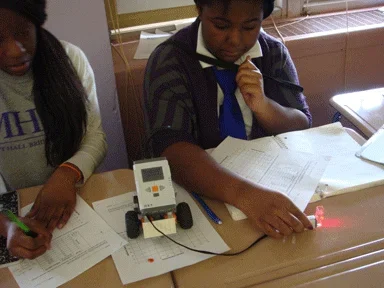 Concentrations of unknown solutions are determined by plotting reflectance values for standard solutions. Students collect, plot, and analyze the data using robots and color sensors.Copyright 2013 Jasmin Hume, Polytechnic Institute of NYU
- concentration
- The amount of a component in a given area or volume.
- dilute
- To reduce concentration by adding more liquid.
- incident light
- Direct light that falls on a surface or a substance.
- insoluble
- Incapable of being fully dissolved into a liquid.
- media
- A liquid solution.
- reflected light
- Incident light that bounces off a substance in the direction from which it came.
- scatter light
- When incident light bounces off a substance in many different directions.
- soluble
- Capable of being dissolved into a liquid.
- standard
- Something set up and established as a rule for the measure of quantity, weight, extent, value or quality.
- transmit light
- When incident light travels through a substance.
- unknown
- Something that requires discovery, identification or clarification.
Pre-Activity Assessment
Pre-Assessment: Before starting the activity, administer the five-question Pre-Activity Assessment (PDF) to introduce the topic and gauge students' baseline knowledge of the subject matter.
Activity Embedded Assessment
Worksheet: Direct students to complete the Determining Concentration Worksheet (PDF) as they conduct the activity, collect and plot data, make calculations, and answer questions. Have students complete their own worksheets, but encourage them to collaborate with their group members. Remind student groups not to share answers with one another.
Post-Activity Assessment
Post-Assessment: At activity end, administer the Post-Activity Assessment (PDF). Review student answers to gauge their concluding comprehension of the subject matter.
Remind students that the cuvettes have no lids, and they should be careful not to spill their solutions.
- For lower grades, eliminate the data plotting and simply have students record the values in the table.
- For upper grades, have students use Microsoft Excel to plot their data and perform regression analyses on the set of standard solutions. Have students determine the equation for the standard solutions curve and use it to generate the concentrations of the unknown solutions. Also have students estimate percent reflected light for the unknown solutions using the known concentration values, as well as calculate percent error.
Contributors
Jasmin Hume
Supporting Program
AMPS GK-12 Program, Polytechnic Institute of New York University
Acknowledgements
This activity was developed by the Applying Mechatronics to Promote Science (AMPS) Program funded by National Science Foundation GK-12 grant no. 0741714. However, these contents do not necessarily represent the policies of the NSF, and you should not assume endorsement by the federal government.
Copyright
2013 by Regents of the University of Colorado; original © 2013 Polytechnic Institute of New York University