
Deformation: Nanocomposite Compression
Legacy Curriculum
Hey there! This curriculum is no longer being curated or supported. It may contain materials that are no longer available or outdated information. Please use this document for reference.
 Teamwork in action.Copyright 2010 Jennifer S. Haghpanah, Polytechnic Institute of NYU
Students learn about nanocomposites, compression and strain as they design and program robots that compress materials. Student groups conduct experiments to determine how many LEGO® MINDSTORMS® motor rotations it takes to compress soft nanocomposites, including mini marshmallows, Play-Doh®, bread and foam. They measure the length and width of their nanocomposite objects before and after compression to determine the change in length and width as a function of motor rotation.
Many types of engineers design and build robots to complete tasks. For example, some biomedical and computer science engineers design robots that perform surgery on patients or measure patients' vital signs. Some biomedical and chemical engineers design material-based robots that combine multiple components to generate composites with various functions—such as drug delivery, tissue engineering and scaffold design—that are responsive to stimulations in an environment. Electrical and mechanical engineers often work together to design smart items—trashcans, coffee makers, slow cookers and microwaves--that simplify everyday tasks.
After this activity, students should be able to:
- Design and build a LEGO robot capable of compressing an object.
- Program a robot with LEGO software.
- Open up the MINDSTORMS data logging program with the rotation sensor and find out how many motor rotations it takes to compress a given object.
- Calculate the ratio of strain on an object using Equation 1, where L is the length of the object being deformed and Lchange is the change in length of the deformed object.
Equation 1: strain = (Lchange)/ L
- CCSS.Math.Content.4.NBT.B.4 Fluently add and subtract multi-digit whole numbers using the standard algorithm.
Grade 4
Do you agree with this alignment? - CCSS.Math.Content.5.G.A.2 Represent real world and mathematical problems by graphing points in the first quadrant of the coordinate plane, and interpret coordinate values of points in the context of the situation.
Grade 5
Do you agree with this alignment? - CCSS.Math.Content.5.NBT.B Perform operations with multi-digit whole numbers and with decimals to hundredths.
Grade 5
Do you agree with this alignment? - CCSS.Math.Content.5.NBT.B.6 Find whole-number quotients of whole numbers with up to four-digit dividends and two-digit divisors, using strategies based on place value, the properties of operations, and/or the relationship between multiplication and division. Illustrate and explain the calculation by using equations, rectangular arrays, and/or area models.
Grade 5
Do you agree with this alignment? - CCSS.Math.Content.6.NS.B.3 Fluently add, subtract, multiply, and divide multi-digit decimals using the standard algorithm for each operation.
Grade 6
Do you agree with this alignment?
- Requirements for design are made up of criteria and constraints.
Grades 6-8
Do you agree with this alignment? - STEL-4N Analyze examples of technologies that have changed the way people think, interact, and communicate.
Grades 6-8
Do you agree with this alignment? - STEL-7S Create solutions to problems by identifying and applying human factors in design.
Grades 6-8
Do you agree with this alignment?
- 5.G.2 Represent real world and mathematical problems by graphing points in the first quadrant of the coordinate plane, and interpret coordinate values of points in the context of the situation.
Grade 5
Do you agree with this alignment? - 5.NBT.6 Find whole-number quotients of whole numbers with up to four-digit dividends and two-digit divisors, using strategies based on place value, the properties of operations, and/or the relationship between multiplication and division. Illustrate and explain the calculation by using equations, rectangular arrays, and/or area models.
Grade 5
Do you agree with this alignment? - 6.NS.2 Fluently divide multi-digit numbers using the standard algorithm.
Grade 6
Do you agree with this alignment? - 6.NS.3 Fluently add, subtract, multiply, and divide multi-digit decimals using the standard algorithm for each operation.
Grade 6
Do you agree with this alignment? - Perform operations with multi-digit whole numbers and with decimals to hundredths.
Grade 5
Do you agree with this alignment?
- 3-5-ETS1-1 Define a simple design problem reflecting a need or a want that includes specified criteria for success and constraints on materials, time, or cost.
Grades 3-5
Do you agree with this alignment? - 3-5-ETS1-3 Plan and carry out fair tests in which variables are controlled and failure points are considered to identify aspects of a model or prototype that can be improved.
Grades 3-5
Do you agree with this alignment?
- 3-5-ETS1-1 Define a simple design problem reflecting a need or a want that includes specified criteria for success and constraints on materials, time, or cost.
Grades 3-5
This resource focuses on the following Three Dimensional Learning aspects of NGSS:
Science & Engineering Practices- Define a simple design problem that can be solved through the development of an object, tool, process, or system and includes several criteria for success and constraints on materials, time, or cost.Do you agree with this alignment?
Disciplinary Core Ideas- Possible solutions to a problem are limited by available materials and resources (constraints). The success of a designed solution is determined by considering the desired features of a solution (criteria). Different proposals for solutions can be compared on the basis of how well each one meets the specified criteria for success or how well each takes the constraints into account.Do you agree with this alignment?
Crosscutting Concepts- People's needs and wants change over time, as do their demands for new and improved technologies.Do you agree with this alignment?
Do you agree with this alignment? - Define a simple design problem that can be solved through the development of an object, tool, process, or system and includes several criteria for success and constraints on materials, time, or cost.
- 3-5-ETS1-3 Plan and carry out fair tests in which variables are controlled and failure points are considered to identify aspects of a model or prototype that can be improved.
Grades 3-5
This resource focuses on the following Three Dimensional Learning aspects of NGSS:
Science & Engineering Practices- Plan and conduct an investigation collaboratively to produce data to serve as the basis for evidence, using fair tests in which variables are controlled and the number of trials considered.Do you agree with this alignment?
Disciplinary Core Ideas- Tests are often designed to identify failure points or difficulties, which suggest the elements of the design that need to be improved.Do you agree with this alignment?
- Different solutions need to be tested in order to determine which of them best solves the problem, given the criteria and the constraints.Do you agree with this alignment?
Do you agree with this alignment? - Plan and conduct an investigation collaboratively to produce data to serve as the basis for evidence, using fair tests in which variables are controlled and the number of trials considered.
Each group needs:
- LEGO MINDSTORMS NXT robot, such as the NXT Base Set (5003402) for $159.98 at https://shop.education.lego.com/legoed/en-US/catalog/product.jsp?productId=5003402& isSimpleSearch=false&ProductLine=NXT
- LEGO MINDSTORMS Education NXT Software 2.1, available as a single license (2000080) for $39.97 or a site license (5003413) for $271.96 at https://shop.education.lego.com/legoed/en-US/catalog/product.jsp?productId=prod120017&isSimpleSearch=false&ProductLine=LEGO+MINDSTORMS+Education+NXT
- computer, loaded with NXT 2.1 software
- LEGO MINDSTORMS NXT Intelligent brick (in addition to the one provided in the kit above), part # 9841, available for $169.99 at http://shop.lego.com/en-US/NXT-Intelligent-Brick-9841?CMP=AFC-BP6648365778&HQS=9841
- calculator
- ruler
- mini marshmallow
- piece of Play-Doh (about the same size as a mini marshmallow)
- piece of foam (such as Styrofoam, about the same size as a mini marshmallow)
- piece of bread (about the same size as a mini marshmallow)
- Deformation: Foam Compression Worksheet (PDF), one per student
Students should be familiar with multiplication, division, and the basic concept of a function.
Take a look around and notice that you are continually surrounded by materials of different sizes and shapes. Some materials can take on different shapes or forms when they are dropped on the floor, stepped on or compressed! The term compression is often used to describe the decrease in volume of an object.
Today we're going to talk about and experience compressing a specific material type called nanocomposites. Nanocomposite is a big word, but you are already familiar with (and have probably compressed) the soft, human-made nanocomposites that we will use in the activity: marshmallow, Play-Doh, bread and foam.
A nanocomposite is simply the result of multiple materials combined together to make a nano-sized material. Some of the most fascinating materials found in nature—arthropods exoskeletons, mollusks, marine worm teeth and human bone—are nanocomposites that engineers are inspired to recreate using synthetic materials.
Why would engineers bother to make nanocomposites? Well, because they have some kind of desirable quality—perhaps cosmetic, structural or functional—that makes them useful or wanted in some way, just like the fun, squishy texture of a marshmallow or Play-Doh!
In today's activity, you will design, build, and program LEGO NXT robots to compress the soft nanocomposites I just mentioned: marshmallows, Play-Doh, bread and foam. Then, you will get to determine the amount of compression you applied to each material by using a rotation sensor with the MINDSTORMS data logging program.
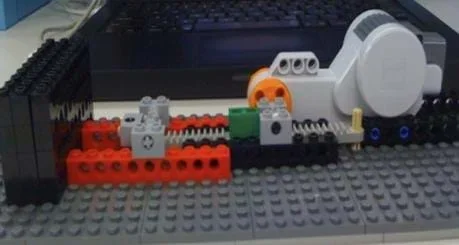 The LEGO compressor system.Copyright 2011 Jennifer S. Haghpanah, Polytechnic Institute of NYU
Background
Materials chemists and engineers are continually learning more about material properties, such as how much stress a material can undergo before changing its shape. Stress is simply defined as the amount of force applied to a material over a certain area. Strain is the amount that a material expands after a stress is applied to a material. In this activity, students determine the amount of strain on test materials by measuring their change in length following compression (see Equation 1).
Before the Activity
- Gather materials.
- Make copies of the Deformation: Foam Compression Worksheet (PDF).
- Consider building an example robot in advance, using the LEGO Digital Designer (LDD) Compressor Robot Instructions (LXF).
With the Students
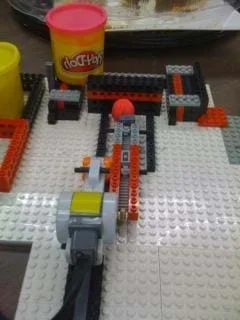 Example compressor system in action.Copyright 2011 Jennifer S. Haghpanah, Polytechnic Institute of NYU
- Distribute the worksheets.
- Teach students the vocabulary words and have them fill out the "pre-activity" section of the worksheets (defining stress and strain).
- Explain the activity: Each group is responsible for designing and building a robot capable of compressing a mini marshmallow, as well as similarly-sized pieces of Play-Doh, bread and foam.
- Give students time to fill out the "hypothesis," "materials" and "procedure" worksheet sections.
- Divide the class into groups of four students each. Assign roles to the group members of each team:
- Robot Worker - makes changes to the robot
- Program Worker - programs the robot and uses the data logging program to record the number of motor rotations for each compression
- Measurer - measures changes in length of the object before and after compression
- Calculator - calculates the strain on each object
- Remind students of the activity objective (to design and build a robot that can compress the test material samples). If available, show them an example robot. Depending on time constraints and/or student ability, either encourage students to design their robots through trial and error or give them ideas from the pictures included in this activity.
- Direct students to program their robots using the LEGO Digital Designer (LDD) Compressor Robot Instructions (LXF).
- Remind students to plug their cables into motor A, located on the NXT brick. The LEGO MINDSTORMS program should look like Figure 1. Explain that they can program the motors to move more quickly or slowly and can specify the amount of time it runs by clicking on "motor" in the LEGO MINDSTORMS NXT application.
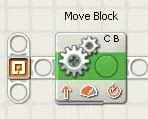 Figure 1. Program image for the activity's compression robot.
 - Before moving on, require each group to demonstrate that its robot is capable of compressing an object.
- Go over the MINDSTORMS data logging program with students and show them how the rotation sensor works. (For help with the data logging program, see this YouTube video). Show students how to open the program, choose motor A, and select the rotation sensor to see how much the motor rotates.
- Have student groups guess how many motor rotations it will take their robots to compress each of the four test materials.
- As an example, demonstrate compression of the test materials for the class using one group's robot or the example robot built in advance. Ask students to make predictions and observations about the number of motor rotations it takes to compress a chosen demo object. Show them how to use a ruler to measure the length and change in length of the object. Go over Equation 1 and teach them how to calculate strain using the example measurements. Demonstrate how to find out how many times the motor rotated by selecting the rotation sensor in the MINDSTORMS data logging program. Ask students how their predictions compared with the actual motor rotations.
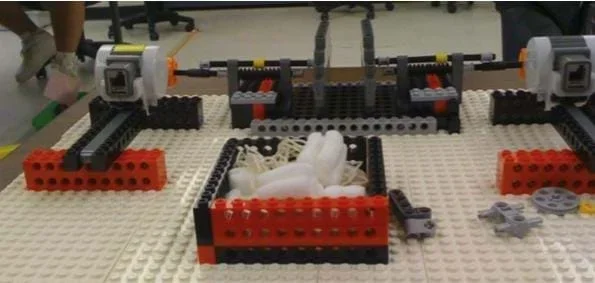 An example robotic compressor designed by a student group.Copyright 2011 Jennifer S. Haghpanah, Polytechnic Institute of NYU
 - Tell students they are now responsible for repeating the same procedure for their four test materials, as well as filling out the "data" worksheet section. Give groups time to gather data. Circulate the classroom to answer questions as they work.
- Have students reflect on their findings and fill out the "results/conclusion" worksheet section.
- Facilitate a class discussion to compare group findings and discuss what students learned from the activity.
- Conclude by administering the post-activity assessment described in the Assessment section.
- compression
- A system of forces that decrease the volume of an object.
- deformation
- When an object gets changed due to an internal or external force.
- force
- A push or pull exerted on an object.
- length
- The measure of how long something is from one end to another.
- nanocomposite
- A solid material less than 100 nm in size with multiple phases and dimensions.
- nanometer
- (nm) A nanometer is a unit of length that is 1 billionth of a meter. Nanocomposite materials are measured in nanometers.
- rotation sensor
- A LEGO MINDSTORMS NXT device that can measure rotation of an axle (16 positions per rotation).
- strain
- The change in dimensions of an object when influenced by an external force.
- stress
- The amount of force exerted on a specified area.
Pre-Activity Assessment
Guessing Game: Ask students to predict which of the provided materials will require the most rotations to compress.
Activity Embedded Assessment
Data, Results and Conclusions: Have students complete the Deformation: Foam Compression Worksheet (PDF) with their observations, measurements and calculations. Review their answers to assess their understanding.
Post-Activity Assessment
Tuning the Equation: Challenge students by asking them to relate the strain of an object to the stress on an object. See if they can make an equation that relates stress to strain. (Answer: Young's modulus measures the stiffness of a material by looking at how much the material stretches under a given amount of stress. Young's modulus states that stress is proportional to strain in the equation below (Equation 2).
Equation 2: E (Young's modulus) = σ (stress) / є (strain)
- Be careful not to touch the gears while the compressor and MINDSTORMS program are running.
Hewitt, Paul G. Conceptual Physics. Saddle River, NJ: Prentice Hall, 2002.
Zitzewitz, Paul. Physics Principles and Problems. Columbus, OH: McGraw-Hill, 2002.
Contributors
Jennifer S. Haghpanah
Supporting Program
AMPS GK-12 Program, Polytechnic Institute of New York University
Acknowledgements
Ackn sb: This activity was developed by the Applying Mechatronics to Promote Science (AMPS) Program funded by National Science Foundation GK-12 grant no. 0741714. However, these contents do not necessarily represent the policies of the NSF, and you should not assume endorsement by the federal government.
Copyright
2013 by Regents of the University of Colorado; original © 2010 Polytechnic Institute of New York University