
Ding! Going Up? Elevators and Engineering
Legacy Curriculum
Hey there! This curriculum is no longer being curated or supported. It may contain materials that are no longer available or outdated information. Please use this document for reference.
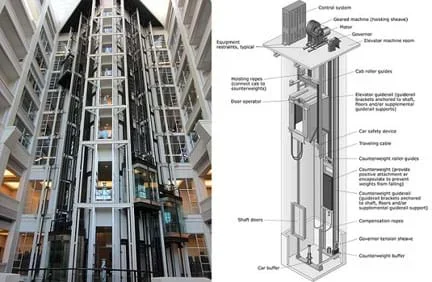 An example elevator in Portland, OR (left). A diagram of an elevator and its components (right).Copyright 2012 Another Believer, Wikimedia Commons (left), Federal Emergency Management Agency (right) http://commons.wikimedia.org/wiki/File:Montgomery_Park,_Portland,_OR_2012_-_elevators.JPG http://www.fema.gov/earthquake/fema-e-74-reducing-risks-nonstructural-earthquake-damage-34
Students create model elevator carriages and calibrate them, similar to the work of design and quality control engineers. Students use measurements from rotary encoders to recreate the task of calibrating elevators for a high-rise building. They translate the rotations from an encoder to correspond to the heights of different floors in a hypothetical multi-story building. Students also determine the accuracy of their model elevators in getting passengers to their correct destinations.
Engineers who design convenient transportation equipment for daily use by thousands of people must also ensure the public's safety. The widespread use of escalators, moving walkways and elevators in buildings, airports and skyscrapers has created the demand for machines that operate effectively, accurately and dependably under high-traffic flow. Engineers devise many control theories and devices to guarantee people get to their destinations safely and timely.
After this activity, students should be able to:
- Identify the control device used in elevators, escalators and moving walkways.
- Explain how engineers use these control devices to guarantee that people arrive safely at their destinations.
- Define and explain calibration, control devices and rotary encoders.
- CCSS.Math.Content.HSA-REI.B Solve equations and inequalities in one variable
Grades 9-12
Do you agree with this alignment? - CCSS.Math.Content.HSA-REI.B.3 Solve linear equations and inequalities in one variable, including equations with coefficients represented by letters.
Grades 9-12
Do you agree with this alignment? - CCSS.Math.Content.HSA-REI.D.10 Understand that the graph of an equation in two variables is the set of all its solutions plotted in the coordinate plane, often forming a curve (which could be a line).
Grades 9-12
Do you agree with this alignment? - CCSS.Math.Content.HSG-GMD.B Visualize relationships between two-dimensional and three-dimensional objects
Grades 9-12
Do you agree with this alignment? - CCSS.Math.Content.HSS-ID.A Summarize, represent, and interpret data on a single count or measurement variable
Grades 9-12
Do you agree with this alignment? - CCSS.Math.Content.HSS-ID.B.6 Represent data on two quantitative variables on a scatter plot, and describe how the variables are related.
Grades 9-12
Do you agree with this alignment? - CCSS.Math.Practice.MP1 Make sense of problems and persevere in solving them.
Grades K-12
Do you agree with this alignment? - CCSS.Math.Practice.MP2 Reason abstractly and quantitatively.
Grades K-12
Do you agree with this alignment? - CCSS.Math.Practice.MP4 Model with mathematics.
Grades K-12
Do you agree with this alignment?
- Students will develop an understanding of the attributes of design.
Grades K-12
Do you agree with this alignment? - Students will develop an understanding of engineering design.
Grades K-12
Do you agree with this alignment? - Students will develop abilities to assess the impact of products and systems.
Grades K-12
Do you agree with this alignment? - Students will develop an understanding of the characteristics and scope of technology.
Grades K-12
Do you agree with this alignment? - Students will develop an understanding of the relationships among technologies and the connections between technology and other fields of study.
Grades K-12
Do you agree with this alignment? - STEL-7AA Illustrate principles, elements, and factors of design.
Grades 9-12
Do you agree with this alignment?
- A.REI.10 Understand that the graph of an equation in two variables is the set of all its solutions plotted in the coordinate plane, often forming a curve (which could be a line).
Grades 9-12
Do you agree with this alignment? - A.REI.3 Solve linear equations and inequalities in one variable, including equations with coefficients represented by letters.
Grades 9-12
Do you agree with this alignment? - MP.1 Make sense of problems and persevere in solving them.
Grades -1-12
Do you agree with this alignment? - MP.2 Reason abstractly and quantitatively.
Grades -1-12
Do you agree with this alignment? - MP.4 Model with mathematics.
Grades -1-12
Do you agree with this alignment? - S.ID.6 Represent data on two quantitative variables on a scatter plot, and describe how the variables are related.
Grades 9-12
Do you agree with this alignment? - Solve equations and inequalities in one variable
Grades 9-12
Do you agree with this alignment? - Visualize relationships between two-dimensional and three-dimensional objects
Grades 9-12
Do you agree with this alignment? - Summarize, represent, and interpret data on a single count or measurement variable
Grades 9-12
Do you agree with this alignment?
- HS-ETS1-2 Design a solution to a complex real-world problem by breaking it down into smaller, more manageable problems that can be solved through engineering.
Grades 9-12
Do you agree with this alignment? - HS-ETS1-3 Evaluate a solution to a complex real-world problem based on prioritized criteria and trade-offs that account for a range of constraints, including cost, safety, reliability, and aesthetics, as well as possible social, cultural, and environmental impacts.
Grades 9-12
Do you agree with this alignment? - HS-ETS1-4 Use a computer simulation to model the impact of proposed solutions to a complex real-world problem with numerous criteria and constraints on interactions within and between systems relevant to the problem.
Grades 9-12
Do you agree with this alignment?
- HS-ETS1-2 Design a solution to a complex real-world problem by breaking it down into smaller, more manageable problems that can be solved through engineering.
Grades 9-12
This resource focuses on the following Three Dimensional Learning aspects of NGSS:
Science & Engineering Practices- Design a solution to a complex real-world problem, based on scientific knowledge, student-generated sources of evidence, prioritized criteria, and tradeoff considerations.Do you agree with this alignment?
Disciplinary Core Ideas- Criteria may need to be broken down into simpler ones that can be approached systematically, and decisions about the priority of certain criteria over others (trade-offs) may be needed.Do you agree with this alignment?
Do you agree with this alignment? - Design a solution to a complex real-world problem, based on scientific knowledge, student-generated sources of evidence, prioritized criteria, and tradeoff considerations.
- HS-ETS1-3 Evaluate a solution to a complex real-world problem based on prioritized criteria and trade-offs that account for a range of constraints, including cost, safety, reliability, and aesthetics, as well as possible social, cultural, and environmental impacts.
Grades 9-12
This resource focuses on the following Three Dimensional Learning aspects of NGSS:
Science & Engineering Practices- Evaluate a solution to a complex real-world problem, based on scientific knowledge, student-generated sources of evidence, prioritized criteria, and tradeoff considerations.Do you agree with this alignment?
Disciplinary Core Ideas- When evaluating solutions it is important to take into account a range of constraints including cost, safety, reliability and aesthetics and to consider social, cultural and environmental impacts.Do you agree with this alignment?
Crosscutting Concepts- New technologies can have deep impacts on society and the environment, including some that were not anticipated. Analysis of costs and benefits is a critical aspect of decisions about technology.Do you agree with this alignment?
Do you agree with this alignment? - Evaluate a solution to a complex real-world problem, based on scientific knowledge, student-generated sources of evidence, prioritized criteria, and tradeoff considerations.
- HS-ETS1-4 Use a computer simulation to model the impact of proposed solutions to a complex real-world problem with numerous criteria and constraints on interactions within and between systems relevant to the problem.
Grades 9-12
This resource focuses on the following Three Dimensional Learning aspects of NGSS:
Science & Engineering Practices- Use mathematical models and/or computer simulations to predict the effects of a design solution on systems and/or the interactions between systems.Do you agree with this alignment?
Disciplinary Core Ideas- Both physical models and computers can be used in various ways to aid in the engineering design process. Computers are useful for a variety of purposes, such as running simulations to test different ways of solving a problem or to see which one is most efficient or economical; and in making a persuasive presentation to a client about how a given design will meet his or her needs.Do you agree with this alignment?
Crosscutting Concepts- Models (e.g., physical, mathematical, computer models) can be used to simulate systems and interactions—including energy, matter, and information flows—within and between systems at different scales.Do you agree with this alignment?
Do you agree with this alignment? - Use mathematical models and/or computer simulations to predict the effects of a design solution on systems and/or the interactions between systems.
 Elevator test passengers: Jefferson, Lincoln, Roosevelt and Washington.Copyright 2013 Denise W. Carlson, College of Engineering, University of Colorado Boulder
Each group needs:
- LEGO MINDSTORMS EV3 robot, such as EV3 Core Set (5003400) at https://education.lego.com/en-us/products/lego-mindstorms-education-ev3-core-set/5003400#lego-mindstorms-education-ev3 (includes programmable EV3 intelligent brick; 3 2 interactive servo motors; sound, color, ultrasonic and 2 touch sensors; and many other components and instructions)
- calculator
- measuring tape
- paper
- masking tape
- 41 cents as "passengers" to act as weights, these specific coins: nickel, penny, dime and quarter
- Elevator Building Guide (PDF)
- Data Collection Worksheet (PDF), one per student
- Elevator Rubric (PDF)
Note: This activity can also be conducted with the older (and no longer sold) LEGO MINDSTORMS NXT set instead of EV3; see below for those supplies:
- LEGO MINDSTORMS NXT robot, such as the NXT Base Set
To share with the entire class:
- scissors
- spool of string
- computer with internet access and USB cable
- ruler
- masking tape
- Floor Ruler (PDF) (or a tape measure that can be positioned and marked)
- Floor Ruler Building Guide (PDF)
- Elevator RobotC Programming Guide (PDF)
- Data Collection Worksheet (docx)
- Data Collection Worksheet (pdf)
- Data Collection Worksheet Answer Key (docx)
- Data Collection Worksheet Answer Key (pdf)
- Floor Ruler (docx)
- Floor Ruler (pdf)
- Floor Ruler Building Guide (docx)
- Floor Ruler Building Guide (pdf)
- Elevator Building Guide (docx)
- Elevator Building Guide (pdf)
- Elevator RobotC Programming Guide (docx)
- Elevator RobotC Programming Guide (pdf)
- elevator.c (NXT version)
- Elevator Rubric (docx)
- Elevator Rubric (pdf)
Familiarity with the following terms: circumference, diameter, angle, degree, unit conversion, graphing experimental data points and linear vs. non-linear equations. Knowledge of rotary encoders, as presented in the Rotary Encoders and Human Computer Interactions activity.
You have just been hired as an engineering contractor to help build public transport equipment for your city's highest skyscraper! You will build an elevator and, with your knowledge of rotary encoders, make sure that it safely and effectively delivers the public to their destinations in the skyscraper.
To complete the job successfully, your elevator must meet the following criteria and constraints:
- The elevator box must be designed to safely carry a few passengers, namely, Washington, Roosevelt, Jefferson and Lincoln (show students the 41 cents in coins: quarter, dime, nickel and penny).
- The elevator box must be securely attached to the elevator cable. Safety is paramount.
- The cable must be connected to a servo motor.
- The elevator must be able to travel up to at least five different floors. Each floor is six inches high.
- Each floor must be calibrated using the rotary encoder.
- When in use with the servo motor, the accuracy of the top floor height must be within 5% of the total building height.
- The passengers' safety will be verified when they reach the top of the building.
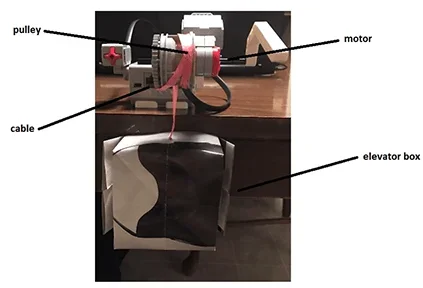 Example LEGO MINDSTORMS EV3 elevator model.Copyright 2017 University of Colorado Boulder
Time Note
Plan on the following segments of time for the 55-minute activity:
- 10 minutes to learn about the application of rotary encoder in elevators.
- 15 minutes to build the elevator with LEGO parts.
- 20 minutes to predict and collect data on the elevator "floors."
- 10 minutes to perform calculations and graph measurements.
Before the Activity
- Gather all materials and LEGO EV3 kits.
- Prepare a floor ruler using the Floor Ruler (PDF) and Floor Ruler Building Guide (PDF), or a measuring tape (marked so that each floor is precisely six inches high).
- Make copies of the Data Collection Worksheet (PDF), Elevator Building Guide (PDF) and Elevator Rubric (PDF).
- Prepare to show students the 43-second video animation on the operation of rotary encoders in elevators at https://www.youtube.com/watch?v=ea8Kr4vVlWk.
- Prepare the LEGO intelligent bricks with the provided software; refer to the Elevator RobotC Programming Guide (PDF).
With the Students
- Divide the class into groups of four students each and in each team assign two to work on the LEGO motor assembly (using the Elevator Building Guide) and two to work on the elevator box assembly.
- Hand out the worksheets to guide students through the activity. You may want to list the engineering project requirements on the classroom board (as listed in the Introduction/Motivation section).
- An elevator motor uses the mathematical relation between circumference and diameter to figure out how much to pull the elevator cable to get the passenger box to the correct height. If an elevator motor rotates once, the cable pulls on the elevator box vertically upwards the same amount as the circumference of the pulley.
- Consider, if we have a pulley diameter of 2 inches, what is the circumference of the pulley? (Answer: 2π inches or 6.28 inches.) If a "floor" is 6 inches high, how many rotations do we need? (Answer: 6.26 inches / 6 inches = 1.05 rotations) Have students follow the steps to predict the angular rotations necessary to arrive at each floor. See Figure 1 for the calculation setup. Have students write their predictions on the worksheet.
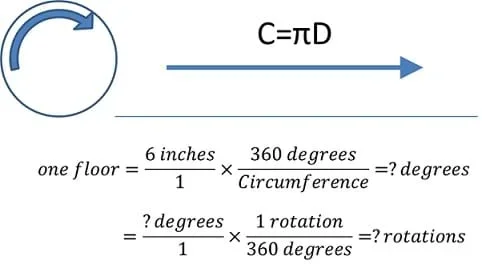 Calculations for predicting the number of rotations of the pulley to lift the elevator one floor.Copyright 2013 Paul Phamduy, Polytechnic Institute of NYU
 - For the activity, distribute to each team a LEGO kit, calculator, measuring tape, extra paper, masking tape and string.
- Have groups design and assemble their LEGO motor assemblies (using the Elevator Building Guide) and elevator box assemblies using the LEGO kits and other materials. Have them record on their worksheets the height, length and width of their elevator boxes as well as the method used to attach the elevator boxes to the cable string.
- To prepare for calibration, have students align the prepared Floor Ruler, starting at the floor of the classroom, next to the elevator (see Figure 2).
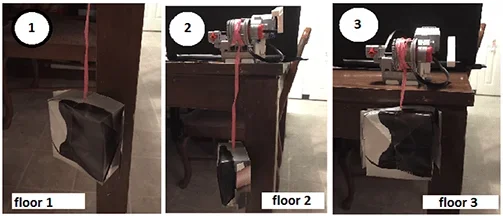 Figure 2. Instructions for calibration of the LEGO MINDSTORMS EV3 elevator.Copyright 2017 University of Colorado Boulder
 - Have students use the servomotor tool function on the LEGO intelligent brick, see Figure 3. To do this, press the middle button to turn on the brick > use the left/right gray arrow buttons to go to "View" > press the middle button > go to "motor controller" in degrees > middle button > "Port A" > middle button. By turning the servomotor, students see that the angle value on the LEGO brick changes.
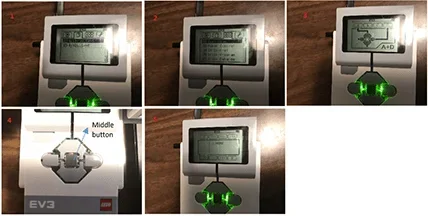 Figure 3. Instructions for viewing the servomotor tool.Copyright 2017 University of Colorado Boulder
 - Students begin by unwinding their elevators so that the elevator boxes touch the floor. Have them record the floor number, elevator height from the ground using a measuring tape, and number of degrees on the LEGO screen to reach the height.
- Have students rotate the servomotor by turning the handle on their devices so that the elevator reaches the next floor. Figure 4 shows the two gray arrow buttons used to control the servomotor. Repeat step 9 for all floors.
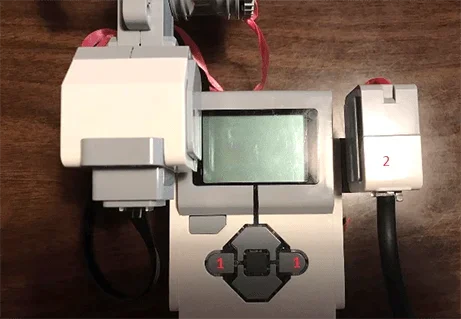 Figure 4. Using the provided program, students can specify rotations controlling the height of the elevator using the gray buttons (1) on the EV3 intelligent brick to control the servomotor (2).Copyright 2017 University of Colorado Boulder
 - Students calculate percent difference by using the equation: "percent difference" = ("degrees to get to floor"/"actual degree to get to floor" – 1) X 100.
- Have students graph the calibration data with rotations on the x-axis and floor height on the y-axis.
- Ask students to comment on whether this is a non-linear or linear relationship between rotations and floor height.
- Have students reset the elevator box on the ground floor and run the elevator.c (C) program.
- Next, have students put their four passengers (coin weights), Washington, Roosevelt, Jefferson and Lincoln, onto their elevators.
- Students enter in their rotations for the top floor, press the button, and watch the elevator box reach the top floor.
- Students measure and record the height of the top floor and calculate its accuracy. Students comment on the safety of their passengers.
- Conclude the activity with each team presenting their results to the class with an analysis of their graphs. How well did they meet the engineering project requirements?
- Together as a class, answer some discussion questions.
- How does the rotation of the elevator motor translate to the vertical motion of the elevator box? (Answer: circumference = pi * diameter)
- How does the rotary encoder know that the elevator box has reached the correct floor in a building? (Answer: Each floor should be calibrated to a specific degrees or rotations by encoder.)
- Did your passenger make it to the top floor safely? (Answers will vary.)
- How safe do you think elevators should be? What are acceptable risks and casualties? (Answer: Answers will vary. The chance of an elevator fatality in a year is 1 in 10,440,000. For comparison, the chances for car fatality is 1 in 10,000.)
- calibration
- The process of standardizing or precisely adjusting a measure or tool.
- electromechanics
- A device or system that combines electrical and mechanical processes.
- rotary encoder
- An electromechanical control device that converts angular motion to a translation.
- translation
- Movement of a point at a constant distance in a specified direction.
Pre-Activity Assessment
Questions: Ask a few questions to engage students in the bigger real-world context of the activity topic and assess their base knowledge of the topic. Ask the students:
- Even though many horror movies show people stuck in elevators, why do you feel it is safe to use an elevator?
- How do you think engineers design elevators to be safe and work effectively?
Activity Embedded Assessment
Worksheet: Observe students as they progress through the Data Collection Worksheet (PDF). Review their data, calculations, answers and graphs to gauge their mastery of the subject matter.
Post-Activity Assessment
Quick Group Presentations: Use the Elevator Rubric (PDF) to assess students' elevator designs and their depth of understanding. How well did groups meet the engineering project requirements?
If time permits, have students redesign their elevator boxes to be more stable.
A 43-second video animation, "Accurate Elevator Positioning with Rotary Encoders" by Pepperl+Fuchs shows the operation of rotary encoders in elevators at https://www.youtube.com/watch?v=ea8Kr4vVlWk
Book of Odds, Inc. Accessed June 5, 2013. http://www.bookofodds.com/
Fascinating facts about the invention of the elevator by Elisha Graves Otis in 1852. Last revised March 26, 2007. The Great Idea Finder. Accessed June 5, 2013. http://www.ideafinder.com/history/inventions/elevator.htm
Harris, Tom. How Elevators Work. How Stuff Works. Accessed June 5, 2013. (good animation) http://science.howstuffworks.com/transport/engines-equipment/elevator3.htm
Harris, Tom. How Escalators Work. How Stuff Works. Accessed June 5, 2013. (good animation) http://science.howstuffworks.com/transport/engines-equipment/escalator1.htm
List of motor vehicle deaths in U.S. by year. Last updated May 20, 2013. In Wikipedia, The Free Encyclopedia. Accessed June 6, 2013. http://en.wikipedia.org/wiki/List_of_motor_vehicle_deaths_in_U.S._by_year
Contributors
Paul Phamduy; Chris Leung
Supporting Program
AMPS GK-12 Program, Polytechnic Institute of New York University
Acknowledgements
This activity was developed by the Applying Mechatronics to Promote Science (AMPS) Program funded by National Science Foundation GK-12 grant no. 0741714. However, these contents do not necessarily represent the policies of the NSF, and you should not assume endorsement by the federal government.
Additional support was provided by the Central Brooklyn STEM Initiative (CBSI), funded by six philanthropic organizations.
Copyright
2013 by Regents of the University of Colorado; original © 2013 Polytechnic Institute of New York University