
Friction Force
Legacy Curriculum
Hey there! This curriculum is no longer being curated or supported. It may contain materials that are no longer available or outdated information. Please use this document for reference.
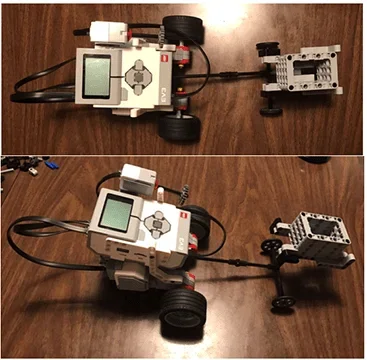 Students practice engineering analysis by evaluating the friction forces in various designs.
Students use LEGO® MINDSTORMS® robotics to help conceptualize and understand the force of friction. Specifically, they observe how different surfaces in contact result in different frictional forces. A LEGO robot is constructed to pull a two-wheeled trailer made of LEGO parts. The robot is programmed to pull the trailer 10 feet and trial runs are conducted on smooth and textured surfaces. The speed and motor power of the robot is kept constant in all trials so students observe the effect of friction between various combinations of surfaces and trailer wheels. To apply what they learn, students act as engineers and create the most effective car by designing the most optimal tires for given surface conditions.
Friction is an important concept in engineering. In the automotive and aerospace engineering fields, the calculation of frictional forces plays a significant role in the materials selection and tire design. Engineers designing cars, trucks, motorcycles, bicycles, skateboards, and even airplanes select specific rubber compositions for the tire material to guarantee the desired level of traction between surfaces. Rubber tires are designed to generate enough friction between surfaces so that the tires do not slip. When designing objects that rely upon ideal traction, such as shoes and tires, the goal is met by researching and testing materials properties. Students act as engineers by testing different materials interact to cause different frictional forces and then select materials for optimal designs.
After this activity, students should be able to:
- Describe how friction varies based on the surfaces of two objects in contact, and provide examples.
- Explain how friction affects objects in motion.
- Control a robot with a touch sensor.
- Measure and record data from an experiment.
- CCSS.Math.Content.3.MD.B.3 Draw a scaled picture graph and a scaled bar graph to represent a data set with several categories. Solve one- and two-step "how many more" and "how many less" problems using information presented in scaled bar graphs.
Grade 3
Do you agree with this alignment? - CCSS.Math.Content.4.MD.B Represent and interpret data.
Grade 4
Do you agree with this alignment? - CCSS.Math.Practice.MP2 Reason abstractly and quantitatively.
Grades K-12
Do you agree with this alignment? - CCSS.Math.Practice.MP5 Use appropriate tools strategically.
Grades K-12
Do you agree with this alignment?
- Students will develop an understanding of the relationships among technologies and the connections between technology and other fields of study.
Grades K-12
Do you agree with this alignment? - Models are used to communicate and test design ideas and processes.
Grades 3-5
Do you agree with this alignment? - The process of experimentation, which is common in science, can also be used to solve technological problems.
Grades 3-5
Do you agree with this alignment?
- 3.MD.3 Draw a scaled picture graph and a scaled bar graph to represent a data set with several categories. Solve one- and two-step "how many more" and "how many less" problems using information presented in scaled bar graphs.
Grade 3
Do you agree with this alignment? - MP.2 Reason abstractly and quantitatively.
Grades -1-12
Do you agree with this alignment? - MP.5 Use appropriate tools strategically.
Grades K-12
Do you agree with this alignment? - Represent and interpret data.
Grade 4
Do you agree with this alignment?
- 3-5-ETS1-3 Plan and carry out fair tests in which variables are controlled and failure points are considered to identify aspects of a model or prototype that can be improved.
Grades 3-5
Do you agree with this alignment? - 3-PS2-1 Plan and conduct an investigation to provide evidence of the effects of balanced and unbalanced forces on the motion of an object.
Grade 3
Do you agree with this alignment?
- 3-5-ETS1-3 Plan and carry out fair tests in which variables are controlled and failure points are considered to identify aspects of a model or prototype that can be improved.
Grades 3-5
This resource focuses on the following Three Dimensional Learning aspects of NGSS:
Science & Engineering Practices- Plan and conduct an investigation collaboratively to produce data to serve as the basis for evidence, using fair tests in which variables are controlled and the number of trials considered.Do you agree with this alignment?
- Represent data in graphical displays (bar graphs, pictographs and/or pie charts) to reveal patterns that indicate relationships.Do you agree with this alignment?
Disciplinary Core Ideas- Tests are often designed to identify failure points or difficulties, which suggest the elements of the design that need to be improved.Do you agree with this alignment?
- Different solutions need to be tested in order to determine which of them best solves the problem, given the criteria and the constraints.Do you agree with this alignment?
Do you agree with this alignment? - Plan and conduct an investigation collaboratively to produce data to serve as the basis for evidence, using fair tests in which variables are controlled and the number of trials considered.
- 3-PS2-1 Plan and conduct an investigation to provide evidence of the effects of balanced and unbalanced forces on the motion of an object.
Grade 3
This resource focuses on the following Three Dimensional Learning aspects of NGSS:
Science & Engineering Practices- Plan and conduct an investigation collaboratively to produce data to serve as the basis for evidence, using fair tests in which variables are controlled and the number of trials considered.Do you agree with this alignment?
- Science investigations use a variety of methods, tools, and techniques.Do you agree with this alignment?
Disciplinary Core Ideas- Each force acts on one particular object and has both strength and a direction. An object at rest typically has multiple forces acting on it, but they add to give zero net force on the object. Forces that do not sum to zero can cause changes in the object's speed or direction of motion. (Boundary: Qualitative and conceptual, but not quantitative addition of forces are used at this level.)Do you agree with this alignment?
- Objects in contact exert forces on each other.Do you agree with this alignment?
Crosscutting Concepts- A system can be described in terms of its components and their interactions.Do you agree with this alignment?
Do you agree with this alignment? - Plan and conduct an investigation collaboratively to produce data to serve as the basis for evidence, using fair tests in which variables are controlled and the number of trials considered.
To share with the entire class:
- LEGO MINDSTORMS EV3 robot, such as EV3 Core Set (5003400) at https://education.lego.com/en-us/products/lego-mindstorms-education-ev3-core-set/5003400#lego-mindstorms-education-ev3
- LEGO MINDSTORMS Education EV3 Software 1.2.1, free online, you have to register a LEGO account first; at https://www.lego.com/en-us/mindstorms/downloads/download-software
- computer, loaded with EV3 1.2.1 software
- 2 surfaces, each a distance of 10 feet: 1) a rough surface such as carpet or gym mats, 2) a smooth surface such as tile floor, linoleum or glass
- stopwatch
- various materials to serve as alternatives to rubber robot tires, such as tape, string, rubber bands
- Steps to Construct the Trailer (PDF)
- Friction Force Pre-Assessment (PDF), one per person
- Friction Force Data Sheet (PDF), one per person
- Friction Force Post-Assessment (PDF) one per student
Note: This activity can also be conducted with the older (and no longer sold) LEGO MINDSTORMS NXT set instead of EV3; see below for those supplies:
- LEGO MINDSTORMS NXT robot, such as the NXT Base Set
- LEGO MINDSTORMS Education NXT Software 2.1
- Friction Force EV3 Program (ev3)
- Friction Force NXT Program (rbt)
- Friction Force Pre-Assessment (pdf)
- Friction Force Pre-Assessment (docx)
- Friction Force Pre-Assessment Answer Key (pdf)
- Friction Force Pre-Assessment Answer Key (docx)
- Friction Force Data Sheet (pdf)
- Friction Force Data Sheet (docx)
- Friction Force Data Sheet Answer Key (pdf)
- Friction Force Data Sheet Answer Key (docx)
- Friction Force Post-Assessment (pdf)
- Friction Force Post-Assessment (docx)
- Friction Force Post-Assessment Answer Key (pdf)
- Friction Force Post-Assessment Answer Key (docx)
- Steps to Construct the Trailer (pdf)
- Steps to Construct the Trailer (docx)
Familiarity with the concept of force.
Can you imagine a world without friction? This world would be a rather bizarre world to live in. What would be different? Without friction, you would not be able to walk or run, and wheels of cars, buses, and trains would not be able to turn. This is quite difficult to imagine! It is because of friction that we can do all the activities we enjoy in our daily lives.
Let's go through what happens every time we take a step. We plant a foot on the ground and at the instant we push down and our feet or shoes come in contact with the surface of the ground, friction acts in the opposite way. This means we can "push" our feet against the ground and walk—instead of slipping.
Imagine trying to play basketball, soccer, bowling or even baseball on an ice skating rink—a surface with very little friction. What would happen? (Listen to student ideas.) You might fall down, slide around and not be able to get back up! Since we are so accustomed to experiencing friction all the time, we can only come to appreciate this force when we close our eyes to imagine how bizarre our world would be without this force!
In today's experiment, you have been hired to work as engineers for the car company Super Cars. This company is a multimillion dollar corporation that is investing their resources on testing different types of wheels on different surfaces to see how friction and traction affects a car's motion. As engineers, you will test out wheels with and without rubber tires to see which provide the best traction on rough and smooth surfaces. As engineers we will draw conclusions from our tests and then use this new knowledge to select the material that best enables our cars to travel a certain distance in the least amount of time.
Background
In this activity, the LEGO robot pulls a trailer attachment across different surfaces for a distance of 10 feet. The LEGO brick must have the program "friction.ev3" file downloaded. A LEGO MINDSTORMS touch sensor is used to control the robot. Once it is pressed, the robot moves forward until the sensor is pressed again. Students work and participate as an entire class rather than in smaller groups.
Before the Activity
- Make copies of the Friction Force Pre-Assessment (PDF), Friction Force Data Sheet (PDF) and Friction Force Post-Assessment (PDF) one each per student.
- Construct the LEGO robot using the "Five Minute Bot" instructions provided here: https://www.youtube.com/watch?v=Dhe2jXi3Fc4
- Construct the two-wheeled "trailer" attachment that the robot drags. All materials are included in the LEGO kit; see the Steps to Construct the Trailer (PDF) for images to help build the trailer.
- Make sure to fully charge the EV3 brick battery packs in advance. Uncharged bricks may alter the robot speed.
- Download the LEGO software on the computer. Then download the Friction Force EV3 Program (EV3) "friction.ev3" on the brick using the LEGO software. Follow these steps to download this ev3 file: First, open friction.ev3 using the software. Once the file is open, connect the robot to the computer via USB, then click the download button on the software home page.
- Make sure motors are connected to the A and B ports of the EV3 brick and the touch sensor connected to port 1 of the EV3 brick.
- Measure 10 feet each of carpet runway and smooth flooring runway for the robot to travel. Use objects found in the classroom to mark starting and finish lines.
With the Student
- Administer the pre-activity assessment before starting the activity.
- Present students with the Introduction/Motivation content.
- Hand out the data sheets.
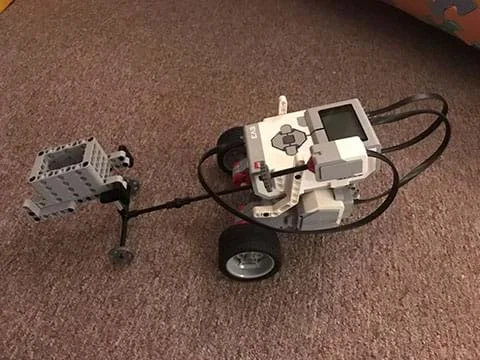 Figure 1. Experimental set-up #1: Wheels without tires on a carpeted surface.Copyright 2017 University of Colorado Boulder
- Begin with the set-up shown in Figure 1. For this trial, the wheels on the trailer should not have rubber tires and the surface should be a rough or textured surface, such as a carpeted floor.
- Conduct the trial:
- Place the robot at the start position and run the "friction.ev3" program.
- Once you run the program, press the touch sensor to start the robot moving forward. As soon as the robot starts moving, use the stopwatch to start timing.
- Let the robot to travel 10 feet to the finish line. When the robot reaches the finish line, stop the timer and press the touch sensor to stop the robot.
- Have students record the time on their data sheets.
- Repeat the trial steps (#5) on tile floor, as shown in Figure 2.
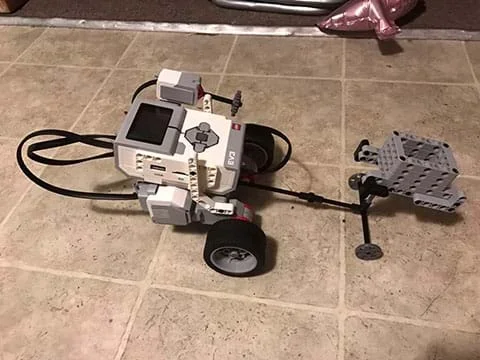 Figure 2. Experimental set-up #2: Wheels without tires on a tile surface.Copyright 2017 University of Colorado Boulder
- Cover the wheels of the trailer with the rubber tires and repeat the trial steps (#5).
- The set-ups for the third and fourth trials are shown in Figures 3 and 4, respectively.
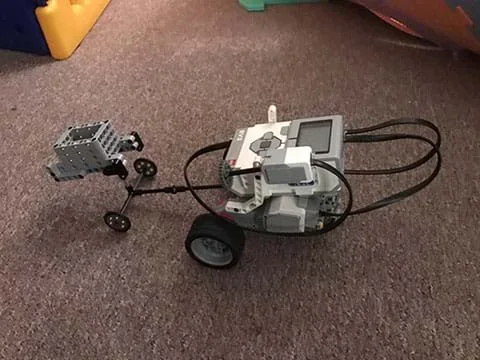 Figure 3. Experimental set-up #3: Wheels with tires on a carpeted surface.Copyright 2017 University of Colorado Boulder
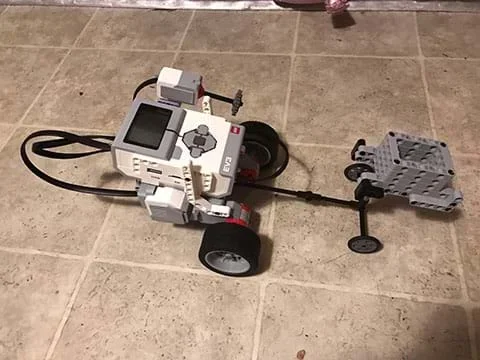 Figure 4. Experimental set-up #4: Wheels with tires on a tile surface.Copyright 2017 University of Colorado Boulder
- Once students have recorded measurement data from the four trials, have them individually answer the four analysis questions on the data sheet. Then discussion their results and conclusions as a class. Have students turn in their data sheets for grading.
- Next, continuing to act as engineers, ask students to brainstorm materials that could be used on the trailer wheels as alternatives to rubber tires. Provide a few example items for students to pick from, such as tape, string and rubber bands.
- Have each student draw a design of their alternative wheels, with all materials labeled. Time permitting, let students add their alternative wheel design to the trailer wheels and test their designs by conducting additional trials.
- Administer the post-activity assessment.
- force
- A push or pull that can cause an object's motion to change.
- friction
- A force that resists relative motion between two objects in contact.
- motion
- A description of an objective relative to its location. Motion describes how fast an object changes its location.
- traction
- The friction force allowing an object to stick to a surface that it is in contact with.
Pre-Activity Assessment: Administer the four-question Friction Force Pre-Assessment (PDF)to gauge students' prior knowledge of the concept of friction and how it affects the motion of objects.
Data Sheets: During the activity, have students complete the Friction Force Data Sheet (PDF) to record their data and answer questions on the results of the experiments, based on the friction present in each trial. Give students times to work individually on the data sheet, and then gather students together as a class to discuss the results and conclusions. Collect the data sheets to assess each student's comprehension of the concepts.
Post-Activity Assessment: At activity end, administer the six-question Friction Force Post-Assessment (PDF) to evaluate students' understanding of the concept of friction, how it affects the motion of objects, and how it affected the activity experiments. Compare students' pre- and post-activity assessments to gauge how much they learned during the activity.
Motion. Dictionary and Thesaurus® Miriam Webster Online. http://www.merriam-webster.com/dictionary/motion
Contributors
Akim Faisal
Supporting Program
AMPS GK-12 Program, Polytechnic Institute of New York University
Acknowledgements
This activity was supported by the Central Brooklyn Robotics Initiative (CBRI) and the Applying Mechatronics to Promote Science (AMPS) Program funded by National Science Foundation GK-12 grant no. 0741714. However, these contents do not necessarily represent the policies of the NSF and you should not assume endorsement by the federal government.
Copyright
2013 by Regents of the University of Colorado; original © 2010 Polytechnic Institute of New York University