
Gears: Lift It Up!
Legacy Curriculum
Hey there! This curriculum is no longer being curated or supported. It may contain materials that are no longer available or outdated information. Please use this document for reference.
 Two sixth-grade students using the LEGO pulley and gear setup for the activity.
A gear is a simple machine that is very useful to increase the speed or torque of a wheel. In this activity, students learn about the trade-off between speed and torque when designing gear ratios. The activity setup includes a LEGO® MINDSTORMS® pulley system with two independent gear sets and motors that spin two pulleys. Each pulley has weights attached by string. In a teacher demonstration, the effect of adding increasing amounts of weight to the pulley systems with different gear ratios is observed as the system's ability to lift the weights is tested. Then student teams are challenged to design a gear set that will lift a given load as quickly as possible. They test and refine their designs to find the ideal gear ratio, one that provides enough torque to lift the weight while still achieving the fastest speed possible.
Gears are a fundamental element of many machines. Gears transmit power and can be used to gain the mechanical advantage necessary to lift a heavy load, or simply speed up a process if the load is light. Mechanical engineers use gears when designing machines such as bicycles, elevators and automobiles in order to increase the speed of a device, or its ability to pull or lift heavy objects. When mechanical engineers design devices with gears, they choose gear sets based on specific design requirements, keeping in mind how different gear ratios affect a system's performance.
After this activity, students should be able to:
- Describe the relationship between gear ratio, speed and lifting ability.
- Calculate a gear ratio.
- Choose gears for a gear set that optimizes lifting speed for lifting a given load (weight) and test the gear ratio.
- CCSS.Math.Content.6.RP.A Understand ratio concepts and use ratio reasoning to solve problems.
Grade 6
Do you agree with this alignment? - CCSS.Math.Content.6.RP.A.1 Understand the concept of a ratio and use ratio language to describe a ratio relationship between two quantities.
Grade 6
Do you agree with this alignment?
- Students will develop an understanding of the attributes of design.
Grades K-12
Do you agree with this alignment? - Students will develop an understanding of engineering design.
Grades K-12
Do you agree with this alignment? - Modeling, testing, evaluating, and modifying are used to transform ideas into practical solutions.
Grades 6-8
Do you agree with this alignment? - STEL-7J Evaluate designs based on criteria, constraints, and standards.
Grades 3-5
Do you agree with this alignment?
- 6.RP.1 Understand the concept of a ratio and use ratio language to describe a ratio relationship between two quantities.
Grade 6
Do you agree with this alignment? - Understand ratio concepts and use ratio reasoning to solve problems.
Grade 6
Do you agree with this alignment?
- MS-ETS1-1 Define the criteria and constraints of a design problem with sufficient precision to ensure a successful solution, taking into account relevant scientific principles and potential impacts on people and the natural environment that may limit possible solutions.
Grades 6-8
Do you agree with this alignment? - MS-ETS1-2 Evaluate competing design solutions using a systematic process to determine how well they meet the criteria and constraints of the problem.
Grades 6-8
Do you agree with this alignment?
- MS-ETS1-1 Define the criteria and constraints of a design problem with sufficient precision to ensure a successful solution, taking into account relevant scientific principles and potential impacts on people and the natural environment that may limit possible solutions.
Grades 6-8
This resource focuses on the following Three Dimensional Learning aspects of NGSS:
Science & Engineering Practices- Define a design problem that can be solved through the development of an object, tool, process or system and includes multiple criteria and constraints, including scientific knowledge that may limit possible solutions.Do you agree with this alignment?
Disciplinary Core Ideas- The more precisely a design task's criteria and constraints can be defined, the more likely it is that the designed solution will be successful. Specification of constraints includes consideration of scientific principles and other relevant knowledge that is likely to limit possible solutions.Do you agree with this alignment?
Crosscutting Concepts- The uses of technologies and any limitations on their use are driven by individual or societal needs, desires, and values; by the findings of scientific research; and by differences in such factors as climate, natural resources, and economic conditions.Do you agree with this alignment?
- All human activity draws on natural resources and has both short and long-term consequences, positive as well as negative, for the health of people and the natural environment.Do you agree with this alignment?
Do you agree with this alignment? - Define a design problem that can be solved through the development of an object, tool, process or system and includes multiple criteria and constraints, including scientific knowledge that may limit possible solutions.
- MS-ETS1-2 Evaluate competing design solutions using a systematic process to determine how well they meet the criteria and constraints of the problem.
Grades 6-8
This resource focuses on the following Three Dimensional Learning aspects of NGSS:
Science & Engineering Practices- Evaluate competing design solutions based on jointly developed and agreed-upon design criteria.Do you agree with this alignment?
Disciplinary Core Ideas- There are systematic processes for evaluating solutions with respect to how well they meet the criteria and constraints of a problem.Do you agree with this alignment?
Do you agree with this alignment? - Evaluate competing design solutions based on jointly developed and agreed-upon design criteria.
For the teacher demonstration:
- LEGO MINDSTORMS EV3 robot, such as the EV3 Core Set (5003400) at https://education.lego.com/en-us/products/lego-mindstorms-education-ev3-core-set/5003400#lego-mindstorms-education-ev3
- LEGO MINDSTORMS Education EV3 Software 1.2.1, free online, you have to register a LEGO account first; at https://www.lego.com/en-us/mindstorms/downloads/download-software
- 12 binder clips (see Figure 2)
- 30 hex nuts, such as the 5/16-inch zinc-plated coarse-threaded hex nuts at Home Depot
- string, 4 feet (1.2 m) length
- computer
- stopwatch
Each group* needs:
- LEGO MINDSTORMS EV3 robot, such as the EV3 Core Set (5003400) at https://education.lego.com/en-us/products/lego-mindstorms-education-ev3-core-set/5003400#lego-mindstorms-education-ev3
- string, 4 feet (1.2 m) length
- 1 binder clip
- 4 hex nuts
- computer with MATLAB by MathWorks; if Matlab is not available in your classroom/school, download a free trial at https://www.mathworks.com/programs/trials/trial_request.html?prodcode=ML&s_iid=main_trial_ML_tb and the RWTH - MINDSTORMS EV3 Toolbox for MATLAB at https://www.mathworks.com/matlabcentral/fileexchange/18646-rwth-mindstorms-nxt-toolbox
- stopwatch
- Pre-Quiz (PDF), one per student
- Building Guide for Modified Gear Set (PDF), one per group
- Engineering Challenge Worksheet (PDF), one per group
- Post-Quiz (PDF), one per student
*Note: Ideally, build one setup for demonstration purposes and provide each group with its own EV3 Core Set (additional software packs do not need to be purchased) to build their own experimental setups. Multiple setups facilitate the activity, but if not available, conduct the activity with only one setup, which requires the EV3 Core Set and software.
Note: This activity can also be conducted with the older (and no longer sold) LEGO MINDSTORMS NXT set instead of EV3; see below for those supplies:
- LEGO MINDSTORMS NXT robot, such as the NXT Base Set
- LEGO MINDSTORMS Education NXT Software 2.1
- computer, loaded with NXT 2.1 software
- Gears Pre-Quiz (docx)
- Gears Pre-Quiz (pdf)
- Gears Pre-Quiz Answer Key (docx)
- Gears Pre-Quiz Answer Key (pdf)
- Building Guide for Modified Gear Set (docx)
- Building Guide for Modified Gear Set (pdf)
- gearwinch.m
- Engineering Challenge Worksheet (docx)
- Engineering Challenge Worksheet (pdf)
- Engineering Challenge Worksheet Example Answers (docx)
- Engineering Challenge Worksheet Example Answers (pdf)
- Gears Post-Quiz (docx)
- Gears Post-Quiz (pdf)
- Gears Post-Quiz Answer Key (docx)
- Gears Post-Quiz Answer Key (pdf)
Knowledge of ratios, division and reducing fractions and ratios based on the greatest common factor.
Would you believe me if I told you, that you could lift 500 pounds using only the power from your arms? Using the "right" gear ratio, which is the ratio of the input speed to the output speed of a set of gears, this seemingly impossible task becomes possible.
Gears are mechanisms used by engineers in many, many situations. For example, many bicycles have multiple gears that give the rider some options—like helping to make it easier for the rider to pedal up steep hills, and enabling the rider to go great distances with every pedal stroke on level terrain. Most elevators use gears so as to put less strain on the motor doing the lifting. Bicycle gears transmit power from the pedals to the back wheel (with the help of a chain) and their gear ratios can be changed for different performance criteria (climbing hills vs. speed on the flats).Copyright 2007 Thegreenj, Wikimedia Commons http://commons.wikimedia.org/wiki/File:Rearbikegears.jpg
What other devices use gears? (See if students have any ideas. Possible answers: All sorts of vehicles, like cars, trucks and motorcycles. Also everyday household objects like clocks and odometers, as well as industrial equipment like conveyor systems, meters and scales. Think of mechanical devices that have motors that produce rotational motion.)
In this activity, we'll learn how to choose the best gear ratio for a specific task and discover the trade-off between speed and power.
Background
Incorporating gears in engineering designs is one way engineers produce a mechanical advantage. In this activity, students lift weights using a pulley and gear system. It is important to keep in mind that using gears does not affect the total work done by the system, but it does affect the lifting speed and the amount of weight that can be lifted.
A gear ratio is the ratio of the input speed (speed of the driver gear or gear attached to a motor or power source) to the output speed (speed of the driven gear). The gear ratio can be calculated simply by using the number of teeth on each gear; the "gear ratio" is equal to the ratio of the number of teeth on the driver (input) gear to the number of teeth on the driven (output) gear. For example, if the driver gear has 45 teeth and the driven gear has 10 teeth, the gear ratio is 45:10 = 9:2. Note that the gear ratio is reduced by dividing both numbers by their greatest common factor.
Specifically, by altering the gear ratio, engineers can make a wheel spin faster or with more torque (strength in the turning). For example, to make an analog watch, watchmakers use gears so that the hands on the watch move at the correct speed. An engineer designing a truck may prefer to use a gear set to increase the torque at the wheel in order to increase the load (or weight) the truck can pull.
Gears have many applications in engineering and are used to meet the particular criteria of designs. For example, speed may be the most important factor in some designs, while power and torque may be more important for other designs. In this activity, students see the trade-offs for different gear ratios.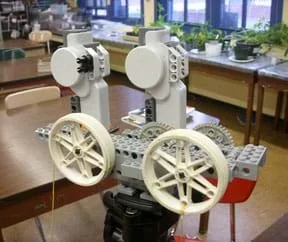 Figure 1. LEGO motors driving two separate sets of gears for comparison. Instructions for constructing the setup are provided in the building guide attachment.Copyright 2012 Jeffrey Laut, AMPS, NYU-Poly
Before the Activity
- Gather materials and make copies of the Pre-Quiz (PDF) and Post-Quiz (PDF), one each per student. Also make copies of the Building Guide for Modified Gear Set (PDF) and Engineering Challenge Worksheet (PDF), one each per group.
- For the teacher demonstration, construct one LEGO MINDSTORMS EV3 gear system as shown in Figure 1. Follow the step-by-step instructions with photographs in the Building Guide for Modified Gear Set (PDF). Student teams construct their own setups as part of the activity.
- Prepare a computer with MATLAB, along with the RWTH - MINDSTORMS EV3 Toolbox for MATLAB, available at the URLs provided in the Materials List.
- Familiarize yourself with the MATLAB script, gearwinch.m (M), used for this activity. To run it, double click on the MATLAB script and press the F5 key.
- Use binder clips and nuts to prepare the "weights" (see Figure 2); it is best if the nuts are generally the same size. For each group, prepare one binder clip with 4 nuts attached to it. For the demonstration, prepare a set of 12 binder clips: Two binder clips each with no nuts attached, two bind clips each with 1 nut, two binder clips each with 2 nuts, two binder clips each with 3 nuts, two binder clips each with 4 nuts and two binder clips each with 5 nuts.
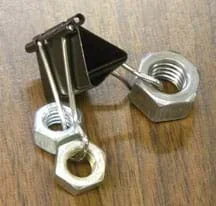 Figure 2. A modular weight system made from attaching hex nuts to a binder clip. Adding or removing nuts easily changes the weight.Copyright 2012 Jeffrey Laut, AMPS, NYU-Poly
With the Students—Introduction
- Administer the pre-quiz as described in the Assessment section.
- Briefly introduce how gears work and the real-world scenarios in which they are used, including the Introduction/Motivation section, as well as selected information from the Background section.
- Prediction: Ask the students: Which type of gear ratio would be better for lifting heavy objects? A big gear on the motor, a small gear being driven, or is it the opposite? (Answer: For lifting heavy objects, the driver gear [gear on the motor] needs to be the smaller gear. For a faster turning rate, the driver gear needs to be the bigger gear.)
With the Students—Teacher Demonstration
- First, place a binder clip with no weights on each string, and lift the string. (It does not matter which gears are used in the first trial.) With the students, calculate the gear ratio: gear ratio = number of teeth on the driver gear: number of teeth on the driven gear.
- Change the gears in the gear set and repeat step 1. Repeat using a few of the possible combinations of gears. Observe that the gear set with the larger gear on the motor lifts the binder clip much faster. Only change the gears in this demonstration.
- At this point, students have seen that the gear ratios affect speed. Later, they will see that the lifting ability of the motor is greatly affected by this as well. Ask students: Which one of the gear ratios would you choose if you were designing an elevator? (At this point, expect students to choose the faster one; later, they will come to see that this is not a good choice.)
- Repeat steps 1 and 2, adding more weight, one nut at a time (use the prepared set of binder clips). Observe that with the addition of the nuts (weight), the gear set with the larger gear on the motor exhibits slower performance than before, while the other gear set appears to be unaffected.
- Guide students to realize that the gear set with the smaller gear on the motor is faster. This is due to the available torque at the output of the gear set. Use a stopwatch to measure the time for the gears to pull the binder to the top. Two students with stopwatches can assist with this part.
- Ultimately, expect students to discover that the gear set that was the fastest with no weight is not able to move once burdened by a weight equivalent to about four nuts on a binder clip. Although this gear ratio increases the velocity at the output, it also decreases the available turning force (torque). Emphasize this fact because it is a key concept when designing gear ratios.
- Ask students to reflect back on their gear ratio choices for designing an elevator. Why is the slower gear ratio better? (Answer: It has more torque, and therefore, more lifting ability.)
- Make another comparison: riding a multi-speed bicycle. The gear ratio that enables you to travel the fastest would be the most difficult gear ratio to use when trying to bike up a hill. This is because the gear ratio optimized for speed requires the cyclist to exert more torque on the base gear. Changing gears helps riders maintain the pedaling resistance at the cost of speed. At this point explain the concepts of trade-off and optimization.
With the Students—-Engineering Challenge
- As a class, review the universal engineering design process—a series of steps used by engineering teams to guide them as they develop new solutions, products, structures and systems. Typically, the steps include: defining a problem, researching the problem (including identifying criteria and specifying constraints), generating ideas and selecting an approach, making a model or prototype, testing and evaluating the design, modifying and refining the design until you are satisfied with the solution.
- Divide the class into small groups, such as three students each. Give each group a LEGO kit, binder clip with 4 nuts attached and a worksheet.
- Present the engineering design challenge for the groups: Design a gear set that will lift this heavy load (the provided four-nut weight) as quickly as possible (the fastest). The design challenge is also written on the worksheet. Direct students to first design the gear set based on what they observed in the demonstration.
- After the gear set is designed, have groups implement it and assess its performance by timing how long it takes to lift the binder weight to the top.
- After implementation and performance evaluation, direct groups to modify their designs as they see fit—to meet the design challenge—as long as they provide explanations to explain why they modified them.
- Have groups complete the worksheet questions—a short performance summary and group comparison recap.
- Conclude by leading a class discussion on the design that worked best to pull up the heavy load the fastest. See some suggested questions/answers in the Assessment section.
- Administer the post-quiz as described in the Assessment section.
- gear
- A toothed wheel that meshes with teeth in another part to transmit or receive force and motion. A rotating mechanism that transmits power and produces a mechanical advantage.
- gear ratio
- A ratio of the input speed to the output speed of a set of gears.
- optimize
- To balance many (often competing) requirements to achieve the best design for the circumstances.
- torque
- A turning force produced by gears.
- trade-off
- A balancing of things, all of which cannot be had at the same time. A giving up of one thing in return for another.
Pre-Activity Assessment
Pre-Quiz: Have students complete the five-question Gears Pre-Quiz (PDF) to assess their base knowledge about gears and the applications of mechanical advantage in physical systems. The questions are multiple-choice and true/false. Administer a similar post-quiz at activity end.
Activity Embedded Assessment
Worksheet: As students are engaged in the activity, evaluate their comprehension through observations, asking questions as they work, and examining their answers on the Engineering Challenge Worksheet (PDF) that groups complete as they work. Make sure students are understanding the importance of the gear ratio to speed and torque.
Post-Activity Assessment
Class Discussion: Lead a class discussion, to review results and conclusions. Ask the students:
- Which design worked the best to pull up the heavy load the fastest? What is its gear ratio? (Answer: The best gear ratio for this activity is the 8-tooth gear attached to the motor and the 40-tooth gear driven by the motor, with a gear ratio of 1:5.)
- What improvements did you make to your design and why? (Answers will vary; see if students' logic shows their understanding of the relationship between gear ratio, speed and lifting ability)
- What steps of the engineering design process do you recall doing? What steps did you repeat? (Answers will vary. Expect that groups repeated the generating ideas, testing and evaluating, modifying and refining steps more than once.)
- How does a gear ratio relate to speed and torque? (Answer: A large gear attached to the motor and a smaller gear being driven can lift light objects very quickly, but suffers when trying to lift heavy objects. Conversely, a small gear on the motor and a large gear being driven lifts very slowly, but can lift very heavy objects. Torque is the available turning force; if you "gear down," you change speed for power; your device will be slow but unstoppable for heavy lifting.)
- What are some real-world examples? (Possible answers: Mechanical engineers who design heavy machinery often rely on "gearing up" a motor. That means changing power for speed so a device moves faster, but won't be as powerful. Often a DC motor spins very fast, but has low torque output. The gear ratio for these motors may be increased hundreds of times.)
- What do we mean by a trade-off? What was the trade-off in our design challenge today? (Answer: As an example, a bicycle gear ratio that helps a rider climb a steep hill does not work well when trying to pedal really fast on level terrain; one gear ratio is unable to perform both objectives, so you must choose which objective is important and which you give up. A trade-off is a balancing of things when they cannot all be had at the same time. It may mean giving up one thing in order to achieve another. In today's challenge, our trade-off was between speed and torque. If we used a gear ratio designed only for speed, it would not provide enough torque to lift the weight. If we used a gear ratio designed only for torque, the weight would be lifted very slowly. Therefore, we designed the best gear ratio so that enough torque was provided to lift the weight while still achieving the fastest speed possible. When we need to balance competing requirements to achieve the best design for a particular circumstance, engineers call this optimization.)
Post-Quiz: At activity end, have students complete the five-question Gears Post-Quiz (PDF) to assess their understanding of the activity topics. The multiple-choice and true/false are similar to those on the pre-quiz so you can make a pre/post comparison to gauge any change in comprehension.
- For lower grades, explain in detail every trial during the demonstration to ensure that students are realizing how the different gear ratios affect the lifting speed. For each trial, calculate the gear ratio as a class to provide more guidance or do not have students calculate gear ratios and simply focus on the relative size of the gears (smallest gear attached to the motor, largest gear as the driven gear).
- For higher grades, conduct fewer demonstration trials and only go through the gear ratio calculation once. Have students explore the different gear sets and gear ratios on their own to discover which gear sets lift each amount of weight the fastest.
More About Gears. Thomasnet.com. Accessed February 3, 2015. http://www.thomasnet.com/about/gears-33560400.html
Contributors
Jeffrey Laut; Paul Phamduy
Supporting Program
AMPS GK-12 Program, Polytechnic Institute of New York University
Acknowledgements
This activity was developed by the Applying Mechatronics to Promote Science (AMPS) Program in the School of Engineering, funded by National Science Foundation GK-12 grant no. 0741714. However, these contents do not necessarily represent the policies of the NSF, and you should not assume endorsement by the federal government.
Copyright
2015 by Regents of the University of Colorado; original © 2012 Polytechnic Institute of New York University