
Wide World of Gears
Legacy Curriculum
Hey there! This curriculum is no longer being curated or supported. It may contain materials that are no longer available or outdated information. Please use this document for reference.
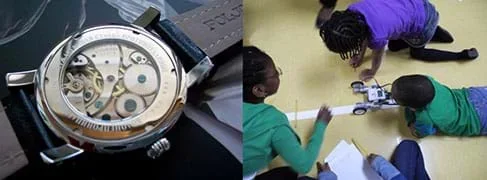 Gears are commonly found in wristwatches. Students working with robotic racer (right).Copyright (left) Wikimedia Commons; (right) 2010 Polytechnic Institute of NYU
In an interactive and game-like manner, students learn about the mechanical advantage that is offered by gears. By virtue of the activity's mechatronics presentation, students learn to study a mechanical system as a dynamic system under their control as opposed to a static image. The system presented is of two motorized racing cars built using the LEGO® MINDSTORMS® robotics platform. The altered variable between the two systems is the gear train; one is geared up for speed and the other is geared down for torque. Students collect and analyze data to reinforce particular aspects and effects of mechanical advantage.
The modification to mechanical systems offered by gears is an advanced example of simple machines. Mechanical engineers design gear systems for machines of all forms for industry and everyday life. Gears may be used in various configurations ranging from very simple (binary set-up) to very complex (compound gear pairs). Gears are seen in many different devices, such as mechanical watches/chronographs, film cameras and automobiles. The study of gear systems is often neglected in K-6 education due to its complexity; however, this exercise in racing robots aims to simplify a central concept for many mechanical engineers, the "big impact" effects of using gears in two different configurations.
After this activity, students should be able to:
- Collect, average and compare single variable datasets.
- Compute speed from distance and time measurements.
- Clearly and confidently explain that gears can be used together in different sizes.
- Predict what would occur if gears were added to a system in either gearing-up or gearing-down configurations.
- CCSS.Math.Content.4.OA.A.2 Multiply or divide to solve word problems involving multiplicative comparison, e.g., by using drawings and equations with a symbol for the unknown number to represent the problem, distinguishing multiplicative comparison from additive comparison.
Grade 4
Do you agree with this alignment?
- Compare, contrast, and classify collected information in order to identify patterns.
Grades 3-5
Do you agree with this alignment? - STEL-8A Analyze how things work.
Grades -1-2
Do you agree with this alignment?
- 3-PS2-2 Make observations and/or measurements of an object's motion to provide evidence that a pattern can be used to predict future motion.
Grade 3
Do you agree with this alignment?
- 3-PS2-2 Make observations and/or measurements of an object's motion to provide evidence that a pattern can be used to predict future motion.
Grade 3
This resource focuses on the following Three Dimensional Learning aspects of NGSS:
Science & Engineering Practices- Make observations and/or measurements to produce data to serve as the basis for evidence for an explanation of a phenomenon or test a design solution.Do you agree with this alignment?
- Science findings are based on recognizing patterns.Do you agree with this alignment?
Disciplinary Core Ideas- The patterns of an object's motion in various situations can be observed and measured; when that past motion exhibits a regular pattern, future motion can be predicted from it. (Boundary: Technical terms, such as magnitude, velocity, momentum, and vector quantity, are not introduced at this level, but the concept that some quantities need both size and direction to be described is developed.)Do you agree with this alignment?
Crosscutting Concepts- Patterns of change can be used to make predictions.Do you agree with this alignment?
Do you agree with this alignment? - Make observations and/or measurements to produce data to serve as the basis for evidence for an explanation of a phenomenon or test a design solution.
To share with the entire class:
- a constructed and pre-programmed racer set-up (2 cars); the specific pieces shown in the set-up instructions are available at https://www.lego.com/en-us/service/help/products/themes-sets/mindstorms/connecting-your-lego-mindstorms-ev3-to-bluetooth-408100000007886; purchase the necessary parts for the racer set-up through either of the two following options:
- MINDSTORMS EV3 robot, such as EV3 Core Set (5003400) for $389.95 at https://education.lego.com/en-us/products/lego-mindstorms-education-EV3-core-set-/5003400
- 1 WeDo Resource Set, for $59.95, available at https://shop.education.lego.com/legoed/en-US/catalog/product.jsp?productId=9585&isSimpleSearch=true&ProductLine=WeDo-; includes all remaining pieces shown in the set-up instructions
- thin nylon twine, 2-3 ft (0.6-0.9 m) length ($3 per 200-300 ft roll)
- fender washers, 3/16" x 1-1/4" (0.48cm x 3.18cm) x 100-200 pcs ($10 per box of 100 pcs; these may be reused for other LEGO EV3 based lessons that require small quantifiable weights that fit nicely onto axle pieces or nylon twine)
- Gears Pre-Assessment Survey (PDF), Gears Post-Assessment Survey (PDF)and Pod Racer Activity Workbook (PDF), one each per student
Alternative: LEGO MINDSTORMS NXT Set:
Note: This activity can also be conducted with the older (and no longer sold) LEGO MINDSTORMS NXT set instead of EV3; see below for those supplies:
- 2 LEGO MINDSTORMS Education NXT Base Sets
- EV3 program Wide World of Gears (ev3)
- Gears Pre-Assessment Survey (EV3 version) (doc)
- Gears Pre-Assessment Survey (EV3 version) (pdf)
- Gears Post-Assessment Survey (EV3 version) (doc)
- Gears Post-Assessment Survey (EV3 version) (pdf)
- Gears Assessment Survey Answer Key (EV3 version) (doc)
- Gears Assessment Survey Answer Key (EV3 version) (pdf)
- Gears Pre-Assessment Survey (NXT version) (doc)
- Gears Pre-Assessment Survey (NXT version) (pdf)
- Gears Post-Assessment Survey (NXT version) (doc)
- Gears Post-Assessment Survey (NXT version) (pdf)
- Gears Assessment Survey Answer Key (NXT version) (doc)
- Gears Assessment Survey Answer Key (NXT version) (pdf)
- Pod Racer Activity Workbook (docx)
- Pod Racer Activity Workbook (pdf)
- Pod Racer Activity Workbook example (docx)
- Pod Racer Activity Workbook example (pdf)
The teacher should be familiar with LEGO MINDSTORMS EV3 as a building and programming platform. The following Internet site provides primers for EV3 building and programming.
Knowledge of pairing EV3 Intelligent Bricks via Bluetooth is necessary. The following Internet sites provide instructive steps for pairing EV3 bricks using Bluetooth.
(Be ready to show students some example gears.)
Today, we will do a fun activity to learn all about gears! Has anyone ever seen a gear before? Where might you find a gear? (Possible answers: Bike, clock, watch.) You may have seen a gear before but maybe weren't sure how they are used or why.
Today we are going to learn all about how gears work. Gears can be used together to rotate in succession. As one gear turns, either because my hand is moving it or because a motor is moving it, another can turn as well because it is connected, giving an arrangement of gears so that they interact with one another. (Note to teacher: It is very helpful visually to hold up two gears in front of students and demonstrate how one rotating gear can cause the second gear to rotate.)
In this activity, we'll learn two different ways gears can be connected with each other. They are termed "gear up" and "gear down." But first, let's go back to our examples. Who remembers where gears are seen in everyday life? Based on these examples, such as bikes, watches and clocks, which are all simple machines that engineers have designed, why might engineers use gears? What is their purpose? What happens when you "change gears" on a bike? (Expected answers: It makes it easier to go faster or easier to go up a hill, pedaling becomes more difficult or easier, etc.)
(At this point, introduce the simplified definitions of "gearing up" and "gearing down," defined strictly by the arrangement of gears.) Let's investigate as a class how each set-up, gearing up and gearing down, affects the speed and the strength of the different cars.
(After conclusions are drawn from the observations of the experiments, present more generalized definitions of "gearing up" and "gearing down," as provided in the Vocabulary section.)
Background
- In this activity, students use two experimental set-ups that are distinct in their gear train arrangements. "Gear Up" set-ups and "Gear Down" set-ups are configured such that one runs faster (but with less torque) and the other runs with more torque (but slower), respectively, as shown in Figure 1.
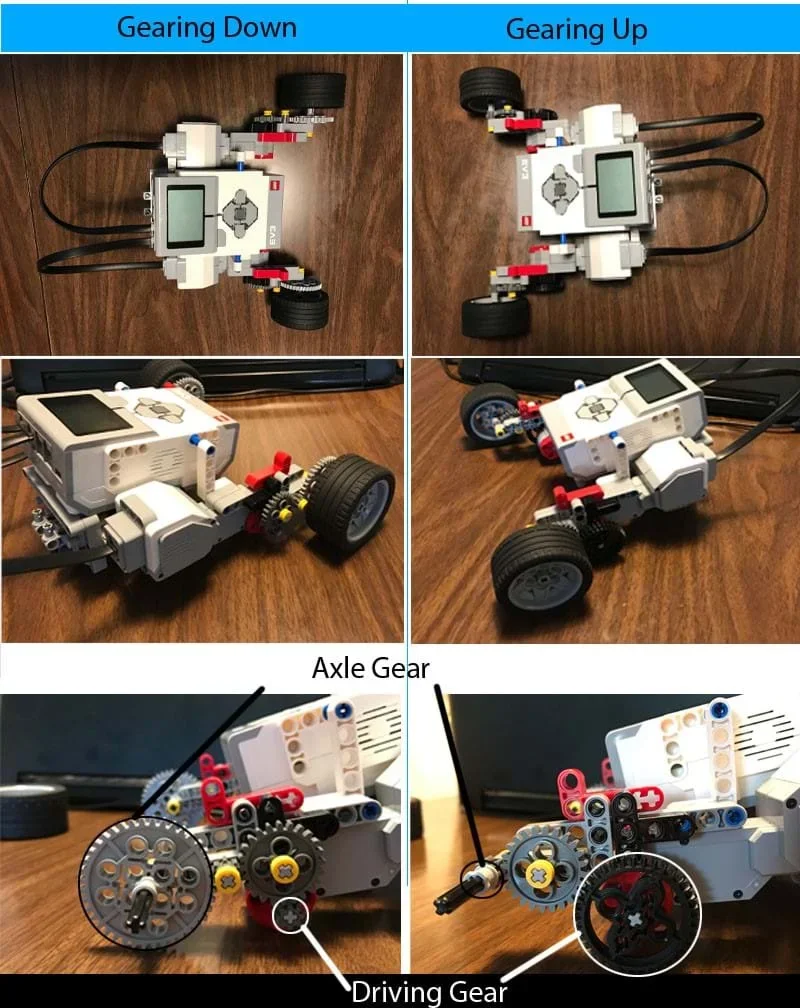 Figure 1. Overhead view (top) and side view (middle) of assembled robotic racers. Close-up of the gear assembly (bottom).Copyright 2017 University of Colorado Boulder
 - The program that is loaded onto each controlling EV3 brick should be calibrated such that the rotation sensors within the motor accurately measure distance. After calibration, a single program is needed to conduct the series of experimental speed trials. Students begin time trials by placing the robot on the ground, ensuring that the touch sensor is depressed; only then will the robot begin to move after a three-second countdown. Traveling an arbitrary distance, the robot continuously logs the distance traveled and time until the robot is lifted off the ground, thereby ending the trial. The program allows for repetition of the experiment by pressing the Enter button.
- Students tabulate the data recorded by the robot at the end of each trial: distance traveled and travel time. Students calculate the average speed of the robot for each of its trials and average them. The robots can then be tested to carry cargo, in the form of fender washers, which can be grouped and tied to the robots' axles, as shown in Figure 2. Students can investigate the maximum amount of cargo (in the form of washers count) that the two types of robots can manage to carry.
- After students conclude their hypotheses based on their observations of the two robots' performance, begin the competition portion of the activity. In the competitions, students predict the outcomes based on what they learned in the previously performed experiments. Conduct speed trial and tug-of-war competitions to test "geared up" and "geared down" robot sets, respectively. Speed trials are arranged as simple races between two or more racers. Tug-of-war trials are conducted between two racers running in opposite directions, connected by string or LEGO components.
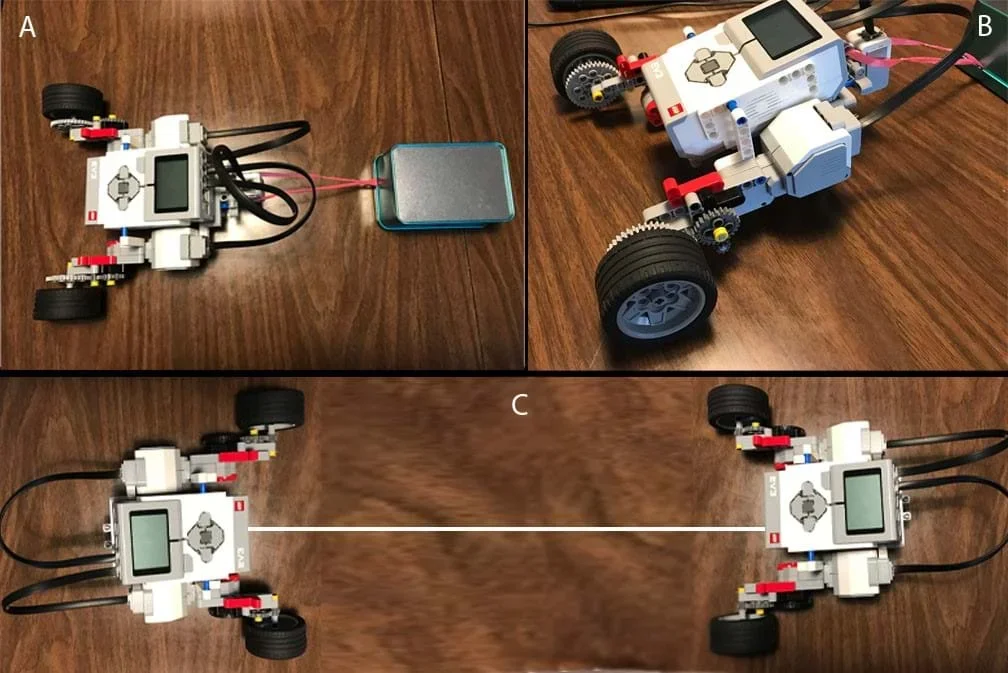 Figure 2. A) Set-up showing tow trial to quantify the maximum amount of washers (weight) that each robot can carry. B) Close-up of how nylon twine is tied to an exposed axle that runs along the robot's horizontal axis. C) Set-up showing tug-of-war competition to test hypothesis driven by the results of the tow trials.Copyright 2017 University of Colorado Boulder
Before the Activity
- Assemble each robot racer. The primary difference between the two types of racers is their gear train assembly (see Figure 3). Refer to the attached building and programming instructions for exact, step-by-step instructions. The program is common to both types of racers and is contained within a single file, wide_world_of_gears.ev3 (EV3), which refers to three additional MyBlocks. These MyBlocks are already included in the programming file.
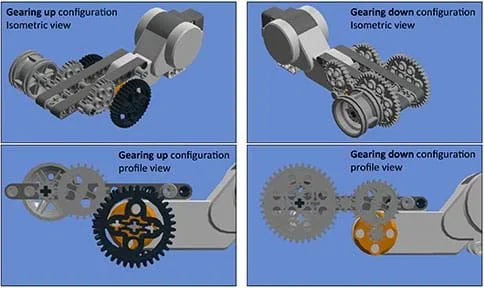 Figure 3. Isometric views (above) and profile views (below) of gearing up and gearing down gear train assemblies for the robotic racers.Copyright 2010 Polytechnic Institute of NYU
 - Once assembled and programmed, calibrate the racers to measure distance using the gear train configurations. Calibration depends on the material on which the racers will be tested (for example, carpet, tile or wood). Calibration requires the comparison of the actual distance traveled by the robot, measured with a yardstick, with the computed distance. Higher or lower discrepancies from the actual value require the negative or positive (linear) adjustment of the calibration factor, indicated in the EV3-G program as a variable. As with all robotic set-ups, each racer must be inspected for structural integrity and tested for program reliability.
- Fully charge the EV3 brick battery packs.
- Make copies of the Gears Pre-Assessment Survey (PDF), Gears Post-Assessment Survey (PDF), and Pod Racer Activity Workbook (PDF), one each per student.
With the Students
- Administer the pre- assessment survey prior to exposure to the activity set-up.
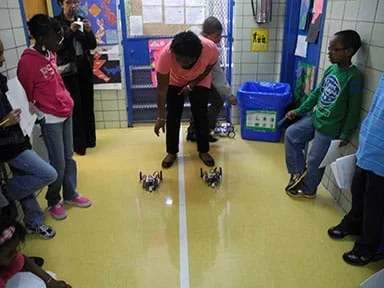 Figure 4. Competition race between geared-up class racers.Copyright 2010 Polytechnic Institute of NYU
 - As a class, briefly discuss gears and their usage in the "everyday world."
- Define "gearing up" and "gearing down" as simply defined in the Vocabulary section, using LEGO demos or online media.
- Develop a group hypothesis regarding the effect of "gearing up" and "gearing down" configurations on the racers' speed and towing abilities.
- Briefly describe the operation of the racer robots and how they can be used to test the class' hypothesis. Four experiments will be conducted:
- Experiment #1: Gearing-down time trials
- Experiment #2: Gearing-up time trials
- Experiment #3a: Gearing-down tow trials
- Experiment #3b: Gearing-up tow trials
- Distribute the Pod Racer Activity Workbook (PDF) to each student. This includes operation instructions and data tables for students to log data. If required, demonstrate execution of the instructions to carry out one trial with one racer set-up.
- Discuss the results with the class and, if time permits, conduct either racing competitions and/or tug-a-war competitions (Figure 4).
- Conclude by administering the Gears Post-Assessment Survey (PDF).
- gear
- A wheel with teeth around its edge that mesh with the teeth of another wheel to transmit power (as in a bike) or change the direction of motion in a machine (as in a clock). Think of the clocks of Hugo Cabret. Fixed ratios of speed in various parts of a machine are often established by the arrangement of gears, like the fast movement of a minute hand and the slower movement an hour hand in a clock.
- gear(ing) down
- (introductory description): Arrangement of gears that uses a larger gear at a wheel and a smaller gear with a motor to make the wheel spin slower than the motor, but with more twisting force. (thorough description): Arrangement of gears within a gear train that multiplies twisting force, accompanied by a sacrifice in speed.
- gear(ing) up
- (introductory description): Arrangement of gears that uses a smaller gear at a wheel and a larger gear with a motor to make the wheel spin faster than the motor, but with less twisting force. (thorough description): Arrangement of gears within a gear train that converts twisting force into a gain in speed.
Pre-Activity Assessment
Pre-Assessment Quiz: Distribute the Gears Pre-Assessment Survey (PDF), consisting of questions designed to probe students' current understanding of the application of gears.
Post-Activity Assessment
Discussion: After students have completed their observations on both configurations, hold a class discussion and guide class' conclusion of the hypothesis and tabulate average speeds (across all trials) for each of the racers. Follow with racing competitions.
Post-Assessment Quiz: Distribute the Gears Post-Assessment Survey (PDF) to students to evaluate what they learned about gears during the activity.
Contributors
Carlo Yuvienco
Supporting Program
AMPS GK-12 Program, Polytechnic Institute of New York University
Acknowledgements
The development of this activity was supported by the Applying Mechatronics to Promote Science (AMPS) Program funded by National Science Foundation GK-12 grant no. 0741714. However, these contents do not necessarily represent the policies of the NSF and you should not assume endorsement by the federal government
Copyright
2013 by Regents of the University of Colorado; original © 2010 Polytechnic Institute of New York University