
Materials Properties Make a Difference
Legacy Curriculum
Hey there! This curriculum is no longer being curated or supported. It may contain materials that are no longer available or outdated information. Please use this document for reference.
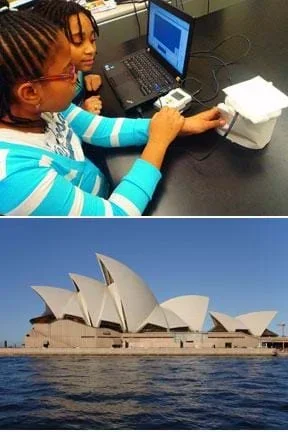 Materials properties are observable and measurable characteristics of solids. The designers of the Sydney Opera House made design decisions about the materials used to create it.Copyright (top) 2012 Rezwana Uddin, Polytechnic Institute of NYU; (bottom) 2005 Matthew Field, Wikimedia Commons http://commons.wikimedia.org/wiki/File:Sydney_opera_house_side_view.jpg
Students investigate the materials properties—such as acoustical absorptivity, light reflectivity, thermal conductivity, hardness, and water resistance—of various materials. They use sound, light and temperature sensors to collect data on various materials. They practice making design decisions about what materials would be best to use for specific purposes and projects, such as designing houses in certain environments to meet client requirements. After testing, they use the provided/tested materials to design and build model houses to meet client specifications.
**Note: This activity uses the retired LEGO NXT robot which is no longer available for purchase.
In the design of any project, scientists and engineers are very aware of the properties of the materials they use, and the most suitable materials for a project are carefully chosen based on those properties. For example, civil engineers must have a thorough understanding of available materials and the properties of those materials used in their projects in order to plan how the structures they design (such as houses, bridges, buildings, dams, opera houses, skyscrapers, roller coasters or highways) will hold up to environmental and usage stresses. Architects and civil engineers work together to make sure that while the design of a structure satisfies the necessities of safety and reliability, the materials chosen also help create a beautiful and comfortable atmosphere for those who interact with it daily.
After this activity, students should be able to:
- Describe a variety of materials properties in addition to the ones they can observe with their senses.
- Explain the design decisions engineers make when choosing materials specific to a project.
- Determine materials properties of objects using sensors and other tests.
- STEL-1H Design solutions by safely using tools, materials, and skills.
Grades 3-5
Do you agree with this alignment? - STEL-3D Explain how various relationships can exist between technology and engineering and other content areas.
Grades 3-5
Do you agree with this alignment?
- 3-5-ETS1-3 Plan and carry out fair tests in which variables are controlled and failure points are considered to identify aspects of a model or prototype that can be improved.
Grades 3-5
Do you agree with this alignment? - 5-PS1-3 Make observations and measurements to identify materials based on their properties.
Grade 5
Do you agree with this alignment?
- 3-5-ETS1-3 Plan and carry out fair tests in which variables are controlled and failure points are considered to identify aspects of a model or prototype that can be improved.
Grades 3-5
This resource focuses on the following Three Dimensional Learning aspects of NGSS:
Science & Engineering Practices- Plan and conduct an investigation collaboratively to produce data to serve as the basis for evidence, using fair tests in which variables are controlled and the number of trials considered.Do you agree with this alignment?
Disciplinary Core Ideas- Tests are often designed to identify failure points or difficulties, which suggest the elements of the design that need to be improved.Do you agree with this alignment?
- Different solutions need to be tested in order to determine which of them best solves the problem, given the criteria and the constraints.Do you agree with this alignment?
Do you agree with this alignment? - Plan and conduct an investigation collaboratively to produce data to serve as the basis for evidence, using fair tests in which variables are controlled and the number of trials considered.
- 5-PS1-3 Make observations and measurements to identify materials based on their properties.
Grade 5
This resource focuses on the following Three Dimensional Learning aspects of NGSS:
Science & Engineering Practices- Make observations and measurements to produce data to serve as the basis for evidence for an explanation of a phenomenon.Do you agree with this alignment?
Disciplinary Core Ideas- Measurements of a variety of properties can be used to identify materials. (Boundary: At this grade level, mass and weight are not distinguished, and no attempt is made to define the unseen particles or explain the atomic-scale mechanism of evaporation and condensation.)Do you agree with this alignment?
Crosscutting Concepts- Standard units are used to measure and describe physical quantities such as weight, time, temperature, and volume.Do you agree with this alignment?
Do you agree with this alignment? - Make observations and measurements to produce data to serve as the basis for evidence for an explanation of a phenomenon.
Each group needs:
- a variety of test materials, such as cardboard, Styrofoam (such as packing peanuts), white paper, wooden Popsicle sticks, cotton balls, plastic wrap, plus any other potential model building materials of your choice that provide a range of measurements using sound, light and temperature sensors, as well as hardness and water tests
- LEGO MINDSTORMS NXT Base Set; this kit includes light and sound sensors, NXT Intelligent Brick, LEGO MINDSTORMS NXT software, including the Data Logging tool, which is used in this activity; the LEGO brick is equipped with programs to show readings from different sensors
- Client Design Requirements Sheet (PDF), a list of requirements and a description of the environment that each group's house needs to be designed for, created in advance by the teacher, three examples are provided on this attachment, to get the teacher started
- very hot water in a small cup, for the thermal conductivity test
- a cup of water on a tray, for the water resistance test
- sharp pencils, for the hardness test
- sink and paper towels, for clean-up of water test
- glue, tape, scissors and paper, to make testing enclosures of the different materials
To share with the entire class:
- LEGO temperature sensor; alternatively, if not available, use a thermometer and manually take readings at regular intervals
Familiarity with the concept of mass, as well as physical properties of objects as observed by one's senses.
Materials properties are characteristics that we can observe about specific materials using our senses and other tools and equipment. Using our senses alone, what might be some of the materials properties that we can detect? (Listen to student responses.) We can use our senses to observe a material's color, texture, how it tastes and how it smells.
However many additional properties are not measurable with just our senses. Can you think of any? (Listen to student ideas.) These properties include characteristics such as electrical conductivity, density, chemical reactivity, elasticity, pH and boiling point. As scientists and engineers, these are all factors that we may be interested to know in order to better understand and choose the materials we work with.
In addition, a good understanding of materials properties helps scientists and engineers make better decisions about the kinds of materials that are best for specific projects. For example, if you were designing a house in Antarctica, you would want to know which materials have properties such that they hold on to heat and keep it within the house rather than allowing the cold arctic air inside and the warm inside air out. On the other hand, if you were designing a house for a tropical island that gets lots of hurricanes and sometimes flooding, you would want to choose materials that remain sturdy even when very wet.
For this activity, we will pretend to be civil engineers studying materials properties in order to best design a house for the environment it is in and to meet the requirements of the client (what they want) who hired us to design the house.
Teacher Note
It helps if the teacher is familiar with the LEGO MINDSTORMS NXT base kit and its software, especially the NXT Data Logging tool. For the activity, it is not necessary to write any programs. Learn more about the LEGO MINDSTORMS Education NXT Software 2.1 at https://shop.education.lego.com/legoed/en-US/catalog/product.jsp?productId=prod120017&isSimpleSearch=false&ProductName=LEGO-MINDSTORMS-Education-NXT-Software-2.1&ProductLine=LEGO-MINDSTORMS-Education-NXT
It is possible to run this activity without using the LEGO brick and sensors by conducting tests such as the hardness and water resistance tests used in the activity. Consider density, elasticity, tensile strength, as well as thermal conductivity using a simple thermometer. Refer to the resources in the Additional Multimedia Support section for lists of other materials properties.
Before the Activity
- Gather and prepare the materials for each group. Make sure to provide each group with enough of the test materials to both test with and to build a small model house. If limited on materials or time, forego building the model houses, and ask students to draw their house designs, explaining their ideas on paper with material choices and purposes clearly identified.
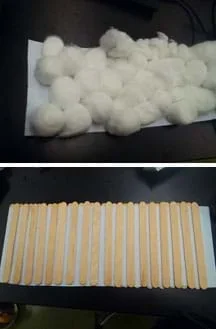 Figure 1. To make loose materials faster for students to test, prepare them by adhering them to paper.Copyright 2012 Rezwana Uddin, Polytechnic Institute of NYU
 - For the steps when students test materials that are composed of loose parts, such as cotton balls, Popsicle sticks or Styrofoam (if packing peanuts are used), it helps to glue the material on some paper in advance (see Figure 1) so that the material is easier to handle as an "enclosure." One suggestion is to glue the material on a piece of paper such that a cup, to be used for the temperature sensing test, can be entirely wrapped by it, as well as making a square "lid" of paper with the material glued to it so that the sensor or cup can also be covered from above (see Figure 3). For materials not composed of loose parts, such as cardboard or paper, students can simply create a box enclosure using glue or tape, of similar dimensions to the cup.
- Prepare for each team a different set of house design requirements. To do this, modify the attached Client Design Requirements Sheet (PDF), which provides three examples to get you started.
- Prepare a LEGO NXT brick for each group by using an NXT cable (included in the base kit) to connect one sensor (light, sound or temperature) to the brick on port 1, 2, 3 or 4; make note of the port used so that the correct one can be identified for viewing.
- Practice taking measurements using the sound and light sensors with the NXT brick, and using the temperature sensor with the NXT Data Logging tool, as described in the testing procedure, below.
With the Students—Testing Procedure
Divide the class into groups of four students each and present all the materials. Have each team build a small enclosed "room" out of just one material and then conduct the following five materials properties tests. Record findings from each test. Then make enclosures and repeat these tests for all materials.
- Acoustical test using sound sensor: Place the NXT sound sensor completely within the enclosure (not touching the enclosure anywhere), play a sound, or have another NXT brick play a sound from just outside the enclosure. What was the sensor reading? Record it and compare this reading for enclosures made of other materials. Refer to Troubleshooting Tips for the sound sensor.
To use the sound and light sensors, it is not necessary to write any programs. Simply use the View command directly from the NXT brick menu during the activity. This menu is what is displayed on the screen as soon as the NXT brick is turned on; Use the right arrow button until the "View" option is available; press the middle button to select it. Once it has been selected, scroll right until the correct sensor is selected. Also specify which port the sensor is connected to.
- Reflection test using a light sensor: Hold the light sensor about a centimeter away from the material, and run the program. Record the reading from the light sensor. How well does this material let in light or reflect light? Compare to other readings for other materials.
- Thermal conductivity test using temperature sensor: For safety reasons and if limited resources, consider having the teacher demonstrate this test at the front of the classroom instead of having each group conduct it. Use the NXT Data Logging Tool that is part of the software included with the LEGO base kit to display how heat is lost from inside the enclosure at different rates for different insulating materials. Follow these steps to start an "experiment" with this tool. (Alternatively, if a temperature sensor is not available, simply use a thermometer and manually take readings at regular intervals, such as every 10 seconds for 5 minutes.)
- Connect the NXT brick to the computer via the USB cable (provided in the LEGO base kit).
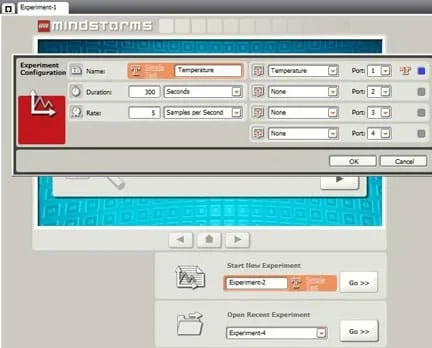 Figure 2. To use the NXT temperature sensor, use the NXT Data Logging Tool and set the "Experiment Configurations" as shown.Copyright 2012 Rezwana Uddin, Polytechnic Institute of NYU
 - Open up the NXT Data Logging Tool, which is part of the LEGO MINDSTORMS NXT software provided in the base kit. In the welcome screen, create a new name for an experiment under "Start New Experiment' and hit "Go." Prepare the "Experiment Configurations" as shown in Figure 2. In this example, this sets up the experiment with a name of "Temperature," duration of 300 seconds, rate of 5 samples per second, and sensor chosen as "Temperature" on port 1. The duration of 300 seconds is for one material; feel free to experiment with other amounts of time, but be consistent throughout the activity for each material. Make sure the port number matches the port the sensor is plugged into. Press OK when the configurations have been set.
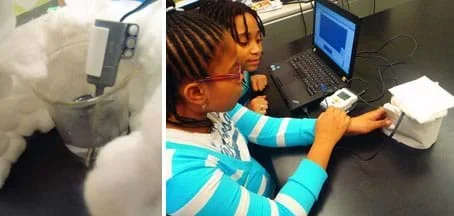 Figure 3. Place the LEGO temperature sensor in the hot water and enclose the cup with the test material. Then view the data logged from the temperature sensor.Copyright 2012 Rezwana Uddin, Polytechnic Institute of NYU
 - Place the cup of very hot water inside the enclosure along with the temperature sensor placed in the water, and have the NXT brick reading the measurements, placed outside (see Figure 3). Tip: To avoid accidents, make sure the water is a good distance away from the computer!
- On the computer, hit the green play button in the bottom right of the logging software screen to start the data logging. See Figure 4 for an example of collected data.
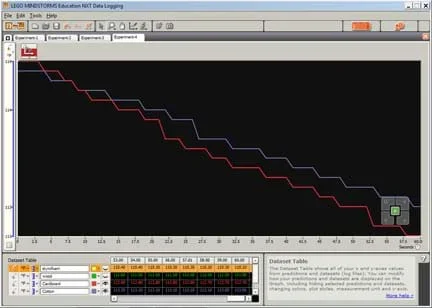 Figure 4. Example captured logging data shows water temperature changes over two minutes while insulated by cardboard (red) and cotton (blue).Copyright 2012 Rezwana Uddin, Polytechnic Institute of NYU
 - The NXT Data Logging Tool graphs the rate of temperature change for the allotted time. It may be more efficient to have students move on with other parts of the experiment while this runs, and return to it after the five minutes are up. Discuss the resulting data plot with the class.
- You can plot multiple lines on the same graph by changing the material being tested and hitting run (the green play button on the bottom right) again for the experiment, without making any other changes. Feel free to change the labels and line colors to make it easier to understand and compare the data; look under the "Dataset Table" heading in the NXT Logging Tool screen (across the bottom; see Figure 4).
- Discuss with students: How quickly did the temperature drop? (In this case, it makes more sense to compare the lines and the rate at which the temperature dropped for materials rather than to compare specific measurements.)
- Hardness test using a sharp pencil: Try and puncture the enclosure with a pencil (careful!). Use a 1-10 scale to record the difficulty of puncturing through the material.
- Water resistance test: Place the enclosure on a tray and spill a cup of water onto the tray. Observe what happens to the model. How well does the model material hold up? Record a description.
With the Students—Test Analysis & Application
- After the materials properties tests are completed for all materials, have students share their results and discuss their findings for each of the materials. Ask the students:
- Acoustics test using a sound sensor: Which material was best at absorbing sound? (Answer: Cotton balls.)
- Reflection test using a light sensor: Which material was best at reflecting light? (Answer: Depends on the color of the test material. Lighter and brightly colored objects reflect light more than dark objects. For clear materials, measurements depend on the properties of whatever materials are behind them.)
- Thermal conductivity test using a temperature sensor: Which material was the most insulating? (Answer: Thermal conductivity results will vary, depending on how the sensors are enclosed in the material and the time allotted for the experiment.)
- Hardness test using a sharp pencil: Which material was most resistant to damage from a sharp object? (Answer: Popsicle sticks.)
- Water resistance test: Which material held up best against water? (Answer: Styrofoam.)
- Applications: For what building purposes might use materials with the properties we measured to get the results we want? (Possible answers: The acoustics characteristics of materials are important to know when designing places you want to keep quiet and/or places you want to extend and enlarge sound, such as bedrooms, libraries, movie theaters, auditoriums, music recording studios. Light-colored and highly reflective materials make objects easier to be seen and reflect light to increase brightness. Insulating materials are good for walls and roofs in climates where we do not want the heated or cooled inside air to conduct out of the house, or the extremely hot or cold outside temperatures to alter the inside house temperatures. Tough materials with high hardness measurements could be useful in regions of high wind and frequent storms, such as tornadoes and hurricanes, where strong winds and flying debris might be damaging, or for use as roofs that can hold heavy snow. In wet regions, we want materials that do not deteriorate in conditions of high humidity, rain and/or flooding.)
- Now that students have a better understanding of the properties associated with the materials, ask them to design houses for clients. Give each team its own client design requirements. Direct teams to brainstorm and agree on a design. What materials will you use and why? How might you combine different materials in order to achieve the best results? How will you make your designs be well suited to living in the environments and meeting client requirements? Then have student teams use the given materials to build the model houses they designed.
- Once the model homes are built, have each team present its design to the class, describing why they made the design choices that they did. Encourage peer critique and suggestions for improvement.
- acoustic absorption
- The process by which sound waves hitting a material are absorbed by it rather than bounced back.
- hardness
- A measure of how resistive a material is to physical change.
- insulating (temperature)
- Preventing the passage of heat into or out of a space.
- materials property
- A property of a solid material that is often used to compare materials when selecting the most suitable materials for specific purposes.
- reflectivity
- The ability of a material to reflect back a certain amount of light.
Pre-Activity Assessment
Opening Discussion: With various materials on display, discuss materials properties with the class. Ask the students: What are some materials properties? What materials properties can you describe for these materials? Expect answers to pertain to properties that can be observed directly using one's senses, such as color, texture, taste, smell. Use this discussion to learn how broadly students define materials properties at the beginning of the activity.
Activity Embedded Assessment
Results & Conclusions Discussion: After the materials properties tests are completed for all materials, have students share their results and discuss their findings for each of the materials. Ask students the questions in the Procedure section. Use this as an opportunity to gauge students' level of comprehension.
Post-Activity Assessment
Class Presentations: Have teams present the model houses that they designed and built, describing all the design choices they made, how the materials properties affected their decisions, as well as the materials properties of the used materials. Encourage peer critique and suggestions for improvement. Evaluation of student design choices indicates their mastery of the concepts.
- Be cautious with scissors, stabbing pencils and hot water!
- Keep water away from electronic equipment such as the sensors and NXT brick.
Make sure all sensors are correctly connected to the ports specified in the program.
This sound sensor testing works best in a quiet room.
Make sure the sound sensor is not touching any of the enclosure walls. The NXT sound sensor can be unreliable so it may take a few tries. If you do not get a steady reading, ignore random jumps in the reading and record and compare the approximate range of readings. For example, the readings for cotton balls may vary from 20-40, whereas the readings for cardboard may vary from 50-70.
Assign students to research other materials properties and how they could be tested and measured.
Measure and describe other properties of the same materials using sensors or other equipment.
- For lower grades, simplify the requirements, study each materials property separately and have groups design model houses intended to meet no more than two specific requirements at a time, for example, a very quiet house, a very warm house, etc.
- For more advanced students, incorporate cost of materials and challenge teams to compete to design and build houses that best meet one client's requirements while reducing costs. Assign a cost to each material based on type and amount of material used. Introduce the idea of how engineering trade-offs must be made based on cost and other competing factors
V. Ryan's Properties of Materials page: http://www.technologystudent.com/joints/matprop1.htm
Wikipedia's List of Materials Properties page: http://en.wikipedia.org/wiki/List_of_materials_properties
Contributors
Rezwana Uddin
Supporting Program
AMPS GK-12 Program, Polytechnic Institute of New York University
Acknowledgements
This activity was developed by the Applying Mechatronics to Promote Science (AMPS) Program funded by National Science Foundation GK-12 grant no. 0741714. However, these contents do not necessarily represent the policies of the NSF and you should not assume endorsement by the federal government.
Copyright
2013 by Regents of the University of Colorado; original © 2012 Polytechnic Institute of New York University