
Measuring g for Gravity
Legacy Curriculum
Hey there! This curriculum is no longer being curated or supported. It may contain materials that are no longer available or outdated information. Please use this document for reference.
 Students use LEGO MINDSTORMS robots to examine and measure gCopyright 2009 Keeshan Williams, Polytechnic Institute of NYU
Using the LEGO® MINDSTORMS® kit, students construct experiments to measure the time it takes a free falling body to travel a specified distance. Students use the touch sensor, rotational sensor, and the NXT brick to measure the time of flight for the falling object at different release heights. After the object is released from its holder and travels a specified distance, a touch sensor is triggered and time of object's descent from release to impact at touch sensor is recorded and displayed on the screen of the NXT. Students calculate the average velocity of the falling object from each point of release, and construct a graph of average velocity versus time. They also create a best fit line for the graph using spreadsheet software. Students use the slope of the best fit line to determine their experimental g value and compare this to the standard value of g.
A fundamental understanding of the role of gravity is the foundation for many feats of engineering that we see in our everyday lives, such as bridges, buildings, airplanes and boats. This experiment is designed to show how similarly shaped objects, of different weights, have the same acceleration when in free fall. Engineers need a solid understanding of forces in order to predict future behavior of the structures or objects they design.
After this activity, students should be able to:
- Construct a plot of velocity vs. time.
- Propose explanations for the difference in the calculated and standard g.
- Perform basic programming using the LEGO MINDSTORMS NXT software.
- Plot data using spreadsheet software.
- CCSS.Math.Content.7.EE.B.4 Use variables to represent quantities in a real-world or mathematical problem, and construct simple equations and inequalities to solve problems by reasoning about the quantities.
Grade 7
Do you agree with this alignment? - CCSS.Math.Content.8.F.A.1 Understand that a function is a rule that assigns to each input exactly one output. The graph of a function is the set of ordered pairs consisting of an input and the corresponding output.
Grade 8
Do you agree with this alignment? - CCSS.Math.Content.8.F.B.4 Construct a function to model a linear relationship between two quantities. Determine the rate of change and initial value of the function from a description of a relationship or from two (x, y) values, including reading these from a table or from a graph. Interpret the rate of change and initial value of a linear function in terms of the situation it models, and in terms of its graph or a table of values.
Grade 8
Do you agree with this alignment? - CCSS.Math.Content.8.SP.A.1 Construct and interpret scatter plots for bivariate measurement data to investigate patterns of association between two quantities. Describe patterns such as clustering, outliers, positive or negative association, linear association, and nonlinear association.
Grade 8
Do you agree with this alignment?
- Some technological problems are best solved through experimentation.
Grades 6-8
Do you agree with this alignment? - STEL-8J Use devices to control technological systems.
Grades 6-8
Do you agree with this alignment?
- MS-PS2-2 Plan and conduct an investigation to provide evidence that the change in an object's motion depends on the sum of the forces on the object and the mass of the object.
Grades 6-8
Do you agree with this alignment?
- MS-PS2-2 Plan an investigation to provide evidence that the change in an object's motion depends on the sum of the forces on the object and the mass of the object.
Grades 6-8
This resource focuses on the following Three Dimensional Learning aspects of NGSS:
Science & Engineering Practices- Plan an investigation individually and collaboratively, and in the design: identify independent and dependent variables and controls, what tools are needed to do the gathering, how measurements will be recorded, and how many data are needed to support a claim.Do you agree with this alignment?
- Science knowledge is based upon logical and conceptual connections between evidence and explanations.Do you agree with this alignment?
Disciplinary Core Ideas- The motion of an object is determined by the sum of the forces acting on it; if the total force on the object is not zero, its motion will change. The greater the mass of the object, the greater the force needed to achieve the same change in motion. For any given object, a larger force causes a larger change in motion.Do you agree with this alignment?
- All positions of objects and the directions of forces and motions must be described in an arbitrarily chosen reference frame and arbitrarily chosen units of size. In order to share information with other people, these choices must also be shared.Do you agree with this alignment?
Crosscutting Concepts- Explanations of stability and change in natural or designed systems can be constructed by examining the changes over time and forces at different scales.Do you agree with this alignment?
Do you agree with this alignment? - Plan an investigation individually and collaboratively, and in the design: identify independent and dependent variables and controls, what tools are needed to do the gathering, how measurements will be recorded, and how many data are needed to support a claim.
Each group needs:
- LEGO MINDSTORMS NXT robot, such as the NXT Base Set (5003402) for $159.98 at https://shop.education.lego.com/legoed/en-US/catalog/product.jsp?productId=5003402& isSimpleSearch=false&ProductLine=NXT; two bricks are needed for this activity; alternatively, the activity may be done with stopwatches intead of the robots, as described in the Activity Extensions section)
- LEGO MINDSTORMS Education NXT Software 2.1, available as a single license (2000080) for $39.97 or a site license (5003413) for $271.96 at https://shop.education.lego.com/legoed/en-US/catalog/product.jsp?productId=prod120017&isSimpleSearch=false&ProductLine=LEGO+MINDSTORMS+Education+NXT
- computer, loaded with NXT 2.1 software
- 2-3 balls of similar shape and different weights
- tape measure or meter stick
- Measuring g Activity Worksheet (PDF), one per student
It is useful if the teacher has had experience programming with LEGO MINDSTORMS NXT robots. Students should have a basic understanding of graphing in Cartesian coordinates, the slope-intercept form of an equation for a line, and determining slope given an equation for a line.
What exactly is gravity? How does gravity affect us and objects around us? Gravity is commonly thought of as a universal force that holds matter together. It is actually a force of attraction between matter or objects. Any two objects have a gravitational force that tries to pull them closer together, and the greater the mass of the objects and the smaller the distance between the objects, the greater the gravitational force. We feel gravity as a force the Earth exerts on objects in its vicinity, because the Earth is the closest object to us with the greatest mass. On the surface of the Earth, gravity is the net force that is responsible for downward motion of free falling objects. It accelerates all objects at the same rate, that is, two objects of roughly the same size and shape, but different weights, when dropped from the same height, will hit the ground at the same time. To illustrate this, the experimental apparatus will be constructed using the LEGO MINDSTORMS NXT kit.
Newton's second law states that the net force on an object is equal to the mass of the object times its acceleration;
F = ma (1)
where m is mass and a is acceleration. For an object in free fall, equation 1 can be written as;
F = mg (2)
where m is mass and g is the acceleration due to gravity. Equating equations 1 and 2 shows that the acceleration of the object is due to force of gravity and is independent of mass;
F = ma = mg --> a= g (3)
For a conservative system, the total amount of energy remains constant. In our setup, only forces in the vertical direction come into play (neglect air resistance). At the beginning of the experiment, the object is fixed at a specified distance above some base level (e.g. the ground). At the starting position, the object is considered to have potential energy or energy that can be turned into work (PE) but no kinetic energy or energy of motion (KE). As soon as the object is released, some of its PE is converted to KE, and the object begins to fall due to gravity. As freefall continues more of its PE is converted to KE and the velocity of the object increases. This change in the object's velocity as it falls is the acceleration due to gravity, g, which has a constant value of 9.8 m/s2.
From experiments and calculus, the final velocity (vf) and final position (xf) of an object is given by
vf = v0 + gt (4)
xf = x0 + v0t + ½ gt2 (5)
For this activity, we will be measuring the average velocity, such that:
vavg = ½ (vf + v0) (6)
where vf and vo are the final and initial velocities, respectively. Substitution of equation 6 into equation 5 yields:
vavg = v0 + ½ gt (7)
Keep in mind the initial velocity v0 will be zero for each trial. This means that equation 7 can be reduced to:
vavg = ½ gt (8)
Equation 8 will be very important in helping us calculate an experimental g value and comparing it to the standard g value.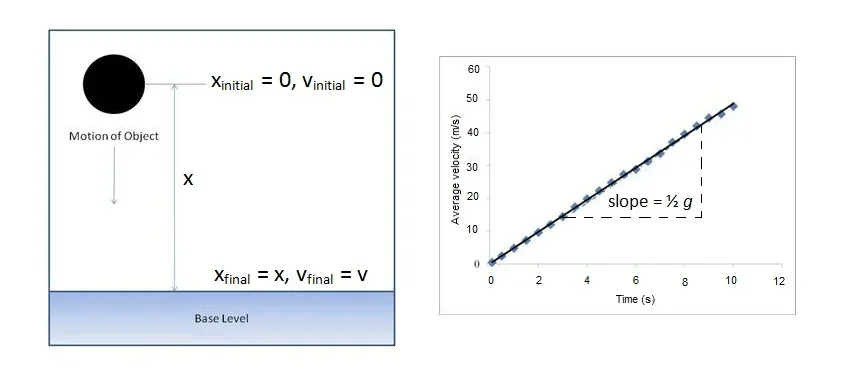 An object with an initial velocity of zero will hit the ground (base level) with a final velocity in accordance with equation 4.Copyright 2009 Keeshan Williams, Polytechnic Institute of NYU
Before the Activity
- Download LEGO Digital Designer and load Measuring g – Building Instructions (LXF).
- Construct the experimental apparatus according to the attached building instructions.
- Establish a Bluetooth connection between the two NXTs. Load the attached LEGO MINDSTORMS NXT program. Download Measuring g – Controller (RBT)onto the brick attached to the object holder. Download Measuring g – Receiver (RBT) onto the brick attached to the touch sensor/platform. (Instructions on using and setting up a Bluetooth connection can be found on page 34 of the LEGO MINDSTORMS NXT user guide)
With the Students
- Distribute Measuring g Activity Worksheet (PDF) to students.
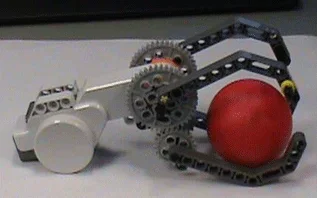 Figure 1: A ball is placed in the object holder.Copyright 2009 Keeshan Williams, Polytechnic Institute of NYU
 - Place ball in object holder as shown in Figure 1 and position a specified distance directly above target. The full set up is shown in Figure 2.
- Measure the vertical distance between the object and the base plate of the touch sensor.
- Run the Measuring g – Receiver program on the brick attached to the touch sensor. Run the Measuring g – Controller program on the brick attached to the object holder.
- On the Measuring g Activity Worksheet, record the time it takes for the object to hit the touch sensor after it is dropped from the object holder. This time will be displayed on the screen of the LEGO MINDSTORMS NXT.
- Calculate average velocity of each run using the following equation:
velocity = distance/ time
- Repeat steps 1 -5 while either raising or lowering the starting position of the object. Record data in chart on the Measuring g Activity Worksheet for four additional starting positions.
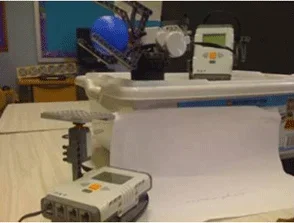 Figure 2: A ball is placed in the object holder and held at a vertical distance from the touch sensor.Copyright 2009 Keeshan Williams, Polytechnic Institute of NYU
 - Repeat for another object of different weight.
- Using spreadsheet software such as Excel, construct a graph of average velocity vs. time for all objects tested.
- Perform a linear regression analysis (a best fit line) of the data and obtain the equation for the line (in the form of y = mx +b) as well as the square of error (R2). A good fit is determined by a R2 that is close to 1, which in turn will determine how well the calculated values of g agree with the standard value of g.
- Based on equation 8, above, the value for the slope (m) is the acceleration g divided by 2. By multiplying this slope by a factor of two, it will give a measured value g of the free falling object. Compare this value to the standard value of g.
- Compare the values for the measured acceleration of the different the objects tested. Keep in mind that the values determined for g should be similar for all objects tested.
- acceleration
- The rate of change of velocity with respect to time.
- gravity
- The force of attraction by which terrestrial bodies tend to fall toward the center of the earth.
- kinetic energy
- The energy of motion.
- potential energy
- The energy of position.
- velocity
- The rate of change of position with respect to time.
Activity Embedded Assessment
Analysis – Measuring g Activity Worksheet (PDF)
Students complete the activity worksheet and in doing so, perform the following analysis. Students observe that although the best fit lines generated for the objects tested may look different, they should have a similar slope. Also, students gauge the reliability of the best fit line by the R2 value, with 1 being a perfect fit. Students consider and research explanations for the difference in the values for the measured acceleration and accepted value of g (9.8 m/s2). In conclusion, students are asked to think about examples of engineering applications where knowing the value of g is crucial, such as designing a rocket ship or sending a satellite into orbit.
This activity could be performed without the use of the LEGO MINDSTORMS NXT, and instead, students could use stopwatches to measure the time it takes an object to fall and hit the ground. Therefore, one possible activity extension is to have students perform this activity as is and again without the use of the LEGO MINDSTORMS NXT to compare the results. Students should consider which measured g value is closest to the accepted g value. Which method provided a more accurate result? Did the LEGO MINDSTORMS NXT help or hinder measuring g? What does this suggest about the assistance of a robot in scientific and engineering calculations and experimentations?
Dictionary.com. Dictionary.com, LLC. Accessed August 2, 2009. (Source of some vocabulary definitions, with some adaption) http://dictionary.reference.com/
LEGO.com. The LEGO Group. Accessed August 2, 2009. http:// www.Mindstorms. http:// lego.com
Contributors
Keeshan Williams; Nicole Abaid; Jennifer Haghpanah
Supporting Program
AMPS GK-12 Program, Polytechnic Institute of New York University
Acknowledgements
This activity was developed under the Applying Mechatronics to Promote Science (AMPS) Program funded by National Science Foundation GK-12 grant no. 0741714. However, these contents do not necessarily represent the policies of the NSF and you should not assume endorsement by the federal government.
Copyright
2013 by Regents of the University of Colorado; original © 2009 Polytechnic Institute of New York University