
Viscosity: The Flow of Milk
 Students exploring the viscosity of various fluids.Copyright 2012 Jennifer S. Haghpanah, Polytechnic Institute of NYU
Students study the physical properties of different fluids and investigate the relationship between the viscosities of liquid and how fast they flow through a confined area. Student groups conduct a brief experiment in which they quantify the flow rate to understand how it relates to a fluid's viscosity and ultimately chemical composition. They explore these properties in milk and cream, which are common fluids whose properties (and even taste!) differ based on fat content. They examine control samples and unknown samples, which they must identify based on how fast they flow. To identify the unknowns requires an understanding of the concept of viscosity. For example, heavy cream flows at a slower rate than skim milk. Ultimately, students gain an understanding of the concept of viscosity and its effect on flow rate.
Engineers commonly design equipment or devices that requires them to take into consideration the viscosity of particular fluids. Chemical engineers design chemicals of very different viscosities(ranging from rubber to petroleum to alcohols and aqueous solutions) and all their processes and reactions must take into account the flow rate of these substances. In the design of artificial heart valves and vascular stents, biomedical engineers must have an intimate knowledge of the flow rate and properties of blood when it flows through arteries and veins in order to design devices that function correctly. Mechanical engineers who design combustion engines consider the liquid flow rate of oils, petroleums and fuels under different conditions. Understanding the relationship between viscosity and flow rate are essential in any engineering process involving liquids!
After this activity, students should be able to:
- Explain the reasoning behind the varying flow rates of milks with various fat content.
- Describe the relationship between viscosity and flow rate, and extrapolate information from it.
- Explain the importance of viscosity consideration in scientific use and engineering applications.
- Collect and analyze data from an experimental set-up.
- Identify dependent and independent variables in an experiment.
- CCSS.Math.Content.6.NS.B.3 Fluently add, subtract, multiply, and divide multi-digit decimals using the standard algorithm for each operation.
Grade 6
Do you agree with this alignment? - CCSS.Math.Content.8.SP.A.1 Construct and interpret scatter plots for bivariate measurement data to investigate patterns of association between two quantities. Describe patterns such as clustering, outliers, positive or negative association, linear association, and nonlinear association.
Grade 8
Do you agree with this alignment? - CCSS.Math.Practice.MP2 Reason abstractly and quantitatively.
Grades K-12
Do you agree with this alignment?
- STEL-3G Explain how knowledge gained from other content areas affects the development of technological products and systems.
Grades 6-8
Do you agree with this alignment? - STEL-8L Interpret the accuracy of information collected.
Grades 6-8
Do you agree with this alignment?
- 6.NS.3 Fluently add, subtract, multiply, and divide multi-digit decimals using the standard algorithm for each operation.
Grade 6
Do you agree with this alignment? - 8.SP.1 Construct and interpret scatter plots for bivariate measurement data to investigate patterns of association between two quantities. Describe patterns such as clustering, outliers, positive or negative association, linear association, and nonlinear association.
Grade 8
Do you agree with this alignment? - MP.2 Reason abstractly and quantitatively.
Grades -1-12
Do you agree with this alignment?
- CCC.4.6-8.3 Models can be used to represent systems and their interactions—such as inputs, processes and outputs—and energy and matter flows within systems.
Grades 6-8
Do you agree with this alignment? - SEP.1.6-8.2 Construct and interpret graphical displays of data to identify linear and nonlinear relationships.
Grades 6-8
Do you agree with this alignment? - SEP.7.6-8.3 Conduct an investigation to produce data to serve as the basis for evidence that meet the goals of an investigation.
Grades 6-8
Do you agree with this alignment?
Each group needs:
- 1 2-ml column
- 5 test tubes
- 5 prepared samples of milk in beakers
- skim milk (non-fat)
- 1% milk (low-fat)
- 2% milk (reduced-fat)
- heavy cream
- whole milk (control sample)
- 1 funnel or pipette
- 1 timer
- 1 beaker/bowl (to collect the liquid)
- markers or colored pencils
- Milk Race: Investigating Viscosity Worksheet (PDF), one per student
Know how to collect data and make scientific graphs from data, how fluids act and that their functionalities may vary based on their chemical/ physical nature.
 Preparation of known and unknown samples.Copyright 2012 Yeri Park, Polytechnic Institute of NYU
Have you ever really looked at all the items at your home? You probably have 100s of different fluids. Which ones come to mind? (Listen to student ideas.) Think of water, shampoo, mouthwash, sodas, milk, chicken broth, orange juice, ketchup, oils, lotion, vinegar, anti-freeze, window cleaner, and the list goes on.
What do all these different solutions have in common and why we are talking about them? Well, all these solutions may exist as either a homogenous (uniform solution) or heterogeneous (assorted mixture solution) and they all have a flow associated with them. Not all fluids flow at the same rate; some may come out of a container very quickly, while others may take some time to empty out. Many different factors can govern how fast a fluid flows including the chemical properties of the solution such as the types of chemical bonds that the solution is comprised of, the homogeneity/ heterogeneity and thickness of the solution. Can anyone think of a fluid that flows very quickly? (Possible answers: Water, soda, juice.) Can anyone think of a fluid that flows very slowly? (Possible answers: Honey, cream, oil.)
Let's think about milk. What kind of milk do you drink? (Possible answers: Whole, skim, 1%, 2%, fat-free, soy, almond, heavy cream.) Have you ever noticed that some types of milk are thicker than others? Do you think that contributes to how fast it flows out of a container?
Today, we're going to do an experiment that takes a look at how fast different types of milk flow. Before we start, you're going to make a hypothesis on which type of milk will flow the fastest and which type of milk will flow the slowest. Once you have those predictions in your notebook, we can start the milk race!
Background
The chemistry of fluids and solutions is an important and sometimes difficult concept for students to grasp because solutions have properties that are usually not tangible or visible. It helps students to fully understand fluids and fluid dynamics if they can experiment and make a mess with solutions. One can easily pour a solution on a table and see how fast it flows just by how fast it moves across the table.The movement of the solution across a table can vary depending on the nature of the solution and the environment surrounding the solution. Today, scientists and engineers characterize the properties of liquid solutions via viscometer, rheometer and even contact angle measurements. Therefore, it is advantageous to teach young scientists and engineers about liquids because they are all around us and students may someday have a job in which they need to characterize fluids.
Procedure
- Hand out a worksheet to each student.
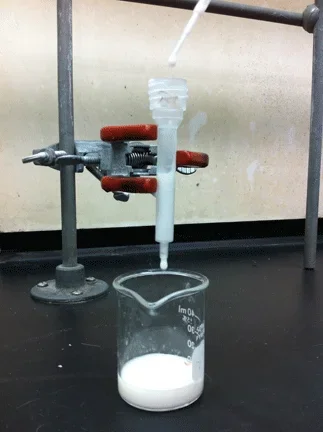 Running milk through a column.Copyright 2012 Jasmin Hume, Polytechnic Institute of NYU
 - Divide the class into groups of two to four students. Collect test tubes of milk samples consisting of one known/control sample (whole milk) and four unknown samples (skim milk, 1% milk, 2% milk, and heavy cream).
- Using a funnel or pipette, pour the first sample (whole milk) through the capped column.
- When ready, un-cap the column, start the timer, and count the number of drops that drip out of the column during a one-minute period.
- Repeat step 3 three times to obtain an average # of drops per minute (flow rate).
- Repeat steps 2-4 for the unknown samples.
- Graph the flowrate (drops per minute) of each sample on a bar graph.
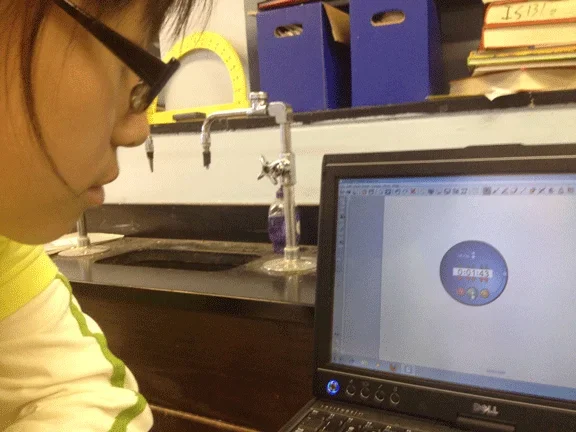 Time check.Copyright 2012 Yeri Park, Polytechnic Institute of NYU
 - Using your graph, order the test tubes from highest flow rate to lowest flow rate.
- Direct students to identify the unknowns by their respective flow rates. Since heavy cream is the most viscous, its flow rate will be the slowest, followed by whole milk, 2% milk, 1% milk, and lastly skim milk.
 Students hard at work.Copyright 2012 Yeri Park, Polytechnic Institute of NYU
 Students arrange test tubes in order of increasing viscosity.Copyright 2012 Yeri Park, Polytechnic Institute of NYU
- contact angle
- The angle at which a liquid/gas meets a solid surface.
- flow
- The distance traveled by a fluid through a confined space per unit of time.
- fluid
- A substance that has no fixed shape and yields to external pressure. For example, a liquid.
- heterogeneous
- When a sample is made of many different materials that are not uniform in solution.
- homogenous
- When a sample is uniform in composition.
- rheometer
- An instrument for measuring the rheological, or deformation and flow of matter, properties of a substance.
- solute
- The small amount of chemical or solution that is being dissolved in the large amount of solution.
- solution
- A chemical mixture comprised of a solute and solvent.
- solvent
- The large amount of solution that is dissolving the solute.
- viscosity
- A fluid's internal resistance to shear in a defined environment.
- viscometer
- An instrument for measuring viscosity of liquids.
Pre-Activity Assessment
Comprehension Questions: Ask the students:
- What is viscosity? (Answer: Viscosity is a fluid's internal resistance to shear in a defined environment.)
- How might the differences in viscosity affect how fast a liquid flows out of a container? (Answer: The higher the viscosity, the slower the liquid flows out of a container. The lower the viscosity, the faster the liquid flows out of a container.)
- What are the components of milk and cream? What types of molecules are found in these liquids? (Answer: The components of milk and cream include a variety of proteins, lipid molecules, water, dissolved carbohydrates, vitamins and inorganic minerals. Three main types of biomolecules are found in milk: carbohydrates, proteins and lipids.)
- What does the percentage of fat content in milk and cream refer to? What does it tell us about the chemistry of the solution? (Answer: The percentage of fat content in milk and cream refers to the proportion of milk [or cream] by weight that is made up of butterfat. Cream usually has fat concentrations in the range of 25–40%, while milk is 0–4% milkfat. The fat content indicates differences in the chemical properties of the solution, such as the viscosity. In general, as we have seen in this activity, the higher the fat content, the higher the viscosity.)
Activity Embedded Assessment
Activity Engagement: Walk around the room to make sure groups order the test tubes in accordance with their calculated flow rates. Make sure that measurements for each sample are performed three times, in order to obtain a better statistical average.
Post-Activity Assessment
Activity Reflection: Ask students the following questions> Answers are provided in the Milk Race: Investigating Viscosity Worksheet Answer Key (PDF).
- What are the dependent and independent variables in this experiment?
- How were you able to identify the unknown liquids?
- Was your hypothesis correct?
- What can you say about the relationship between viscosity and the flow rate of a liquid?
- What do properties like viscosity and flow rate have to do with the chemistry of a particular liquid?
- How do different concentrations of fat in milk/cream affect their viscosity and flow rate through a column?
- When would researchers or engineers want to use liquids of high viscosities? low viscosities?
Homework
Home Search: List five examples of liquids you find at home that have high viscosities and five that have low viscosities. Bonus points for items that no other students mention.
Contributors
Yeri Park; Jasmin Hume; Jennifer Haghpanah
Supporting Program
AMPS GK-12 Program, Polytechnic Institute of New York University
Acknowledgements
This activity was developed by the Applying Mechatronics to Promote Science (AMPS) Program funded by National Science Foundation GK-12 grant no. 0741714. However, these contents do not necessarily represent the policies of the NSF, and you should not assume endorsement by the federal government.
Copyright
2013 by Regents of the University of Colorado; original © 2012 Polytechnic Institute of New York University