
Parallel and Intersecting Lines—A Collision Course?
Legacy Curriculum
Hey there! This curriculum is no longer being curated or supported. It may contain materials that are no longer available or outdated information. Please use this document for reference.
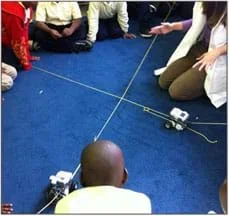 Students see the consequences of robots traveling parallel and non-parallel lines.Copyright 2011 Ursula Koniges, AMPS Program, Polytechnic Institute of NYU
Students act as civil engineers developing safe railways as a way to strengthen their understanding of parallel and intersecting lines. Using pieces of yarn to visually represent line segments, students lay down "train tracks" on a carpeted floor, and make guesses as to whether these segments are arranged in parallel or non-parallel fashion. Students then test their tracks by running two LEGO® MINDSTORMS® robots to observe the consequences of their track designs, and make safety improvements. Robots on intersecting courses face imminent collision, while robots on parallel courses travel safely.
Civil engineering is a broad field that encompasses designing and building of physical structures such as bridges, buildings and roads. Railway engineering is one particular specialty of civil engineering. This activity enables student application of somewhat abstract geometrical concepts to the practical example of railways; something familiar and tangible to many children. By applying these concepts to a known setting, with predictable consequences, students are able to solidify their understanding of abstract terms while simultaneously becoming acquainted with civil engineering.
After this activity, students should be able to:
- Identify sets of parallel lines.
- Identify sets of non-parallel lines.
- Identify points of intersection in non-parallel lines.
- Project the intersection points of non-parallel lines.
- CCSS.Math.Content.4.G.A Draw and identify lines and angles, and classify shapes by properties of their lines and angles.
Grade 4
Do you agree with this alignment?
- The process of experimentation, which is common in science, can also be used to solve technological problems.
Grades 3-5
Do you agree with this alignment?
- Draw and identify lines and angles, and classify shapes by properties of their lines and angles.
Grade 4
Do you agree with this alignment?
To share with the entire class:
- 2 LEGO MINDSTORMS EV3 robots (instructions to build and program basic robots are included with LEGO EV3 kits); LEGO MINDSTORMS EV3 robot, such as EV3 Core Set (5003400) at https://education.lego.com/en-us/products/lego-mindstorms-education-ev3-core-set/5003400#lego-mindstorms-education-ev3
- 2 pieces of a brightly colored yarn, each ~1.5 feet (.5 m) in length
- 2 pieces of a brightly colored yarn, each ~6 feet (2 m) in length
- chalk or dry erase marker to use with the classroom board
- Pre-Activity Quiz (PDF), one per student
- Post-Activity Quiz (PDF), one per student
Alternative: LEGO MINDSTORMS NXT Set:
Note: This activity can also be conducted with the older (and no longer sold) LEGO MINDSTORMS NXT set instead of EV3; see below for those supplies:
- 2 LEGO MINDSTORMS NXT robots
Note: As an alternative to using the LEGO robots, provide much longer lengths of yarn and have students walk along the two tracks to see if they "collide" with each other. Make it a fun "game," by dividing the class into teams with a representative from each team acting out each track scenario. Then give teams some time to quietly discuss the answers to the questions posed in the Procedure section before coming back together as a class. Then, call on teams to share their answers to the questions and see which teams got them right.
Students should have some familiarity with the terms parallel and intersect.
Who are the people who design structures such as roads, bridges and railways? (Listen to student ideas.) Civil engineers design and create these types of structures. If you were designing highways, bridges or railways, what would you need to think about? (Listen to student responses.) Well, safety is one important consideration. Engineers must ensure the safety of people who use these structures by designing them to minimize and prevent crashes, collapses or other catastrophes.
Some civil engineers focus their work solely on transportation projects, including roads, traffic, highways, tunnels, bridges, airports, public transportation systems, and how all these work together. Railway engineering is a type of civil engineering that focuses on the design and fabrication of railways.
Who can give me a definition of "parallel lines?" (Listen to the definitions from a few students. Then illustrate the correct definition of parallel using the classroom board. Draw two parallel lines and highlight what about those two lines makes them parallel.)
Who can give me a definition of "non-parallel lines?" (Listen to the definitions from a few students. Then illustrate the correct definition of non-parallel using the classroom board. Draw two non- parallel lines and highlight what about those two lines makes them not parallel. Contrast this definition and visual illustration with the definition and visual illustration for parallel lines.)
Who can give me a definition of "points of intersection?" (Listen to the definitions from a few students. Then illustrate the correct definition by extending the lines of parallel and non-parallel lines on the classroom board. By extending the lines, students observe that parallel lines never intersect, and the non-parallel lines either intersect or could be projected to result in points of intersection at distant points.)
Before the Activity
- Gather materials.
- Make copies of the Pre-Activity Quiz (PDF) and Post-Activity Quiz (PDF).
- Build and program the two EV3 robots.
- Make available a large carpeted floor area.
With the Students—Quiz and Concepts
- Administer the pre-activity assessment, as described in the Assessment section. Collect the quizzes for later use in determining the effectiveness of the activity on content learning.
- Assess, review and discuss the concepts of civil engineering, parallel lines, non-parallel lines, and points of intersection, as presented in the Introduction/Motivation section.
- Briefly introduce the concept of developing non-dangerous train tracks to the students, by stating the following:
- Safe train tracks help make train crashes less likely.
- When engineers (particularly civil engineers who specialize in railway engineering) design train tracks, they must consider the safety of passengers, passers-by, and the trains.
- In this activity, we will design "train tracks" that make crashes between robots less likely.
With the Students—Random Tracks
- Select two volunteers from the class.
- Have student 1 lay down the first short piece of yarn on the floor in a straight line.
- Ask student 2 to lay the second short piece of yarn on the floor, any way they please, as long as it is also in a straight line.
- Ask the students to identify the lines as either parallel, or non-parallel, and explain why.
- Select two additional volunteers from the class.
- Direct these students to each overlay one of the short pieces of yarn with a longer piece of yarn (to extend the shorter piece) so that the intersection or non-intersection of these lines is better illustrated.
- Ask students to again identify the lines as either parallel, or non-parallel, and explain why.
- Ask students to guess what would happen if two robots were to travel on those lines.
- Once predictions are made, choose two students to place the two EV3 robots somewhere on the lines, and have them drive forward continuously.
- As a group, ask students to discuss their observations in the context of safe railway engineering.
- Ask students what they would need to do, if anything, to create a set of tracks that would ensure the two robots travel safely, without intersection. Make sure they explicitly use the terms parallel and non-parallel in their answers.
With the Students—Design of Parallel Tracks
- Tell the class that they are engineers with the challenge to design a safe set of tracks that are parallel, so that the two robots can travel safely on the tracks.
- Select two volunteers from the class.
- Have student 1 lay down the first short piece of yarn on the floor in a straight line.
- Ask student 2 to lay the second short piece of yarn on the floor so that the two short pieces are aligned the same way (parallel).
- Ask the class to identify the lines as parallel, or non-parallel, and explain why.
- Select two additional volunteers from the class.
- Direct these two students to each overlay one of the short pieces of yarn with a longer piece of yarn so that the non-intersection of these lines is better illustrated.
- Ask the students to again identify the lines as either parallel, or non-parallel, and explain why.
- Ask the students to guess what would happen if two robots were to travel on those lines.
- Once predictions are made, choose two students to place the two EV3 robots somewhere on the lines, and drive forward continuously.
- As a group, ask students to discuss their observations in the context of safe railway engineering.
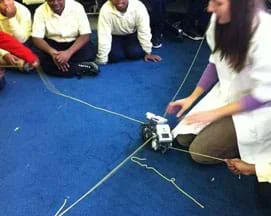 Collision!Copyright 2011 Ursula Koniges, AMPS Program, Polytechnic Institute of NYU
With the Student—Design of Non-Parallel Tracks
- Tell the class that their engineering team is now challenged to design a potentially unsafe set of tracks that are intersecting and run the risk of causing a crash of the two robots.
- Select two volunteers from the class.
- Have student 1 lay down the first short piece of yarn on the floor in a straight line.
- Ask student 2 to lay the second short piece of yarn on the floor so that the two short pieces either directly intersect, or will eventually intersect.
- Ask the class to identify the lines as parallel, or non-parallel, and explain why.
- Select two additional volunteers from the class.
- Direct these students to each overlay one of the short pieces of yarn with one longer piece of yarn so that the intersection of these lines is better emphasized.
- Ask the students to again identify the lines as either parallel, or non-parallel, and explain why.
- Ask the students to guess what would happen if two robots were to travel on those lines.
- Once predictions are made, choose two more students to place the two EV3 robots somewhere on the lines, and drive forward continuously.
- As a class, have students discuss their observations in the context of safe railway engineering. What could be done to prevent the robots from crashing?
- Conclude by administering the post-activity assessment, as described in the Assessment section. If time and materials permit, conduct the small group extension activity.
- civil engineering
- A field of engineering in which people design and create structures for human use, such as roads, bridges, skyscrapers, stadiums and railways.
- intersection points
- The point at which two or more lines cross.
- parallel lines
- Two or more lines that will not intersect as they extend infinitely.
- railway engineering
- Railway systems engineering is an engineering discipline dealing with the design, construction and operation of all types of railway transportation systems. It encompasses a wide range of engineering specialties, including civil, computer, electrical, mechanical, industrial and production engineering. This discipline is different from a railroad engineer (or locomotive engineer, train operator, train driver or engine driver), which is a person who drives a train.
Pre-Activity Content Assessment: Before starting the activity, administer the attached five-question Pre-Activity Quiz (PDF) to evaluate students' base understanding of the subject matter.
Board Work: Use the classroom board to assess and review with students the concepts of parallel and non-parallel lines, and points of intersection.
Post-Activity Content Assessment: After the activity, administer the Post-Activity Quiz (PDF) (with questions similar to the pre-activity quiz) to evaluate students' understanding of the concepts. Comparing the pre- and post-activity quizzes reveals how much difference the activity made in students' comprehension of the subject matter and skill enhancement.
Small Group Extension: The large group activity provides students with a broad overview of the topic in a low-pressure, instructor-guided group setting. Once this teaching has been completed, consider extending the activity by repeating it with students in smaller groups, depending on class size and robot availability. This gives students the opportunity to build upon the knowledge gained from the large group activity to enhance individual student understanding through experimental design of their own tracks, which can be compared with those designed by their peers.
- For lower grades, emphasize the practical application aspects of the activity, and place less emphasis on the Introduction/Motivation concepts content, so as to develop students' perception of geometry as fun and pertinent.
- For upper grades, during the practical application portion of the activity, invite students to think about the connection between the robot motion, and situations where this might be relevant in our world. For example, invite them to consider how train tracks, road intersections, highway viaducts, roadway flyover ramps, subways, flight paths, and other crossing arenas are developed.
Contributors
Ursula Koniges
Supporting Program
AMPS GK-12 Program, Polytechnic Institute of New York University
Acknowledgements
This activity was developed by the Applying Mechatronics to Promote Science (AMPS) Program funded by National Science Foundation GK-12 grant no. 0741714. However, these contents do not necessarily represent the policies of the NSF, and you should not assume endorsement by the federal government.
Copyright
2013 by Regents of the University of Colorado; original © 2011 Polytechnic Institute of New York University