
The Power of Mechanical Advantage
Legacy Curriculum
Hey there! This curriculum is no longer being curated or supported. It may contain materials that are no longer available or outdated information. Please use this document for reference.
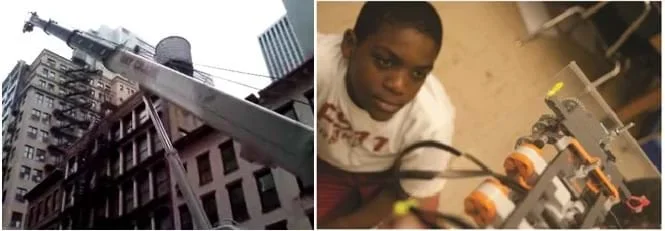 Students explore the mechanical advantage of pulleysCopyright 2010 Polytechnic Institute of NYU
Students learn about the mechanical advantage offered by pulleys in an interactive and game-like manner. By virtue of the activity's mechatronic presentation, they learn to study a mechanical system not as a static image, but rather as a dynamic system that is under their control. Using a LEGO® MINDSTORMS® robotics platform and common hardware items, students build a mechanized elevator system. The ability to control different parameters (such as motor power, testing load and pulley arrangement) enables the teacher, as well as the students, to emphasize and reinforce particular aspects/effects of mechanical advantage.
The mechanical advantage offered by pulleys is probably the most self-evident example of simple machines used pervasively in industry and everyday life. Pulleys, in their various configurations, are often seen in engineered cranes, elevators, boats and construction hoists. Although knowledge of simple machines is often conveyed in the form of diagrams on blackboards or on paper, pulleys are in fact not as static as they are presented in such one-dimensional drawings. Witnessing the mechanical advantage offered by pulleys benefits from movement, as this activity demonstrates.
After this activity, students should be able to:
- Clearly and confidently explain that pulleys are simple machines that offer mechanical advantage and define mechanical advantage in the form of examples.
- Draw diagrams of pulley set-ups that are capable of applying mechanical advantage.
- Predict observations of a system's lifting abilities if pulleys are added to it (that is, the ability to lift objects that the motors were previously unable to lift, and the loosening of tension amongst load line segments).
- CCSS.Math.Content.4.OA.A.2 Multiply or divide to solve word problems involving multiplicative comparison, e.g., by using drawings and equations with a symbol for the unknown number to represent the problem, distinguishing multiplicative comparison from additive comparison.
Grade 4
Do you agree with this alignment?
- The process of experimentation, which is common in science, can also be used to solve technological problems.
Grades 3-5
Do you agree with this alignment?
- 3-5-ETS1-3 Plan and carry out fair tests in which variables are controlled and failure points are considered to identify aspects of a model or prototype that can be improved.
Grades 3-5
Do you agree with this alignment? - 3-PS2-1 Plan and conduct an investigation to provide evidence of the effects of balanced and unbalanced forces on the motion of an object.
Grade 3
Do you agree with this alignment? - 3-PS2-2 Make observations and/or measurements of an object's motion to provide evidence that a pattern can be used to predict future motion.
Grade 3
Do you agree with this alignment?
- 3-5-ETS1-3 Plan and carry out fair tests in which variables are controlled and failure points are considered to identify aspects of a model or prototype that can be improved.
Grades 3-5
This resource focuses on the following Three Dimensional Learning aspects of NGSS:
Science & Engineering Practices- Plan and conduct an investigation collaboratively to produce data to serve as the basis for evidence, using fair tests in which variables are controlled and the number of trials considered.Do you agree with this alignment?
Disciplinary Core Ideas- Tests are often designed to identify failure points or difficulties, which suggest the elements of the design that need to be improved.Do you agree with this alignment?
- Different solutions need to be tested in order to determine which of them best solves the problem, given the criteria and the constraints.Do you agree with this alignment?
Do you agree with this alignment? - Plan and conduct an investigation collaboratively to produce data to serve as the basis for evidence, using fair tests in which variables are controlled and the number of trials considered.
- 3-PS2-1 Plan and conduct an investigation to provide evidence of the effects of balanced and unbalanced forces on the motion of an object.
Grade 3
This resource focuses on the following Three Dimensional Learning aspects of NGSS:
Science & Engineering Practices- Plan and conduct an investigation collaboratively to produce data to serve as the basis for evidence, using fair tests in which variables are controlled and the number of trials considered.Do you agree with this alignment?
- Science investigations use a variety of methods, tools, and techniques.Do you agree with this alignment?
Disciplinary Core Ideas- Each force acts on one particular object and has both strength and a direction. An object at rest typically has multiple forces acting on it, but they add to give zero net force on the object. Forces that do not sum to zero can cause changes in the object's speed or direction of motion. (Boundary: Qualitative and conceptual, but not quantitative addition of forces are used at this level.)Do you agree with this alignment?
- Objects in contact exert forces on each other.Do you agree with this alignment?
Crosscutting Concepts- Cause and effect relationships are routinely identified.Do you agree with this alignment?
Do you agree with this alignment? - Plan and conduct an investigation collaboratively to produce data to serve as the basis for evidence, using fair tests in which variables are controlled and the number of trials considered.
- 3-PS2-2 Make observations and/or measurements of an object's motion to provide evidence that a pattern can be used to predict future motion.
Grade 3
This resource focuses on the following Three Dimensional Learning aspects of NGSS:
Science & Engineering Practices- Make observations and/or measurements to produce data to serve as the basis for evidence for an explanation of a phenomenon or test a design solution.Do you agree with this alignment?
- Science findings are based on recognizing patterns.Do you agree with this alignment?
Disciplinary Core Ideas- The patterns of an object's motion in various situations can be observed and measured; when that past motion exhibits a regular pattern, future motion can be predicted from it. (Boundary: Technical terms, such as magnitude, velocity, momentum, and vector quantity, are not introduced at this level, but the concept that some quantities need both size and direction to be described is developed.)Do you agree with this alignment?
Crosscutting Concepts- Patterns of change can be used to make predictions.Do you agree with this alignment?
Do you agree with this alignment? - Make observations and/or measurements to produce data to serve as the basis for evidence for an explanation of a phenomenon or test a design solution.
Each group needs a full set of the following construction materials for one pulley system:
- 1 platform 12" x 20" x ¼" thick (for the mounting template; see Pulley Set-Up Assembly Instructions (PDF)); use basswood or Plexiglas® or other durable material
- 1 platform 9" x 9" x ¼" thick (for the platform to hold the load; see Pulley Set-Up Assembly Instructions (PDF)); use basswood or Plexiglas® or other durable material
- 2 curved metal screw hooks (3/16")
- 1 screw (1-½" L x 3/16")
- 6 nuts (3/16")
- package of cable/zip ties (assorted colors)
- power drill
- 3/16" diameter drill bit (appropriate for wood and/or Plexiglas®)
- string or high-test fishing line (such as 25-lb weight)
- 2 LEGO EV3 Intelligent Bricks (2 x $145)
- Additional LEGO Technic parts for the construction of the pulley systems (~$100)
- pulley_station file (ev3)
- pulley_remote file (ev3)
- pulley_station file- NXT (rbt)
- pulley_remote file- NXT (rbt)
- Mounting Template (pdf)
- Pulley Set-Up Assembly Instructions - EV3 version (docx)
- Pulley Set-Up Assembly Instructions - EV3 version (pdf)
- Pulley Set-Up Assembly Instructions - NXT version (docx)
- Pulley Set-Up Assembly Instructions - NXT version (pdf)
- The Power of Mechanical Advantage Pre-Activity Assessment Worksheet (docx)
- The Power of Mechanical Advantage Pre-Activity Assessment Worksheet (pdf)
- The Power of Mechanical Advantage Post-Activity Assessment Worksheet (docx)
- The Power of Mechanical Advantage Post-Activity Assessment Worksheet (pdf)
- The Power of Mechanical Advantage Pre-Activity Assessment Worksheet Answers (docx)
- The Power of Mechanical Advantage Pre-Activity Assessment Worksheet Answers (pdf)
- The Power of Mechanical Advantage Post-Activity Assessment Worksheet Answers (docx)
- The Power of Mechanical Advantage Post-Activity Assessment Worksheet Answers (pdf)
- Pulley Power Activity Worksheet (docx)
- Pulley Power Activity Worksheet (pdf)
The teacher should be familiar with LEGO MINDSTORMS EV3 as a building and programming platform. The following Internet sites provide details on EV3 building and programming:
Knowledge of pairing EV3 Intelligent Bricks via Bluetooth is necessary. The following Internet sites provide instructive steps for doing so:
What is your favorite simple machine? (Give students time to discuss among themselves.) If you chose the pulley, let's discuss why they are such great machines and where you find them in everyday life. First off, what is a pulley? (Listen to student definitions.) A pulley is a simple machine that uses a wheel of some sort with a rope, string or chain wrapped around the wheel. The string is able to be pulled from one end, and in so doing, lifts an object that is attached (tied) to the other end. This object that is being pulled is called a load—defined as a weight (big or small) that we wish to move. Pulleys are cool in that they are a lot like LEGO pieces, as they can be combined and built on top of each other to make more advanced systems or machines.
One thing that makes pulleys so amazing is a unique feature they have called mechanical advantage. This term is simply defined as a way to move/push/pull more weight than could be done without using a pulley. Basically, simple machines can make us into superheroes! Think about why Iron Man is able to lift cars above his head—by mechanical advantage!
However, today's activity is not about lifting cars, but instead about using simple machines to lift more weight. And what better simple machine to demonstrate this concept than the pulley? Today, we will use two pulleys to lift several textbooks. After this activity, you will realize that it is just a matter of changing the building materials before we can lift cars above our heads, just like superheroes!
Background
Students often define "simple machines" by listing devices that are typically presented as simple machines, such as pulleys, levers and ramps. The overall goal for this activity is to provide the first steps in communicating to students that simple machines are more than a list of devices. Make the point that mechanical advantage is the unique characteristic that relates all simple machines. Let them know that in this activity, they will observe mechanical advantage, not just "pulleys."
Make the real-life connection by asking the class to think of examples of pulleys used in everyday life to reinforce the evidence and prevalence of pulleys and pulley systems. Examples include cranes, elevators and construction hoists.)
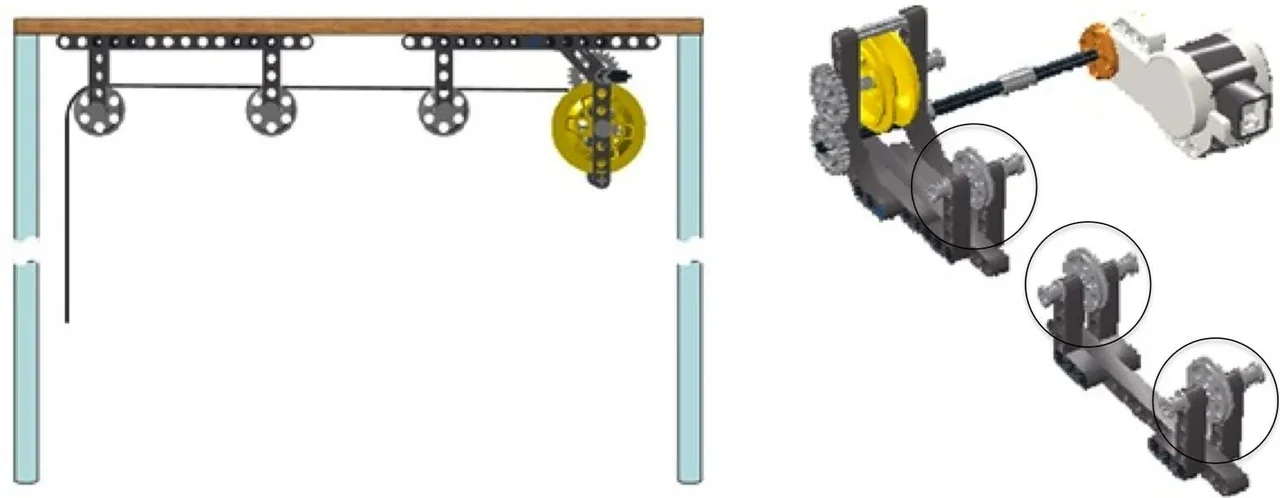 Figure 1. Profile view of mounted pulley setup (left). Isometric view of the set-up, attached to a motor (right)Copyright 2010 Polytechnic Institute of NYU
In this activity, students use a combination of fixed and movable pulleys to provide mechanical advantage to a mechatronic set-up. Figure 1 (left) shows a profile view of the fixed-position mechanics of the pulley set-up, and an inverted isometric view (right) for clarity. Refer to Figure 5 for the detail of how to thread the string/fishing line through the moving pulley attachment. The mounting surface may be ¼" modeling wood or Plexiglas®, which is prepared and set-up by the teacher in advance. The spacings for the motor, reel and extension pulley mounts are indicated on the attached Mounting Template. If fishing line (or strong thread) is used, the reel must be able to sufficiently take up slack and maintain the load (that is, not slip due to the smoothness or elasticity of the line). The one (or two) motors that are configured with each set-up should be attached to ports on a designated pulley station EV3 brick.
The mechanical system was designed to take on only two configurations: 1) a system for which no mechanical advantage is offered (shown in Figure 2, top) whereby fixed pulleys are maintaining tangential contact with the load line, with the exception of the pulley at the far left; and 2) a system for which mechanical advantage is offered by four pulleys—two moving and two fixed (Figure 2, bottom).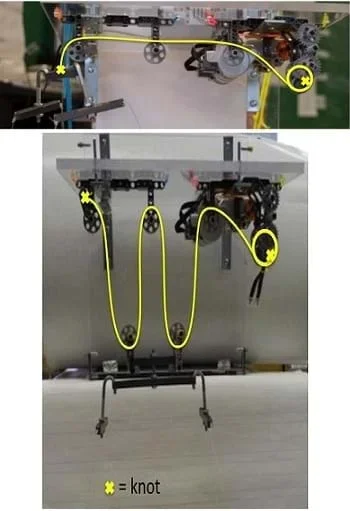 Figure 2. Configuration 1 pulley set-up with three immobile pulleys (top). Configuration 2 set-up with two mobile pulleys (bottom).Copyright 2010 Polytechnic Institute of NYU
Before the Activity
- Gather all materials.
 Figure 3. Two sheets of Plexiglas® form a ramp to mount the EV3 Intelligent Brick—one example of how present the activity user interface may be presented.Copyright 2010 Polytechnic Institute of NYU
 - Make copies of the Pulley Power Worksheet (PDF), Pre-Activity Worksheet (PDF), and Post-Activity Worksheet (PDF).
- Charge all EV3 brick battery packs prior to class. In addition, plug pulley station EV3 bricks into an AC outlet during operation to ensure the battery does not rapidly drain due to the constant load on the motors. Each of the set-ups should be preconfigured to Configuration 1 (no movable pulleys in the system, Figure 2, top) adjusted such that the slack is taken all the way up. This allows students to become accustomed to the controls by letting them lower the platform all the way to the ground.
- Before students arrive, pair (via Bluetooth) all EV3 Intelligent bricks that are designated as "controller bricks," with their respective pulley station bricks. Figure 3 shows an example of how the general controller setup is mounted on a Plexiglas® frame to imitate the appearance of a console game controller (an optional step).
With the Students
- Administer the Pre-Activity Worksheet prior to activity exposure. (Note: Do not allow students to approach the activity station set-ups upon entering the room; gather them in a common area where no pulley set-ups reside. If necessary, cover the pulley set-ups to avoid having to compete with students' curiosity.)
- Prior to dividing the class into groups, guide them through the steps of that day's experiment. Tell them that they will observe mechanical advantage by way of pulleys, providing evidence of what has already been taught to them.
- Conduct a demo, using the Figure 2 images as guides, to easily switch between Configurations 1 and 2.
- Describe the EV3 controller interface operation to students. Demonstrate that upon execution of the program, the device first prompts for a power setting that is adjustable by turns of the motor-attached wheel. After pressing the center orange button, the program allows application of motor torque by way of pressing the directional arrow buttons (left for one direction and right for the opposite direction), enabling upward or downward movement of the platform. Encourage students to choose power values that are just enough to move the platform up and down at reasonable speeds. This allows the observation of mechanical advantage to be more straightforward. If necessary, outline these program steps on the white/chalk board for easy reference.
- Hand out the Pulley Power Worksheets to students in preparation for the following steps.
Part 1: Configuration 1
- Direct students to gently lower the platform to the floor. Tell them to document the power at which they set the motors. Have them raise the platform again. Then, distribute thin books to the students. Direct them to slowly load a book onto the platform, and tell them to lower the platform all the way to the ground again and attempt to bring the platform up. Have them repeat these steps, adding a successive number of books to the platform. Have students stop after the motors are no longer capable of lifting the platform. Figure 4 demonstrates the pulley in use.
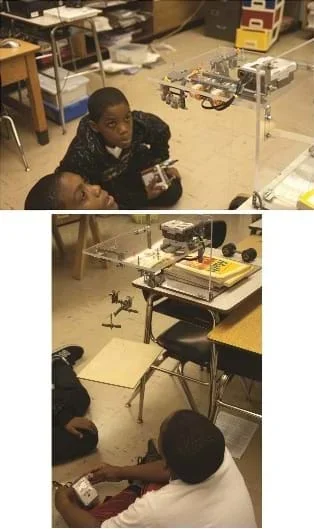 Figure 4. Students are fully engaged in pulley set-up.Copyright 2010 Polytechnic Institute of NYU
 - Remind students to record the total number of books that they were able to stack on the platform. Weighing the books is an option for a more quantitative evaluation of mechanical advantage, after which the students use the following equation (Equation 1) to find out the total weight of the load on the system.
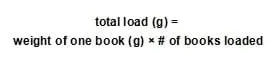 Equation 1. To solve the total weight of the load on the pulley system.
Make additional observations, such as descriptions of the tension along the string/thread supporting the load.
- Direct students to lower the platform back to the ground and remove the books.
Part 2: Configuration 2
- Direct students to modify their systems to Configuration 2. If they make errors in this step, remind them that the building process is part of the activity and is a learning and exploration experience.
- Upon successful completion of the configuration switch, direct the groups to lower the platform to the ground again. (Note: Slack should have been taken up by the addition of the two movable pulleys to the system.)
- Direct students to add the total number of books achieved in Part 1 (the number at which the motors struggled lifting). Ask to students to attempt to lift the platform using the controller brick.
- Remind students to record their observations (including the tension along the load line) and potential hypotheses as to how mechanical advantage is actually working. The tension along the load line should be reduced by approximately a factor of four (see Figure 5).
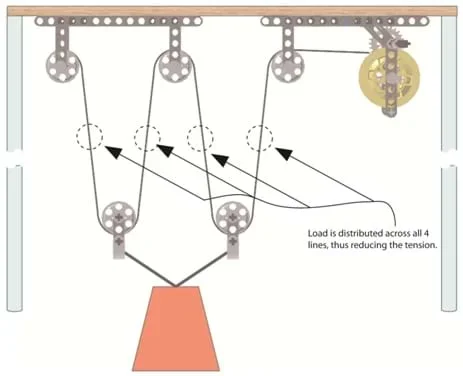 Figure 5. The mechanical advantage is shown through the distribution of load amongst four lines when using two movable pulleys with three fixed pulleys.Copyright 2010 Polytechnic Institute of NYU
Part 3: Wrap Up
- Ask the class how groups all changed their set-ups and what the observed effects were. If desired, list student feedback on the chalk/white board to encourage collaboration among groups with regard to their findings.
- For a more quantitative study, highlight the maximum number of books each set-up was able to lift. Then, compare this number with the number of moving pulleys used; that is, zero or two. The set-up is designed to yield an approximately four-fold increase in lifting capacity given a set motor power setting. Therefore, if the set-up is only able to lift two textbooks without pulleys, it should be able to lift approximately 7-9 books with the two pulleys added. Emphasize this mathematical relationship by specifically highlighting the data that involves the maximum number of books that each set-up can lift at a given power setting.
- simple machine
- A device that applies force, changes the direction of a force, or changes the strength of a force, in order to perform a task, generally involving work done on a load.
- mechanical advantage
- The ratio of output force (acting on a load) produced by a machine to the applied effort (the input force).
- pulley
- A machine consisting of a wheel over which a pulled rope or chain runs to change the direction of the pull used for lifting a load.
- load
- The resistance or weight acted on by a machine.
- mechatronic
- The combination of electronic and mechanical devices.
Pre-Activity Assessment
Worksheet/Quiz: Administer the Pre-Activity Worksheet (PDF) to probe students' beginning understanding of the application of pulleys.
Post-Activity Assessment
Discussion: Draft a table on the board (see Figure 6). After the students have completed their observations on both configurations, hold a class discussion. Use the table to list relevant student observations. Ask students to refer to their Pulley Power Worksheet (PDF) for the tabulated results for their particular group.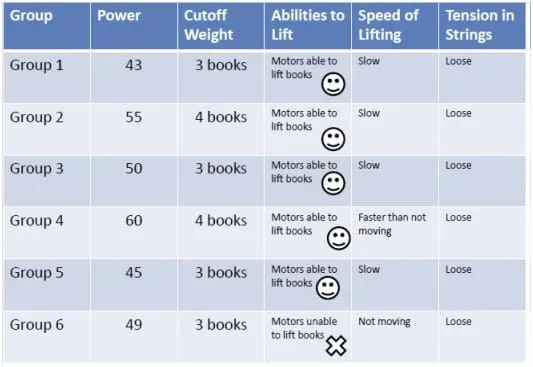 Figure 6. Example table used to record student feedback.Copyright 2010 Polytechnic Institute of NYU
Worksheet/Quiz: Administer the Post-Activity Worksheet (PDF) to gauge students' comprehension of pulleys.
- Eye protection is at the discretion of the instructor. (Note: Though rare, under excessive pulley system loads, bushings may slide off their respective axles. Such cases have resulted in a LEGO bushing popping out of the set-up, sometimes at a fast speed, posing an eye-safety issue.The instructor should exercise full awareness of the set-up during its operation, keeping a close watch on the set-ups and their maintenance. After each use, check the bushings and axles on each set-up for bending and potential structural failures.)
- The high-test fishing line is manufactured with a very thin lead core, lending to its strength. Though it is safe to handle, anyone who handles the line during set-up should rinse his/her hands after use.
"Mechanical advantage" The American Heritage® Science Dictionary. Houghton Mifflin Company. 21 Dec. 2010. <Dictionary.com http://dictionary.reference.com/browse/mechanical advantage>.
"Simple machine" The American Heritage® Science Dictionary. Houghton Mifflin Company. 21 Dec. 2010. <Dictionary.com http://dictionary.reference.com/browse/simple machine>.
"Pulley" The American Heritage® Science Dictionary. Houghton Mifflin Company. 21 Dec. 2010. <Dictionary.com http://dictionary.reference.com/browse/pulley>.
"Load" The American Heritage® Science Dictionary. Houghton Mifflin Company. 21 Dec. 2010. <Dictionary.com http://dictionary.reference.com/browse/load>.
Contributors
Carlo Yuvienco; Janet Yowell
Supporting Program
AMPS GK-12 Program, Polytechnic Institute of New York University
Acknowledgements
This activity was developed by the Applying Mechatronics to Promote Science (AMPS) Program funded by National Science Foundation GK-12 grant no. 0741714. However, these contents do not necessarily represent the policies of the NSF, and you should not assume endorsement by the federal government.
Copyright
2013 by Regents of the University of Colorado; original © 2010 Polytechnic Institute of New York University