
How Far Does the Robot Go?
Legacy Curriculum
Hey there! This curriculum is no longer being curated or supported. It may contain materials that are no longer available or outdated information. Please use this document for reference.
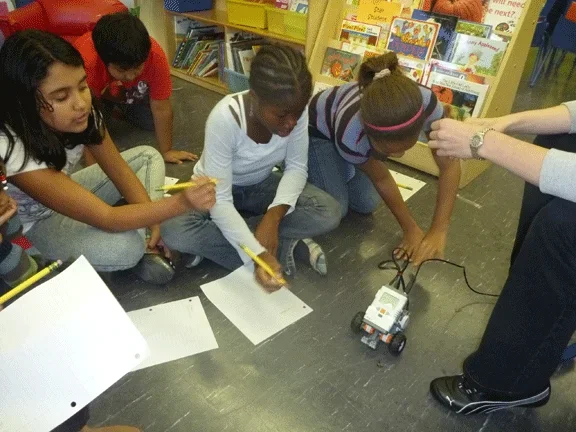 Students calculate distance traveled by robotsCopyright 2012 Elina Mamasheva, AMPS Program, Polytechnic Institute of NYU
Students practice their multiplication skills using robots with wheels built from LEGO® MINDSTORMS® kits. They brainstorm distance travelled by the robots without physically measuring distance and then apply their math skills to correctly calculate the distance and compare their guesses with physical measurements. Through this activity, students estimate parameters other than by physically measuring them, practice multiplication, develop measuring skills, and use their creativity to come up with successful solutions.
The application of mathematics is an essential component of engineering. Without a fundamental understanding of basic concepts, such as multiplication and measuring, it is not possible to understand more advanced mathematical concepts that are necessary to solve many engineering challenges. Engineers routinely estimate, calculate, measure as part of solving real-world problems. For example, in nanotechnology, it is highly challenging to measure actual distances at the miniscule scale. So, engineers estimate distances mathematically using known geometric or algebraic relationships. Creative problem solving is a valued concept for engineers. As an example, critical thinking and creative problem solving are put to the test to find ways to minimize the production of hazardous waste products in chemical plants while maintaining efficient industrial processing.
After this activity, students should be able to:
- Explain that distance can be determined in alternative ways.
- Relate the distance to the product of circumference of the wheels and the number of revolutions.
- Develop a scientific method to approach real-world problems.
- CCSS.Math.Content.6.NS.B.2 Fluently divide multi-digit numbers using the standard algorithm.
Grade 6
Do you agree with this alignment? - CCSS.Math.Content.6.NS.B.3 Fluently add, subtract, multiply, and divide multi-digit decimals using the standard algorithm for each operation.
Grade 6
Do you agree with this alignment? - CCSS.Math.Content.6.SP.B.5 Summarize numerical data sets in relation to their context, such as by:
Grade 6
Do you agree with this alignment? - CCSS.Math.Content.6.SP.B.5a Reporting the number of observations.
Grade 6
Do you agree with this alignment? - CCSS.Math.Content.6.SP.B.5b Describing the nature of the attribute under investigation, including how it was measured and its units of measurement.
Grade 6
Do you agree with this alignment? - CCSS.Math.Content.6.SP.B.5c Giving quantitative measures of center (median and/or mean) and variability (interquartile range and/or mean absolute deviation), as well as describing any overall pattern and any striking deviations from the overall pattern with reference to the context in which the data were gathered.
Grade 6
Do you agree with this alignment? - CCSS.Math.Content.7.G.B.4 Know the formulas for the area and circumference of a circle and use them to solve problems; give an informal derivation of the relationship between the circumference and area of a circle.
Grade 7
Do you agree with this alignment? - CCSS.Math.Content.HSA-REI.B.3 Solve linear equations and inequalities in one variable, including equations with coefficients represented by letters.
Grades 9-12
Do you agree with this alignment?
- Asking questions and making observations helps a person to figure out how things work.
Grades K-2
Do you agree with this alignment? - The process of experimentation, which is common in science, can also be used to solve technological problems.
Grades 3-5
Do you agree with this alignment?
- 6.NS.2 Fluently divide multi-digit numbers using the standard algorithm.
Grade 6
Do you agree with this alignment? - 6.NS.3 Fluently add, subtract, multiply, and divide multi-digit decimals using the standard algorithm for each operation.
Grade 6
Do you agree with this alignment? - 6.SP.5 Summarize numerical data sets in relation to their context, such as by:
Grade 6
Do you agree with this alignment? - 7.G.4 Know the formulas for the area and circumference of a circle and use them to solve problems; give an informal derivation of the relationship between the circumference and area of a circle.
Grade 7
Do you agree with this alignment? - A.REI.3 Solve linear equations and inequalities in one variable, including equations with coefficients represented by letters.
Grades 9-12
Do you agree with this alignment?
Each group needs:
- flexible measuring tape
- 2-3 foot length of roll paper (such as butcher block or craft paper)
- meter stick (can be replaced by the measuring tape)
- marker
- LEGO MINDSTORMS EV3 robot, such as EV3 Core Set (5003400) at https://education.lego.com/en-us/products/lego-mindstorms-education-ev3-core-set/5003400#lego-mindstorms-education-ev3
- LEGO MINDSTORMS Education EV3 Software 1.2.1, free online, you have to register a LEGO account first. At https://www.lego.com/en-us/mindstorms/downloads/download-software
- computer, loaded with EV3 1.2.1 software
- Robot Go Worksheet (PDF), one per student
Alternative: LEGO MINDSTORMS NXT Set:
Note: This activity can also be conducted with the older (and no longer sold) LEGO MINDSTORMS NXT set instead of EV3; see below for those supplies:
- LEGO MINDSTORMS NXT robot, such as the NXT Base Set
- LEGO MINDSTORMS Education NXT Software 2.1
- computer, loaded with NXT 2.1 software
To share with the entire class:
- blackboard or white board
- chalk or markers
Knowledge of the basics of circular geometry and basic multiplication skills. An understanding of the concept of radius and how it relates to circumference and pi.
Let's imagine that we are scientists and engineers for the duration of this class. What do scientists and engineers do while they are at work? (Give students a chance to respond.) In general terms, the work to find and create solutions to real-world problems.
Since you are still in school and do not yet have a lot of experience being engineers, I'm going to give you a simple problem to solve: I have this robot that I built using LEGO building bricks, and I want to know how far it can travel. How can we determine the distance that the robot travels without physically measuring the distance between the starting point and ending location of the robot?
Here is an example of a real-world version of this problem: Imagine you built a robot and sent it into space to explore Mars. While it is on Mars, you want to know the distance that it travels around the planet. You obviously cannot fly there and physically measure the distance. So, what other methods can you come up with to estimate the distances that the robot travels?
(Listen to student ideas; encourage them to respond. Help them if they cannot get to the expected answer.) We know that the robot uses wheels to travel. The circumference of the wheels can help us determine our answer. By knowing the length of the wheels' circumference and multiplying it by the number of revolutions the wheels make we can figure it out. This gives us the distance! And how can we find out the circumference of the circle? (From math class, students should know the equation C= 2πr).
Now that we have proposed a solution to the problem, let's test this solution to see if it works. Let's get started! Put on your engineering hats and let's get this robot rolling.
Background
A LEGO MINDSTORMS kit is required for this activity. In addition to being fun for students to use, it can also be used to demonstrate all the concepts described in this activity, as well as be re-used for many other classroom lessons and activities.
Students are encouraged to think of ways to determine the distance travelled by the robot without physically measuring the distance from the starting to ending location. After students brainstorm, they try to determine the distance in three steps: 1) by measuring the radius of the wheels, 2) using the equation C=2πr to calculate the circumference of the wheels, and 3) multiplying the circumference of the wheels by the number of revolutions that the robot was programmed to move. After students do this, they can physically measure the distance travelled using a meter stick or measuring tape and compare it to the number they obtained by multiplication.
Students learn that errors in measurement are inherent. Measurement is subject to both human and instrumental errors. Instruments, when poorly calibrated, may give inaccurate readings. Even when correctly calibrated, two similar instruments may give two slightly different readings of the same parameter. In terms of human error, measurement can be subjective; for example, using a regular thermometer, one person may read a temperature as 25.5°C while another one sees it as 25.7°C.
Before the Activity
- Assemble the robot using simple instructions provided in the LEGO MINDSTORMS kit.
- Load the software with the LEGO MINDSTORMS software. (Note: Although the program required for this activity is straightforward, spend time becoming familiar with the software.)
- Make copies of the Robot Go Worksheet (PDF), one per student.
With the Students
- Divide the class into groups of five students each. The number of groups can vary, depending on class size and the availability of the robots and computers.
- Hand out the worksheets and supplies.
- Have each student measure the radius of the robot wheel. Record it in the second column in the table in Part I of the worksheet.
Take the average of students' measurements and record it in the table under Part I of the worksheet. Point out the nature of human error. Physical measurements are dependent upon each person's reading of the tape measure/metric stick and might be different from one person to the next. Therefore, an average of many data points is a good way to improve the accuracy of the parameter that will be used for our distance calculations.
- As a group, have students calculate the circumference of the wheel and record it in the third column of their worksheets.
- Place the sheet of paper under the robot to mark the beginning and ending locations of the robot.
- In the MINDSTORMS software, set the number of revolutions to a certain number. Take into consideration the paper length and make sure the robot does not travel off the sheet.
- Have one student mark the starting location of the robot on the long sheet of paper.
- Run the program.
- Have another student mark the final location of the robot.
- Have students individually calculate the distance travelled on the back side of their worksheets.
- Have each student physically measure the distance travelled by the robot.
- Instruct students to calculate the average of the values (distance travelled) reported by the students.
- Repeat for different number of revolutions (go back to step 6).
- circumference
- The length of a circle (2πr).
- revolution
- One complete turn of a wheel.
- distance
- The space between two specified points.
- parameter
- Obtaining a numerical value of a measurement.
Pre-Activity Assessment
Circular Geometry — Before starting the activity review circular geometry concepts with students. In general terms, what is the circumference of the wheel? One easy way to think of it is as a "length" of a circle. For example, if we were to "break" the circle, and extend the two endpoints, we would get a straight line (that is, the "length" of the circle). Illustrate this concept using a string (shape it in a circle, and then extend the endpoints) or even a robot! Mark any point on the wheel of the robot with colored tape (to make it easier to see one revolution of the wheel). Put the robot on a piece of paper, with the colored tape on the very bottom of the wheel. Mark this location on the piece of paper, and roll the robot forward until the colored mark comes back to the very bottom (the colored mark on the wheel makes one revolution). Mark the second location on the piece of paper. The distance between the two marks gives the circumference of the wheel and illustrates the concept of one circular revolution.
Activity Embedded Assessment
Problem Solving — Encourage students to think creatively by incorporating the following critical thinking questions into the activity.
Q: How can we determine the distance travelled by a robot on Mars?
A: We know the radius of the robot wheels. First, we calculate the circumference of the wheels using the equation C=2πr; then we determine the distance that the robot travels by multiplying the circumference by the number of revolutions that we have programmed it to travel.
Q: How can we be sure that this distance is accurate?
A: We can conduct a simple experiment here on Earth: We built a small version of the Mars robot and measured the radius of the wheels. Then we calculate the circumference of the wheel and multiply it by the number of programmed revolutions and finally, got the distance. We conduct many trials to ensure accurate results. After each robot run, we physically measure the distance travelled. And finally, we compare the results with other students.
Q: Why is it necessary to conduct many trials?
A: One trial is not enough in any scientific experiment in any field because every measurement has inherent errors. Errors might be human: one student's reading of the meter stick may be different from another student. Look at the Part I of the Robot Go Worksheet (PDF) to determine if this is true. Errors might be from equipment and instruments, too, such as from wear and tear, faulty calibration, or programming mistakes. To overcome this, in all data-gathering scientific experiments averages of many trials are used to improve the estimate the value of parameters.
Post-Activity Assessment
The Scientific Method — Using conclusions from the critical thinking questions in the activity embedded assessment, lead a post-activity class discussion that points out the steps of the scientific method:
- Identify a problem. (How far does the robot go?)
- State a possible solution/hypothesis. (The distance travelled is the product of the circumference of the wheel and the number of revolutions.)
- Conduct an experiment. (Determine the circumference, program the robot for a number of revolutions, and multiply the circumference of the wheel by the number of revolutions.)
- Verify results. (Measure the distance with a measuring tape.)
- Conclusions. (Does experimental evidence match the real situation?)
- If students have not yet learned the basics of circular geometry, such as radius and pi, directly measure wheel circumference by wrapping a measuring tape around the wheel, thus eliminating the need to measure the radius and then calculate the circumference.
- For upper grades, as a separate activity, have students build the robot using the simple instructions provided in the base kit. Also, introduce the concept of standard deviation in the measurement; the average value can be presented as (avg value) ± st.dev.
Contributors
Elina Mamasheva; Keeshan Williams
Supporting Program
AMPS GK-12 Program, Polytechnic Institute of New York University
Acknowledgements
This activity was developed by the Applying Mechatronics to Promote Science (AMPS) Program funded by National Science Foundation GK-12 grant no. 0741714. However, these contents do not necessarily represent the policies of the NSF, and you should not assume endorsement by the federal government.
Copyright
2013 by Regents of the University of Colorado; original © 2012 Polytechnic Institute of New York University