
Measuring Distance with Sound Waves
Legacy Curriculum
Hey there! This curriculum is no longer being curated or supported. It may contain materials that are no longer available or outdated information. Please use this document for reference.
Students learn about sound waves and use them to measure distances between objects. They explore how engineers incorporate ultrasound waves into medical sonogram devices and ocean sonar equipment. Students learn about properties, sources and applications of three types of sound waves, known as the infra-, audible- and ultra-sound frequency ranges. They use ultrasound waves to measure distances and understand how ultrasonic sensors are engineered.
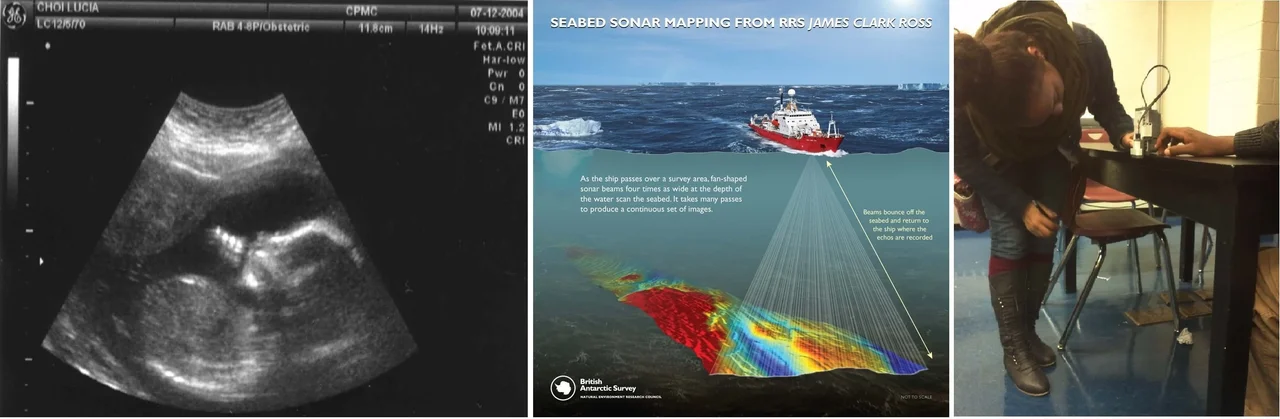 Two applications that use sound waves to measure distance: A sonogram uses high-frequency ultrasound to make an image of a fetus (left), and a ship's sonar sensor uses ultrasound signals to scan the ocean floor (middle). A student uses LEGO® MINDSTORMS® robot ultrasonic sensor to measure distance (right).Copyright (left to right) 2004 San Pullara, Wikipedia; Natural Environment Research Council; 2012 Irina Igel, Polytechnic Institute of NYU http://en.wikipedia.org/wiki/File:Baby_in_ultrasound.jpg http://www.antarctica.ac.uk/press/images/press/854/swath_illustration_final.jpg
Sounds are everywhere in our daily lives. While we easily and frequently control the sound volume of TVs and music players, we can also use sound's other properties to determine the health and gender of growing fetuses or to locate sunken ships on the ocean floor. In fact, sonograms and sonar devices take advantage of a very simple physics and math relationship that enables sound waves to be used as a tool to calculate distances (distance = time x velocity).
After this activity, students should be able to:
- Describe how sound waves can be used to measure the distance between objects.
- Give examples of ultrasound applications in technology and everyday life.
- Convert units, such as seconds into microseconds.
- Identify the frequency range for human hearing, known as the audible range.
- CCSS.Math.Content.6.RP.A.3d Use ratio reasoning to convert measurement units; manipulate and transform units appropriately when multiplying or dividing quantities.
Grade 6
Do you agree with this alignment? - CCSS.Math.Content.HSA-REI.B.3 Solve linear equations and inequalities in one variable, including equations with coefficients represented by letters.
Grades 9-12
Do you agree with this alignment? - CCSS.Math.Content.HSF-TF.B.5 Choose trigonometric functions to model periodic phenomena with specified amplitude, frequency, and midline.
Grades 9-12
Do you agree with this alignment?
- New technologies create new processes.
Grades 9-12
Do you agree with this alignment? - STEL-1O Assess how similarities and differences among scientific, mathematical, engineering, and technological knowledge and skills contributed to the design of a product or system.
Grades 9-12
Do you agree with this alignment?
- 6.RP.3.d Use ratio reasoning to convert measurement units; manipulate and transform units appropriately when multiplying or dividing quantities.
Grade 6
Do you agree with this alignment? - A.REI.3 Solve linear equations and inequalities in one variable, including equations with coefficients represented by letters.
Grades 9-12
Do you agree with this alignment? - F.TF.5 Choose trigonometric functions to model periodic phenomena with specified amplitude, frequency, and midline.
Grades 9-12
Do you agree with this alignment?
- HS-PS4-5 Communicate technical information about how some technological devices use the principles of wave behavior and wave interactions with matter to transmit and capture information and energy.
Grades 9-12
Do you agree with this alignment?
- HS-PS4-5 Communicate technical information about how some technological devices use the principles of wave behavior and wave interactions with matter to transmit and capture information and energy.
Grades 9-12
This resource focuses on the following Three Dimensional Learning aspects of NGSS:
Science & Engineering Practices- Communicate technical information or ideas (e.g. about phenomena and/or the process of development and the design and performance of a proposed process or system) in multiple formats (including orally, graphically, textually, and mathematically).Do you agree with this alignment?
Disciplinary Core Ideas- Information can be digitized (e.g., a picture stored as the values of an array of pixels); in this form, it can be stored reliably in computer memory and sent over long distances as a series of wave pulses.Do you agree with this alignment?
- Photoelectric materials emit electrons when they absorb light of a high-enough frequency.Do you agree with this alignment?
- Multiple technologies based on the understanding of waves and their interactions with matter are part of everyday experiences in the modern world (e.g., medical imaging, communications, scanners) and in scientific research. They are essential tools for producing, transmitting, and capturing signals and for storing and interpreting the information contained in them.Do you agree with this alignment?
Crosscutting Concepts- Systems can be designed to cause a desired effect.Do you agree with this alignment?
- Modern civilization depends on major technological systems.Do you agree with this alignment?
- Science and engineering complement each other in the cycle known as research and development (R&D).Do you agree with this alignment?
Do you agree with this alignment? - Communicate technical information or ideas (e.g. about phenomena and/or the process of development and the design and performance of a proposed process or system) in multiple formats (including orally, graphically, textually, and mathematically).
For the teacher's introductory presentation and activity preparation:
- PC or laptop, running MS PowerPoint®
- computer projector
- Measuring Distance with Sound Waves Presentation (PPTX), a PowerPoint file
- thermometer, to measure room temperature
- (optional) Android or Apple smartphone/tablet computer
- (optional) Tone Generator app (free for Apple devices, download at: https://itunes.apple.com/us/app/tone-generator/id457003837?mt=8), or audio frequency recordings (available at Wikipedia: https://en.wikipedia.org/wiki/Audio_frequency)
- LEGO MINDSTORMS Education EV3 Core Set available at https://education.lego.com/en-us/products/lego-mindstorms-education-ev3-core-set/5003400#lego-mindstorms-education-ev3
- (optional) PING))) Ultrasonic Distance Sensor available at Parallax, Inc.
Each group needs:
- 1 LEGO MINDSTORMS EV3 brick
- 1 ultrasonic sensor
- 1 cable
- various LEGO pieces to attach sensor to EV3 brick
- Distance and Time Worksheet (PDF), one per person
Note: This activity can also be conducted with the older (and no longer sold) LEGO MINDSTORMS NXT set instead of EV3; see below for those supplies:
- LEGO MINDSTORMS NXT robot, such as the NXT Base Set
- Measuring Distance with Sound Waves Presentation (pptx)
- Measuring Distance with Sound Waves Presentation (pdf)
- Distance and Time Worksheet (docx)
- Distance and Time Worksheet (pdf)
- Distance and Time Worksheet Answers (docx)
- Distance and Time Worksheet Answers (pdf)
- Ultrasound Sensor Homework (docx)
- Ultrasound Sensor Homework (pdf)
- Ultrasound Sensor Homework Answers (docx)
- Ultrasound Sensor Homework Answers (pdf)
- Students should know that distance can be found using time and velocity of travel.
- Students should be able to describe a wave in terms of its properties: frequency, amplitude, etc.
(After conducting the pre-activity assessment, as described in the Assessment section, show students the Measuring Distance with Sound Waves (PPTX) PowerPoint presentation.)
Sound waves are everywhere around us, even when we cannot hear them. Human hearing responds to sound frequencies in the range between 20 Hz and 20,000 Hz (as shown in Figure 1).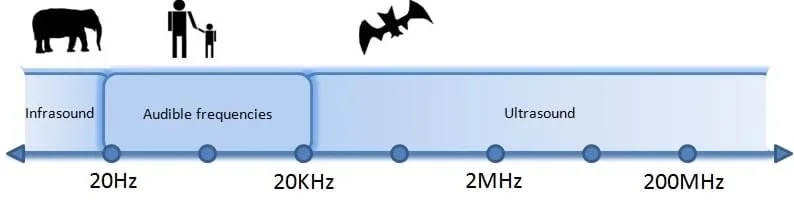 Figure 1. Sound frequency ranges for infrasound, audible and ultrasound waves and the corresponding mammals that can hear them.Copyright 2012 Irina Igel, Polytechnic Institute of NYU
It is important to make sure we first understand how to describe sound waves. The frequency of a wave is defined as the number of cycles the wave completes in a unit of time. More specifically, frequency of 1Hz, or one hertz, indicates that the wave oscillates one cycle over a time period of 1 second. Look at what happens to a sine wave when its frequency is increased from 1Hz to 5Hz. (Show the slide or draw the sign waves provided in Figure 2.) The sine wave on the left (of Figure 2) completes 1 full cycle within 1 second or, in other words, has a frequency of 1 Hz. The wave on the right (of Figure 2) oscillates 5 times in 1 second time or has a frequency of 5 Hz. For humans, the impact of the frequency limits means our ears cannot process sounds that complete less than 20, or more than 20000, oscillations per second.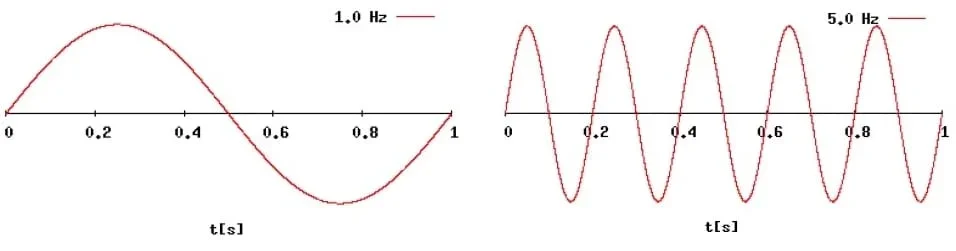 Figure 2. Example of sine wave with 1Hz (left) and 5 Hz frequencies (right).Copyright 2012 Irina Igel, Polytechnic Institute of NYU
Sound frequencies below and above the human threshold have been used for engineering and medical purposes worldwide for more than 50 years. For example, when making a sonogram of fetuses, nurses use ultrasound frequencies (about 2–18 MHz, where one MHz or megahertz is equal to 1,000,000 Hz). This range is known as ultrasound since the frequency is above (ultra) the sound humans can hear. In this case, the ultrasound waves are used to calculate the shape of the tiny baby's body by measuring the distances from the sensor to the fetus inside the mother.
Similarly, ships scanning the ocean floor for sunken submarines, planes or wrecks send ultrasonic pings, or ultrasound waves, that reflect off the surfaces and return back to the sensor.
What does an ultrasound sensor measure? An ultrasonic sensor measures the time that waves take to travel, reflect and come back to the sensor. Knowing the round-trip time and the wave speed in the medium (air, water, etc.), the device calculates the distance traveled. In other words, distance = time x velocity.
Before the Activity
- Gather materials and make copies of the Distance and Time Worksheet (PDF), one per student.
- Build an ultrasonic device as shown in Figure 3, such that each group has one for its use. After gathering LEGO and LEGO MINDSTORMS pieces, expect the building process to take 2-3 minutes.
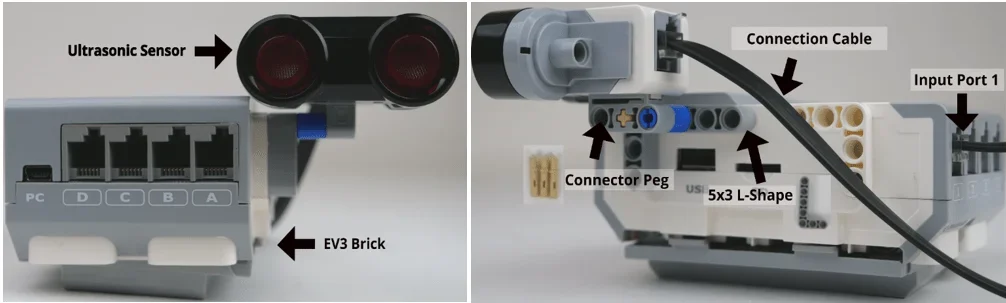 Figure 3. The front (left) and side (right) view of the LEGO-based ultrasonic sensor device that is used to measure distance.Copyright 2019 Nahum Tariku, Univeristy of Colorado Boulder
- Take a test measurement of distance with the built-in EV3 ultrasonic function, as shown in Figure 4.
- Use a thermometer to measure the classroom air temperature, T (in celsius). Alternatively, use a fahrenheit thermometer and convert °F to °C using the following relationship:
![Equation: T (in °C) = [T (in °F) - 32] x 5/9](https://teachengwebstorageprod.blob.core.windows.net/te-content-prod/nyu_soundwaves_activity1_equation1-224x47.webp) Equation 1. To convert °F to °C.
Equation 1. To convert °F to °C. - Calculate the speed of sound in air using the following online calculator http://hyperphysics.phy-astr.gsu.edu/hbase/sound/souspe.html. Alternatively, use the following equation:
 Equation 2. To calculate the speed of sound in air.
 - Prepare a computer and projector to show the Measuring Distance with Sound Waves Presentation (PPTX); prepare notes, if necessary.
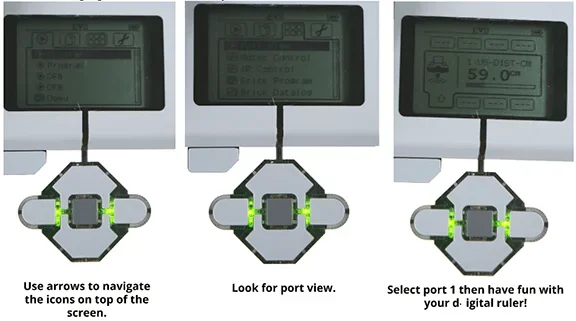 Figure 4. From left to right, the steps to obtain ultrasonic measurements using the built-in EV3 function.Copyright 2019 Nahum Tariku, University of Colorado Boulder
With the Students
- Start a class discussion about various tools that measure distance. To facilitate the discussion, show the first slide in the PowerPoint presentation, which is also the pre-activity assessment question.
- The Measuring Distance with Sound Waves Presentation (PPTX) scaffolds information and concepts important for understanding sound-based distance measurement sensors. Some of these concepts are: 1) the definition and a unit of frequency; 2) frequency ranges for infrasound, audible and ultrasound; 3) the natural occurrences of infra- and ultrasounds; 4) the application of ultrasound in medical, scientific and military applications; and most importantly 5) the design and mathematics of how ultrasonic sensors work.
- (optional; highly recommended) Present students with the following frequency tone demonstration to show that humans have upper and lower hearing threshold frequencies.
Use a smartphone or a table app that plays tones of various frequencies, or the audio frequency recordings available at Wikipedia (see the Materials List for details). Play the tone frequencies near the lower hearing threshold (≈40Hz), comfortable frequencies (≈400Hz), and upper threshold (≈18KHz). Note that frequencies near hearing threshold are much harder to hear from a distance. Call out individual students to come forward and listen to these frequencies closer to the speaker.
- (optional) Present students with the following demonstration to gain an understanding of how sound-based sensors work..
Distribute to students one or more PING))) ultrasonic distance sensors (see Figure 5). To understand how sound-based distance measurement sensors work, one needs to observe that these sensors have hardware to send and receive signals. Explain how the ultrasonic sensor works (refer to the pertinent presentation slides). The principle behind ultrasonic distance measurement is that the sensor sends an ultrasound wave that reflects once it is met by an object on its path. As the wave bounces off, it travels back to the receiver end of the sensor (as shown in Figure 6). The sensor measures the time it takes for the emitted wave to travel from a sender to the object and back to the receiver. Knowing the round-trip travel times and the speeds of the wave in the medium, ultrasonic devices calculate the distance that the sound traveled. Use the following equation to calculate the speed of sound: Equation 3. For calculating the distance that sound travels; distance = velocity x time.
Hence, the distance between the sensor and the object is one-half the distance traveled by the sound wave. Equation 4. The calculation to determine the distance between the sensor and the object.
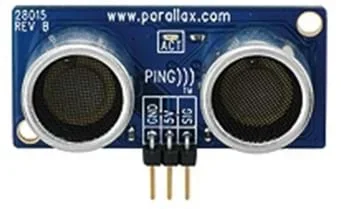 Figure 5. The PING))) ultrasonic distance sensor is similar to the LEGO ultrasonic sensor used in the activity.Copyright Parallax, Inc. http://www.parallax.com/
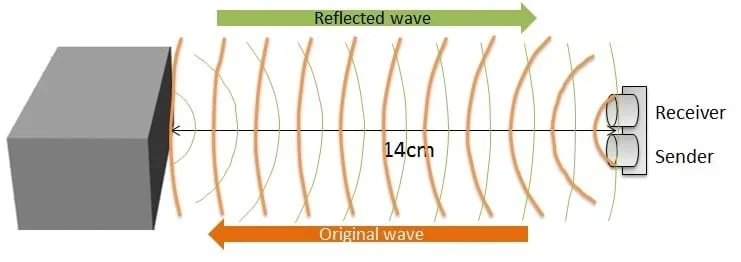 Figure 6. How an ultrasonic sensor uses sound waves to measure distances.
- Teach students how to take distance measurements using the ultrasonic sensor. Refer to the pertinent presentation slides to introduce the LEGO-based ultrasonic device (as shown in Figure 3) and the steps to take measurements (as shown in Figure 4). Note that the LEGO ultrasonic sensor emits sound chirps at 40 000 Hz frequency and can measure the distance of an object located up to 255 cm ± 3cm away.
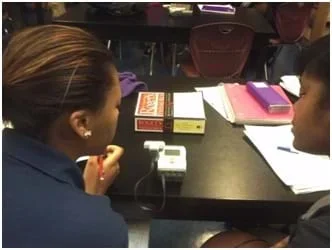 Figure 7. Use the LEGO MINDSTORMS ultrasonic sensor to measure the distance to an object on the table, such as a book.Copyright 2012 Irina Igel, Polytechnic Institute of NYU
 - Divide the class into teams of two students each (or other group sizes, depending on how many robots and sensors are available.) Hand out the Distance and Time Worksheet (PDF) to students.
- Ask student teams to find an object to which they can measure the distance (see Figure 7). Choose an object that is flat, so that it is at least 3cm (≈ 1 in) high and 5 cm (≈ 2 in) wide. Round and/or thin objects are very hard for the sensor to detect.
- Provide students with the value of the speed of sound that you obtained earlier using the temperature measurement (refer to the Before the Activity instructions).
- Once students have chosen objects, ask them to take three distance measurements using the LEGO-based ultrasonic sensor. Have students log their measurements in the worksheet table, and follow the worksheet instructions to calculate the round-trip time it takes for a sound wave to travel from the sensor to the object and back. Note that the time of travel will be extremely small (on scale of microseconds).
- Ask students to answer the rest of the worksheet questions. They figure out how many cycles the ultrasound wave travels in one second. They also calculate the number of cycles the wave travels during round-trip travel from the sensor to the object and back.
- Conclude by assigning the homework handout as a post-activity assessment.
- frequency
- A measurement of the rate of motion. Frequency of a wave is defined as the number of cycles per unit time (for example, seconds).
- sonogram
- An image produced by ultrasound, often for medical imaging purposes.
- ping
- The pulse of sound emitted by sonar devices.
- chirp
- Acronym for compressed high-iIntensity radar pulse. A signal in which the frequency increases or decreases with time.
- audible frequency
- A wave frequency that is greater than 20 Hz and less than 20000Hz. This frequency range is audible to most people.
- ultrasound frequency
- A wave frequency that is greater than 20000 Hz and that is above the upper threshold of human hearing.
- infrasound frequency
- A wave frequency that is less than 20 Hz and that is below the lower threshold of human hearing.
- ultrasound
- A sound wave with frequency greater than the upper threshold of human frequency, that is greater than 20000 Hz.
- radar
- An object-finding system that uses radio waves to determine the distance, speed of and direction to objects within its range.
- sonar
- An object-finding system that uses sound waves to determine the distance, speed of and direction to objects within its range.
Pre-Activity Assessment
Quick Challenge: Measuring Distance without a Ruler: Before introducing any of the sound-related concepts, present students with the following challenge: Imagine you are driving and want to determine the distance between your car and the car in front of you. Come up with a way to determine the distance between the cars without leaving your car. After a few minutes, ask students to share their ideas. (Possible solutions: Eyeball approximations compared to objects of known length nearby, laser distance meter, GPS satellite data, ultrasound sensor, video tracking of the car, etc. Guide the discussion towards using sound waves as a tool to calculate distance between objects.)
Activity Embedded Assessment
Worksheet: Have students complete the Distance and Time Worksheet (PDF) as they collect data and answer problem questions. They are asked to figure out how many cycles the ultrasound wave travels in one second and calculate the number of cycles the wave travels during round-trip travel from the sensor to the object and back. Review their answers to determine their understanding of ultrasound sensors.
Post-Activity Assessment
Homework: Assign students to complete the Ultrasound Sensor Homework (PDF). Review their answers to gauge their mastery of the subject matter.
Before conducting the activity, make sure the LEGO brick has enough battery power to operate for the entire activity.
Make sure that the connection cable is plugged into the correct input port on the LEGO brick.
Nave., C.R. Sensitivity of Human Ear. HyperPhysics 2010. Accessed April 7, 2012. http://hyperphysics.phy-astr.gsu.edu/hbase/sound/earsens.html
Ultrasound. Wikipedia. The Free Encyclopedia. Accessed April 7, 2012. http://en.wikipedia.org/wiki/Ultrasound
Prochnow, Dave. LEGO MINDSTORMS NXT Hacker's Guide. 1st edition. McGraw-Hill Companies Inc., 2006.
Browse the NGSS Engineering-aligned Physics Curriculum hub for additional Physics and Physical Science curriculum featuring Engineering.
Contributors
Irina Igel
Supporting Program
AMPS GK-12 Program, Polytechnic Institute of New York University
Acknowledgements
This activity was developed by the Applying Mechatronics to Promote Science (AMPS) Program funded by National Science Foundation GK-12 grant no. 0741714. However, these contents do not necessarily represent the policies of the NSF, and you should not assume endorsement by the federal government.
Additional support was provided by the Central Brooklyn STEM Initiative (CBSI), funded by six philanthropic organizations.
Copyright
2013 by Regents of the University of Colorado; original © 2012 Polytechnic Institute of New York University