
Renewable Energy Design: Wind Turbines
Legacy Curriculum
Hey there! This curriculum is no longer being curated or supported. It may contain materials that are no longer available or outdated information. Please use this document for reference.
Students are introduced to renewable energy, including its relevance and importance to our current and future world. They learn the mechanics of how wind turbines convert wind energy into electrical energy and the concepts of lift and drag. Then they apply real-world technical tools and techniques to design their own aerodynamic wind turbines that efficiently harvest the most wind energy. Specifically, teams each design a wind turbine propeller attachment. They sketch rotor blade ideas, create CAD drawings (using Google SketchUp) of the best designs and make them come to life by fabricating them on a 3D printer. They attach, test and analyze different versions and/or configurations using a LEGO wind turbine, fan and an energy meter. At activity end, students discuss their results and the most successful designs, the aerodynamics characteristics affecting a wind turbine's ability to efficiently harvest wind energy, and ideas for improvement. The activity is suitable for a class/team competition. Example 3D rotor blade designs are provided.
![A pie chart shows the total world energy consumption by source: 80.6% fossil fuels, 16.7% renewables and 2.7% nuclear. The renewables pie piece is further broken down into energy sources by a smaller pie chart: 11.44% biomass heat, 3.34% hydropower, with the remaining sources all less than 1% (solar hot water, geothermal heat, ethanol, biodiesel, biomass electricity, wind power [.51%], geothermal electricity, solar PV power, solar CSP, ocean power).](https://teachengwebstorageprod.blob.core.windows.net/te-content-prod/nyu_windturbine_activity1_image1web-396x188.webp) Total world energy consumption showing renewable and nonrenewable energy sources.Copyright 2012 Delphi234, Wikimedia Commons https://commons.wikimedia.org/wiki/File:Total_World_Energy_Consumption_by_Source_2010.png
Total world energy consumption showing renewable and nonrenewable energy sources.Copyright 2012 Delphi234, Wikimedia Commons https://commons.wikimedia.org/wiki/File:Total_World_Energy_Consumption_by_Source_2010.png
As the world population grows exponentially, the human demand for more energy expands at the same rate. In our highly integrated and technological world, we consume electrical energy (electricity) every day in uncountable ways through the use of computers, mobile phones and so many other electronic devices! Faced with such a large world consumption of energy, concern emerges for our planet's ability to sustain the expanding energy demands into the future, which explains the extraordinary interest in the fields of renewable energy and sustainable environments to address this major global challenge. A brief description of the types of engineers who are innovating in these fields is provided at the end of this document. In this activity, students conduct work as mechanical engineers by understanding, designing and building structural components for energy-efficient wind turbines.
After this activity, students should be able to:
- Explain the physical meaning of energy.
- Describe the different forms of energy and energy sources.
- List, compare and explain differences between renewable energy and nonrenewable energy.
- Explain how a wind turbine functions; describe its six basic components and how it converts wind energy into electrical energy.
- Describe and demonstrate the relationship between wind movement and a wind turbine's aerodynamic features.
- CCSS.Math.Content.7.G.A Draw, construct, and describe geometrical figures and describe the relationships between them.
Grade 7
Do you agree with this alignment? - CCSS.Math.Content.7.G.B Solve real-life and mathematical problems involving angle measure, area, surface area, and volume.
Grade 7
Do you agree with this alignment? - CCSS.Math.Content.8.G.A Understand congruence and similarity using physical models, transparencies, or geometry software.
Grade 8
Do you agree with this alignment?
- Students will develop an understanding of the effects of technology on the environment.
Grades K-12
Do you agree with this alignment? - Students will develop an understanding of the attributes of design.
Grades K-12
Do you agree with this alignment? - Students will develop an understanding of and be able to select and use energy and power technologies.
Grades K-12
Do you agree with this alignment? - Students will develop an understanding of the relationships among technologies and the connections between technology and other fields of study.
Grades K-12
Do you agree with this alignment? - STEL-3G Explain how knowledge gained from other content areas affects the development of technological products and systems.
Grades 6-8
Do you agree with this alignment?
- HS-ETS1-1 Analyze a major global challenge to specify qualitative and quantitative criteria and constraints for solutions that account for societal needs and wants.
Grades 9-12
Do you agree with this alignment? - HS-ETS1-2 Design a solution to a complex real-world problem by breaking it down into smaller, more manageable problems that can be solved through engineering.
Grades 9-12
Do you agree with this alignment? - HS-PS3-3 Design, build, and refine a device that works within given constraints to convert one form of energy into another form of energy.
Grades 9-12
Do you agree with this alignment? - MS-ETS1-1 Define the criteria and constraints of a design problem with sufficient precision to ensure a successful solution, taking into account relevant scientific principles and potential impacts on people and the natural environment that may limit possible solutions.
Grades 6-8
Do you agree with this alignment? - MS-ETS1-2 Evaluate competing design solutions using a systematic process to determine how well they meet the criteria and constraints of the problem.
Grades 6-8
Do you agree with this alignment?
- HS-ETS1-1 Analyze a major global challenge to specify qualitative and quantitative criteria and constraints for solutions that account for societal needs and wants.
Grades 9-12
This resource focuses on the following Three Dimensional Learning aspects of NGSS:
Science & Engineering Practices- Analyze complex real-world problems by specifying criteria and constraints for successful solutions.Do you agree with this alignment?
Disciplinary Core Ideas- Criteria and constraints also include satisfying any requirements set by society, such as taking issues of risk mitigation into account, and they should be quantified to the extent possible and stated in such a way that one can tell if a given design meets them.Do you agree with this alignment?
- Humanity faces major global challenges today, such as the need for supplies of clean water and food or for energy sources that minimize pollution, which can be addressed through engineering. These global challenges also may have manifestations in local communities.Do you agree with this alignment?
Crosscutting Concepts- New technologies can have deep impacts on society and the environment, including some that were not anticipated. Analysis of costs and benefits is a critical aspect of decisions about technology.Do you agree with this alignment?
Do you agree with this alignment? - Analyze complex real-world problems by specifying criteria and constraints for successful solutions.
- HS-ETS1-2 Design a solution to a complex real-world problem by breaking it down into smaller, more manageable problems that can be solved through engineering.
Grades 9-12
This resource focuses on the following Three Dimensional Learning aspects of NGSS:
Science & Engineering Practices- Design a solution to a complex real-world problem, based on scientific knowledge, student-generated sources of evidence, prioritized criteria, and tradeoff considerations.Do you agree with this alignment?
Disciplinary Core Ideas- Criteria may need to be broken down into simpler ones that can be approached systematically, and decisions about the priority of certain criteria over others (trade-offs) may be needed.Do you agree with this alignment?
Do you agree with this alignment? - Design a solution to a complex real-world problem, based on scientific knowledge, student-generated sources of evidence, prioritized criteria, and tradeoff considerations.
- HS-PS3-3 Design, build, and refine a device that works within given constraints to convert one form of energy into another form of energy.
Grades 9-12
This resource focuses on the following Three Dimensional Learning aspects of NGSS:
Science & Engineering Practices- Design, evaluate, and/or refine a solution to a complex real-world problem, based on scientific knowledge, student-generated sources of evidence, prioritized criteria, and tradeoff considerations.Do you agree with this alignment?
Disciplinary Core Ideas- Criteria and constraints also include satisfying any requirements set by society, such as taking issues of risk mitigation into account, and they should be quantified to the extent possible and stated in such a way that one can tell if a given design meets them.Do you agree with this alignment?
- At the macroscopic scale, energy manifests itself in multiple ways, such as in motion, sound, light, and thermal energy.Do you agree with this alignment?
- Although energy cannot be destroyed, it can be converted to less useful forms—for example, to thermal energy in the surrounding environment.Do you agree with this alignment?
Crosscutting Concepts- Energy cannot be created or destroyed—it only moves between one place and another place, between objects and/or fields, or between systems.Do you agree with this alignment?
- Modern civilization depends on major technological systems. Engineers continuously modify these technological systems by applying scientific knowledge and engineering design practices to increase benefits while decreasing costs and risks.Do you agree with this alignment?
Do you agree with this alignment? - Design, evaluate, and/or refine a solution to a complex real-world problem, based on scientific knowledge, student-generated sources of evidence, prioritized criteria, and tradeoff considerations.
- MS-ETS1-1 Define the criteria and constraints of a design problem with sufficient precision to ensure a successful solution, taking into account relevant scientific principles and potential impacts on people and the natural environment that may limit possible solutions.
Grades 6-8
This resource focuses on the following Three Dimensional Learning aspects of NGSS:
Science & Engineering Practices- Define a design problem that can be solved through the development of an object, tool, process or system and includes multiple criteria and constraints, including scientific knowledge that may limit possible solutions.Do you agree with this alignment?
Disciplinary Core Ideas- The more precisely a design task's criteria and constraints can be defined, the more likely it is that the designed solution will be successful. Specification of constraints includes consideration of scientific principles and other relevant knowledge that is likely to limit possible solutions.Do you agree with this alignment?
Crosscutting Concepts- The uses of technologies and any limitations on their use are driven by individual or societal needs, desires, and values; by the findings of scientific research; and by differences in such factors as climate, natural resources, and economic conditions.Do you agree with this alignment?
- All human activity draws on natural resources and has both short and long-term consequences, positive as well as negative, for the health of people and the natural environment.Do you agree with this alignment?
Do you agree with this alignment? - Define a design problem that can be solved through the development of an object, tool, process or system and includes multiple criteria and constraints, including scientific knowledge that may limit possible solutions.
- MS-ETS1-2 Evaluate competing design solutions using a systematic process to determine how well they meet the criteria and constraints of the problem.
Grades 6-8
This resource focuses on the following Three Dimensional Learning aspects of NGSS:
Science & Engineering Practices- Evaluate competing design solutions based on jointly developed and agreed-upon design criteria.Do you agree with this alignment?
Disciplinary Core Ideas- There are systematic processes for evaluating solutions with respect to how well they meet the criteria and constraints of a problem.Do you agree with this alignment?
Do you agree with this alignment? - Evaluate competing design solutions based on jointly developed and agreed-upon design criteria.
Each group needs:
- paper and pencil, for sketching rotor blade designs
- LEGO MINDSTORMS EV3 robot, such as EV3 Core Set (5003400) at https://education.lego.com/en-us/products/lego-mindstorms-education-ev3-core-set/5003400#lego-mindstorms-education-ev3.
- LEGO MINDSTORMS Education EV3 Software 1.2.1, free online, you have to register a LEGO account first; at https://www.lego.com/en-us/mindstorms/downloads/download-software
- computer, loaded with EV3 1.2.1 software
- LEGO MINDSTORMS Renewable Energy Add-On Set (solar, wind and water), available at Amazon; includes solar panel, generator and energy meter
- desktop 3D printer and associated desktop 3D printing software, such as MakerBot Replicator Desktop 3D Printer, available at https://www.makerbot.com/3d-printers/replicator/, and the MakerBot Desktop BETA v3.7 3D printing software, available for free download at https://www.makerbot.com/3d-printers/apps/makerbot-print/; if a desktop 3D printer is not available, consider making a donation request at www.DonorsChoose.org to help offset the cost of this useful classroom product; DonorsChoose.org is only for educational purposes
- 3D CAD/modeling software, such as Google SketchUp, available for free download at www.sketchup.com
- a wind source, such as a fan with an effect of at least 40 W, enough to be able to provide a 2.0 V reading on the LEGO energy meter
- Wind Turbines Pre-Quiz (PDF), one per student
- Rotor Blade Data Analysis Worksheet (PDF), one per group
- Wind Turbines Post-Quiz (PDF), one per student
Alternative: LEGO MINDSTORMS NXT Set:
Note: This activity can also be conducted with the older (and no longer sold) LEGO MINDSTORMS NXT set instead of EV3; see below for those supplies:
- LEGO MINDSTORMS NXT robot, such as the NXT Base Set
- LEGO MINDSTORMS Education NXT Software 2.1
- Wind Turbines Pre-Quiz (docx)
- Wind Turbines Pre-Quiz (pdf)
- Wind Turbines Pre-Quiz Answer Key (docx)
- Wind Turbines Pre-Quiz Answer Key (pdf)
- 3D Design Examples (zip)
- Rotor Blade Data Analysis Worksheet (docx)
- Rotor Blade Data Analysis Worksheet (pdf)
- Wind Turbines Post-Quiz (docx)
- Wind Turbines Post-Quiz (pdf)
- Wind Turbines Post-Quiz Answer Key (docx)
- Wind Turbines Post-Quiz Answer Key (pdf)
- LEGO 3D Design Example (zip)
- Making Sense Assessment (docx)
- Making Sense Assessment (pdf)
- Students should have a general understanding of electricity and its uses.
- Teachers should be familiar with the LEGO MINDSTORMS EV3 core set, software, renewable energy add-on set, 3D CAD/modeling software and desktop 3D printer.
What is energy? The word is used so commonly in everyday language, but do we really understand what energy is? Where does it come from? Can we touch it? Is it visible? Does it weigh anything? What does it mean to have energy?
Energy is derived from the Greek word energeia meaning in or at work. It is an innate quality that describes and quantifies an object's ability to do work or action. Energy is the driving force of how the universe works and how it moves. Without it, everything would cease to exist. Since energy is a quantitative (versus qualitative) property of an object or action, it is measured in the SI unit joules (J), named after the physicist James Prescott Joule.
One fundamental principle about energy is that energy cannot be created nor destroyed; it can only be transformed from one energy form to another. This means that all of the energy that ever existed since the beginning of time in the universe is the exact amount of energy that existed yesterday, exists today and will exist tomorrow. The total energy in the universe always remains constant. We call this concept the law of conservation of energy.
All energy is categorized into two states: kinetic energy or potential energy. Kinetic energy describes the amount of energy an object possesses when it is in motion, such as the energy in a moving bowling ball. Potential energy describes the amount of stored energy that an object possesses, such as the stored energy due to gravity in a hanging fruit in a tree that is ready to fall. When the fruit begins to fall towards the ground, its potential energy is transformed into kinetic energy as it falls (moves). A good understanding of kinetic energy is important to understanding many concepts in this activity.
Remember that energy cannot be created; it can only be transformed from one energy form to another energy form. Every day we experience energy in its different forms, such as light (radiant energy), heat (thermal energy) and electricity (electrical energy)! These energy forms are provided by resources known as energy sources. Remember, these energy sources cannot create energy; they simply provide energy in a particular form. For instance, the sun is an energy source that provides energy in the form of heat and light, known as solar and radiant energy. Fossil fuels (oil, coal, petroleum, natural gas) are the most commonly used energy sources in the world. They are burned (combusted) and their energy is converted to electricity. They are also refined as fuels that can be used to warm homes or power transportation (such as gasoline for cars!). Other energy sources include wind and water (hydropower).
Another way to look at all these energy sources is to categorize them into whether they are renewable or nonrenewable energy sources. Who knows the difference?
- A renewable energy source provides energy that is easily replenishable. This means the energy can be accessed from resources that are readily available on Earth at any given point in time. Examples include sun, water (hydropower), geothermal heat and biological materials (biomass) from living or recently living organisms.
- A nonrenewable energy source provides energy that is considered not easily replenishable because it is being consumed by humans at a much faster rate than it can be replenished. These forms of energy will be depleted and unavailable for future use if they are not managed and maintained. Examples include coal, petroleum, natural gas (fossil fuels) and nuclear power, which are common energy sources used to heat homes, cook and power vehicles.
Humans make use of both renewable and nonrenewable energy sources to generate electricity for use in our homes, schools, businesses and factories. Here's the daunting fact—in the U.S., 91% of all energy used is from nonrenewable energy sources. We use nonrenewable energy to fuel our vehicles, warm or cool our homes and cook our food. This is a large consumption of nonrenewable energy on a yearly basis that creates great concerns about whether these energy sources will be available in the near future—not to mention how their use impacts the Earth's ecosystem. Unfortunately, only 9% of U.S. energy consumption is derived from renewable energy sources, with biomass being the largest source. As a result of this situation, a great initiative is growing around the world to increase the usage of renewable energy sources in order to secure our world's energy future.
In this activity, we are going to work as if we were engineers and focus our attention towards understanding, designing, experimenting with and testing a particular renewable energy source to help save our world's energy future! The renewable energy source we will study is wind! The dynamic force and energy of the wind can be "captured" and used to do work! How? The wind's kinetic energy (energy in motion) can be "captured" and transformed into electricity (electrical energy) that we can use to power our homes through a device known as a wind turbine. Wind turbine technology can harness energy naturally provided by the wind to generate electricity. Fortunately, a lot of wind is available on our planet, so wind is considered a replenishable resource; hence it is a great renewable energy source!
To design and build a wind turbine, we must first understand its structure and the mechanics that control it. Similar in structure to a windmill, wind turbines are composed of six basic components: rotor, rotor blades, shaft, electric generator, gearbox, tower (see Figure 1).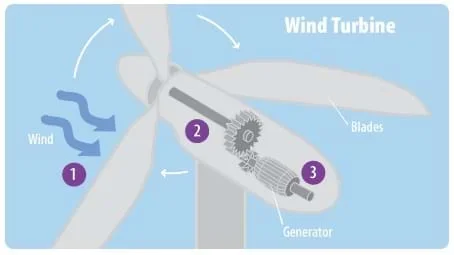 Figure 1. As the wind blows over wind turbine blades, it causes the blades to lift and rotate. The rotating blades turn a shaft that is connected to a generator. The generator creates electricity as it turns.Copyright A Student's Guide to Global Climate Change, U.S. Environmental Protection Agency http://www3.epa.gov/climatechange/kids/solutions/technologies/wind.html
As the rotating central piece of a wind turbine, the rotor is key to its function. Extending from the rotor, large propeller-like blades capture the dynamic motion of the wind's kinetic energy. The wind's force against the rotor blades causes the blades and the rotor to rotate, resulting in a conversion of the wind's kinetic energy into rotational mechanical energy.
The rotor is connected to a rod called the shaft. The shaft directly connects the rotor to an electrical generator. The shaft's sole purpose is to transfer the rotational mechanical energy generated by the rotating rotor directly into the input of the electrical generator.
Most wind turbines contain a gearbox connected to the shaft with the purpose to turn the slow rotation of the rotor and shaft into a faster rotations that is more suitable to drive an electrical generator.
To generate electricity, the rotating electrical generator connected to the shaft is placed between two magnets to induce electricity to flow through a conductor by a process called electromagnetic induction. At this step, rotational mechanical energy is converted directly into electrical energy, which can be stored and transmitted as electricity to an electric utility company.
Since wind is stronger higher up from the ground, a wind turbine's rotor, rotor blades, shaft and electrical generator are all attached to the top of a tall tower to enable it to capture higher speed winds. Typically, these towers are 30 meters tall.
When multiple wind turbines are clustered together in a location of steady wind, we call them a wind farm. The electricity generated by wind farms is collected and sent long distances to electric utility companies for distribution to neighborhoods and businesses. The best sites for wind farms are typically windy hilltops, shorelines and open plains.
Now, with an understanding of the structure and the individual parts that compose wind turbines, we can begin to design our own wind turbines that will help capture the most wind energy to convert it into electrical energy. But first let's get an understanding of aerodynamics.
Aerodynamics is the way air moves around objects. Aerodynamic behavior explain how birds and airplanes are able to fly and how race cars are able to travel at extremely high speeds. Any flying object has a meaningful aerodynamic design to enable it stay afloat in the air. Rotor blades on wind turbines have unique and intentional aerodynamic designs as well. Aerodynamic design enables rotor blades to capture most of the wind's kinetic energy. A rotor blade's design is similar to an airplane wing. The same two aerodynamic forces that lift and fly airplanes are at work when wind exerts force against a wind turbine rotor blade. These two forces are known as lift and drag (see Figure 2).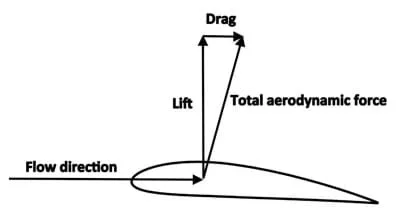 Figure 2. Diagram illustrating the lift and drag forces.Copyright 2014 J. Doug McLean, Wikipedia—The Free Encyclopedia https://en.wikipedia.org/wiki/File:Airfoil_lift_and_drag.jpg
Lift is the force that pushes something up. Drag is the force that tries to "drag" or slow down an object. An object's shape dictates the amount of lift and drag that will occur. Round surfaces have less drag than flat ones. Narrow surfaces typically have less drag than wider ones. In general, if more air hits a surface, more drag occurs.
In the case of wind turbine rotor blades, the direction and amount of wind force that is applied against the rotor blades determines the amount of lift and drag that causes the blades to rotate. The stronger the force of wind exerted against the rotor blades, the stronger the lift and the drag, which in turns rotates the wind turbine and generates more electricity.
So when designing rotor blades, engineers consider the size, aerodynamic shape and number of blades attached to the wind turbine's rotor. These three components (size, aerodynamic shape and the number of blades) dictate how much lift and drag forces act against the wind turbine's rotor blades. Remember, the use of curves and round surfaces results in better aerodynamic shapes, as seen in the design of aircraft wings, helicopters, kites and sailboats.
Background
In this activity, students apply their technical understanding of wind turbine structure, components and optimal rotor blade aerodynamic design to create wind turbines that efficiently harvest the most wind energy. Encourage students to experiment with different rotor blade designs, considering their shapes, lengths and number, with the intent to optimize lift and minimize drag. After construction, students quantify and compare rotor blade designs to determine which is the most efficient for harvesting wind energy for conversion to electrical energy.
Some additional cool facts about wind:
- Wind power is the fastest-growing energy source in the world since 1990.
- U.S. and China are the largest producers of wind power in the world, and Denmark has the highest percentage of wind power utilization compared to other energy sources.
- In the U.S., wind energy powers more than nine million homes.
In the 3D printing world, a large and open support community called "Thingiverse" offers a place for people to freely share digital designs that can be uploaded and printed using desktop 3D printers, necessitating little effort of your own. Thingiverse was created by MakerBot Industries, makers of 3D printers. Access the website at https://www.thingiverse.com/ to post comments, concerns and 3D designs.
The LEGO 3D Design Examples (ZIP) zip file contains examples (in .stl file format) using 3D modeling software to obtain designs that cater to this activity. Feel free to 3D print these examples and experiment with them. Note that the example 3D designs already include the LEGO connector needed to attach the printed designs to the LEGO wind turbine set. For more 3D design examples, see Additional Multimedia Support section.
The LEGO MINDSTORMS Education EV3 is a series of kits made by the LEGO Group that contains software and hardware to create small, programmable and customizable robots. Kits include a programmable EV3 brick used as the system controller, as well as modular parts, sensors and motors to create mechanical systems. The LEGO energy meter is a sensor composed of two items: a LEGO energy LCD display and a LEGO energy storage NiMH detachable battery. The energy meter measures and displays real-time voltage, current and power generated by an attached power source (such as a solar panel or wind turbine). Additionally, it measures the amount of energy stored in its NiMH detachable battery.
Before the Activity
- Gather materials and make copies of the Wind Turbines Pre-Quiz (PDF), Rotor Blade Data Analysis Worksheet (PDF) and Wind Turbines Post-Quiz (PDF).
- Become acquainted with the LEGO core set and renewable energy add-on set. The add-on set includes the components to build a wind turbine, as well as an energy meter. For more information on how to use the energy meter together with the LEGO set, see https://www.amazon.com/Lego-Education-Renewable-Energy-9688/dp/B004LIGZOW. Introduce the technology to students and give them time to experiment with the sets.
- Follow instructions in the LEGO renewable energy add-on set to program the LEGO brick. Teach students how to do this before beginning the activity.
- Become acquainted with a 3D desktop printer and 3D printing software of your choice; the activity is based on using the 3D printer and its 3D software listed in the Materials List. Take the time to 3D print and experiment with the designs provided in the 3D Design Examples (ZIP) zip file.
With the Students
- Administer the pre-quiz, as described in the Assessment section.
- Present the Introduction /Motivation content and background information. Then discuss with the class how to design the most efficient wind turbines. Outline the best aerodynamic design features for designing rotor blades, such as propeller-like, smooth and rounded surface characteristics. Discuss and clarify aerodynamic terminology including lift and drag.
- Present the design challenge (the activity goal): To design, create and test rotor blade designs to achieve a design that harvests the most wind energy possible, as measured by the LEGO energy meter. (optional) You may want to present the challenge in the form of a competition: Which engineering team can obtain the highest value(s) on the energy meter? Or perhaps provide a certain satisfactory range of energy meter values, such as the following:
2 V = Good job: you may be considered for the electric utility company contract
2.5 V = Great job: you are a high contender for the electric utility company contract
3 V = Excellent job: you have won the electric utility company contract!
- Direct students to consider the aerodynamic wind turbine features just described and apply this knowledge as they sketch on paper multiple rotor blade designs of various sizes and shapes. Encourage students to use solid mathematical approaches, such as trigonometry, geometry, circumference, area and metric dimensions, while designing on paper. Be open and accepting of various design approaches, even though some may seem far-fetched; testing their own designs provides students with valuable learning opportunities to see which aerodynamic design approaches are best.
- Divide the class into groups of three to five students each. Direct the groups to each examine the paper designs sketched by their team members, select the best rotor blade design (or agree on a combined design) that they would like to create, and then draw it by hand, precisely. Some teams may want to plan on fabricating slight variations in their blade designs in order to compare them via testing. As students make their final drawings, suggest that they examine the LEGO add-on set blades as examples for approximate dimensions and to see how they are attached.
- Give teams time to draw their on-paper rotor blade designs in Google SketchUp (or another 3D CAD/modeling software). Suggest that students refer to (or work from) the example 3D designs, which already include the LEGO connector needed to attach the printed designs to the LEGO wind turbine set. (optional) If you are not comfortable teaching students how to design using the 3D modeling software, direct them to find and modify rotor blade designs found on https://www.thingiverse.com/.
- Have groups fabricate their 3D rotor blade models using a 3D printer. This is a good time to consider how many rotor blade attachments each team wants to incorporate and test as part of its wind turbine design.
- While the designs are being 3D printed, have each team follow the LEGO add-on set instructions to construct the wind turbines.
- Hand out one worksheet to each group. Direct the groups to decide on and prepare various testing parameters such as which rotor blade design is in use (if multiple rotor blade designs were printed) or different numbers of rotor blades attached to the wind turbine. Have each group attach its 3D printed rotor blades to their wind turbines to get ready for testing.
- Position the wind turbine and wind source in an optimal position relative to each other so the blades catch the most wind possible from the wind source. Typically, keeping 12 inches between the wind turbine and wind source works well. Choose a fan power setting such that the energy meter display shows a value of approximately or more than 2.0 V.
- Have students conduct their team experimental trials to test the wind turbine under various parameters. Record energy meter readings and other data in the worksheet table.
- Play with varying conditions such as wind source position, wind source power settings, number of wind turbine rotor blades, etc., comparing the resulting energy meter readings.
- After experimenting with various conditions, direct students to document which rotor blade design and/or rotor blade count harvested the most wind energy, as dictated by the energy meter readings.
- As a class, share and compare group results, as described in the Assessment section.
- Administer the post-quiz, as described in the Assessment section.
- aerodynamics
- The way air moves around objects.
- drag
- A force of resistance that tries to slow an object when air force is applied against the object.
- electrical generator
- A device that converts a wind turbine's rotating mechanical energy into electrical energy. An electrical generator "generates" electricity.
- electromagnetic induction
- A process that generates electricity by use of a conductor placed between two rotating magnets.
- energy
- A characteristic describing/quantifying an object's ability to perform some type of action or work. The word is derived from the Greek word "energeia" meaning "in or at work."
- energy source
- Resources that supply a particular form of energy.
- gearbox
- As part of a wind turbine, a device that turns the slow rotations of rotor blades and shaft into faster rotations that are more suitable to drive electrical generators. In a wind turbine, connected between the shaft and the electric generator.
- kinetic energy
- The type of energy an object possesses when it is in motion.
- law of conservation of energy
- A physical law that describes that energy cannot be created nor destroyed; it can only be transformed from one energy form to another.
- lift
- A force that pushes up an object when air force is applied against the object.
- potential energy
- The stored energy an object possesses.
- nonrenewable energy
- Energy that is not easily replenished.
- renewable energy
- Energy that is easily replenished.
- rotor
- The central rotating piece of a wind turbine that is connected to the rotor blades.
- rotor blade
- As part of a wind turbine, an object with a shape and surface designed to capture wind energy. Attached as extensions to the rotor.
- shaft
- As part of a wind turbine, a rod-like apparatus that directly connects the rotor to the electrical generator. Its purpose is to transfer the rotational mechanical energy generated by the rotating rotor directly to the input of the electrical generator.
- tower
- A tall structure that elevates and supports all the wind turbine components.
- wind farm
- A cluster of wind turbines at one location.
- wind turbine
- A device that converts the wind's kinetic energy into electricity (electrical energy).
Pre-Activity Assessment
Pre-Quiz: Administer the six-question Wind Turbines Pre-Quiz (PDF), which asks students general short-answer questions about energy, energy sources, renewable versus nonrenewable energy and wind turbines. Review their answers to gauge their base knowledge and learn of any misconceptions.
Activity Embedded Assessment
Worksheet: As students work through the activity, make sure that they are engaged and understand the activity goal. While they complete trial experiments to test their blade designs, have teams complete a Rotor Blade Data Analysis Worksheet (PDF) by recording their collected quantitative data in the worksheet table. Review their worksheets to assess their engagement and depth of comprehension.
Post-Activity Assessment
Class Discussion: As a class, share and compare group results. Which designs generated the most wind energy? Which team created the best design? Ask students to examine the most successful designs to ascertain the best aerodynamic and component features. Further, ask them to suggest modifications and improvements that might result in better energy meter readings.
Post-Quiz: After the activity is completed, administer the Wind Turbines Post-Quiz (PDF), which provides comprehensive questions to determine students' improvements and depth of understanding about energy, renewable energy and wind turbines.
Making Sense: Have students reflect about the science phenomena they explored and/or the science and engineering skills they used by completing the Making Sense Assessment (PDF).
Take standard safety precautions when working with electronics.
The best energy generation results are obtained if the wind turbines are set in an optimal position so the blades catch the most wind possible from the fan (wind source). Try setting the center of the wind source level with the motor on which the wind turbine rotor blades are attached.
Look under the LEGO software Help menu for helpful tips and support on getting started with EV3 programming and much more.
The 3D Design Examples (ZIP) zip file contains examples (in .stl file format) downloaded from the Thingiverse website and modified using 3D modeling software to obtain designs that cater to this activity. Feel free to 3D print these examples and experiment with them.
Bachelor of Engineering in Mechanical Engineering & Renewable Energy. Athlone Institute of Technology, Ireland. Accessed November 6, 2013.
Energy Basics: What Is Energy? EIA Energy Kids. U.S. Energy Information Administration. Accessed October 8, 2013. http://www.eia.gov/kids/energy.cfm?page=about_home-basics
Energy Engineer Job Description. Prospects: The UK's Official Graduate Careers Website. AGCAS and Graduate Prospects. Accessed October 18, 2013. http://www.prospects.ac.uk/energy_engineer_job_description.htm
Environmental Engineers Try to Capture Renewable Energy. GreenCareersGuide.com. Accessed November 3, 2013. http://www.greencareersguide.com/Environmental-Engineers-Try-to-Capture-Renewable-Energy.html
Harper, Douglas. "Energy." Last updated October 1, 2007. Online Etymology Dictionary. Accessed October 12, 2013. http://www.etymonline.com/index.php?allowed_in_frame=0&search=energy&searchmode=none
How Wind Turbines Generate Electricity. Published February 20, 2011. WindTurbines.net. Accessed October 18, 2013. (74-slide presentation) http://www.slideshare.net/windturbinesnet/how-wind-turbines-generate-electricity-6995868
Power Engineering and Renewable Energies. Hochschule Mannheim. Accessed November 3, 2013. http://www.english.hs-mannheim.de/study-programmes/bachelor-courses/power-engineering-and-renewable-energies.html
Solar Energy Engineering. Engineering.com Library. Accessed October 18, 2013. http://www.engineering.com/SustainableEngineering/RenewableEnergyEngineering/SolarEnergyEngineering.aspx
Thomas, R, and S. Sydenham. Wind Energy. Kid Cyber. Accessed October 18, 2013. http://www.kidcyber.com.au/topics/windenerg.htm
Tug of War—Renewable vs. Non-Renewable Energy. Last updated October 23, 2012. Glacial Energy. Accessed November 8, 2013. http://blog.glacialenergy.com/2012/10/23/tug-of-war-renewable-vs-non-renewable-energy/
Types of Energy. Kids Zone, EnWin Utilities Ltd. Accessed October 23, 2013. http://www.enwin.com/kids/electricity/types_of_energy.cfm
What Is Aerodynamics? Last updated September 3, 2013. NASA Knows! (Grades K-4). Accessed October 18, 2013. http://www.nasa.gov/audience/forstudents/k-4/stories/nasa-knows/what-is-aerodynamics-k4.html
Wind Energy. Chapter 16, Energy Story. Energy Quest, California Energy Commission. Accessed November 18, 2013. http://www.energyquest.ca.gov/story/chapter16.html
Wind Energy. Last updated January 28, 2013. U.S. Environmental Protection Agency. Accessed October 2013. http://www.epa.gov/climate/climatechange/kids/solutions/technologies/wind.html; new page: http://www3.epa.gov/climatechange/kids/solutions/technologies/wind.html
Wind Energy Engineer. Science Buddies. Accessed October 18, 2013. http://www.sciencebuddies.org/science-engineering-careers/engineering/wind-energy-engineer
Following is a brief list and description of several types of engineers who are innovating in the field of renewable energy and sustainable environments:
- Energy engineers are working towards finding more efficient and cleaner methods to supply and transmit energy in all of its different forms in order to meet the world's energy demands. Energy engineers such as solar and wind energy engineers improve existing energy generation methods to include renewable solar and wind harvesting technologies such as solar panels and wind turbines.
- Solar energy engineers work with physicists, chemical engineers and materials scientists to improve efficiency in harvesting solar energy (light and heat energy generated from the sun) to improve the viability of using solar panels and other solar technologies.
- Wind energy engineers analyze wind speed and wind direction in order to evolve the technology and determine the best locations to harvest wind energy from wind turbines.
- Environmental engineers study the Earth's natural environment in order to develop solutions towards improving better habitation conditions for humans and the planet's other organisms. In the field of renewable energy and sustainable environments, environmental engineers develop better renewable energy technologies to harvest energy in its most natural forms such as solar, wind, tidal (water), biomass and geothermal.
- Electrical/power engineers study the generation, transmission and distribution of electrical energy to supply electrical power to homes and businesses. With the increasing global demand for energy, especially for more electricity and electrical power, comes the need to create a new field of study for renewable electrical energy in order to meet the high energy demands. Electrical and power engineers are innovating the next generation of renewable electrical energy by researching the processes of converting harvested renewable energy into electrical energy, which can be used for every day electricity use such as powering homes, lights, computers and possibly cars in the near future.
- Mechanical engineers traditionally analyze, design and manufacture mechanical systems such as machines and engines. Yet, mechanical engineering is a broad field of study and has a role in almost every engineering discipline. Mechanical engineers have an increasing responsibility to optimize the cost of energy and energy sources for which they design mechanical systems. Their technical skills are greatly needed to select and implement the most efficient energy sources.
Contributors
Gisselle Cunningham; Russell Holstein; Lindrick Outerbridge
Supporting Program
AMPS GK-12 Program, Polytechnic Institute of New York University
Acknowledgements
This activity was developed by the Applying Mechatronics to Promote Science (AMPS) Program funded by National Science Foundation GK-12 grant no. 0741714. However, these contents do not necessarily represent the policies of the NSF, and you should not assume endorsement by the federal government.
Copyright
2015 by Regents of the University of Colorado; original © 2013 Polytechnic Institute of New York University