
Portable Sundial
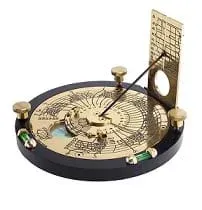 Students examine sundialsCopyright Wikimedia Commons http://commons.wikimedia.org/wiki/File:Horus_Sundials_Portable_Horizontal_Sundial.jpg
Students investigate the accuracy of sundials and the discrepancy that lies between "real time" and "clock time." They track the position of the sun during the course of a relatively short period of time as they make a shadow plot, a horizontal sundial, and a diptych sundial. (The activity may be abridged to include only one or two of the different sundials, instead of all three.)
This activity focuses on the importance of accuracy in time measurements that are used today in a wide variety of instruments such as cell phones, computers and GPS navigation systems to synchronize their functions. Improving precision, be it in component size or digital time measurement, is a design criterion that engineers address everyday.
- How the sun moves across the sky.
- The difference between "clock time" and "real time."
- How to find geographical north.
- Terminology, such as solstice, equinox, etc.
- How to make a sundial, what makes it accurate, and what skews the time it tells.
- STEL-5F Analyze how an invention or innovation was influenced by its historical context.
Grades 6-8
Do you agree with this alignment? - STEL-6D Engage in a research and development process to simulate how inventions and innovations have evolved through systematic tests and refinements.
Grades 6-8
Do you agree with this alignment? - STEL-8M Use instruments to gather data on the performance of everyday products.
Grades 6-8
Do you agree with this alignment?
- Describe lunar and solar eclipses, the observed moon phases, and tides. Relate them to the relative positions of the earth, moon, and sun.
Grades 6-8
Do you agree with this alignment? - Explain how the tilt of the earth and its revolution around the sun result in an uneven heating of the earth, which in turn causes the seasons.
Grades 6-8
Do you agree with this alignment?
Shadow Plot:
- 1 piece of large white paper
- pencil width wooden dowel (or similar) 30.48 cm(12") to 38.1 cm (15") long
- ball of clay
- two 12" piece of duct tape, cut into eight 3" strips
- permanent marker
- timer
Horizontal Sundial:
- small wooden disk
- 3/4"-1" nail
- pencil
- pen
- pair of scissors
- index card
- hammer
- protractor
- sheet of paper
- (optional) string
- wood glue
Diptych Sundial:
- template for diptych assembly (see attached Construction Worksheet)
- 1 piece of heavy paper
- glue
- string, preferably elastic
Humans feel it necessary to mark the passage of time. And everyone has noticed shadows changing throughout the day. Someone unknown in the past found out that if a shadow was cast by a sloping object pointing to the celestial pole, it would cast a consistent shadow that would be in the same place at the same time every day. Though it has been suggested that this may have been 2,000 years ago, it is more likely that it would have been around 500 years ago, because before the development of clocks, it would have been difficult to determine what "the same time each day" meant.
Practically everybody knows what a sundial is. Most people have a notion that, if they had to, they could make one. But most people's practical knowledge of sundials is limited to having seen those popular brass horizontal dials on plinths in gardens.
And there is a widespread, and totally wrong, belief that sundials are not very good at telling the time. The poor reputation of sundials is ill deserved, and has arisen mostly because we have all accepted "clock time" as an absolute standard, without devoting any thought to the nature of the time it is measuring.
Background
Sundials measure time as it is. Noon is when the sun is highest in the sky (when it crosses the meridian). Watches measure time as we would like it to be, with noon tomorrow exactly 24 hours, 0 minutes, and 0 seconds away from noon today. But noon on December 26 is actually 24 hours, 0 minutes, and 29 seconds away from noon on Christmas Day. And noon on September 15 is only 23 hours, 59 minutes, and 39 seconds away from noon on the following day.
In the winter, the days are short and the sun is low in the sky. Each day after the winter solstice, which occurs on December 21, the sun's path becomes a little higher in the southern sky. The sun also begins to rise closer to the east and set closer to the west until we reach the day when it rises exactly east and sets exactly west. This day is called the equinox. We marke the Spring Equinox on March 21 and a Fall Equinox on September 21.
The sun is at its lowest path in the sky on the Winter Solstice. After that day, the sun follows a higher and higher path through the sky each day until it is in the sky for exactly 12 hours. Every place on earth experiences a 12-hour day twice a year on the Spring and Fall Equinox.
On the Summer Solstice, the sun is at its highest path through the sky and the day is the longest. Because the day is so long, the sun does not rise exactly in the east, but rises to the north of east and sets to the north of west allowing it to be in the sky for a longer period of time.
After the Summer Solstice, the sun follows a lower and lower path through the sky each day until it reaches the point where it is in the sky for exactly 12 hours again. This is the Fall Equinox. Just like the Spring Equinox, the sun rises exactly east and sets exactly west on this day, and everyone in the world experiences a 12-hour day.
After the Fall Equinox the sun continues to follow a lower and lower path through the sky and the days grow shorter and shorter until it reaches its lowest path, and then we are back at the Winter Solstice where we started.
Recommended Resources:
The history of daylight saving (or daylight shifting), the standardization of time, and when regions around the globe spring ahead and fall back: http://www.webexhibits.org/daylightsaving/
Diagram and explanation of the path of the sun through the year: https://www-istp.gsfc.nasa.gov/stargaze/Secliptc.htm
A history of sundials over many civilizations: https://www.farmersalmanac.com/sundials-time-began-18870
The mathematics of sundials (a bit advanced for students, but good for teachers): http://www.sundials.org/index.php/teachers-corner/sundial-mathematics.html
Preparation
Shadow Plot:
- Gather materials.
- If necessary, cut wooden dowel to 12" to 15" long.
- Locate geographic north (see Directions section, below).
Horizontal Sundial:
- Obtain materials.
- Locate your latitude (http://www.findlatitudeandlongitude.com/).
- Locate geographic north (see Directions section, below).
- (optional) If you want to make your sundial into a necklace or key chain, drill a hole into the wooden disk to pass the string through.
- If doing this activity with a large group of young children,, prepare the nails in the wooden disks as well (steps 1-2 in the Directions section).
Diptych Sundial:
- Obtain materials.
- Print out the Diptych Template (see the attached Construction Worksheet).
- Locate your latitude (see http://www.findlatitudeandlongitude.com/).
- Locate geographic north (see the Directions section, below).
Directions
This activity can fit with an infinite number of topics. One suggestion is to explore with students the way time is measured, the history of clocks, and the way that we tell time.
Construction & Testing:
PART I. FINDING GEOGRAPHIC NORTH TO POSITION YOUR SUNDIAL:
The sundial must be positioned with the gnomon pointing north/south and, of course, the dial must be located where a shadow will be cast by the gnomon most of the day. Use one of the following three methods to find geographic north for your latitude.
Method 1: The Purist's Method
To determine the orientation without reference to other mechanical devices, find north by observing Polaris, the North Star, at night. In positioning the sundial, the gnomon is actually being pointed to the North Celestial Pole, which is within 1-degree of the North Star. Thus, find Polaris at the end of the Little Dipper, and line up your dial by pointing the gnomon towards Polaris. You might want to record the orientation of your dial for future reference. This method does not work in southern latitudes.
Method 2: The Practical Method
Use a magnetic compass to determine the north/south line, but because of the difference between magnetic north and true north, the dial reading could be off by an hour or more, depending on the local difference between magnetic and true north.
Method 3: The Lazy Method
For a first approximation, determine the the orientation at any time by using a clock or watch, and positioning the dial so the shadow shows the correct time. However, if left in this position, an error of up to 30 minutes could result over the year because of what is known as the "equation of time." Because of the Earth's orbital motion around the sun, the solar day (approximately 24 hours) is not exactly the same length from day to day, varying by up to +/- 16 minutes a day.
PART II. BUILDING THE SUNDIAL:
A. SHADOW PLOT:
CONSTRUCTION: (refer to the attached Construction Worksheet for images) A shadow plot can also help you obtain a feel for how the sun's path changes across the sky from day to day. To best see this effect, work on the shadow plot for several weeks.
- Set up your shadow plot in the morning, around 9:00am.
- Find a flat location that is clear from shadows all day long.
- Push a ball of clay into the ground.
- Insert the wooden dowel into the ball of clay so that it stands vertically. Use four of strips of duct tape to cover the clay to keep it from melting in the sun and help secure the dowel. The dowel must stand in this exact location for the length of the activity (from one day to several weeks), so make sure it is perfectly vertical and very secure.
- Once the dowel is in place, look for its shadow. Lay a piece of paper down on the north side of the dowel with the long edge up against the base of the dowel support. If you did not previously find geographic north (as described in the Directions section), you can now determine which direction is north since you know the sun is in the east and the dowel shadow is facing west.
- Use the remaining four strips of duct tape to secure the corners of the paper. Make sure to keep the middle of the paper clear as this is where you will make your plot.
- You are now ready to start making your measurements. The shadow from the dowel should be on the piece of paper. If it is not, wait about an hour and return once the shadow is cast onto the paper. When you have the shadow on the paper, make a mark at the very end of the shadow.
- Return to the plot about once every 30 minutes and make a mark at the end of the shadow each time. It is helpful to use a timer. If you start your plot at 9:00am, you should have enough markings by 3:00pm.
USING YOUR SHADOW PLOT:
- After one day of shadow measurements, you are ready to draw the north-south line. On your completed shadow plot draw a smooth curve through all of the marks that you made, without moving the paper. The more often you took measurements, the easier it is to draw this curve accurately.
- Once you have drawn a smooth curve through the markings, find the shortest distance between the dowel base and this curve. Draw a line from the dowel base to this point. This line is called a north-south line. It is the line along which the sun casts a shadow at local noon. (Your local noon may not be exactly when the clock says noon, depending on where you are in your time zone.) This north-south line points exactly north and south. A line drawn perpendicular to this line points east and west. You need to know the exact direction of north to use your horizontal sundial.
B. HORIZONTAL SUNDIAL:
CONSTRUCTION: To align the gnomon, you must position it such that it makes an angle equal to the latitude angle where it will be used with the horizontal face of the sundial (refer to the attached Construction Worksheet for images). The easiest way to get the nail into the wooden disk at this angle is to do the following:
- Hammer the nail straight into the center of the wooden disk, making sure not to hammer the nail through the back of the disk.
- Hammer the nail from side so that it begins to bend over. Continue to bend the nail over until it is at the same angle as your latitude. If the nail becomes loose, use a little wood glue at the base to secure it.
- To begin construction of the hour line template, use a pencil to draw a horizontal line on the piece of white paper.
- Align the protractor on the horizontal line and make a pencil tick at the 90-degree mark.
- Draw a vertical line from the tick mark down to the horizontal line. You have just created the noon and six o'clock lines!
- Use a protractor and make a pencil tick at the following angles FROM THE VERTICAL NOON LINE (on both the left and right hand sides of the vertical line): 10.7, 22.2, 35.3, 50.8, 69.2, and 90. These coincide with 1, 2, 3, 4, 5, and 6 hours from noon, respectively.
- Use the straight edge of the protractor and connect each tick mark to the intersection of the horizontal and vertical lines.
- Once you have a hard copy of the image, place the wooden disk on top of the paper such that the center of the disk, where the nail hole is, is directly over the intersection of the horizontal and vertical lines. The horizontal line, marked with a six on each side, should run underneath your disk exactly across the center.
- Without shifting the wooden disk, rotate it until the head of the nail is pointing up the 12 o'clock line.
- Holding the wooden disk very still, make 13 pencil marks on the top face of the wood, each mark in line with the appropriate hour line. Because the face of the sundial is so small, it is best to only include a few of the hour numbers.
- (optional) If you want to make your sundial into a necklace or key chain, thread the hole with string to the desired length and tie off.
USING YOUR HORIZONTAL SUNDIAL:
- Take the sundial outside on a sunny day and hold it perfectly horizontal. Make sure to point the head of the gnomon (nail) due north. The shadow cast by the gnomon should fall on the appropriate hour line. This type of sundial is not 100% accurate, but it is close and you should be able to tell the time within 15 minutes. (NOTE: Daylight savings time means you will need to adjust your sundial to agree with local "clock" time.)
C. DIPTYCH SUNDIAL
CONSTRUCTION: The folding sundial you are about to make is called a diptych sundial. Such dials have been created for four or five centuries and were traditionally made of ivory or boxwodd. The diptych dial provided here was designed by Dr. Allan Mills, Astronomy Group, Leicester University, UK. The scanned images and text were prepared by Dr. Randall Brooks, National Museum of Science and Technology, Ottawa Canada. (refer to the attached Construction Worksheet for the template; also see http://www.sundials.co.uk/projects.htm#diptych)
- Obtain the diptych template from your teacher.
- Paste onto a piece of heavy paper.
- Obtain the latitude of your location (teacher may provide).
- On the base of the dial, mark the latitude angle on both scales, drawing lines through each of the X symbols at the top. Cut the flaps off along these lines.
- Note the dashed lines; two of these are marked "score on back, fold forward" and two marked "score on front, fold down." After scoring, make the necessary folds in the direction indicated.
- Along the line with "noon" written above, fold the upper section forward so that the two panels make a right angle.
- To finish the dial, attach a string (preferably elastic) through holes at the top and bottom at the points where all the hour lines converge so that the string is taught when the dial is folded. This string is the gnomon and casts a shadow to indicate the time.
- time
- The period during which an action, process, or condition exists or continues; a minute, hour, day, or year, as indicated by a clock or calendar.
- standard time
- The time established by law or by general usage over a region or country.
- daylight savings time
- Time usually one hour ahead of standard time.
- noon
- The middle of the day: 12 o'clock in the daytime. Noon has not always meant "12 o'clock in the daytime." In the ancient Roman way of keeping track of time, the hours of the day were counted from sunrise to sunset. The ninth hour of their days (~ 3pm to us) was called nona, Latin for "ninth." In the early period of English, the word was borrowed as noon, also referring to the ninth hour after sunrise. By the 14th century, however, the word came to be used for midday, 12 o'clock, as used today.
- sunrise
- The apparent rising of the sun above the horizon; the time at which the sun rises.
- sunset
- The apparent sinking of the sun below the horizon; the time at which the sun sets.
- sundial
- A device that shows the time of day by the position of the shadow cast on a marked plate or disk usually by an object with a straight edge.
- gnomon
- An object (as on a sundial) that by the position or length of its shadow serves to indicate the hour of the day.
- solstice
- The point in the apparent path of the sun at which the sun is farthest north or south of the equator; the time of the sun's passing a solstice, which usually occurs on June 21 and December 21.
- equinox
- Either of the two times each year, about March 21 and September 23, when the sun appears overhead at the equator and day and night are everywhere of equal length.
Rubric Evaluation: Use the attached Rubric for Performance Testing (PDF) to assess and grade student work. The rubric considers the criteria of construction, team cooperation and data collection.
Mills, Alan. Project 4: The Diptych Dial. Astronomy Group, Leicester University, UK. Accessed November 3, 2011. http://www.sundials.co.uk/projects.htm#diptych
Yohkoh Public Outreach Project, The Solar Classroom. Solar Physics at MSU, Montana State University. Accessed November 3, 2011. http://solar.physics.montana.edu
Resources for determining your latitude and longitude. Northern Arizona University. Accessed November 3, 2011. http://jan.ucc.nau.edu/~cvm/latlon_find_location.html
Zwiefelhofer, David B. Find latitude and longitude. Accessed November 3, 2011. http://www.findlatitudeandlongitude.com/
Sundials on the Internet. Accessed November 3, 2011. (Links to good websites about sun dials) http://www.sundials.co.uk
Supporting Program
Center for Engineering Educational Outreach, Tufts University
Copyright
2013 by Regents of the University of Colorado; original © 2004 Worcester Polytechnic Institute