
Net-Zero Ecological Building Design
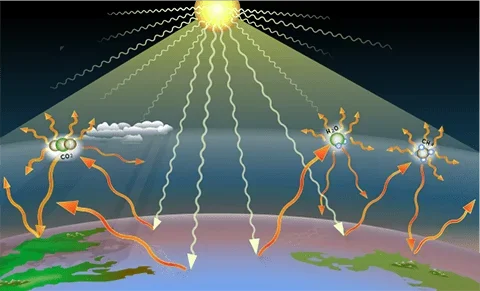 Biogeochemical cycles are complex systems that are impacted by a wide range of terrestrial phenomena, including anthropogenic emissions from human activities.Copyright 2022 Alice Litt, (Diagram adapted from the U.S. Department of Energy), Public Domain, Wikimedia Commons: https://commons.wikimedia.org/wiki/File:Carbon_cycle.jpg
The federal government has set a goal to reach 100% carbon pollution-free electricity by 2035 and there is a target to reach net-zero greenhouse gas emissions by 2050. A building development company that is known for futuristic designs and climate change activism has hired students to design the blueprints needed to modify old buildings/structures to meet a goal established by the federal government. Students work in small groups as they design the type of building for which they will draw blueprints. The building they design must have both net-zero carbon emissions and active roles in the water, carbon, and nitrogen cycles. Students then join expert groups where they learn about one of the energy sources or cycles. This information is then shared with their poster group and students draw their blueprints. There is a peer review and time for modifications before the blueprints are shared in a presentation.
Architectural engineers focus on the design and function of safe and sustainable buildings. To do this, they apply practical and theoretical engineering principles and technology to design and construct buildings and building systems. Many times, architectural engineers use structural, mechanical, electrical, lighting, acoustical, and construction engineering to create high-performance buildings that are sustainable, resilient, economically viable, that ensure the safety, health, comfort, and productivity of occupants.
After this activity, students should be able to:
- Describe and give an example of a biogeochemical cycle.
- Explain the need for alternative energy sources.
- Identify ways that negative human impact on the environment can be reduced.
- HS-LS2-5 Develop a model to illustrate the role of photosynthesis and cellular respiration in the cycling of carbon among the biosphere, atmosphere, hydrosphere, and geosphere.
Grades 9-12
This resource focuses on the following Three Dimensional Learning aspects of NGSS:
Science & Engineering Practices- Use a model based on evidence to illustrate the relationships between systems or between components of a system.Do you agree with this alignment?
Disciplinary Core Ideas- Photosynthesis and cellular respiration are important components of the carbon cycle, in which carbon is exchanged among the biosphere, atmosphere, oceans, and geosphere through chemical, physical, geological, and biological processes.Do you agree with this alignment?
- The main way that solar energy is captured and stored on Earth is through the complex chemical process known as photosynthesis.Do you agree with this alignment?
Crosscutting Concepts- Models (e.g., physical, mathematical, computer models) can be used to simulate systems and interactions—including energy, matter, and information flows—within and between systems at different scales.Do you agree with this alignment?
Do you agree with this alignment? - Use a model based on evidence to illustrate the relationships between systems or between components of a system.
- HS-LS2-7 Design, evaluate, and refine a solution for reducing the impacts of human activities on the environment and biodiversity.
Grades 9-12
This resource focuses on the following Three Dimensional Learning aspects of NGSS:
Science & Engineering Practices- Design, evaluate, and refine a solution to a complex real-world problem, based on scientific knowledge, student-generated sources of evidence, prioritized criteria, and tradeoff considerations.Do you agree with this alignment?
Disciplinary Core Ideas- When evaluating solutions it is important to take into account a range of constraints including cost, safety, reliability and aesthetics and to consider social, cultural and environmental impacts.Do you agree with this alignment?
- Moreover, anthropogenic changes (induced by human activity) in the environment—including habitat destruction, pollution, introduction of invasive species, overexploitation, and climate change—can disrupt an ecosystem and threaten the survival of some species.Do you agree with this alignment?
- Humans depend on the living world for the resources and other benefits provided by biodiversity. But human activity is also having adverse impacts on biodiversity through overpopulation, overexploitation, habitat destruction, pollution, introduction of invasive species, and climate change. Thus sustaining biodiversity so that ecosystem functioning and productivity are maintained is essential to supporting and enhancing life on Earth. Sustaining biodiversity also aids humanity by preserving landscapes of recreational or inspirational value.Do you agree with this alignment?
- Biodiversity is increased by the formation of new species (speciation) and decreased by the loss of species (extinction).Do you agree with this alignment?
Crosscutting Concepts- Much of science deals with constructing explanations of how things change and how they remain stable.Do you agree with this alignment?
Do you agree with this alignment? - Design, evaluate, and refine a solution to a complex real-world problem, based on scientific knowledge, student-generated sources of evidence, prioritized criteria, and tradeoff considerations.
Each student needs:
- laptop or computer for research - links are provided
Each group needs:
- large sheet of paper/poster board
- multiple markers/pencils in various colors
- white paper for sketching
- paper copies of the following:
- Net-Zero Ecological Building Design Rubric (PDF)
- Blueprint Checklist (PDF)
- Peer Review Sheet (PDF)
- Net-Zero Ecological Building Design Worksheet (PDF)
- Bringing it together Notes (PDF)
- Water Cycle Worksheet (PDF) (1 for each student in the water cycle expert group)
- Carbon Cycle Worksheet (PDF) (1 for each student in the carbon cycle expert group)
- Nitrogen Cycle Worksheet (PDF) (1 for each student in the nitrogen cycle expert group)
- Energy Source Sheet (PDF) (1 for each student in the energy source expert group)
- Pros and Cons Worksheet (PDF) (1 for each student in the energy source expert group)
- To be checked using the biomass, geothermal, nuclear, solar, and wind answer keys
- Alt Energy Ethanol Worksheet (PDF)
- Alt Energy Biodiesel Worksheet (PDF)
- Alt Energy Electric Worksheet (PDF)
- Alt Energy Natural Gas Worksheet (PDF)
- Alt Energy Hydrogen Worksheet (PDF)
- Alt Energy Propane Worksheet (PDF)
- Alt Energy Biodiesel Worksheet (docx)
- Alt Energy Biodiesel Worksheet (pdf)
- Alt Energy Biodiesel Worksheet Answer Key (docx)
- Alt Energy Biodiesel Worksheet Answer Key (pdf)
- Alt Energy Ethanol Worksheet (docx)
- Alt Energy Ethanol Worksheet (pdf)
- Alt Energy Ethanol Worksheet Answer Key (docx)
- Alt Energy Ethanol Worksheet Answer Key (pdf)
- Alt Energy Electric Worksheet (docx)
- Alt Energy Electric Worksheet (pdf)
- Alt Energy Electric Worksheet Answer Key (docx)
- Alt Energy Electric Worksheet Answer Key (pdf)
- Alt Energy Hydrogen Worksheet (docx)
- Alt Energy Hydrogen Worksheet (pdf)
- Alt Energy Hydrogen Worksheet Answer Key (docx)
- Alt Energy Hydrogen Worksheet Answer Key (pdf)
- Alt Energy Natural Gas Worksheet (docx)
- Alt Energy Natural Gas Worksheet (pdf)
- Alt Energy Natural Gas Worksheet Answer Key (docx)
- Alt Energy Natural Gas Worksheet Answer Key (pdf)
- Alt Energy Propane Worksheet (docx)
- Alt Energy Propane Worksheet (pdf)
- Alt Energy Propane Worksheet Answer Key (docx)
- Alt Energy Propane Worksheet Answer Key (pdf)
- Net-Zero Ecological Building Design Worksheet (docx)
- Net-Zero Ecological Building Design Worksheet (pdf)
- Net-Zero Ecological Building Design Worksheet Answer Key (docx)
- Net-Zero Ecological Building Design Worksheet Answer Key (pdf)
- Pros and Cons Worksheet (docx)
- Pros and Cons Worksheet (pdf)
- Pros and Cons Worksheet Biomass Answer Key (docx)
- Pros and Cons Worksheet Biomass Answer Key (pdf)
- Pros and Cons Worksheet Geothermal Answer Key (docx)
- Pros and Cons Worksheet Geothermal Answer Key (pdf)
- Pros and Cons Worksheet Hydropower Answer Key (docx)
- Pros and Cons Worksheet Hydropower Answer Key (pdf)
- Pros and Cons Worksheet Nuclear Answer Key (docx)
- Pros and Cons Worksheet Nuclear Answer Key (pdf)
- Pros and Cons Worksheet Solar Answer Key (docx)
- Pros and Cons Worksheet Solar Answer Key (pdf)
- Pros and Cons Worksheet Wind Answer Key (docx)
- Pros and Cons Worksheet Wind Answer Key (pdf)
- Blueprint Checklist (docx)
- Blueprint Checklist (pdf)
- Bringing it Together Notes (docx)
- Bringing it Together Notes (pdf)
- Net-Zero Ecological Building Design Rubric (docx)
- Net-Zero Ecological Building Design Rubric (pdf)
- Design Worksheet Answer Key (docx)
- Energy Source Sheet (docx)
- Energy Source Sheet (pdf)
- Peer Review Sheet (docx)
- Peer Review Sheet (pdf)
- Carbon Cycle Worksheet (docx)
- Carbon Cycle Worksheet (pdf)
- Carbon Cycle Worksheet Answer Key (pdf)
- Nitrogen Cycle Worksheet (docx)
- Nitrogen Cycle Worksheet (pdf)
- Nitrogen Cycle Worksheet Answer Key (docx)
- Nitrogen Cycle Worksheet Answer Key (pdf)
- Water Cycle Worksheet (docx)
- Water Cycle Worksheet (pdf)
- Water Cycle Worksheet Answer Key (docx)
- Water Cycle Worksheet Answer Key (pdf)
Students should be familiar (or familiarize themselves) with the terms: ecosystem, biotic, and abiotic.
Did you know that federal government under President Biden’s administration has set a goal to reach 100% carbon pollution-free electricity by 2035 and there is a target to reach net-zero greenhouse gas emissions by 2050? What do you think will have to happen to reach these goals? How will human activities have to change? What will be done differently? How do the buildings people make impact greenhouse gases?
An ecosystem is made up of a community of interacting organisms, remember that living things are biotic, and the environment they live in, remember that non-living things are abiotic. How do you think the buildings we make can affect an ecosystem, both the biotic and abiotic parts. Think about this school. How does it affect the water when it rains? How does it affect the plants that grow? What role do you think this school has in greenhouse gas emissions? What if we could reduce these impacts?
Let’s consider the following questions to better understand the phenomena behind greenhouse gas emissions and how they impact climate change:
- What type of gases are greenhouse gases?
- How do humans affect this process?
- What happens because of more greenhouse gases being released?
- What activities do humans do that increase greenhouse gas emissions?
For this activity, a building development company that is known for futuristic designs and climate change activism wants to modify old buildings/structures to meet the government’s goal. They have hired our class as architectural engineers to design the plans! Let’s dive into some research and get started on some designs for a new type of building.
Background
An ecosystem is made up of both biotic and abiotic components. Living things depend on each other and on the abiotic factors for survival. While energy flows one way through the food web in the ecosystem, the nutrients cycle through biogeochemical cycles. The cycles that are looked at in this activity are the carbon, nitrogen, and water cycles. These nutrients have different pathways through the ecosystem, but all of them transition between biotic and abiotic. Humans also live in the ecosystem. Our activities interfere with the cycling of nutrients and have caused many problems such as climate change and dead zones. The purpose of the Net Zero Ecological Building Design activity is for students to think about how the buildings we make interfere with the ecosystem and design ways the interference can be reduced. A lot of the problems that we cause have to do with the use of fossil fuels.
The activity requires students to research alternative types of energy and decide which is the best option for the building they are designing. Students will use the GREET database to research fuels. These fuels are meant for transport, but in this activity it is noted that this is a futuristic design and there is an assumption that there is technology in place so that these fuels can be used to heat the building. Students will also research other alternative energy sources to determine the source of electricity for the building.
This activity has students working in groups of four called “poster groups”. This is the group that will design and draw the blueprints for the building structure they are creating. It can be any type of structure (house, apartment, movie theater, grocery store, etc.). The design they create should show how the building has an active role within the carbon, nitrogen, and water cycles. The building is part of the ecosystem. Students have the option to design realistic structures, or they can be creative and make a futuristic, hypothetical structure.
To learn about the different cycles and energy sources, the students will work in “expert groups”. Groups should be on the small side. For example, in a class of 24 students there will be six students learning about each cycle. Groups of six are large, so they should be split into groups of three. However, the six students that are learning about energy sources should stay in a group of six as there are six different types of energy that they will be learning about.
Before the Activity
- Gather materials for each poster group.
- Review the documents so you are familiar with the grouping and different tasks.
- Students will either need to work on the digital document or a paper copy that is printed out for them so students can access them when they are ready.
With the Students
Part 1: Introduction and poster groups
- Read the Introduction/Motivation aloud to the class. Make sure to write down students’ brainstorming ideas for the questions in the Introduction/Motivation.
- Divide the class into groups of four students.
Part 2: Knowledge probe with poster groups
- Explain the activity: In groups of four, you will create blueprints for a building structure of your choice that has net-zero greenhouse emissions and an active, positive role in the water, carbon, and nitrogen cycles.
- Introduce the Net-Zero Ecological Building Design Rubric (PDF) for the project.
- Give each group a Net-Zero Ecological Building Design Worksheet (PDF).
- Have students begin Part 1: Knowledge Probe. Make sure all group answers and ideas are recorded on the worksheet.
- When all students are finished with Part 1, they should move to their expert groups to begin Part 2.
Part 3: Research in Expert Groups
- Make sure each cycle expert group (water, carbon, nitrogen) has no more than 2-3 students per group. Groups should be on the small side.
- Make sure the energy resource expert group has at least six students, as there are six different types of energy that they will be learning about.
- Give each team member in each expert group their respective worksheets:
- Water Cycle Worksheet (PDF)
- Carbon Cycle Worksheet (PDF)
- Nitrogen Cycle Worksheet (PDF)
- Energy Source Worksheet (PDF)
- Note: Have students discuss and brainstorm as a group, but they should keep their own separate answers so that they can be shared with their original poster groups.
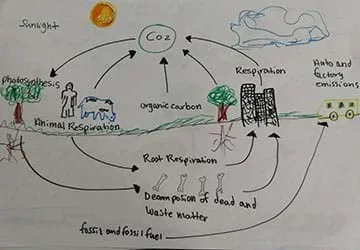 This is a picture of the carbon cycle drawn by students in a carbon focus group.Copyright 2022 Alice Litt, Purdue University RET (CISTAR)
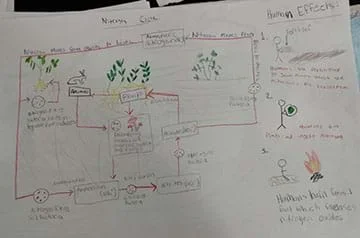 This is a drawing of the nitrogen cycle down by students in a nitrogen focus group.Copyright 2022 Alice Litt, Purdue University RET (CISTAR)
- Energy Source Expert Group:
- Have students in the Energy Source Expert Group choose which alternative fuel they are going to research.
- Give each team member in the Energy Source Expert Group their respective worksheets:
- Have each student fill out their alternative fuel source worksheet individually. Students will be looking up values using an excel database called GREET. The purpose of students using this is so they can determine the amount of carbon dioxide, nitrous oxide, and methane released. There is a lot more information in the database. Students might need help finding the data they are looking for. It is also possible to print out the needed information and have students get the information that way.
- Once each student has completed their individual alternative fuel source worksheet. Have the entire Energy Source Expert group come back together and share their research to determine which fuel is best to use. Note: There is an assumption that the technology is in place for these fuels to be able to heat the buildings that students are designing.
- When the Energy Source Expert Group is finished with step 1 of their Energy Source Worksheet (PDF), they should move on to step 2.
- In Step 2, students review the information here: https://www.eia.gov/energyexplained/renewable-sources/ to define renewable energy and see the different types of renewable energy.
- Each team member should then choose one type of renewable energy to research the pros and cons of.
- Give each team member in the Energy Source Expert Group a copy of the Pros and Cons Worksheet (PDF).
- Using the links provided in the Energy Source Worksheet (PDF), students learn about the renewable energy that they chose and complete the Pros and Cons Worksheet (PDF) for their energy source. Here are the links provided:
- Solar energy: https://www.solarreviews.com/blog/pros-and-cons-of-solar-energy
- Wind energy: https://www.windustry.org/pros_cons_wind_energy
- Geothermal: https://www.solarreviews.com/blog/geothermal-energy-pros-and-cons#what-is-it
- Hydropower: https://www.energysage.com/about-clean-energy/hydropower/pros-cons-hydropower/
- Nuclear energy: https://www.solarreviews.com/blog/nuclear-energy-pros-and-cons
- Biomass energy: https://www.solarreviews.com/blog/biomass-energy-pros-and-cons
- When everyone is finished learning about their renewable energy source, the Energy Source Expert Group should come back together and share the information with the group.
Part 4: Blueprint Planning and Design
- When all expert groups are finished, have students return to their poster groups and share what they learned.
- Give poster groups time to work on their blueprints. Refer students to the Net-Zero Ecological Building Design Worksheet (PDF) and the Blueprint Checklist (PDF) so they can check that all building requirements are included.
Part 5: Peer Review
- When groups have completed their designs, a peer review will take place. Teams will leave their poster at their station and the class will move one station clockwise. Each team member should complete the Peer Review Sheet (PDF) for the topic they are an expert on.
Part 6: Blueprint Revisions and Modifications
- Students return to their posters and read their feedback. Modifications are made as needed.
Part 7: Communication
- Poster presentations are shared with the class.
- abiotic
- Nonliving factors in an ecosystem.
- biotic
- Living factors in an ecosystem.
- ecosystem
- A community of living organisms in conjunction with the nonliving components of their environment, interacting as a system.
Pre-Activity Assessment
Discussion: Conduct the Introduction/Motivation section having the students answer the posed questions individually and in groups.
Activity Embedded (Formative) Assessment
Information gathering: The information students gather in their expert groups should be checked to make sure accurate information is being brought back to the poster group. This can be done informally by walking around to the groups and checking in on them as they work. Or the information can be submitted to the teacher for review.
Peer review: When the blueprint draft is complete, students do a peer review. Poster groups all move clockwise to review a different group’s blueprint. Each expert will give feedback on the topic they focused on using the peer review form. When students return to their own poster, they have the opportunity to make modifications based on the feedback.
Post-Activity (Summative) Assessment
Presentation: Students present their blueprints with their poster group. Students will a description of challenges they faced while designing their blueprints and the solution(s) they used to overcome the challenge. Students also share modifications from their blueprints that could be applied to current buildings to reduce human impact on the environment.
Students can build a 3D model of their structure. Students can study the real life emissions from a similar building structure.
The “jigsaw” design allows for differentiation in the classroom. The nitrogen cycle is a little more challenging than the water and carbon cycles. Students that need more of a challenge within the content can be assigned the nitrogen cycle and students that need to focus more on reading and comprehension can be assigned the water cycle.
Contributors
Alice Litt; Udayan Sing
Supporting Program
Research Experience for Teachers (RET) carried out by the Center for Innovative and Strategic Transformation of Alkane Resources (CISTAR), University of Texas at Austin, Purdue University, Northwestern University, and the National Science Foundation.
Acknowledgements
This work is based upon work supported in part by the National Science Foundation under Cooperative Agreement no. EEC-1647722. This activity was developed as part of a 2021 Research Experience for Teachers (RET) carried out by the Center for Innovative and Strategic Transformation of Alkane Resources (CISTAR), in partnership with University of Texas at Austin, Purdue University, Northwestern University, and the National Science Foundation. Any opinions, findings and conclusions or recommendations expressed in this material are those of the authors and do not necessarily reflect the views of the National Science Foundation.
Copyright
2023 by Regents of the University of Colorado; original © 2021 University of Florida