
Biochar: Measuring and Improving Soil Function
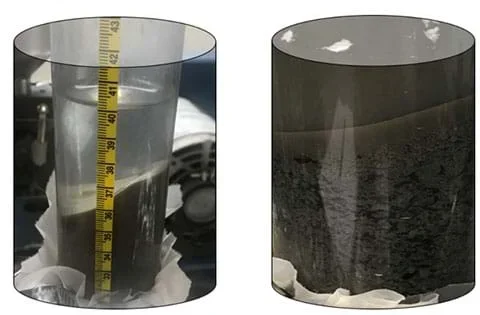 A demonstration of standing water in clay (L) versus standing water in clay with a biochar soil amendment (R).Copyright 2017 Chetan Sawhney, RET Program, Department of Earth, Environmental, and Planetary Sciences, Rice University
Students learn how to manipulate the behavior of water by using biochar—a soil amendment used to improve soil functions. As a fluid, water interacts with soil in a variety of ways. It may drain though a soil’s non-solid states, or its “pores”; lay above the soil; or move across cell membranes via osmosis. In this experiment, students solve the specific problem of standing water by researching, designing, and engineering solutions that enable water to drain faster. This activity is designed for students to explore how biochar helps soils to act as “sponges” in order to retain more water.
Measurement is a fundamental concept in science and engineering. Without the ability to measure, engineers would not be able to design and build their research experiments, much less iterate (improve) them. Not only is measurement critical in engineering, it is also important in industries in which engineering is essential such as farming, construction, and manufacturing.
In agriculture, measurements of water tend to dictate the amount of produce (such as fruits and vegetables) a piece of land can yield. Agricultural engineers and farmers design and improve upon systems to save water. In one particular instance, agricultural engineers add materials, sometimes known as amendments, to soil in order to aid in water retention. As a result, plants thrive in soils with higher concentrations of water because they are less likely to wilt and dry out. In this activity, students facilitate engineering designs and work with measurements, water, and soil to come up with designs for improved water retention.
After this activity, students should be able to:
- Describe what permits or prevents fluids (usually water) to move through pore spaces or fractures of different soil types.
- Describe how biochar can be used to facilitate hydraulic conductivity.
- Evaluate the strengths and weaknesses of different designs for testing hydraulic conductivity.
- Students will develop an understanding of the role of society in the development and use of technology.
Grades K-12
Do you agree with this alignment? - Students will develop an understanding of the attributes of design.
Grades K-12
Do you agree with this alignment? - Students will develop an understanding of the characteristics and scope of technology.
Grades K-12
Do you agree with this alignment? - STEL-4R Assess a technology that minimizes resource use and resulting waste to achieve a goal.
Grades 9-12
Do you agree with this alignment?
- SEP.7.6-8.1 Plan an investigation individually and collaboratively, and in the design: identify independent and dependent variables and controls, what tools are needed to do the gathering, how measurements will be recorded, and how many data are needed to support a claim.
Grades 6-8
Do you agree with this alignment?
- demonstrate the use of course apparatuses, equipment, techniques, and procedures, including meter sticks, rulers, pipettes, graduated cylinders, triple beam balances, timing devices, pH meters or probes, thermometers, calculators, computers, Internet access, turbidity testing devices, hand magnifiers, work and disposable gloves, compasses, first aid kits, binoculars, field guides, water quality test kits or probes, soil test kits or probes, 100-foot appraiser's tapes, tarps, shovels, trowels, screens, buckets, and rock and mineral samples;
Grades 11-12
Do you agree with this alignment?
- TA.1 Creativity and innovation. The student demonstrates creative thinking, constructs knowledge, and develops innovative products and processes using technology. The student is expected to:
Grades 9-12
Do you agree with this alignment?
Each group needs:
- 50-ml (or larger) graduated cylinder
- laboratory-grade metal ware set—suggested dimensions: support stand (8" x 5"), rod (24" height, 12mm diameter), cork lined burette clasp with metal retort ring (2.5" diameter) available at Amazon
- 100 g of soils (one of each type: clay, sand, silt and loam) available at Wards’s Science
- Note: loam is a mix of clay, silt, and sand
- 6 g biochar, available at Amazon
- 91 cm (½ yard) of organza or similar type fabric (for example, silky fabric used in curtains, dryer sheets) available at Amazon
- stopwatch
- 4 rubber bands
- 200-ml graduated cylinder, for measuring water
- 4–5 funnels (optional), available at Amazon
- mortar and pestle (optional), available at Amazon
- access to a computer with PowerPoint® to view the Measurements with Biochar Presentation (PPTX); alternatively, print out the slide presentation
- Lab Presentation Rubric (PDF)
For the class to share:
- scale, such as a scientific scale or simple kitchen scale, to measure 2 g to 50 g
- plastic graduated cylinders or plastic 2-liter soda bottles; students can cut and/or redesign a soda bottle to imitate the functions of a graduated cylinder; for example, turning a 2-liter bottle upside down and using the bottle top as the draining point
- funnels for pouring soil types into the graduated cylinders
- scissors, for cutting the plastic graduated cylinders or soda bottles
- masking tape and markers, for labeling graduated cylinders
A basic understanding of science tools with some knowledge of the effects of standing water.
In terms of water, what is the cost of producing the items listed in Table 1?
[Expect student responses to vary. The idea is for students to pause and reflect on the vast amount of water needed to produce just one item (for example, an apple). Use Table 1 for answers to how many liters of water are needed per kg of the item.]
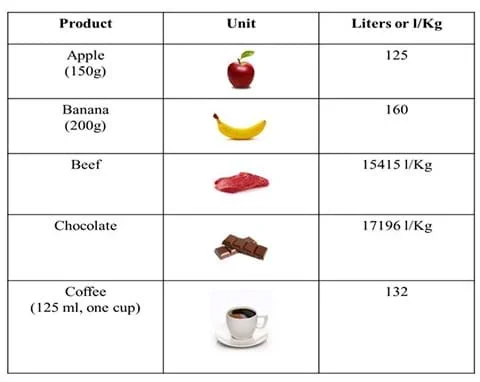 Table 1. Food products and the amount of water needed to produce each.Copyright 2017 Chetan Sawhney, RET Program, Department of Earth, Environmental, and Planetary Sciences, Rice University
Over the course of this activity, we will explore how to manipulate the behavior of one of the most important molecules on this planet—water. We will study why it is important to be able to manipulate water (H2O) and how a soil amendment, biochar, can aid in both drought prevention and preventing standing water. We will use various lab equipment and apparatus to carry out the experiment with precision and safety.
When considering situations that involve water, engineers must contend with two weather- and climate-related phenomena: an overabundance of water that may lead to flooding, and a lack of water that may lead to drought. Agricultural engineers strive to mitigate flooding and drought, particularly in the face of climate change and its resultant severe weather.
Flood waters have both visible and hidden dangers. Visible dangers are typically obvious: erosion of land and destruction of property and infrastructure that distribute swaths of debris to large areas. Hidden dangers are microscope in nature: bacteria, viruses, and germs that begin to feed and multiply in the standing water as a result of flooded sewer lines. Previous flood waters, such as those in the aftermath of Hurricane Harvey in 2017, contained flesh eating bacteria, which eventually caused the death of two volunteers. Standing water also serves as an ideal breeding ground for mosquitoes and mosquito-borne illnesses. Studies showed an increase in West Nile virus in Gulf Coast areas affected by Hurricane Katrina in 2005.
Devastation caused by floods, of course, comes to mind when water is mentioned as a weather phenomenon, whereas droughts tend to be overlooked unless you ask farmers and agricultural engineers. Droughts are more of a long-term, climatic effect that occur over the course of several months or years. The 2012-17 California drought was one of the driest on record and impacted groundwater and reservoir storage as well as forests—millions of trees died because of a lack of water. Droughts also disrupt agriculture, causing damage to croplands. In extreme but rare cases, droughts cause famine due to crop loss.
[For an engineering scenario, present the real-world after effects of Hurricane Harvey in 2017. Ask students to propose a solution to preventing standing water before the next hurricane season. Likewise, have another set of students propose a solution to city planners for easing the after effects of a severe California drought. After modeling and completing this experiment, expect students to be able to propose various solutions. They may propose adding biochar in both scenarios. In Houston, biochar could be added to soils city-wide to improve the drainage and absorption of standing water. In California, the addition of biochar in drought-prone areas would ease the severe impacts caused by lack of water. If biochar is applied to soils before drought condition, the soils have higher water retention levels, easing the economic impacts.]
Background
Soil water-holding capacity and hydraulic conductivity (K) are two important soil properties. Soil water-holding capacity is the amount of water soil can hold. Hydraulic conductivity is the ease with which water can move through soil pores or fractures. Over the next class periods, students explore how biochar added to four different soil types affects the flow rate of water.
This activity demonstrates measuring procedures and techniques within the context of soil science and engineering. It also introduces the use of several course apparatus and equipment including graduated cylinders, scales and balances, timing devices, calculators, and computers with internet access.
Before the Activity
- Stress the importance of precise measurement, as wekk as using the metric system.
- Make copies of the Lab Presentation Rubric (PDF).
- Be ready to show the Measurement with BIochar Presentation (PPTX). Alternatively, make handout copies of the slide presentation.
With the Students
Day 1: Stage all the materials. Students conduct this activity with teacher supervision.
- Lead students through the Introduction/Motivation section, and conduct the Pre-Activity Assessment.
- Tell students to select two soil types: sand and clay.
- Have students measure 50 grams of each soil type.
- Direct students to hollow out the bottom of four plastic graduated cylinders.
- Either cut the entire bottom using a pair of scissors or use a push pin to poke several holes on the bottom.
- Cover the hollowed-out bottom with either organza fabric, mesh cloth or a dryer sheet. Affix the fabric, cloth, or dryer sheet with a rubber band, as shown in Figure 1.
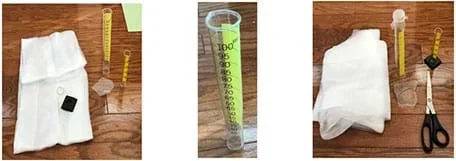 Figure 1. Two graduated cylinders, organza fabric, rubber band, and a stand (L); cylinder with the bottom cut out (center); the finished testing product (R).Copyright 2017 Chetan Sawhney, RET Program, Department of Earth, Environmental, and Planetary Sciences, Rice University
- Have students mark and fill two graduated cylinders with soils only, using the pre-measured soils (50 g sand, and 50 g clay).
- Have students mark and fill the other two graduated cylinders with soils + biochar and mix them into a homogeneous mixture. The soil + biochar measurement for each cylinder should be:
- 48 g sand + 2 g biochar
- 48 g clay + 2 g biochar
- Have students begin the hydraulic conductivity test. Instruct students to place the hollowed-out cylinders into larger graduate cylinders partly-filled with water, as shown in Figure 2. Let the samples sit until fully saturated, then have students raise the samples so that the soils can drain. Drain the soils until no standing water remains; this may take up to 24 hours so leave the samples overnight.
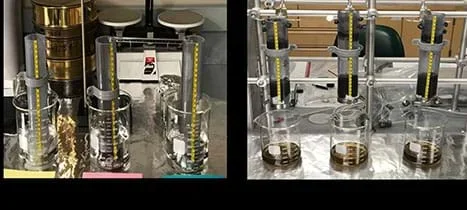 Figure 2. Soil samples being saturated in water (L); water draining through soil samples into cylinders (R).Copyright 2017 Chetan Sawhney, RET Program, Department of Earth, Environmental, and Planetary Sciences, Rice University
Day 2: Permit students to use the Measurements with Biochar Presentation (PPTX) as a model to follow. As time permits, have students design and/or re-engineer the model.
- Remind students that they are acting as agricultural engineers who are exploring the effects of biochar to devise solutions for mitigating the effects of floods and droughts.
- If not already in place, have students place the plastic graduated cylinder on the support stand, as shown in Figure 3, and the other graduated cylinder below to catch draining water. Remind them that hydraulic conductivity is the ease with which water moves through soil pores, so they will be measuring the time it takes the water to move through the soils. Distribute a stopwatch to each group.
- Direct students to fill the sample-containing plastic graduated cylinders with 200 ml of water.
- Have students measure the flow rate, the amount of water that drips through the soil, by measuring the time to takes a given amount of water (~100-150 ml works well) to flow through the soil. Make sure each group records its results because they will graph the data later.
- Note: Water flows through sand in one 60-minute period, while silt might take 90 minutes or more, and clay takes 3-4 days.
- While the water is draining, have students brainstorm different design solutions for testing hydraulic conductivity. Remind students that they will present their solutions to the class (see the Activity Embedded Assessment section).
- Have groups begin preparing their presentations. Distribute the Lab Presentation Rubric (PDF). Have students write down their hypotheses and experimental designs, and brainstorm ways to communicate their data (via graphs and tables).
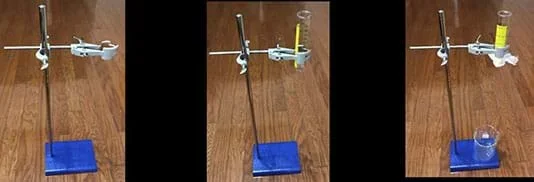 Figure 3. A mock-up of the support stand (L); holding a graduated cylinder with the bottom cut out (center); the finished testing product (R).Copyright 2017 Chetan Sawhney, RET Program, Department of Earth, Environmental, and Planetary Sciences, Rice University
Days 3-4: Continue to test hydraulic conductivity.
- Once the sand hydraulic conductivity test is completed, have students clean out the sand cylinders and repeat the experiment with loam. Expect that water may continue flowing through the clay experiment while students conduct the loam experiment
- Have students present their solutions for testing hydraulic conductivity. Ask them questions from the Activity Embedded Assessment.
- As time permits, ask students groups to brainstorm answers to the Investigating Questions. Lead a class discussion about the effects of biochar, and how engineers can utilize biochar to aid in flood- and drought-prone areas.
Day 5: Groups present results/data, inferences, and conclusions.
- Recommend that students present their data via graphs, and reference the Measurements with Biochar Presentation (PPTX) and Figure 4 as an example.
- If computers are available, have students use PowerPoint to present their findings.
- Use the Lab Presentation Rubric (PDF) for constructive feedback, and grades.
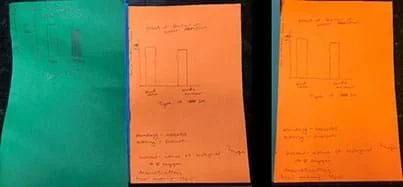 Figure 4. Example bar graphs present the water flow rate by soil types.Copyright 2017 Chetan Sawhney, RET Program, Department of Earth, Environmental, and Planetary Sciences, Rice University
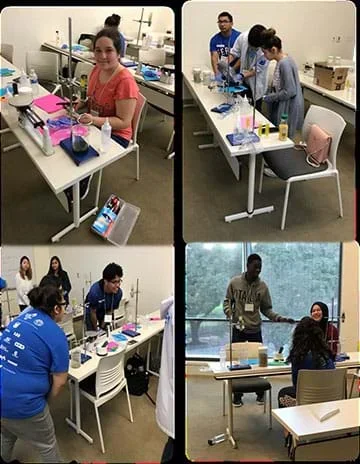 Teenagers conducting the measurements with biochar experiment. They are at different stages of the experiment from measuring to presenting findings.Copyright 2017 Chetan Sawhney, RET Program, Department of Earth, Environmental, and Planetary Sciences, Rice University
- amendment
- A product which is added to soil to improve the soil’s physical qualities, usually its fertility (ability to provide nutrition for plants) and sometimes its mechanics.
- biochar
- A solid carbon-rich material obtained from burning biomass in the absence of oxygen, which prevents combustion and instead produces a mixture of solids similar in physical form to ashes or charcoal.
- biomass
- In energy production, any organic matter such as plant or animal matter than can be used for fuel.
- flow rate
- Quantity of liquid moving through the soil expressed cubic meters per second, or in cubic feet per second or gallons per minute.
- hydraulic conductivity
- The ease with which a fluid, usually water, can move through pore spaces or fractures in soil.
- soil
- A mixture of organic matter, minerals, gases, liquids, and microorganisms that form the outermost layer of the Earth; also a means of water storage, supply, and purification.
Pre-Activity Assessment
Brainstorming: Cultivate student brainstorming skills through asking them the following questions:
- Why is it important for water to make it through the pores of soil?
Possible answers: Water needs to travel through the pores of soil to prevent standing water and floods (to drain away rising and pooling water). Increasing plant-available water, sustaining of a steady water table, and refilling aquifer levels are other reasons why water it is important for water to be able to travel through soil pores.
- What are some ways we can test the flow rate of water in different soil types?
Answers will vary. Possible answer: One way to test flow rate is to gather soil from the subject area and place it in a cylinder or funnel and then pour water through the collected soil.
Activity Embedded Assessment
Design Presentations: After each group creates one or two design solutions for testing hydraulic conductivity, have them present their best design and answer the following questions:
- Did your design allow for specific and exact measurements? How can it be verified?
Example answer:The soil can be measured using a triple-beam balance and water can be measured.
- What are advantages and disadvantages of the engineered design?
Expect student responses to vary, based on their designs. One advantage might be cost if simple lab materials are used to test flow rate. One disadvantage might be a design that did not permit any water to travel through the pores, such as a design that confined the water to remaining on top of the soil’s surface.
Post-Activity Assessment
Final Presentations/Project Reflections: After testing their designs, have students consider again the questions from the activity-embedded assessment, as well as the following.
- Evaluate the presentation using the Lab Presentation Rubric (PDF). Also have students use the rubric to self-grade their lab and presentations.
- Did students present measurement data in chart format, bar, column, pie, scatter plot, etc.?
- Does the design enable testing reproducibility, meaning multiple trials?
If the design allowed for at least three trials with similar data, then the design was a success. If not, reengineering and modification may be needed.
Use gloves to handle the biochar to avoid getting black residue on skin. The residue washes off with soap and water.
Have students research other environmental areas in which biochar might aid in mitigating the effects of climate change.
- For lower grades, have students explore water retention levels and identify different soil types. Have them explore different types of soil by digging about six inches into the ground at permitted school/campus outdoor areas, giving them instant and tangible connections to the learning environment. Then, have students mix that soil with a little water. If the soil sample can be formed into a shape, like a sphere ball, then clay is the soil type. If the soil sample loses its shape or is not able to form a shape, then sand is the predominant soil type. If the soil sample can be formed into a shape, like a sphere ball, but then crumbles easily upon squeezing, silt is the soil type.
- For younger students, have an adult hollow out the bottom of the graduated cylinders.
- For higher grades, have students research other possible feedstock for biochar and how else biochar might aid in mitigating the consequenes of global climate change.
- For higher grades, have students list the different variables (independent, dependent, and control) and then graph their data in Excel or PowerPoint.
Brady, Nyle and Weil, Ray. The Nature and Properties of Soils. Prentice Hall, 2001.
Brewer, Catherine E., et al. “New approaches to measuring biochar density and porosity,” Biomass and Bioenergy. 66: 176-185. 2014. https://doi.org/10.1016/j.biombioe.2014.03.059
Interactive Tools – Product Gallery. 2017 Water Footprint Network. Accessed September 11, 2018. http://waterfootprint.org/en/resources/interactive-tools/product-gallery/
Liu, Zuolin; Dugan, Brandon; Masiello, Caroline; and Gonnerman, Helge. “Biochar particle size, shape, and porosity act together to influence soil water properties.” PLoS ONE 12: e0179079. 2017. https://doi.org/10.1371/journal.pone.0179070.
2000m^2: The Global Field. 2016. Agricultural and Rural Convention * ARC2020. Accessed September 11, 2018. https://www.2000m2.eu
Contributors
Chetan Sawhney
Supporting Program
Nanotechnology RET, Department of Earth Science, School Science and Technology, Rice University
Acknowledgements
This material was developed in collaboration with the Rice University Office of STEM Engagement, based upon work supported by the National Science Foundation under grant no. EEC 1406885—the Nanotechnology Research Experience for Teachers at the Rice University School Science and Technology in Houston, TX. Any opinions, findings and conclusions or recommendations expressed in this material are those of the authors and do not necessarily reflect the views of the National Science Foundation or Rice University.
Special thanks to Xiaodong Gao, and Caroline Masiello for their dedication, time, and tutelage; Carolyn Nichol, Christina Crawford, and Isaias Cerda of the R-STEM program at Rice University for the opportunity.
Copyright
2018 by Regents of the University of Colorado; original © 2017 Rice University