
Exploring Bioluminescence in Aquatic Animals
Some of the world’s most fascinating organisms emit their own light through bioluminescence—which is typically generated by a light-emitting molecule and a specific type of enzyme. Animals might use bioluminescence to signal, attract prey, or attract mates. In this activity, students make sense of how organisms emit light using bioluminescence and how these phenomena can increase organisms’ survival rate in harsh environments. Through the engineering design process, students create their own bioluminescent organism using ultraviolet light and fluorescent materials to help their organism either warn and evade predators, lure and detect prey, or communicate between members of the same species.
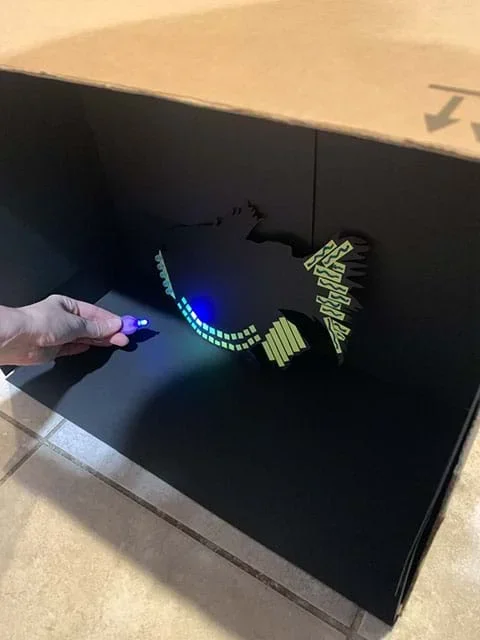 Bioluminescent Organism Cut-Out with Fluorescent Materials Expressing BioluminescenceCopyright 2021 Jessica Robicheaux, Rice University RET
Engineers are interested in developing near-infrared dyes for their enhanced capability in fluorescence detection and imaging in biomedical applications. These imaging techniques include excellent tissue penetration depth, low background with minimal fluorescence from surrounding tissues, and low cost. Biomedical engineers in this field utilize fluorescence to visualize tissue using fluorescent probes. Like bioluminescence in nature, these dyes can be activated by certain wavelengths to help identify targeted tissues.
After this activity, students should be able to:
- Observe the way organisms live and survive in their ecosystem by interacting with the living and nonliving components.
- Compare the structures and functions of different species that help them live and survive in a specific environment such as green fluorescence in fish’s eye lids to help detect prey better.
- Communicate valid conclusions in both written and verbal form.
- MS-LS2-4 Construct an argument supported by empirical evidence that changes to physical or biological components of an ecosystem affect populations.
Grades 6-8
This resource focuses on the following Three Dimensional Learning aspects of NGSS:
Science & Engineering Practices- Construct an oral and written argument supported by empirical evidence and scientific reasoning to support or refute an explanation or a model for a phenomenon or a solution to a problem.Do you agree with this alignment?
- Science disciplines share common rules of obtaining and evaluating empirical evidence.Do you agree with this alignment?
Disciplinary Core Ideas- Ecosystems are dynamic in nature; their characteristics can vary over time. Disruptions to any physical or biological component of an ecosystem can lead to shifts in all its populations.Do you agree with this alignment?
Crosscutting Concepts- Small changes in one part of a system might cause large changes in another part.Do you agree with this alignment?
Do you agree with this alignment? - Construct an oral and written argument supported by empirical evidence and scientific reasoning to support or refute an explanation or a model for a phenomenon or a solution to a problem.
- MS-LS2-5 Evaluate competing design solutions for maintaining biodiversity and ecosystem services.
Grades 6-8
This resource focuses on the following Three Dimensional Learning aspects of NGSS:
Science & Engineering Practices- Evaluate competing design solutions based on jointly developed and agreed-upon design criteria.Do you agree with this alignment?
Disciplinary Core Ideas- There are systematic processes for evaluating solutions with respect to how well they meet the criteria and constraints of a problem.Do you agree with this alignment?
- Biodiversity describes the variety of species found in Earth's terrestrial and oceanic ecosystems. The completeness or integrity of an ecosystem's biodiversity is often used as a measure of its health.Do you agree with this alignment?
- Changes in biodiversity can influence humans' resources, such as food, energy, and medicines, as well as ecosystem services that humans rely on—for example, water purification and recycling.Do you agree with this alignment?
Crosscutting Concepts- The uses of technologies and any limitations on their use are driven by individual or societal needs, desires, and values; by the findings of scientific research; and by differences in such factors as climate, natural resources, and economic conditions. Thus technology use varies from region to region and over time.Do you agree with this alignment?
- Small changes in one part of a system might cause large changes in another part.Do you agree with this alignment?
- Scientific knowledge can describe the consequences of actions but does not necessarily prescribe the decisions that society takes.Do you agree with this alignment?
Do you agree with this alignment? - Evaluate competing design solutions based on jointly developed and agreed-upon design criteria.
- Organisms and environments. The student knows that living systems at all levels of organization demonstrate the complementary nature of structure and function. The student is expected to:
Grade 7
Do you agree with this alignment?
Each pair needs: (providing a variety of items for students to choose from)
- Bioluminescent Organism Cut-Outs (PDF) - student choice (traced on black construction paper would be best)
- Bioluminescent Organism Cards (PPTX) (via the PowerPoint slides)
- Light-Up Your Dyes Student Packet (PDF)
- Light-Up Your Dyes Student Packet Presentation (PPTX)
- bottle of glow paint
- 0.3 meters of glow tape (1 ft.)
- meter of yarn (~3 ft.)
- 2 cotton swabs (for applying glow paint)
- 10 glow beads
- mini-UV light
For the entire class to share:
- Teacher-made deep-sea diorama (i.e., a large shoebox, without lid, whose inside is covered in black construction paper)
- black light
- liquid glue
- scissors
- tape
- black construction paper or thick black cardstock
- white colored pencil (for tracing organisms on black paper)
- Aquatic Bioluminescence PowerPoint Presentation (pptx)
- Aquatic Bioluminescence PowerPoint Presentation (pdf)
- Bioluminescent Organism Cut-Outs (pdf)
- Bioluminescent Organism Cards (pptx)
- Bioluminescent Organism Cards (pdf)
- Light-Up Your Dyes Student Packet (docx)
- Light-Up Your Dyes Student Packet (pdf)
- Light-Up Your Dyes Student Packet Presentation (pptx)
- Light-Up Your Dyes Student Packet Presentation (pdf)
- Making Sense Assessment (docx)
- Making Sense Assessment (pdf)
A familiarity with how structures and functions enable organisms to survive in their environment.
Have you ever wondered why some organisms can glow, flash, and blink? This natural phenomenon is called bioluminescence, which is light produced by a living organism caused by a chemical reaction.
Can you think of some organisms that possess this unique adaptation? What environments can we find these organisms in? One common example would be the firefly. If you have ever seen mysterious flashing lights in the countryside around sunset, then you may have seen a firefly use bioluminescence in action. But how and why does this insect use bioluminescence? The specific bioluminescent chemical reaction for the firefly involves a combination of substances in their abdomen. All these ingredients come together in the insect’s light organ called the luminophore and then light is produced.
So why does the firefly light up the night sky with its flashing fluorescence? This could be for a variety of reasons depending on the species. One reason could be to warn predators of their nasty taste. Another reason could be to communicate with other members of the opposite sex for potential mates.
Despite the beauty and wonder of fireflies, they are not the only organism that can produce light in their bodies. What about aquatic organisms? Would aquatic organisms benefit from using bioluminescence in the deep sea? The answer is yes!
Bioluminescence is more common in aquatic ecosystems rather than land ecosystems. In fact, aquatic organisms use the same chemical (luciferin) and enzyme (luciferase) as the firefly to produce their own light. Bioluminescence is an adaptation that is extremely advantageous in the cold, dark waters of the deep ocean due to light being so rare. Below 3,300 feet, also known as the Twilight Zone, there is absolutely no sunlight and organisms must adapt to living in complete darkness. Many organisms have used bioluminescence to their advantage to communicate with others, find a mate, hunt, and confuse predators.
There are a total of 1,500 species of fish alone that can luminesce, which proves that this adaptation contributes to the overall success of these organisms as they have evolved over time. Most aquatic organisms can control their bioluminescence by being able to turn their “glow” on and off. They also can control the brightness and what color is being emitted, which can be very useful depending on the situation. Overall, bioluminescence is the driving force of many deep-sea organisms and without this special adaptation, these organisms would not be able to survive the harsh conditions the ocean presents.
How could humans use bioluminescence? (Let students offer their thoughts.) Engineers are developing near-infrared fluorescent dyes for their enhanced capability in fluorescence detection and imaging. Like bioluminescence in nature, these dyes can be activated by certain excitation wavelengths to “light up” and help identify disease in the body. Essentially, engineering helps innovate the way we visualize cells in the body by harnessing the power of light.
Today, we are going to construct our very own aquatic bioluminescent organism using the engineering design process. Can you use the power of bioluminescence to help your organism survive the harsh conditions of the deep sea? Let’s try it!
Before the Activity
- Gather materials
- Make copies of the Bioluminescent Organism Cut-Outs (PDF) and Light-Up Your Dyes Student Packet (PDF).
- Print off Bioluminescent Organism Cards (PPTX) front to back (such that organism is on the front and the organism’s information is on the back)
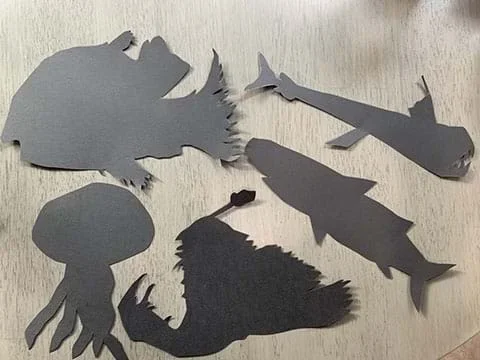 Bioluminescent Organism Cut-OutsCopyright 2021 Jessica Robicheaux, Rice University RET
With the Students
Day 1
Introduce the Concept of Bioluminescence
- Go through the Aquatic Bioluminescence PowerPoint Presentation (PPTX) with students.
- Slide 1: Present the following questions to the class: “Do you ever wonder why some aquatic organisms glow, flash, and blink? Bioluminescence is light produced by a living organism caused by a chemical reaction. Why do some organisms have bioluminescence?”
- Slide 1 (continued): Discuss with students the conditions aquatic organisms may encounter in the deep ocean. Questions to focus on: What are the conditions like in the deep ocean? (Answers: very cold, little food, no light). Is there an abundance of food available? (Answer: no) Ask students to think about how aquatic organisms have adapted to these harsh conditions.
- Slide 1 (continued): Continue investigating questions: “What makes these creatures odd or weird?” More than anything, it is the environment in which they live in the deep ocean - the peculiar conditions to which they have adapted. These include intense pressure far beyond our imagination, and lack of light. In fact, 99% of the sun’s light does not penetrate below the topmost 330 feet (100 m) of the surface of the sea. The pressure at 3,280 feet (1 km), where no light penetrates and where some deep-sea creatures live, is 100 times greater than the pressure we feel at the surface.
- Slide 2: Show students the video from BBC Earth explaining bioluminescence: http://www.youtube.com/watch?v=UXl8F-eIoiM.
- Discuss with students how this adaptation may benefit them.
- Slide 2 (continued) After viewing the video, have students complete the ‘Research Notes’ section in the Light-Up Your Dyes Student Packet (PDF) and the and Light-Up Your Dyes Student Packet Presentation (PPTX). to answer the following question: Why do some aquatic organisms express bioluminescent properties?
- Have students share their evidence with the class. (Valid responses should include warning and evading predators, luring and detecting prey, or communicating between members of the same species.)
- Slide 3: Move onto slide 3 to provide a visual of the conditions of the different ocean zones. Most of the organisms the students will be learning about can be found in the Twilight Zone and below (3300 meters).
Day 2
Design prototype of an aquatic organism that expresses bioluminescent properties based on need (warn and evade predators, lure and detect prey, or communicate between members of the same species).
- Have students work in pairs.
- Have each pair choose a bioluminescent organism from the Bioluminescent Organism Cut-Outs (PDF): (deep-sea anglerfish, stoplight loosejaw, spined pygmy shark, jewel squid, hatchetfish, Sloane’s viperfish, mauve stinger, or black dragonfish).
- After they choose their organism, students take the corresponding Bioluminescent Organism Cards (PPTX) to learn more about the organism and how it specifically meets its needs in the deep ocean using bioluminescence.
- Students identify the need and constraints of the organism to place the bioluminescent materials correctly on the cut-out.
- Students first plan their prototype design in their Light-Up Your Dyes Student Packet (PDF) and the and Light-Up Your Dyes Student Packet Presentation (PPTX). with their partner. Make sure students can view available fluorescent materials (glow paint, glow tape, UV beads, etc.)
- Students will use various fluorescent materials to construct a prototype to help their chosen organism meet its needs (communication, luring prey, or evading predators). The design will need to be created directly on their Bioluminescent Organism Cut-Outs (PDF). The glow materials need to model how their deep-sea creature would use bioluminescence to survive.
- Once students have planned their design, they may begin cutting out their organism, preferably on thick black cardstock. To save time, the cut-outs can be cut out ahead of time.
- Students will have 20 minutes to construct their prototype.
- Once their prototype is complete, students will test their design in the black diorama (teacher made). Teacher will use a blacklight to view the specific type of bioluminescence used for that organism to survive.
- Have students demonstrate their creation to the class.
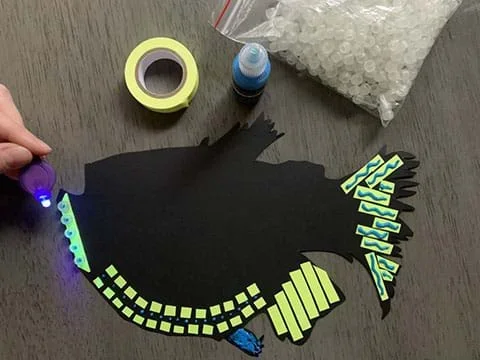 Bioluminescent Organism Cut-Out with Fluorescent Materials Expressing BioluminescenceCopyright 2021 Jessica Robicheaux, Rice University RET
Day 3
Will your organism be able to meet its needs using bioluminescence?
- Students will participate in writing their claims, evidence, and reasoning. Explain to students that writing out their claims, evidence, and reasoning will help with working through problems to arrive at an explanation. These documents also help scientists develop a better understanding of the problem and give you the ability to communicate your thoughts clearly to others.
- Students will answer the question, ‘How does bioluminescence help your aquatic organism survive in the incredibly hah conditions of the deep sea?’ This will take place on page 5 in Light-Up Your Dyes Student Packet (PDF).
- Students must provide at least three pieces of evidence to prove their claim and effectively explain why their organisms are able to survive with their specific adaptations.
- A scoring rubric is provided and included on page 7 of the student packet.
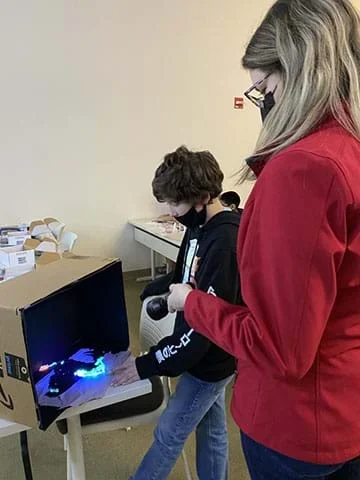
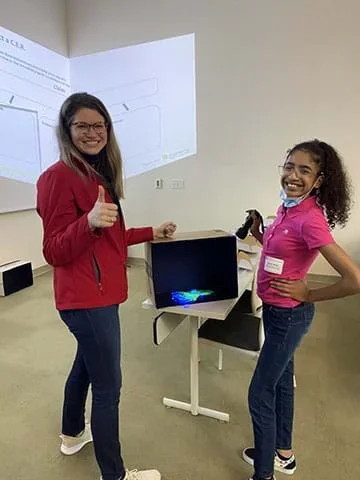 What other ways can we think of to engineering designs using bioluminescence?Copyright 2021, Jessica Robicheaux
- adaptation
- A change or the process of change by which an organism or species becomes better suited to its environment.
- bioluminescence
- The emission of light by a living organism.
- chemical reaction
- A process that involves rearrangement of the molecular or ionic structure of a substance, as opposed to a change in physical form or a nuclear reaction.
- fluorescence
- The emission of light by a material when stimulated by the absorption of radiation or of a subatomic particle.
Pre-Activity Assessment
Brainstorming: As a whole group, have students engage in an open discussion about why certain organisms glow, flash, and blink light. Students then provide evidence to answer that question pertaining to aquatic organisms in their Light-Up Your Dyes Student Packet (PDF) and Light-Up Your Dyes Student Packet Presentation (PPTX).
Quick Poll: Before the activity begins ask students the following question: How do aquatic organisms survive intense pressure, cold and total darkness? Encourage students to agree or disagree with responses.
Activity Embedded (Formative) Assessment
Student Packet: Have students work in pairs on Light-Up Your Dyes Student Packet (PDF) and Light-Up Your Dyes Student Packet Presentation (PPTX). After they finish their research, brainstorming, and planning their prototype design they may begin constructing and applying fluorescent materials to their bioluminescent cut-out.
Hypothesize: Ask students what they think would happen if these aquatic organisms did not possess bioluminescence in the deep ocean. (Answer: Considering bioluminescence is the only source of light in most cases, these organisms would have difficulties fending off predators, luring prey, and attracting mates in the deep ocean.)
Post-Activity (Summative) Assessment
Claim-Evidence-Reasoning: Students will provide a claim, evidence, and reasoning that bioluminescence will increase the survival rate of their aquatic organism.
Making Sense Assessment: Have students reflect on the science concepts they explored and/or the science and engineering skills they used by completing the Making Sense Assessment (PDF).
- No one should ever look directly into a beam of light when working with UV light (blacklight).
- Cut out the Bioluminescent Organism Cut-Outs (PDF) ahead of time.
- Tracing organisms on black cardstock for organism cut-outs would be best. Tracing cut out using white colored pencil would be more authentic to modeling organisms in the deep ocean.
Hoyt, Erich. Weird Sea Creatures. Buffalo, New York, ST: Firefly Books (U.S.) Inc., 2013
Scientific American. How and Why Do Fireflys Light Up?. September, 5, 2005. https://www.scientificamerican.com/article/how-and-why-do-fireflies/#
Contributors
Jessica Robicheaux; Dr. Han Xiao; Axel Loredo
Supporting Program
The NanoTechnology Research Experience for Teachers, Rice University
Acknowledgements
This material was developed in collaboration with the Rice University Office of STEM Engagement, based upon work supported by the National Science Foundation under grant no. EEC 1406885—the Nanotechnology Research Experience for Teachers at the Rice University School Science and Technology in Houston, TX. Any opinions, findings and conclusions or recommendations expressed in this material are those of the authors and do not necessarily reflect the views of the National Science Foundation or Rice University.
Copyright
2022 by Regents of the University of Colorado; original © 2022 Rice University