
Much More than Pretty Colors
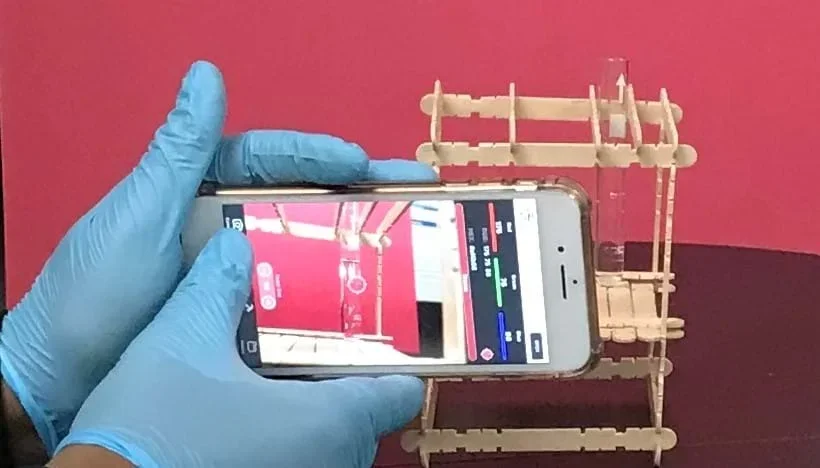 A sample analysis using a smartphone.Copyright 2022 Usha Devathosh, Rice University RET
In a visible spectrophotometer a beam of light shines into a solution containing the sample and detects how much of it comes out of the other side of the solution. Students can compare the amount of light absorbed by the pure solvent to the amount absorbed when the sample is dissolved in it. Spectrophotometers can report measurements such as absorbance. In this investigation, students are guided to construct a spectrophotometer to discover the relationship between absorbance and concentration and ultimately the concentration of an unknown solution.
Spectroscopy is the study of interaction of light and matter as a function of wavelength. Engineers and scientists use spectroscopy as a tool to analyze constituents in various substances and have a wide range of applications in industries. Engineers and scientists use spectroscopy to determine the impurities, presence, or absence of some components in a mixture, and to find the concentration of specific compounds in a solution. For instance, quality control engineers use the spectroscopic method to find the concentration of various dyes used in sports drinks. The basic principles of spectral analysis that students learn in school can also be applied to the more sophisticated instrumentation required to access the ultraviolet, infrared, and X-ray regions of electromagnetic spectrum.
After this activity, students should be able to:
- Relate the absorbance to and concentration of a solution.
- Construct a simple spectrophotometer.
- Analyze spectroscopic data to find the concentration of a component in a solution.
- CCSS.Math.Content.HSA-REI.D.10 Understand that the graph of an equation in two variables is the set of all its solutions plotted in the coordinate plane, often forming a curve (which could be a line).
Grades 9-12
Do you agree with this alignment?
- SEP.1.9-12.2 Apply concepts of statistics and probability (including determining function fits to data, slope, intercept, and correlation coefficient for linear fits) to scientific and engineering questions and problems, using digital tools when feasible.
Grades 9-12
Do you agree with this alignment? - SEP.3.9-12.6 Construct an explanation based on valid and reliable evidence obtained from a variety of sources (including students' own investigations, models, theories, simulations, peer review) and the assumption that theories and laws that describe the natural world operate today as they did in the past and will continue to do so in the future.
Grades 9-12
Do you agree with this alignment?
For the Teacher Demonstration:
- 2 beakers of the same size (250 ml or 500 ml)
- 150 ml – 340 ml water (amount depends on beaker size)
- red food coloring (liquid drops, not gel)
- test tube or graduated cylinder (must be narrower than the beakers)
- red laser pointer
Each group needs:
- smart phone with Colorimeter X app installed (available in the Apple App Store)
- 6 test tubes (10 ml)
- test tube holder
- 2 pipettes, serological 10 ml or syringe (10 ml)
- piece of red construction paper
- 10 ml blue Gatorade
- 200 ml distilled water
- marker - any color
- 25-30 popsicle sticks (or craft sticks)
- graph paper or computer with Excel (for graphing)
- 2 beakers (one for water, one for stock solution)
- Much More Than Pretty Colors Worksheet (PDF) (1 for each student)
Entire class:
Students should know how to construct a line graph.
Students should be familiar with how to perform dilutions of solutions.
Students should have a basic knowledge of chemistry topics such as molecular formulas, ionic compounds, absorbance, and transmittance.
Which is your preferred drink: blue or red Gatorade and why? It’s no surprise if you prefer either blue or red Gatorade, because food coloring is used to enhance the color, complement the taste, and improve the overall quality of the food. There are several natural and artificial food dyes. Have you ever thought about what makes a good food color? First it should be soluble in water and second it should retain the color for a long time. How is that possible? Food dyes are ionic compounds that dissolve in water as both are polar. Food dyes absorb and transmit a certain color by the molecules in the dye with the excitation of electrons.
Food coloring dyes have been used to enhance the color, taste and to improve the overall quality of the food. There are several natural and artificial food dyes. Have you ever thought about what makes a good food color? First it should be soluble in water and second it should retain the color for a long time. How is that possible? Food dyes are ionic compounds that dissolve in water as both are polar. Food dyes absorb and transmit a certain color by the molecules in the dye with the excitation of electrons.
[Begin the Teacher Demonstration; see Procedure for details]
Now, how can we measure the absorbance or transmittance? Let’s see this demonstration with a beaker of red drink and clear drink. What do you see on the board when I pass this laser light through? What is the reason for your observation? Yes, one of them is darker and the other is clear. So, if the solution is colored and dark, it absorbs the light. That means absorbance is directly proportional to the concentration. Now if I transfer the same solution to this narrow tube and observe the difference in light transmitted through the solution. What did you observe and why? Yes, the solution absorbs less light as it is a brighter spot. Therefore, we can come up with another relation between absorbance and the size of the container. Engineers use this relationship to identify the various components in food.
Today you will be the quality control engineer in a food and beverage factory and will analyze the given Gatorade to measure the amount of food dye by constructing a simple type of spectrophotometer.
Background
White light is a part of electromagnetic radiation and composed of different colors with different wavelengths.
How much light is absorbed or transmitted by a substance can be measured using an instrument called spectrophotometer; the technique is called spectrophotometry. A spectrophotometer consists of a sample holder, a light source and a detector. When a beam of visible light is passed through a substance, the absorbance (A) can be calculated using the equation:
A = -log10 (T)
where T is the transmittance of the sample. Transmittance (T) is the ratio of the transmitted light intensity (I0) over the incident light intensity (I) and can be expressed as
T = I/I0
Doing some simple substitution and rearrangement absorbance (A) becomes:
A = -log10 (I/I0)
where (I) is the light intensity after the beam of light passes through the sample and (I0) is the light intensity before the beam of light passes through the sample. The absorbance has a logarithmic relationship to the transmittance; with an absorbance of 0 corresponding to a transmittance of 100% and an absorbance of 1 corresponding to 10% transmittance.
Using a standard solution of known concentration (stock solution), we can plot a graph of absorbance versus concentration. Using this graph, we can measure the concentration of an unknown solution and from the data we can calculate the amount of the unknown substance as well. The relationship between the absorbance and concentration is expressed by the Beer-Lambert Law. As the concentration increases the absorbance increases, therefore absorbance is proportional to concentration.
When we plot a graph, the molar absorptivity constant (ε) is the slope of the line. This is represented by the equation (Beer-Lambert Law):
A = εbC
- A is the absorbance
- ε is the molar absorptivity constant (units are M-1cm-1). It is specific to the substance that is absorbing light at a given wavelength. It represents how much light is absorbed at a particular wavelength.
- b is the path length of the light through the solution. For most standard cuvettes, the path length is 1.00 cm.
- C is the concentration of the solution (M).
If we have solutions of various concentrations of a colored solute, we can measure the absorbance of each solution and then plot absorbance versus concentration. A straight line with a y-intercept of zero and a slope of ε times b will yield a standard graph. Using this plot, we can then determine the concentration of the solute in any solution just by measuring its absorbance.
Before the Activity
- Gather materials and make copies of the Much More Than Pretty Colors Worksheet (PDF) (one for each student)
- Prepare the stock solution by adding a drop of FD&C blue dye to a 250 ml volumetric flask and dilute with distilled water.
- Create a sample holder to show students as an example. See Figure 1 for reference.
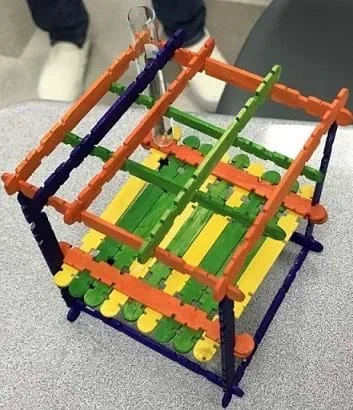 Figure 1. A completed sample holder.Copyright 2022 Usha Devathosh, Rice University RET
With the Students
Day 1: Teacher demonstration, introduction, and students prepare dilute solutions
Day 2: Construction of spectrophotometer, measure the absorbance, and determine the concentration of Gatorade from the Beer’s Law graph.
Part 1: Teacher Demonstration of Beer’s Law
- Introduce the activity by reading the Introduction and Motivation section aloud.
- Conduct the Teacher Demonstration:
- Display two beakers of the same size.
- Label one beaker as “Beaker 1” and label the other beaker as “Beaker 2”.
- Fill Beaker 1 two-thirds full of water.
- Fill Beaker 2 two-thirds full of water and add 5 to 7 drops of red food coloring. (Note: Add more food coloring if the beaker is large.)
- Shine the red laser through Beaker 1 and then shine the laser through Beaker 2. Have students observe the difference in transmittance (the intensity of light exiting the solution.)
- Transfer the red liquid from Beaker 2 into the narrow test tube or graduated cylinder.
- Have students observe and compare the color in Beaker 2 and in the test tube.
- Pass the laser through Beaker 2 and the test tube.
- Have students observe the different in absorbance.
- Explain Beer’s Law and its application in industry. (The Beer-Lambert law states that there is a linear relationship between the concentration and the absorbance of the solution, which enables the concentration of a solution to be calculated by measuring its absorbance. Beer's law is important in the field of physics, chemistry and meteorology.)
Part 2: Student Activity
- Divide students into small groups (or pairs).
- Distribute the Much More Than Pretty Colors Worksheet (PDF).
- Have students read the Introduction section individually or as a group.
- Have students complete the Pre-Lab Questions in the Much More Than Pretty Colors Worksheet (PDF).
- Allow students to gather materials to make their spectrophotometer.
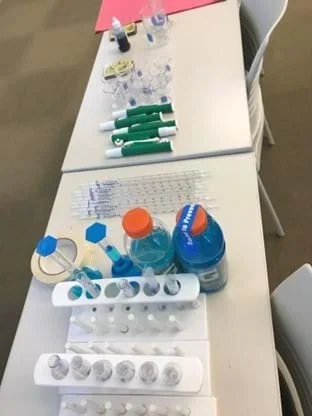 Materials gathered for the activity.Copyright 2022 Usha Devathosh, Rice University RET
 - As students work through the worksheet, they construct a sample holder (as in Figure 1), a window, and a phone/light source holder. Show students the sample holder model created Before the Activity as needed to assist them.
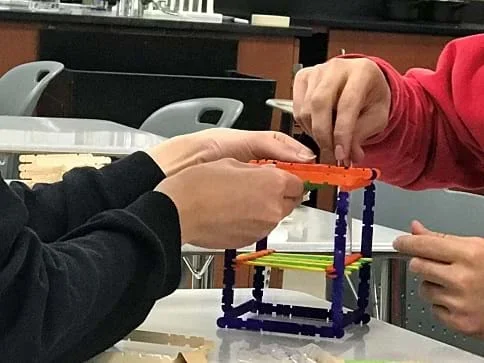 How to construct a sample holder with appropriate size for the test tube with sample?Copyright 2022 Usha Devathosh, Rice University RET
 - Each group should do the following to prepare 10 ml of the diluted sample:
- Label 6 test tubes from 1-6.
- Label two clean pipettes, one for measuring water (label 1) and another for stock solution (label 2).
- Measure 10 ml of distilled water in test tube one using pipette 1. This is the blank.
- Measure 2 ml of stock solution and transfer to the test tube using pipette 2.
- Measure 8 ml of distilled water using pipette 1 to the test tube
- Mix well.
- Students should use the dilution formula to calculate the concentration of the diluted solution.
M1= 6 x 10⁻⁶ (for all)
V2 = 10 ml (for all)
V1 from the data table
Substitute and calculate M2
M1V1=M2V2
6 x 10-6 x 2 = M2 x 10
M2 = (6 x 10-6 x 2)/10
- Each group should do the following to construct a spectrophotometer:
- With the given popsicle sticks construct a spectrophotometer like this figure.
Figure 1. A completed sample holder.Copyright 2022 Usha Devathosh, Rice University RET
- Check that students’ sample holders are complete before they move on to measure absorbance.
- Have students download the ColorimeterX app onto their cell phones. Go to App Store and search for colorimeter. Assist students as needed to download the Colorimeter software.
- Students’ experimental setup may look like that in Figure 2.
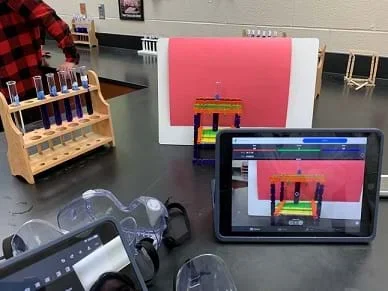 Figure 2. Students set up the absorbance measuring device made by them which resembles the parts of a spectrophotometer.Copyright 2022 Usha Devathosh, Rice University RET
- Students should next measure absorbance by
- Take 10ml of the blank (water) and wipe the side to make it clean and dry.
- Place it in the test tube holder you made.
- Click on the colorimeter software icon on your phone or iPad.
- Tap the camera symbol on your phone or iPad and record the red value on your data sheet.
- Repeat steps 1-3 with diluted samples 2-5.
- Record the data in the data table in the appropriate concentration row.
- Take a picture of your experimental setup and include it in your lab report.
- Calculate the absorbance of the unknown sample.
- Plot a graph on Excel.
- Graph the data concentration (X axis) Vs. absorbance (Y axis). Provide an appropriate title and label X and Y axis.
- Enter the values of concentration and absorbance in two columns.
- Highlight the cells and add scatter plot.
- This will give you a graph.
- Go to the trend line by right click.
- Add equation. Display equation. You will get an equation y= mx +c format.
- Select Linear as the Fit Equation. The best -fit linear regression line will be shown on the graph for your five data points.
- As students gather data, make sure they thoroughly record their findings both on their worksheet and by taking pictures. Remind students that they are recording the red value (R value) to measure how much red light passes through their samples and gets detected by the camera. Encourage students to take turns so that each student can gather and record data.A sample analysis using a smartphone.Copyright 2022 Usha Devathosh, Rice University RET
- As students transition to graphing their data, help as needed. Again, check that each student is participating in the graphing process.
- After students determine the concentration of Gatorade in their samples, remind them of the real-world connection of their activity: quality control engineers in a food and beverage factory.
- absorbance
- A measure of the capacity of a substance to absorb light of a specified wavelength.
- absorption spectrum
- Shows how much light is absorbed by a sample at each wavelength of the radiation.
- absorptivity
- A measurement of how strongly a chemical species absorbs light at a given wavelength.
- beer’s law
- Beer's Law states that the concentration of a chemical solution is directly proportional to its absorption of light.
- dilution
- The process of adding additional solvent to a solution to decrease its concentration.
- electromagnetic radiation
- A form of energy that has wave characteristics and that propagates through vacuum at the characteristic speed of 3.00 x 10⁸ m/s.
- electromagnetic spectrum
- The range of frequencies (the spectrum) of electromagnetic radiation and their respective wavelengths and photon energies.
- molarity
- A measure of the concentration of a chemical species, a solute in a solution, in terms of amount of substance per unit volume of solution.
- spectrum
- A graph that shows the intensity of radiation at different wavelengths or the response of the atomic or molecular system to different wavelengths of the radiation.
- spectrophotometer
- An apparatus for measuring the intensity of light in a part of the spectrum, especially as transmitted, or emitted by substances.
- spectroscopy
- The area of science concerned with the absorption, emission, and scattering of electromagnetic radiation by atoms and molecules, which may be in the gas, liquid, or solid phase.
- stock solution
- A concentrated solution that will be diluted to some lower concentration for actual use.
- transmittance
- It is the amount of light that “successfully” passes through the substance and comes out the other side.
- wavelength
- It is the distance between consecutive corresponding points of the same phase on the wave.
Pre-Activity Assessment
Demonstration & Brainstorming: Teacher demonstrates the relationship between concentration and absorbance. Ask students to think- pair- share during the Beer’s Law demonstration. Let students explain the observation absorbance and concentration are directly proportional from the demonstration. Following that, have students briefly research (~10-15 minutes) what a spectrophotometer is and its basic parts. Then ask students to think about how to use their cell phone to detect the absorbance of a solution like Gatorade and how to design a simple spectrophotometer. Let them brainstorm the idea of instrumentation.
Pre-Lab: Students complete the Pre-Lab section of their Much More Than Pretty Colors Worksheet (PDF) to review concentration and dilution.
Activity Embedded (Formative) Assessment
Worksheet: Students complete the Much More Than Pretty Colors Worksheet (PDF) including sections on preparing a diluted sample, constructing a spectrophotometer, and measuring absorbance. Ensure that students are filling out the tables in the worksheet and discussing the procedure with their group.
Post-Activity (Summative) Assessment
Read the Graph: Students determine the concentration of the Gatorade sample from the graph. From the data obtained, the students should be able to calculate the molar concentration.
Lab Report: Students prepare a report of their experience with the activity. This can be a written report or a group presentation, as appropriate. The reports should include information on the background, experimental setup, data gathering, and analysis.
Ensure that students are wearing gloves and googles when handling samples with blue dye #1.
Have students read the dye bottle and find its volume. Using the molar mass (provided in the lab, or let students calculate it on their own from the molecular formula), they can determine the mass of the dye in the bottle.
The YouTube video Smartphone “Spectrometer” by Tommy Technetium (2016) provides an overview of this activity. Note that the video uses red Gatorade and a green background.
Contributors
Usha Devathosh
Supporting Program
The Nano Technology Research Experience for Teachers, Rice University
Acknowledgements
This material was developed in collaboration with the Rice University Office of STEM Engagement, based upon work supported by the National Science Foundation under grant no. EEC 1406885—the Nanotechnology Research Experience for Teachers at the Rice University School Science and Technology in Houston, TX. Any opinions, findings and conclusions or recommendations expressed in this material are those of the authors and do not necessarily reflect the views of the National Science Foundation or Rice University.
Copyright
2023 by Regents of the University of Colorado; original © 2022 Rice University