
Light Up Your Machines with Biomimicry!
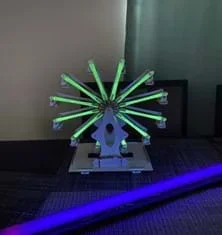 Figure 1. A blacklight illuminates glow-in-the-dark paint on the Ferris wheel.Copyright 2021 Ariel Delos Reyes, Rice University RET
In this activity, students explore different forms of energy such as mechanical, electrical, light, thermal and sound energy and how these energies are converted or change from one form to another. Student work together to build a prototype device of their choice that includes electrical circuitry. They then use biomimicry to add warnings, instructions, and/or signals to their prototype that can be seen in the dark on the road, on the water, in air, or in space.
Engineers often draw ideas from nature to create different designs. For example, burrs on a plant inspired the design of Velcro and studying a gecko’s feet helped to create an improved adhesive material. In this activity, students act like engineers when they use biomimicry to incorporate light energy into their designs inspired by a jellyfish. Researchers are studying a particular type of jellyfish that has bioluminescent qualities that might eventually be used in a range of engineering designs.
After this activity, students should be able to:
- Build and create a model/prototype that uses mechanical, electrical, light, thermal and/or sound energy, such as pulley system, gear, propeller, fan, DC motor, penlight bulb, LED, switches, wires and batteries.
- Recognize and evaluate the limitations of a prototype/model.
- Trace the transformation of energy from one form to another that support the Law of Conservation of Energy.
- CCC.5.6-8.5 The transfer of energy can be tracked as energy flows through a designed or natural system.
Grades 6-8
Do you agree with this alignment? - CCC.5.6-8.6 Energy may take different forms (e.g. energy in fields, thermal energy, energy of motion).
Grades 6-8
Do you agree with this alignment?
- explore the uses of energy, including mechanical, light, thermal, electrical, and sound energy;
Grade 5
Do you agree with this alignment? - demonstrate that light travels in a straight line until it strikes an object or travels through one medium to another and demonstrate that light can be reflected such as the use of mirrors or other shiny surfaces and refracted such as the appearance of an object when observed through water; and
Grade 5
Do you agree with this alignment? - demonstrate energy transformations such as energy in a flashlight battery changes from chemical energy to electrical energy to light energy.
Grade 6
Do you agree with this alignment?
Each group needs:
- either 1 STEM kit (such as those found here, here, or here to create a car, lamp, plane, Ferris wheel, or boat); OR various materials including:
- cardboard boxes
- Popsicle sticks
- wooden skewers
- rubber bands
- plastic water bottles
- Styrofoam pieces
- small wooden wheels
- batteries (9v or AA)
- battery holders (for 9v or AA)
- copper wires
- LED/penlight bulbs
- electrical tape
- masking tape
- DC motor
- glue gun/glue sticks
- switches
- laptop/cellphone for documentation
- index card for each student
- pen or pencil for each student
- Playing with Energy Student Worksheet (PDF) (one for each group)
For the entire class to share:
- glow-in-the-dark paint
- UV beads
- fluorescent tape
- black light
- laptop/tablet
- projector (to present PowerPoint presentation)
Students should understand that energy exists in various forms and that energy cannot be created nor destroyed. Energy can only be converted or transformed from one form to another.
Students should have prior knowledge about open, closed, series, and parallel circuits. They should also be familiar with the different components of circuit such as a switch, wire, battery, and bulb.
Energy is the ability to do work. There are many types of energy, such as kinetic, potential, thermal, light, sound, etc. Energy cannot be created or destroyed; it can only be converted from one form to another. This is called the Law of Conservation of Energy.
Today, you will work in teams to explore the conservation of energy by building prototype devices that use electronic circuits. Your team might create a Ferris wheel, a racecar, a plane, a lamp, or a boat.
Energy such as light energy is also present in the animal kingdom. Aquorea victoria, also sometimes called the crystal jelly, is a bioluminescent jellyfish found off the west coast of North America. This species is best known as the source of two proteins involved in bioluminescence: aequorin (a photoprotein) and green fluorescent protein. Their discoverers won the 2008 Nobel Prize in Chemistry for their work on green fluorescent.
In this activity, we will incorporate this phenomenon by using materials such as glow-in-the-dark paint, fluorescent tape and UV beads that will represent green fluorescent protein to be applied in your model or prototype as a source of light. This is called biomimicry. Animals and plants use bioluminescence and fluorescence to ward off predators, attract prey, or to mate. We will use glowing and reflective materials as a source of light energy on our prototypes. Adding reflectorized or glowing materials to vehicles, machineries, and devices can allow you to see them in the dark and serve as warnings or signals on the road, on the water, in air, or in space. They can also add aesthetic value – meaning, they look really cool!
Background
Mechanical, electrical, light, thermal and sound energy are the forms of energy covered in this activity. Mechanical energy is the energy of motion, such as moving a car, walking, running, moving gears and any object in motion. Electrical energy is produced from batteries and lightning. Light energy is energy that we can see. Thermal energy is known as heat energy while sound energy is the energy that we can hear.
To test how energy is converted from one form to another, we use an electrical circuit with the following components:
- Batteries are the power source converting chemical energy to electrical energy
- Wires serves as conductors for the flow of electrons
- Bulbs or LEDs show the conversion of electrical energy to light
- Buzzers or bells show the conversion of electrical energy to sound energy.
- DC motors and fans show the conversion of electrical energy to mechanical energy.
- Thermal energy or heat is generated if the circuit is left working over a long period of time.
Before the Activity
- Determine if students will create their prototypes using a kit or from scratch with craft and recycled supplies.
- Gather the materials and make copies of the Playing with Energy Student Worksheet (PDF).
- Refer to the Engineering Design Process to guide the activity.
- Introduce students to the job assignments:
- Table Manager - Responsible for monitoring that each member is on task and the overall outcome of the activity
- Material Manager – Responsible for the materials assigned to the group including the inventory, upkeep and orderliness and return of any unused materials
- Record Manager – Responsible for gathering information during group discussion.
- Presenter – Responsible for dividing the tasks for the class Reflection (the post-activity assessment).
- Timer - Responsible for monitoring the time and time management during the activity.
- Discuss group activity expectations as follows:
- Remind them about the collaborative jobs such as table manager, material manager, record manager, presenter, and timer.
- Discuss the directions to be followed in the Playing with Energy Student Worksheet (PDF) including the time elements of the activity.
- Using their laptop or cellphone each group should document their activity before during and after the activity.
With the Students
- Read through the Introduction/Motivation section.
- Present the Forms of Energy and Electrical Circuits Presentation PowerPoint (PPTX) on the relevant vocabulary, the Law of Conservation of Energy, and how energy is converted from one form to another.
- Hand out an index card to each student. Have them write down their answer to the following question: Give an example of a device/machine/tool that uses electrical energy and how this energy is converted from one form to another. Students should answer in complete sentences.
- After every student writes down their answer, let students share and discuss their answers as a class.
- Divide the class into group of 4-5 students.
- Assign students jobs or let students pick their jobs. (Note: some students may hold more than one job depending on group sizes). Emphasize job assignments.
- Table Manager - Responsible for monitoring each member to be on task and the overall outcome of the activity
- Material Manager – Responsible for the materials assigned to the group including the inventory, upkeep and orderliness and return of the materials
- Record Manager – Responsible for gathering information during group discussion.
- Presenter – Responsible for dividing the tasks for the class Reflection (post-activity assessment).
- Timer - Responsible for monitoring the time during the activity.
- Hand out one Playing with Energy Student Worksheet (PDF) to each group.
- Refer to the Engineering Design Process to guide the activity.
- Discuss group activity expectations as follows:
- Remind them about their collaborative jobs such as table manager, material manager, record manager, presenter, and timer.
- Discuss the directions to be followed in the Playing with Energy Student Worksheet (PDF) including the time elements of the activity.
- Remind students to use their laptop or cellphone to document their prototype before, during and after the activity.
- Instruct groups to wait for the teacher’s signal to start the activity, so that the timer can monitor the 45-minute-long activity.
- Before the activity starts, remind students to reflect on the various prototype devices discussed in the Introduction/Motivation. Encourage them to brainstorm as a team to decide on which prototype they will design.
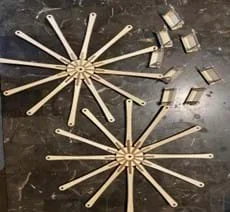 A Ferris wheel prototype from a make-it-yourself kit.Copyright 2021 Ariel Delos Reyes, Rice University RET
- Have the materials manager gather their materials or kit.
- Give students 45 minutes to build and test their prototype.
- Monitor the activity while walking around to give immediate feedback to any questions that arise from each group.
- Ensure that students are including an electrical/circuitry component as they build their prototypes.
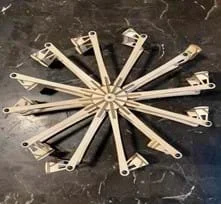 A complete prototype Ferris wheel, ready to test!Copyright 2021 Ariel Delos Reyes, Rice University RET
- Have students test their prototypes to see how the transfer of energy produces motion, light, sound, etc. Remind students to record their observations and thoughts about transfer of energy on their worksheets. For example, the circuitry will provide the source of energy from the battery, the switch will control the flow of energy, wires will convey he current, LEDs show light, moving parts of the prototype will show mechanical energy, etc.
- After 45 minutes, transition students to the next part of the activity, which focuses on light energy based on bioluminescence and fluorescence.
- Have the materials manager collect any additional materials needed (UV beads, glow in the dark paint, fluorescent tape).
- Give students 15 minutes to add glowing/reflective materials to their prototype to serve as warnings or signals on the road, on the water, in air, or in space.
- Monitor students as they incorporate these new materials into their prototypes. Walk around to provide feedback and answer questions.
- Have students test their model under the UV light using the black light (see Figure 1). Have students discuss how effective the additional light energy/reflective materials are at lighting up their machines in the dark.
Figure 1. A blacklight illuminates glow-in-the-dark paint on the Ferris wheel.Copyright 2021 Ariel Delos Reyes, Rice University RET
- Have students complete their Playing with Energy Student Worksheet (PDF) and engage in structured conversation regarding their model/prototype.
- bioluminescence
- The light emitted by a bioluminescent organism by the energy released from the chemical reactions occurring inside (or ejected by) the organism.
- chemical energy
- energy of chemical substances that is released when they undergo a chemical reaction and transform into other substances.
- closed circuit
- A circuit without interruption, providing a continuous path through which current can flow.
- electric current
- A stream of charged particles, such as electrons or ions moving through an electrical conductor or space.
- electrical energy
- The energy derived because of movement of electrons.
- electrical load
- An electrical component of a circuit that consumes electric power.
- energy
- Capacity (of something) to do work.
- fluorescence
- The light given off by certain substances when it absorbs light or other electromagnetic radiation.
- light energy
- Energy that can be seen.
- mechanical energy
- Sum of potential and kinetic energy.
- open circuit
- An electric circuit which the normal path of current has been interrupted either by the disconnections of one part of its conducting pathway.
- parallel circuit
- A two or more pathway of electric current.
- series circuit
- A single pathway of electric current.
- sound energy
- Energy that can be heard.
- switch
- An electrical component that can disconnect or connect conducting path in an electrical circuit.
- thermal energy
- Energy carried by the heat flow or quantity of heat.
Pre-Activity Assessment
Teacher-led class discussion: Teacher presents the Forms of Energy and Electrical Circuits Presentation (PPTX) on the relevant vocabulary, the Law of Conservation of Energy, and how energy is converted from one form to another.
After the short discussion, students get an index card to write their answer to the following: “Give an example of a device/machine/tool that uses electrical energy and how this energy is converted from one form to another.” Students should answer in complete sentences. Let students share and discuss their answers as a class.
Activity Embedded (Formative) Assessment
Teamwork: Groups will discuss how they will work as a team in building their prototype including task delegation or division of work: Building of the prototype, use of electrical circuitry, applying of fluorescent materials, and test run.
Post-Activity (Summative) Assessment
Reflection: Completion of Claim, Evidence and Reasoning and discussion of the limitation of their model/prototype including what improvement they will do if necessary.
Making Sense Assessment: Have students reflect on the science concepts they explored and/or the science and engineering skills they used by completing the Making Sense Assessment (PDF).
- Ensure students are being careful as they assemble their prototypes and create electrical circuits. Monitor students to ensure there are no short circuits.
- Iterate the prototype: Have students use their reflections from the worksheet to refine and redesign their prototypes. Provide more materials as necessary.
- Have students research the Engineering Design Process (EDP) and create a presentation (PowerPoint, Google Slides, or Poster) explaining how they followed the EDP in the activity.
- For younger grades: Have students use biomimicry to add glowing/reflective materials to a pre-made prototype to serve as warnings or signals on the road, on the water, in air, or in space.
- For older students: Do not use kits. Students must create their prototype with electrical circuits completely from teacher-provided materials.
Staley, David. April 19, 2018. “Biomimicry: A History.” The Department of History at Ohio State University. Accessed 6/21/2022, https://ehistory.osu.edu/exhibitions/biomimicry-a-history
Contributors
Ariel Delos Reyes; Dr. Laura Segatori; Ms. Lynna Baryakova
Supporting Program
The Nanotechnology Research Experience for Teachers (RET), Rice University
Acknowledgements
This material was developed in collaboration with the Rice University Office of STEM Engagement, based upon work supported by the National Science Foundation under grant no. EEC 1406885—the Nanotechnology Research Experience for Teachers at the Rice University School Science and Technology in Houston, TX. Any opinions, findings and conclusions or recommendations expressed in this material are those of the authors and do not necessarily reflect the views of the National Science Foundation or Rice University.
Copyright
2022 by Regents of the University of Colorado; original © 2022 Rice University