
To Infinity and Beyond: The Amazing Hydrogels
This activity provides students with the background necessary to understand chelation—a type of bonding of ions and molecules to metal ions—to create hydrogels. During the activity, students use sodium alginate, an extract from brown seaweed, to create hydrogels. By using alginate-based compounds (in other words, compounds extracted from brown algae), these hydrogels are also nontoxic and non-inflammatory. All these properties make the alginates ideal for applications in pharmaceuticals, wound care, hygiene, and optometry.
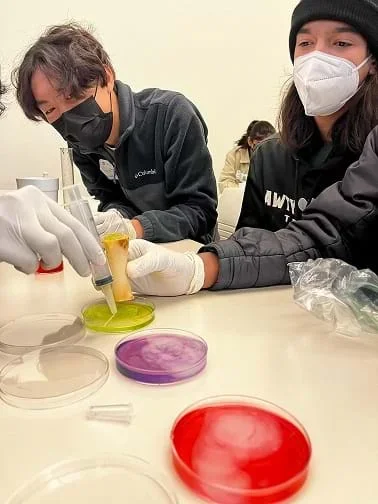 Students test different hydrogel designs.Copyright 2022 Francisco J Padron, Rice University RET
Hydrogels are hydrated polymers that exhibit high elasticity and strength. sodium alginate is a natural hydrophilic biopolymer typically obtained from brown marine algae (such as seaweed), suitable for making hydrogels. The cross-linked polymer swells up in contact with water to form an insoluble hydrogel, with properties intermediate between those of a solid and a liquid. This unique material can be utilized in medicine for drug delivery and implantable medical devices. Potential uses are in tissue repair, cartilages, herniated discs, and implants as bio printed (3D printable) material.
By the end of this activity the students should be able to:
- Create a hydrogel using the crosslinking process.
- Understand and explain the chelation of a polymer using the ionic crosslinking process by exchanging a monovalent metal (Na+1) with a divalent metal (Ca+2).
- Explain what a hydrogel is and its different applications.
- DCI.PS1.B.9-12.1 Chemical processes, their rates, and whether or not energy is stored or released can be understood in terms of the collisions of molecules and the rearrangements of atoms into new molecules, with consequent changes in the sum of all bond energies in the set of molecules that are matched by changes in kinetic energy.
Grades 9-12
Do you agree with this alignment? - HS-PS1-3 Plan and conduct an investigation to gather evidence to compare the structure of substances at the bulk scale to infer the strength of electrical forces between particles.
Grades 9-12
This resource focuses on the following Three Dimensional Learning aspects of NGSS:
Science & Engineering Practices- Plan and conduct an investigation individually and collaboratively to produce data to serve as the basis for evidence, and in the design: decide on types, how much, and accuracy of data needed to produce reliable measurements and consider limitations on the precision of the data (e.g., number of trials, cost, risk, time), and refine the design accordingly.Do you agree with this alignment?
Disciplinary Core Ideas- The structure and interactions of matter at the bulk scale are determined by electrical forces within and between atoms.Do you agree with this alignment?
Crosscutting Concepts- Different patterns may be observed at each of the scales at which a system is studied and can provide evidence for causality in explanations of phenomena.Do you agree with this alignment?
Do you agree with this alignment? - Plan and conduct an investigation individually and collaboratively to produce data to serve as the basis for evidence, and in the design: decide on types, how much, and accuracy of data needed to produce reliable measurements and consider limitations on the precision of the data (e.g., number of trials, cost, risk, time), and refine the design accordingly.
- Scientific processes. The student, for at least 40% of instructional time, conducts laboratory and field investigations using safe, environmentally appropriate, and ethical practices. The student is expected to:
Grades 10-12
Do you agree with this alignment? - Science concepts. The student understands and can apply the factors that influence the behavior of solutions. The student is expected to:
Grades 10-12
Do you agree with this alignment?
For the entire class to share
- 12 g calcium chloride (CaCl2) Note: Alternatively, the teacher can use an already prepared solution (0.1M) and dilute as explained in the procedure section.
- 2 L distilled water (tap water can also be used)
- 10 g sodium alginate powder (food grade): 110 grams (4 oz) cost around $10; can order through Amazon or other suppliers.
- 3 different colors of food coloring/dyes (The bottles of food coloring can be shared among all the groups if needed)
- 1 L beaker to prepare the sodium alginate solution.
- 1 L beaker to prepare the 0.1M calcium chloride solution (stock solution)
- 2 250 mL beakers to dilute the stock solution and to prepare 0.05M and 0.02M calcium chloride solutions.
Each group needs
- 100 mL graduated cylinder (The teacher may choose a pipette or a syringe instead to add calcium chloride in several applications. The amount is specified in the procedure section.)
- 4 Styrofoam cups or 4 beakers (100 mL)
- 3 petri dishes (or 3 Styrofoam cups) for gelling
- Amazing Hydrogels Presentation (pptx)
- Amazing Hydrogels Presentation (pdf)
- Pre-Activity Assessment Worksheet (docx)
- Pre-Activity Assessment Worksheet (pdf)
- Pre-Activity Assessment Worksheet Answer Key (docx)
- Pre-Activity Assessment Worksheet Answer Key (pdf)
- Activity Embedded Assessment Worksheet (docx)
- Activity Embedded Assessment Worksheet (pdf)
- Activity Embedded Assessment Worksheet Answer Key (docx)
- Activity Embedded Assessment Worksheet Answer Key (pdf)
- Post-Activity Assessment Worksheet (docx)
- Post-Activity Assessment Worksheet (pdf)
- Post-Activity Assessment Worksheet Answer Key (docx)
- Post-Activity Assessment Worksheet Answer Key (pdf)
- Making Sense Assessment (docx)
- Making Sense Assessment (pdf)
Students should be familiar with the concept of solutions and concentrations.
(Show Amazing Hydrogels Presentation (PPTX)) Today we are going to explore hydrogels.
Is anyone familiar with the term hydrogel? (Let students raise their hands if they think they know what hydrogels are.) In your life, do you think you have you used hydrogels before? Are wearing contact lenses today? Have you eaten Jell-O recently? Gelatin is a natural hydrogel and contact lenses are made out of manufactured hydrogels. Hydrogels are found in many everyday products from beauty and cosmetics to wound dressings and diapers. You are probably a frequent user of hydrogels, but you just didn’t know it!
Hydrogels are described as hydrophilic (or water-loving) polymers that are capable of absorbing and retaining a lot of water, while also serving as a substrate for other materials such as other polymers, minerals (nanoparticles), or other compounds.
A desirable property of some hydrogels in medicine is their biocompatibility which means they can be used in the body without a negative response. This makes hydrogels extremely useful in many different applications in pharmaceuticals, wound care, hygiene, and optometry.
Let’s think about contact lenses as an example. Contact lenses are made of silicone (polymers that contain silicon) and hydrogels. Contacts need to be hydrated to keep your eyes comfortable, and because they are in direct contact with your eyes, they need to be biocompatible.
Other hydrogels are made to be biodegradable for consumer products. Other specialized hydrogels are even bioabsorbable. This allows to be absorbed and assimilated back into the body.
Hydrogels are also used in drug delivery, wound care and implantable medical devices. Hydrogels absorb and retain such a large amount of water and thus they are a great technology for this application; they can also be used to deliver medications to wounds. One hydrogel product used in wound care is Theragauze, which is used to help heal damaged skin in wounds as well as prevent infection. There are even 3-D printable hydrogels that show promise to mimic cartilage in knee surgery!
Hydrogels are amazing and today we are going to dig a little deeper into how they are engineered.
Background
This activity is aimed to provide students with the background necessary to understand the chelation process to create hydrogels by crosslinking polymers with ionic solutions. Hydrogels are hydrated (absorb and retain water), polymeric networks that exhibit high elasticity and strength. Engineered hydrogels are a promising field as biomaterial for use in medical applications. For this lesson we use sodium alginate to create the hydrogels.
Alginate is a polysaccharide, natural, hydrophilic polymer extracted from brown algae, making it suitable for making hydrogels due to its cross-linking ability, biocompatibility, chelating ability, water solubility, and low cost. The alginate-based hydrogels are also nontoxic and non-inflammatory. These properties make the alginates ideal for applications in pharmaceuticals, wound care, hygiene, and optometry. It is one of the most commonly used biomaterials in injectable hydrogel preparation for tissue-engineering applications.
The students make alginate-based hydrogels by crosslinking the alginate solution with calcium chloride. Additionally, the preparation of the gels does not require special equipment, and once the lesson is complete, the gels and the solutions can be safely disposed in the sink.
In the crosslinking process (chelation), the sodium ion is replaced with calcium (ionic replacement). Because the valence of calcium is +2, the calcium ion can link two strands of alginate polymers and form a 3D network that retains water. The other product of this ion exchange is sodium chloride in solution. The greater the concentration of calcium, and the longer the time to crosslink, the denser the network and harder the hydrogel. This can be used to design different hydrogel types for various applications. Adding other materials such as nanoparticles (minerals) and other polymers (collagen) to the sodium alginate polymer changes the rheological properties of the hydrogels for other interesting applications. This lesson can be used during the curriculum when teaching solutions or ionic compounds.
Alginate polymers form gels in the presence of various divalent cations, e.g. Ca2+, Mg2+, by cross-linking the carboxylate groups on the polymer strands. The purpose of this activity is to create hydrogels using a polymeric solution (sodium alginate) cross-linked with an ionic calcium chloride (CaCl2) solution and investigate the variations in the consistency of the alginate-based hydrogels.
The students use calcium chloride solutions with three concentrations (0.1M and 0.05M, and 0.02M) to cross link the sodium alginate (SA) solution at 1% w/v. Replacing the sodium ions in the alginate with divalent metallic ions such as calcium chelate individual polymer strands into a large, three-dimensional network.
Before the Activity
Solution preparation
Prepare the sodium alginate solution in distilled water at 1% w/v concentration (1 L).
- Add 500 mL to a 1 L beaker and heat up using a hot plate if available.
- Weigh out 10 grams of sodium alginate.
- Add the sodium alginate into the 500 mL of hot water and dissolve the alginate a few grams (3-5 grams) at a time. Use a magnetic stirrer or stir with a glass rod or any other means. The alginate tends to form clumps but keep stirring until all is dissolved.
- When it is dissolved, the solution turns into a syrup or viscous consistency. Continue to dissolve the 10 grams.
- Add/top off water to complete 1 L.
Note: This solution needs to be prepared prior to the lesson because the dissolving of the sodium alginate is slow.
Prepare 0.1M, 0.05M and 0.02M calcium chloride solutions.
- 0.1M solution: dissolve 11.1 grams of calcium chloride in 500 mL of warm or room temperature water in a 1 L beaker. Add 500 mL of water to complete 1 L. The solution is 0.1M.
- 0.05M solution: in a 250 mL beaker, put 125 mL of the 0.1M stock solution. Add 125 mL of water to complete the dilution.
- 0.02M solution: in a 250 mL beaker, put 50 mL of the 0.1M stock solution. Add 200 mL of water to complete the dilution.
Note: The teacher may opt to let the students prepare the dilutions if they have time or it is a more advanced class.
Set up lab for the activity:
- The above quantities are more than enough for 6 groups of four students (24 students). If there are more than 24 students, the students only need to use 20 mL of each of the calcium chloride solutions.
- Each group will have the following (Styrofoam cups or beakers) labeled:
- Cup or beaker 1: 0.1M CaCl2 solution (40 mL)
- Cup or beaker 2: 0.05M CaCl2 solution (40 mL)
- Cup or beaker 3: 0.02M CaCl2 solution (40 mL)
- Cup or beaker with sodium alginate solution (100 mL)
- Graduated cylinder, pipette, or syringe to add the calcium chloride to the sodium alginate.
- Three Petri dishes or three more Styrofoam cups.
- Additionally, each group will use three different food coloring. The food coloring bottles can be shared among all the groups if needed.
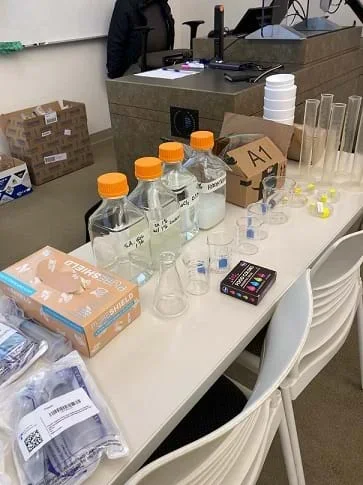 Getting materials prepped for student designs.Copyright 2022 Francisco J Padron, Rice University RET
With the Students
Steps for crosslinking the solution alginate solution with calcium chloride for hydrogel preparation.
Note: Each group will crosslink the solution with the three different CaCl2 concentrations to obtain 3 hydrogels. The students only need to use 20 mL of the calcium chloride solutions, but the surplus can be used to repeat the experiment if needed/wanted or if there are more students.
- Go through the Introduction/Motivation section.
- Tell students the following: We are going to create alginate-based hydrogels by ionic crosslinking. In the crosslinking process (chelation), the sodium ion is replaced with calcium (ionic replacement). Because the valence of calcium is +2, the calcium ion can link two strands of alginate polymers and form a 3D network that retains water. The other product of this ion exchange is sodium chloride in solution. The greater the concentration of calcium, and the longer the time to crosslink, the denser the network and harder the hydrogel. This can be used to design different hydrogel types for various applications. Adding other materials such as nanoparticles (minerals) and other polymers (collagen) to the sodium alginate polymer changes the rheological properties of the hydrogels for other interesting applications.
- Have students fill out the Pre-Activity Assessment Worksheet (PDF).
- Split students into groups of four.
- Have students follow the the next steps for crosslinking the alginate solution with calcium chloride solutions and then answer the questions.
- Have each student group put 30 mL of the sodium alginate solution in each one of the Petri dishes or Styrofoam cups, using the graduated cylinder, pipette, or syringe.
- Have students add a drop or two of food coloring to the calcium chloride in beaker or cup 1 (0.1M).
- Have students put 20 mL of 0.1M solution into one of the Petri dishes or Styrofoam cups with SA from Step 1. Use the graduated cylinder, pipette, or syringe.
- Have students Add a drop or two of a different food coloring to the calcium chloride in beaker or cup 2 (0.05M); Put 20 mL of 0.05M solution into the second Petri dish or Styrofoam cup with SA from Step 1, using the graduated cylinder, pipette, or syringe.
- Have students add a drop or two of another food coloring color to the calcium chloride in beaker or cup 3 (0.02M).
- Have students put 20 mL of 0.02M solution into the last Petri dish or Styrofoam cup with the SA from Step 1, using the graduated cylinder, pipette, or syringe.
- Have students observe the gelling process in each of the 3 Petri dishes or cups and record their observations.
- Have students wait a couple or more minutes and then record any changes in the consistency of the hydrogels.
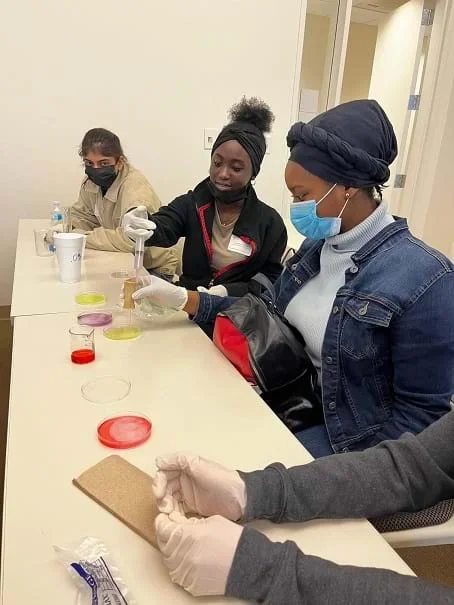 A student tests a hydrogel design.Copyright 2022 Francisco J Padron, Rice University RET
- Have students fill out the Post Assessment Worksheet (PDF).
- Lead the class in a recap of the activity. Ask the following:
- What is a hydrogel?
- What happens during ionic crosslinking?
- What do you think about uses of hydrogels?
- Have students reflect on the following questions:
- What did you learn today?
- What was difficult?
- What could you have done differently?
Pre-Activity Assessment
After introducing the activity with the motivation, the teacher can use the Amazing Hydrogels Presentation (PPTX) or modify it to guide the activity.
Have students to complete the Pre-Activity Assessment Worksheet (PDF).
Activity Embedded (Formative) Assessment
Provide students the Activity Embedded Assessment Worksheet (PDF).
Post-Activity (Summative) Assessment
Have students complete the Post-Activity Assessment Worksheet (PDF).
Have students complete the Making Sense Assessment (PDF).
Calcium chloride and sodium alginate are nontoxic, and the products of the gelled process are also non-toxic. However, the teacher may decide to distribute eye protection when handling solutions as part of lab safety best practices.
The students can prepare or speculate results using other crosslinking solutions such as magnesium chloride, barium chloride solution, or trivalent metals in addition to calcium chloride solutions.
This activity can be scaled up by applying creating different shapes and consistency of hydrogels using a wider range of concentrations of the crosslinking solutions; Hydrogels can also be hydrated by adding additional water if the hydrogel is dry. Rheological properties (viscoelasticity) of the different gels can be tested under stresses.
Burdick, Jason A.; Stevens, Molly M. “Biomedical hydrogels”. Biomaterials, Artificial Organs and Tissue Engineering. (2005) pp 107-115. https://doi.org/10.1533/9781845690861.2.107
Russo, R., Malinconico, M., and Santagata, G. “Effect of Cross-Linking with calcium Ions on the Physical Properties of alginate Films”. Biomacromolecules (2007), 8, 10, pp 3193-3197. DOI: 10.1021/bm700565h
Contributors
Francisco J Padron
Supporting Program
National Science Foundation —The Nanotechnology Research Experience for Teachers at Rice University, 2021
Acknowledgements
This material was developed based upon work supported by the National Science Foundation under grant no. EEC 1406885—the Nanotechnology Research Experience for Teachers at the Rice University School Science and Technology in Houston, TX. Any opinions, findings and conclusions or recommendations expressed in this material are those of the authors and do not necessarily reflect the views of the National Science Foundation.
Special Thanks to Dr. Hargerink Lab, (Dr. J. Hartgerink, J. Swain, A. Farsheed, V. Leyva-Aranda) for the assistance during the summer research experience.
Copyright
2023 by Regents of the University of Colorado; original © 2021 Rice University