
Crystal Creator! Testing the Resistance of Crystals
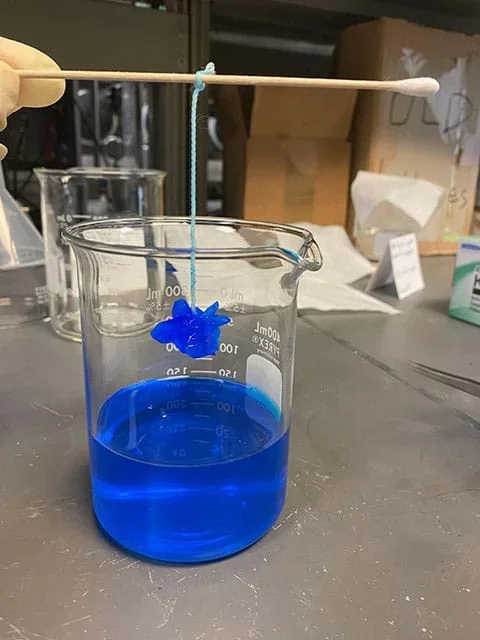 Students create crystalsCopyright 2022 Aerielle Rodriguez, Rice University RET
Lab-designed crystals are a unique method to introduce students to a wide range of basic engineering principles. In this activity, students create large, single crystals using the slow evaporation method to grow insulators with different band gaps—an energy range in a solid where no electronic states can exist—
and, therefore, different resistances. Students then test how resistance is affected by temperature for insulators as well as for conductors. In the process of testing resistance, students learn how optical properties affect a material’s electrical properties and chemical composition.
Engineers must determine the best material to use for given situations. For example, engineers need to know how conductive a material is as this particular property will affect a material’s performance. Engineers determine which conductor or insulator they should use for the different parts of a particular device based partly on the resistivity of that material. If the resistivity can be altered to be more efficient at its job simply by changing the color or opacity of the material, this could have important implications for how the material is used.
After this activity, students should be able to:
- Create a saturated solution.
- Describe why insulators and conductors have their properties in terms of electron movement.
- Graph the effect of temperature and solubility.
- Discuss the effect of temperature on the resistance of insulators and conductors.
- Explain how the wavelength of light affects electron energy.
- CCSS.Math.Content.HSS-ID.B.6 Represent data on two quantitative variables on a scatter plot, and describe how the variables are related.
Grades 9-12
Do you agree with this alignment?
- HS-PS1-3 Plan and conduct an investigation to gather evidence to compare the structure of substances at the bulk scale to infer the strength of electrical forces between particles.
Grades 9-12
This resource focuses on the following Three Dimensional Learning aspects of NGSS:
Science & Engineering Practices- Plan and conduct an investigation individually and collaboratively to produce data to serve as the basis for evidence, and in the design: decide on types, how much, and accuracy of data needed to produce reliable measurements and consider limitations on the precision of the data (e.g., number of trials, cost, risk, time), and refine the design accordingly.Do you agree with this alignment?
Disciplinary Core Ideas- The structure and interactions of matter at the bulk scale are determined by electrical forces within and between atoms.Do you agree with this alignment?
Crosscutting Concepts- Different patterns may be observed at each of the scales at which a system is studied and can provide evidence for causality in explanations of phenomena.Do you agree with this alignment?
Do you agree with this alignment? - Plan and conduct an investigation individually and collaboratively to produce data to serve as the basis for evidence, and in the design: decide on types, how much, and accuracy of data needed to produce reliable measurements and consider limitations on the precision of the data (e.g., number of trials, cost, risk, time), and refine the design accordingly.
- SEP.12.9-12.4 Use mathematical representations of phenomena or design solutions to describe and/or support claims and/or explanations.
Grades 9-12
Do you agree with this alignment?
Each group needs:
- 3 250-mL beakers
- 75-mL or 100-mL graduated cylinder
- 25-mL or 50-mL graduated cylinder
- 3 long pencils
- nylon fishing line
- digital scale
- weighing plates
- voltmeter
- hot plate
- stir stick
- scooper/spatula
- 100 mL deionized water
- pair of tweezers
- Crystal Creator Worksheet (PDF), one per student
For the entire class to share:
- Chromium metal
- granulated Potassium Alum Powder (or alum powder) (100 g per class for initial experiment)
- Chromium Potassium sulfate dodecahydrate (or chrome alum powder) (100 g per class for initial experiment)
- Crystal Creator Worksheet (docx)
- Crystal Creator Worksheet (pdf)
- Crystal Creator Worksheet Answer Key (docx)
- Crystal Creator Worksheet Answer Key (pdf)
- Formative Assessment 1 (docx)
- Formative Assessment 1 (pdf)
- Formative Assessment 1 Answer Key (docx)
- Formative Assessment 1 Answer Key (pdf)
- Formative Assessment 2 (docx)
- Formative Assessment 2 (pdf)
- Formative Assessment 2 Answer Key (docx)
- Formative Assessment 2 Answer Key (pdf)
Can the way something looks on the outside give us a clue to what’s going on inside? Let’s compare some of our metals from the periodic table. Let’s describe the similarities and differences between how they look. (Put up pictures of different metals on the board and have the students record their responses individually).
What did you notice? What you should have noticed was that all these metals look pretty much the same. That’s because the surface of metals can absorb all wavelengths of light. Metals are good conductors meaning their electrons move freely within the material. But insulators are a little bit different. Semimetals and insulators come in a variety of colors and opacities. Their optical properties give us insight into their electrical properties. Today we are going to manipulate the optical properties of crystals, which are insulators, to make them more or less conductive
Background
The visible section of the wavelength of light can give us an insight into the properties of an insulating or conducting material. Within materials there are band gaps—an energy range in a solid where no electronic states can exist. The size of these band gaps determines how insulating the material will be. Conductors have overlapping band gaps and so their valence electrons are able to move freely between the valence band and the conducting band. Insulators have very large band gaps so they need a large input of energy for their valence electrons to jump to the conducting band. When these band gaps fall within the visible spectrum of light, you get different colored crystals.
Alum, or potassium aluminum sulfate, is the chemical compound: KAl(SO4).12H2O. Alum has been used by humans for thousands of years and is still used in a variety of ways: in taxidermy, as a deodorant, in pickling food, and in fire extinguishers. Its most important use is in the purification of drinking water. Alum forms beautiful, regular octahedral crystals.
To grow large single crystals of alum, you first need to grow what is called a seed crystal. This should be a single crystal, but just a small one. (It is normally better for the alum to crystallize as lots of small crystals rather than one big one). A suitable seed crystal is then suspended in a supersaturated solution of alum. A supersaturated solution is one which has more alum dissolved that is normally possible. Such a solution wants to get rid of the extra dissolved solid—if you are careful then the solution will do this by adding solid alum to your seed crystal, making it grow bigger.
Normally alum crystals are colorless, but if ‘normal’ alum (KAl(SO4).12H2O) is mixed with ‘chrome alum’ (KCr(SO4).12H2O) then the crystals will have a purple color.
As temperature goes up resistance goes down for insulators. Normally, insulators have such a high resistance reading that it won’t show up on a voltmeter but when you increase the temperature the resistance goes down and you are able to get a reading. The reason for this is because the increased temperature allows the electrons of insulators to overcome the large band gap between their valence band and conduction band (conductors have overlapping bands allowing their electrons to move freely between the two bands). This explains why insulators and conductors have the properties that they do, it all has to do with electron mobility between the bands.
Before the Activity
- Gather materials and make copies of the Crystal Creator Worksheet (PDF).
- Place everything a group needs at their lab table.
Part 1: How to grow seed crystalsHow to suspend the seed crystal in solution: After the seed crystals have already formed but before testing, students can use this technique to form larger crystals if the seed crystals formed are not large enough to test.Copyright 2022 Aerielle Rodriguez, Rice University RET
- Divide the class into groups of three or four students.
- As a class, have one group create a saturated solution of 100% alum by heating a beaker of 100 g of deionized water over a hot plate and mixing in alum powder until no more will dissolve. (Note: Start by adding 30 g of powder in the 100 mL deionized water. Keep adding small increments until the solution is fully saturated and no more powder will dissolve. This portion can also be done as a teacher demonstration.)
- Repeat Step 2 but for a solution of 100% chrome alum.
- Repeat Step 2 but for a solution of 75% alum/25% chrome alum. This can be done by either:
- Creating the 100% alum and 100% chrome alum solutions first and then combining them in a new beaker with 75 mL 100% alum solution and 25 mL of the chrome alum solution
Or
- Mixing 100 mL of deionized water with a powder made of 37.5 g alum and 12.5 g chrome alum mixed.
- Place each solution in a sunny location (by a window) where it will not be moved or disturbed. Make sure to cover the top of the beaker with a paper towel so no debris falls into the solution.
- As the water evaporates the small crystals will form out of solution at the bottom of the beaker. To get these crystals, transfer the remaining liquid to a new beaker and then use tweezers to remove the seed crystals from the bottom of the beaker.
- Allow seed crystals to dry on a petri dish. Although seed crystals can dry in a few hours, it is suggested to wait overnight especially for smaller crystals that are clumped together. (Note: Seed crystals only need to be used to seed bigger crystals if the initial seed crystals formed are not large enough to wrap a wire around. So only if they are too small to test, if they are large enough already then there is no need to seed bigger crystals.)
- Once seed crystals are dried, attach a string to the seed crystals and suspend the string back into the solution so it can form larger crystals.
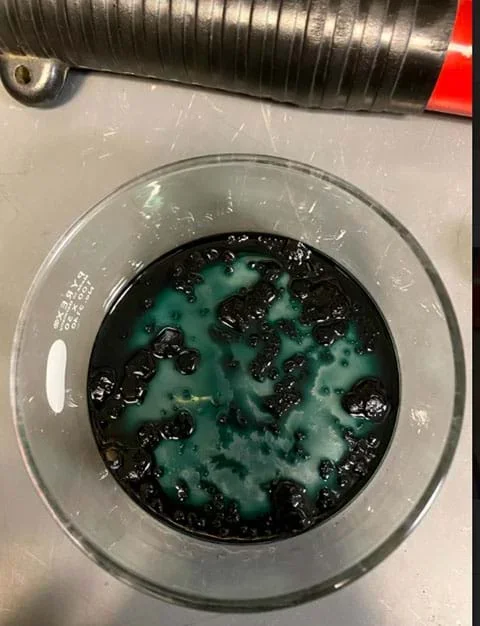 Seed crystals forming at the bottom of a beaker.Copyright 2022 Aerielle Rodriguez, Rice University RET
Part 2: How temperature affects resistance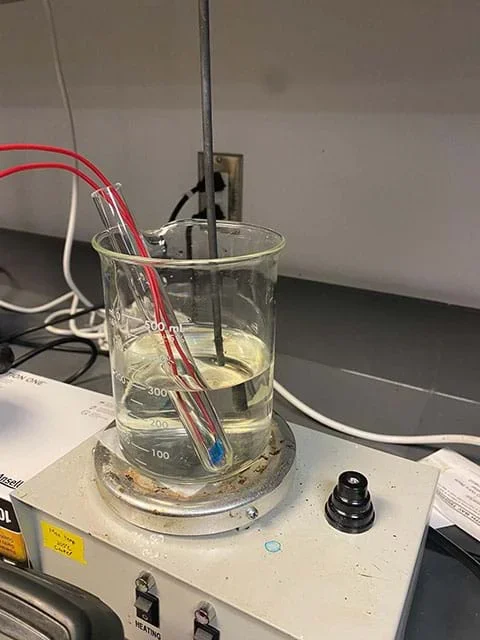 Resistance versus temperature measurements design.Copyright 2022 Aerielle Rodriguez, Rice University RET
- Take the crystals out of their solution and let them dry.
- Set up the resistance measurement set-up by suspending a test tube in a large beaker filled halfway with water that also has a thermometer suspended in the water to measure water temperature.
- Wrap the probes of a voltmeter around opposite sides of the 100% alum crystal (make sure the + and _ send of the probes are not touching).
- Place the 100% alum crystal in your resistance measurement set-up and start recording the temperature (in Celsius) and resistance measurements (in Ohms).
- Repeat Steps 3-4 but for the 75% alum/25% chrome alum and 100% chrome alum crystals.
- Once all the data is collected, graph the results on a temperature versus resistance graph.
- Analyze the results to determine the effect of temperature on resistance of insulators and conductors.
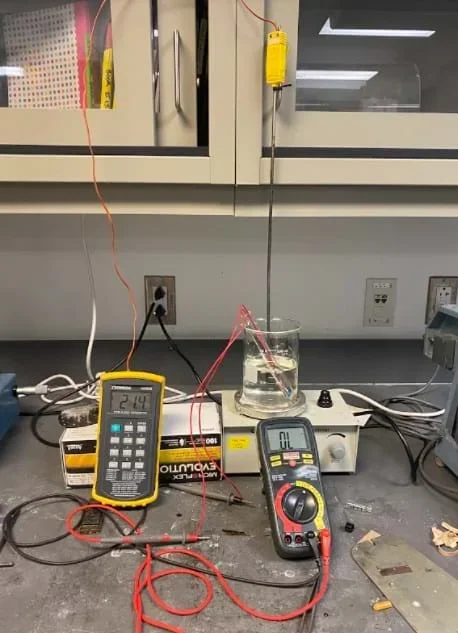 A student-design set up to measure resistance.Copyright 2022 Aerielle Rodriguez, Rice University RET
Part 3: Further designing the crystal
- Have each group research uses for insulating and semi-insulating crystals.
- Each group will choose a use for their crystals that they will try to use as a guide for their engineering design process.
- Example: If the crystal they are trying to make is super insulating what can they change about the crystals we’ve already made to make them better insulators.
- Get the teacher to approve their goal and procedure and the students will conduct experiments to try and improve the crystals made to fit the goal that they have set. Some design changes students can make to their crystals are:
- Change the crystal size
- Change the crystal thickness
- Change the crystal shape
- Change the crystal content percentages (for example. 50% chromium/50% alum, 75% chromium/25% alum, etc.)
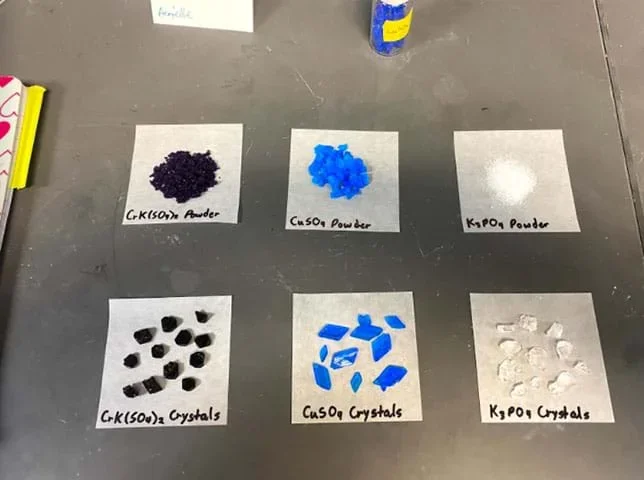 Seed crystals shown next to their powdered original form.Copyright 2022 Aerielle Rodriguez, Rice University RET
- band gap
- An energy range in a solid where no electronic states can exist.
- conductor
- Material in which electric current does flow freely.
- insulator
- Material in which electric current does not flow freely.
- opacity
- The condition of lacking transparency or translucence; opaqueness.
- resistance
- A measure of the opposition to current flow in an electrical circuit.
- saturated
- Solution in which the maximum amount of solvent has been dissolved.
- solution
- A liquid mixture in which the minor component (the solute) is uniformly distributed within the major component (the solvent).
- wavelength
- The spatial period of a periodic wave—the distance over which the wave's shape repeats.
Pre-Activity Assessment
Find the Similarities: Students will look at some metals from the periodic table. They will identify some of their similarities. Students should notice that all metals look similar in color and opacity.
Activity Embedded (Formative) Assessment
Formative Assessment (given after Part 1): Students will answer a 5-question assessment about temperature and solubility in the Formative Assessment 1 (PDF).
Crystal Creator Worksheet: Students will work in small groups to complete the Crystal Creator Worksheet (PDF). After the graph the temperature vs. resistance data for their assigned crystal the class will combine their data to see how each crystal was affected by temperature.
Formative Assessment (given after Part 2): Students will answer 5 short answers questions about temperature and conductivity in the Formative Assessment 2 (PDF).
Hypothesize: The students will analyze the class data and hypothesize why certain crystals were able to lower their resistance more than others. They will use this hypothesis to guide their crystal improvement process.
Post-Activity (Summative) Assessment
Summative Quiz: Students will take a 10-question multiple choice assessment to check how well they have learned the content.
Quick Write: The students will be given 10 minutes to summarize everything they have learned about how electrons relate to color and how this relationship affects conductivity.
Make sure to store the crystals in an airtight container if not testing the resistance immediately as they can oxidize and change the resistance results.
Contributors
Aerielle Rodriguez; Emilia Morosan; Kevin Allen
Supporting Program
The Nano Technology Research Experience for Teachers, Rice University
Acknowledgements
This material was developed in collaboration with the Rice University Office of STEM Engagement, based upon work supported by the National Science Foundation under grant no. EEC 1406885—the Nanotechnology Research Experience for Teachers at the Rice University School Science and Technology in Houston, TX. Any opinions, findings and conclusions or recommendations expressed in this material are those of the authors and do not necessarily reflect the views of the National Science Foundation or Rice University.
Copyright
2023 by Regents of the University of Colorado; original © 2022 University of Connecticut