
Mission Possible - The Voltaic Protocol
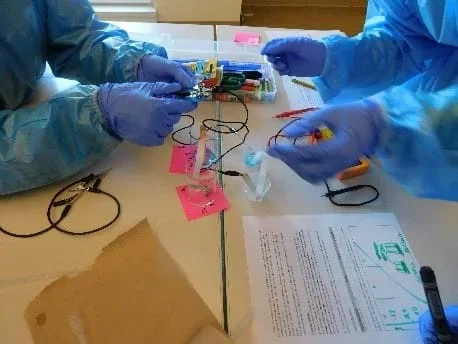 A completed electrical circuit using the voltaic cell as a power sourceCopyright 2022 Rice University Office of Stem Engagement, rstem.smugmug.com
Today’s world sees a critical need for self-sustaining battery power. As society becomes more reliant upon renewable energy, there is an increased demand to create and obtain new forms of self-sustaining power. One of the most common forms of renewable energy in use today consist of rechargeable batteries that operate through a series of chemical reactions. These types of reactions can be reproduced by creating a voltaic cell powered by an oxidation-reduction reaction. For this activity, students work in small groups to complete the following objective:
Students design an electrochemical cell powered by redox reactions that will successfully generate enough electrical current to power a series of light bulbs or similar structures/devices.
Chemical and environmental engineers are constantly being challenged to develop new technologies to generate energy and power from limited resources, sometimes including the challenge of self-sustaining technologies. There is also a need to find ways to improve the overall performance of existing technologies without some of the harmful effects from long-term exposure to extreme environmental temperatures. This activity pertains to real-world engineering in challenging students to create a properly operating galvanic cell from a list of given materials and develop a method to optimize this system under various environmental conditions.
After this activity, students should be able to:
- Identify the reactants and products of a chemical reaction.
- Describe how a galvanic cell transforms chemical energy into electrical energy.
- Use a galvanic cell to power a device within a simple or complex electrical circuit.
- Use the scientific method to solve a problem within specific qualitative and quantitative constraints.
- HS-PS3-4 Plan and conduct an investigation to provide evidence that the transfer of thermal energy when two components of different temperature are combined within a closed system results in a more uniform energy distribution among the components in the system (second law of thermodynamics).
Grades 9-12
This resource focuses on the following Three Dimensional Learning aspects of NGSS:
Science & Engineering Practices- Plan and conduct an investigation individually and collaboratively to produce data to serve as the basis for evidence, and in the design: decide on types, how much, and accuracy of data needed to produce reliable measurements and consider limitations on the precision of the data (e.g., number of trials, cost, risk, time), and refine the design accordingly.Do you agree with this alignment?
Disciplinary Core Ideas- Energy cannot be created or destroyed, but it can be transported from one place to another and transferred between systems.Do you agree with this alignment?
- Uncontrolled systems always evolve toward more stable states—that is, toward more uniform energy distribution (e.g., water flows downhill, objects hotter than their surrounding environment cool down).Do you agree with this alignment?
- Although energy cannot be destroyed, it can be converted to less useful forms—for example, to thermal energy in the surrounding environment.Do you agree with this alignment?
Crosscutting Concepts- When investigating or describing a system, the boundaries and initial conditions of the system need to be defined and their inputs and outputs analyzed and described using models.Do you agree with this alignment?
Do you agree with this alignment? - Plan and conduct an investigation individually and collaboratively to produce data to serve as the basis for evidence, and in the design: decide on types, how much, and accuracy of data needed to produce reliable measurements and consider limitations on the precision of the data (e.g., number of trials, cost, risk, time), and refine the design accordingly.
- HS-PS3-5 Develop and use a model of two objects interacting through electric or magnetic fields to illustrate the forces between objects and the changes in energy of the objects due to the interaction.
Grades 9-12
This resource focuses on the following Three Dimensional Learning aspects of NGSS:
Science & Engineering Practices- Develop and use a model based on evidence to illustrate the relationships between systems or between components of a system.Do you agree with this alignment?
Disciplinary Core Ideas- When two objects interacting through a field change relative position, the energy stored in the field is changed.Do you agree with this alignment?
Crosscutting Concepts- Cause and effect relationships can be suggested and predicted for complex natural and human designed systems by examining what is known about smaller scale mechanisms within the system.Do you agree with this alignment?
Do you agree with this alignment? - Develop and use a model based on evidence to illustrate the relationships between systems or between components of a system.
- Science concepts. The student understands the energy changes that occur in chemical reactions. The student is expected to:
Grades 10-12
Do you agree with this alignment?
Each group will need:
- safety goggles (one pair per student)
- gloves (one pair per student)
- 2 beakers (500 ml)
- graduated cylinder (250 ml)
- copper sulfate (CuSO4) solution (1.0M, 250 mL)
- zinc sulfate (ZnSO4) solution (1.0M, 250 mL)
- 2-4 pieces of electrical wiring each with alligator clips
- strip of copper metal (long enough to sit half submerged in the 250 mL copper sulfate solution)
- strip of zinc metal (long enough to sit half submerged in the 250 mL zinc sulfate solution)
Salt Bridge
- sodium chloride (NaCl) solution (50 mL)
- pipette (plastic or glass)
- 20-cm filter paper strips OR filter paper folded to ~1 cm thick and long enough to touch the liquids in each 250 mL beaker
- How to Create a Galvanic Cell Student Handout (PDF) (one per student)
- How to Create a Galvanic Cell Student Worksheet (PDF) (one per student)
- battery-powered device to test (such as a LED-emitting light, clock, simple motor, etc.) Note: In theory, any battery-operated device should work. However, it is important to think about the amount of voltage that's required to power the device and how easily it can be accessed using simple wiring from the voltaic cell. Ideally, a small light bulb or a small buzzer or alarm are useful because they already have a way to easily connect to the alligator clips or any other existing wires, and they don't require a lot of voltage to power them. Buzzer alarms are available on Amazon at a low cost.
For the class to share:
- computer with projector to display video.
- waste containers for byproducts of chemical reactions (metal ion waste solutions)
- How to Create a Galvanic Cell Student Handout (docx)
- How to Create a Galvanic Cell Student Handout (pdf)
- How to Create a Galvanic Cell Student Worksheet (docx)
- How to Create a Galvanic Cell Student Worksheet (pdf)
- How to Create a Galvanic Cell Student Worksheet Answer Key (docx)
- How to Create a Galvanic Cell Student Worksheet Answer Key (pdf)
- Student Self-Assessment Rubric (docx)
- Student Self-Assessment Rubric (pdf)
- Galvanic Cells and Circuits Pre/Post-Quiz (docx)
- Galvanic Cells and Circuits Pre/Post-Quiz (pdf)
- Galvanic Cells and Circuits Pre/Post-Quiz Answer Key (docx)
- Galvanic Cells and Circuits Pre/Post-Quiz Answer Key (pdf)
Students will need a basic understanding of chemical reactions and redox reactions. A galvanic or voltaic cell uses a redox reaction as its primary source of energy. They will also need to know how a galvanic cell operates and how to create an electrical circuit.
Today, let’s assume the role of a real-life engineer attempting to solve a real-world problem! Our reliance on the convenience of electronic devices has created a huge demand for better batteries that can last longer. From cell phones to electric vehicles, society has started to utilize rechargeable batteries of every form and fashion. However, one of the disadvantages of using rechargeable batteries relates to the need for electrochemical and physical resources to maintain supply to meet demand with limited resources. Is this a “mission impossible” or can we solve this engineering challenge? Let’s find out!
Your mission, should you choose to accept it, is to create an electrochemical cell similar to the environment inside of a rechargeable battery with limited resources. Your cell must be self-sustaining, and it should serve as a reliable source of energy for whatever device that is presented to your group.
Background
What is a galvanic cell and how does it work? A galvanic (or voltaic) cell is a type of electrochemical cell that utilizes chemical reactions to produce electrical energy. Specifically, these chemical reactions can be further classified as oxidation-reduction reactions. An oxidation-reduction reaction, or redox for short, is a type of reaction whereby electrons are transferred via a series of steps which can be referred to as half-reactions. During the oxidation half-reaction an element will undergo a process resulting in an overall loss of electrons. The reduction half-reaction will result in an element that undergoes an overall gain of electrons. This process of electron transfer is more discernible in some redox reactions in comparison to others. The unique properties of a galvanic cell will separate these half-reactions from one another, thus allowing an electrical current to flow through conductive material. This electrical current can then be made available to produce electrical energy.
To successfully create a galvanic cell, the most essential components should include two metal ion solutions of a given concentration and a salt bridge that connects these two solutions to one another. These metal ion solutions could include sulfates, nitrates, etc.
The cell reaction is:
Zn (s) + Cu2+(aq) --> Zn2+(aq) + Cu (s)
Before the Activity
- Gather materials and make copies of the How to Create a Galvanic Cell Student Handout (PDF) and How to Create a Galvanic Cell Student Worksheet (PDF)
With the Students
- Divide students into groups of three or four students for each lab station.
- Hand out group materials or have group materials distributed to each lab station ahead of time.
- Each group should first draw a schematic of their galvanic cell and how they will create a circuit using their cell to power their given device. Each group should show their schematic to the instructor first to get approval before starting actual construction.
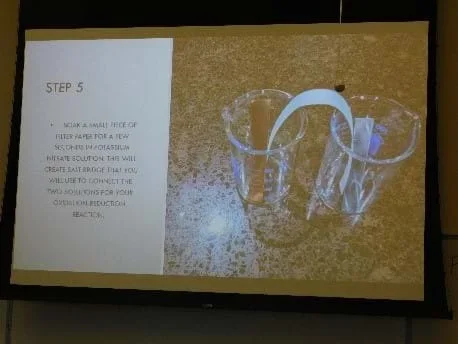 An example of how metal strips and a filter paper salt bridge should look after being set up.Copyright 2022 Rice University Office of Stem Engagement, rstem.smugmug.com
- Using the supplied materials and their schematic to make their galvanic cells, have students follow the step-by-step directions on the How to Create a Galvanic Cell Student Handout (PDF). The directions are:
- Pour 250 ml of copper sulfate and 250 ml of zinc sulfate solution into two separate 500 ml beakers.
- Place a strip of copper metal into the copper sulfate solution and a strip of zinc metal into the zinc sulfate solution. This will begin the oxidation-reduction reaction process.
- Create a salt bridge between the two solutions by soaking the piece of filter paper with the sodium chloride solution. After soaking the filter paper with sodium chloride, position your paper so that each end of filter paper is in contact with the two separate solutions. [The How to Create a Galvanic Cell Student Worksheet (PDF) includes an example to show this setup.]
- Allow the reaction a few minutes to begin. After a few minutes use the voltmeter to test the voltage of the cell by placing an electrode on each end of the two metal strips.
- Once confirmation is received that the cell is producing a potential difference, create a circuit based upon your schematic using your wiring, alligator clips, and your given device.
- Attempt to power your device using your galvanic cell. If your device will not power on you may need to add an additional cell to your circuit to generate more voltage.
- Once the activity is completed clean up your work area and dispose of waste materials following the given lab safety protocols for your station.
- Actively monitor progress for each group during the construction process.
- Once a group of students have successfully created their galvanic cell, provide the group with the electrical circuit materials and the device that they must use their cell to power and/or operate.
- Students will connect alligator clips from their cell to their device to attempt to power it.
- Challenge students if their device does not operate correctly that they may need a second galvanic cell to generate enough voltage to power it. Devices should be connected to each cell in series.A completed electrical circuit using the voltaic cell as a power sourceCopyright 2022 Rice University Office of Stem Engagement, rstem.smugmug.com
- After successfully powering the device, have students answer the post-lab discussion questions in the How to Create a Galvanic Cell Student Worksheet (PDF)
- Provide students with time to fill out the Student Self-Assessment Rubric (PDF) discussing what was learned from the activity, what were possible sources of error, and how the activity could be improved upon in the future.
- anode
- An electrode through which the conventional current enters into a polarized electrical device.
- cathode
- An electrode through which conventional current leaves an electrical device.
- galvanic cell
- A galvanic cell or voltaic cell, named after the scientists Luigi Galvani and Alessandro Volta, respectively, is an electrochemical cell in which an electric current is generated from spontaneous reactions. A common apparatus generally consists of two different metals, each immersed in separate beakers containing their respective metal ions in solution that are connected by a salt bridge (or separated by a porous membrane).
- oxidation
- Oxidation can be considered as an addition of an oxygen atom to a compound.
- redox reaction
- A type of chemical reaction in which the oxidation states of atoms are changed.
- reduction
- A chemical species decreases its oxidation number, usually by gaining electrons.
- salt bridge
- A tube containing an electrolyte (typically in the form of a gel), providing electrical contact between two solutions.
Pre-Activity Assessment
Battery Brainstorming: Place students in small groups and allow each group time to brainstorm ideas about how a battery works and why chemistry is such an important part of a battery’s function. An online polling program or a whiteboard could be used to allow students to present their prior knowledge, discuss ideas, and address possible misconceptions.
Potential pre-assessment questions could include:
- How do batteries use chemicals to generate power? (Answer: A chemical reaction between the metals and the electrolyte frees more electrons in one metal than it does in the other. The metal that frees more electrons develops a positive charge, and the other metal develops a negative charge.)
- What is a galvanic cell? (Answer: Galvanic cells, also known as voltaic cells, are electrochemical cells in which spontaneous oxidation-reduction reactions produce electrical energy.)
- What is an oxidation-reduction reaction? (Answer: A redox reaction is an oxidation-reduction (redox) reaction is a type of chemical reaction that involves a transfer of electrons between two species.)
- What is a series circuit? (Answer: a series circuit is defined as having only one path through which current can flow.)
- Why does a battery eventually stop providing power over time? (Answer: This wearing out process is due to the chemical reaction between the ions and the electrolyte. Some have described it as a parasitic reaction. To keep it simple, the ions do not move as freely the older the battery gets. Once they stop moving back and forth, the battery is officially dead.)
Activity Embedded (Formative) Assessment
Handout: Ensure that students are following the directions on the How to Create a Galvanic Cell Student Handout (PDF). Check that they are accurately drawing a diagram of their galvanic cell and answering the discussion questions.
Post-Activity (Summative) Assessment
Post-Lab Discussion: After students complete the post-lab discussion questions on the How to Create a Galvanic Cell Student Handout (PDF), have a class discussion about the activity.
Student Self-Assessment: Monitor students as they complete the activity. Distribute the Student Self-Assessment Rubric (PDF). Students complete this rubric to reflect on where they think their understanding lies for each success criteria. Use this as a starting-point for a class discussion about the activity.
Check for Understanding: Distribute the How to Create a Galvanic Cell Student Worksheet (PDF). Have students complete the multiple-choice questions and use the How to Create a Galvanic Cell Student Worksheet Answer Key (PDF) to check for their mastery of the material.
- Eye protection should be included due to the need to work with redox reactions and exothermic processes.
- Waste containers should be provided for byproducts of chemical reactions (metal ion waste solutions).
- Students will be working with small amounts of electrical current.
Some issues or obstacles that could occur during this exercise could include a failure of galvanic cell to generate enough current to light bulbs, the salt bridge could malfunction, or chemical solutions improperly leaking into or out of containers. Ways to monitor and fix this is to possibly have pre-built galvanic cells for the students in case their attempts do not work. Having more than one cell pre-built will help give students multiple attempts to try the experiment again without wasting too much time. Another issue could also arise from not having enough sulfate solution in each beaker. This could hinder the flow of electrons and hinder the flow of electrical current in the circuit. To solve this enough sulfate solution should be provided and prepared ahead of time so that each group can submerge both metal strips in their respective solution to at least cover the bottom 1/3 of each metal strip.
As an extension, students could be provided with different metal ion solutions to power their cells and compare cell efficiency and the amount of voltage produced to their initial experiment. Students could also brainstorm on how their voltaic cell could be expanded to power larger devices or multiple devices at the same time.
Ways to adjust this activity for different grade levels could include:
- Lower grades and younger students: have students create voltaic cells out of more simple materials and/or household supplies such as vinegar, copper coins, aluminum foil, cotton balls, and a small device with wire leads to connect a circuit. Students can be evaluated on how quickly they assemble the cell and on their understanding of how the cell works.
- Upper grades and more advanced students: have students substitute different metals to see which metals work best for the redox process. Allow students to discover that some metals are less efficient than others for the reaction process. Students could also be challenged to power different types of devices that require multiple cells connected in a series or in parallel.
The following are possible challenges and distractions that could be used during this activity to give the students an extra challenge. This is to stay true to the mission impossible theme of teams of agents which may face an enemy or unexpected obstacle while attempting to complete their mission. The practical application of this to the real world could be how a problem or project is presented to a team of engineers and that team must decide on the best method on how to solve this problem or how to complete this project. Logistics for a solution must include time, available resources, and budget constraints. Unexpected delays or obstacles should also factor into completion of projects. (For example, how the pandemic has led to a global semi-conductor chip shortage which has in turn affected production in multiple areas of technology from personal computers to the automotive industry)
Using these challenges and distractors not only adds a little more excitement into the activity but it also gives students a chance to experience some of the challenges that an engineering team may face while trying to complete a project in the real world.
As a suggestion, allow groups to do the activity for the first time without a challenge or distraction in order to become comfortable with the process of how to create the cell. Afterwards have students do the activity a second time with the challenge and/or distractors. The moment that distractors or challenges will be utilized could also be announced to the groups as a means of adding suspense and/or excitement to the activity. A group of helpers/students assisting with implementing these challenges or distractors could then walk into the room wearing suits and sunglasses with fanfare or given some type of dramatic introduction. (i.e.:” Oh no. Who is this? Who are these people? Here come the enemy agents! What are they going to do? Everyone prepare yourself because they’re definitely up to no good!)
Possible challenges to use for each group or multiple groups:
- Have students create another voltaic cell but this time they must use half of the supplies that they were given at the beginning.
- Give students a device to power with their voltaic cell but the device will require a larger amount of voltage. (So they may need to create more than one voltaic cell and decide how to add it to their circuit(s))
- Create a voltaic cell with household supplies instead of the standard chemistry laboratory supplies that were given at the beginning of the activity.
(Supplies for this household cell could include: vinegar, copper pennies, aluminum foil, electrical wiring with alligator clips, cotton balls, and a simple light bulb with its holder. Providing various supplies for this challenge will allow students to be more creative in designing a simple cell)
Distractors – The following options could be used to distract students from completing their goal. This is meant to simulate enemy agents or some type of unexpected obstacle that an agent may face while on their mission.
- Use party horns and walk around each group of students to distract them from their work.
- Use a portable stereo to play annoying or distracting songs or music while a group is working. This shouldn’t be interpreted, however, as offensive music or playing songs at extreme volume. One way to find possible options for this distraction is to do a poll prior to the activity asking each student or group about their most annoying song. Once students have revealed their most unlikeable songs they could be played for those students during the activity.
- Randomly walk up to a group of students and take away an essential supply that is needed to complete their lab activity.
- Purposely give a group of students a false chemical and allow students a chance to figure out what is wrong. For example, substitute the salt solution with a deionized water solution instead. (Caution should be used with this distraction to make sure nothing is used which could cause a harmful reaction during the activity)
Once implementing the distractors within the activity provide students will a solution to these problems with a box labeled “countermeasures”. Each box of countermeasures could include: earplugs to help with the annoying music or party poppers, aluminum foil with electrical tape so that students can create their own wiring in place of any stolen electrical wiring, and substitute ion solutions that can replace any confiscated copper and zinc sulfate solutions.
Information about Galvanic Cells and Cell Potential – LibreTexts Chemistry:
https://chem.libretexts.org/Bookshelves/General_Chemistry/Book%3A_Chem1_(Lower)/16%3A_Electrochemistry/16.02%3A_Galvanic_cells_and_Electrodes
How to make a simple galvanic cell – STEM Learning: https://www.youtube.com/watch?v=IUpOht-1g0s
Electrochemistry and Voltaic Cells – METUOpenCourseWare: https://www.youtube.com/watch?v=afEX2FD4Ado
Technical Resource on Galvanic Cells – ScienceDirect: https://www.sciencedirect.com/topics/engineering/galvanic-cell
Making and Testing a Simple Galvanic Cell – Science Project: https://www.scienceprojects.org/making-and-testing-a-simple-galvanic-cell/
Summerlin, L.R., and Ealy, J.L. Jr, Chemical Demonstrations-A Sourcebook for Teachers, American Chemical Society, Washington D.C, 1985, p. 115.
Science Project. Making and Testing a Simple Galvanic Cell. https://www.scienceprojects.org.
Contributors
Mallam Phillips; Quilin Li; Yuren Feng; Cristina Alston; John Ramon
Supporting Program
Nanosystems Research Center for Water Treatment (NEWT Center), Rice University
Acknowledgements
This activity was developed under the National Science Foundation under Rice University Engineering Research Center for Nanotechnology Enabled Water Treatment Systems (NEWT) grant no.1449500. Any opinions, findings, and conclusions or recommendations expressed in this material are those of the authors and do not necessarily reflect the views of the National Science Foundation.
Special thanks to Dr. Quilin Li, Dr. Carolyn Nichol, Dr. John Ramon, Yuren Feng, Christina Alston and Isaias Cerda.
Copyright
2022 by Regents of the University of Colorado; original © 2022 Rice University