
Exploring Sediment Transport and Bayou Design Solutions
 An illustration showing pollutant and sediment transport in a bayou ecosystem.Copyright Mila Taylor, Seven Lakes High School, Katy ISD, Texas
Students explore the concept of sediment transport and its impact on bayous, which play a vital role in city drainage systems in low-lying areas, such as those found in the southeastern United States. Using the engineering design process, they build bayou models in plastic bins using sand and water, observe how water moves sediment, and investigate the effects of erosion, deposition, and flood risks. To address these challenges, students design and test solutions such as sediment traps and barriers to control sediment buildup and improve water flow.
Civil and water resources engineers focus on designing and managing systems that control water flow and support environmental stability. Civil engineers work on infrastructure such as drainage systems, bridges, and flood control projects, while water resources engineers specialize in understanding how water moves through natural and built environments. They address challenges such as erosion, sediment transport, and flood risks to protect communities and maintain healthy waterways.
After this activity, students should be able to:
- Understand the concept of sediment transport and its impact on bayous.
- Learn how urban development affects sediment levels in waterways.
- Use the engineering design process to create a model of a bayou.
- Test and evaluate sediment control measures.
- MS-ESS2-2 Construct an explanation based on evidence for how geoscience processes have changed Earth's surface at varying time and spatial scales.
Grades 6-8
This resource focuses on the following Three Dimensional Learning aspects of NGSS:
Science & Engineering Practices- Construct a scientific explanation based on valid and reliable evidence obtained from sources (including the students' own experiments) and the assumption that theories and laws that describe the natural world operate today as they did in the past and will continue to do so in the future.Do you agree with this alignment?
Disciplinary Core Ideas- The planet's systems interact over scales that range from microscopic to global in size, and they operate over fractions of a second to billions of years. These interactions have shaped Earth's history and will determine its future.Do you agree with this alignment?
- Water's movements—both on the land and underground—cause weathering and erosion, which change the land's surface features and create underground formations.Do you agree with this alignment?
Crosscutting Concepts- Time, space, and energy phenomena can be observed at various scales using models to study systems that are too large or too small.Do you agree with this alignment?
Do you agree with this alignment? - Construct a scientific explanation based on valid and reliable evidence obtained from sources (including the students' own experiments) and the assumption that theories and laws that describe the natural world operate today as they did in the past and will continue to do so in the future.
- MS-ESS3-3 Apply scientific principles to design a method for monitoring and minimizing a human impact on the environment.
Grades 6-8
This resource focuses on the following Three Dimensional Learning aspects of NGSS:
Science & Engineering Practices- Apply scientific principles to design an object, tool, process or system.Do you agree with this alignment?
Disciplinary Core Ideas- Human activities have significantly altered the biosphere, sometimes damaging or destroying natural habitats and causing the extinction of other species. But changes to Earth's environments can have different impacts (negative and positive) for different living things.Do you agree with this alignment?
Crosscutting Concepts- The uses of technologies and any limitations on their use are driven by individual or societal needs, desires, and values; by the findings of scientific research; and by differences in such factors as climate, natural resources, and economic conditions. Thus technology use varies from region to region and over time.Do you agree with this alignment?
- Relationships can be classified as causal or correlational, and correlation does not necessarily imply causation.Do you agree with this alignment?
Do you agree with this alignment? - Apply scientific principles to design an object, tool, process or system.
- MS-ETS1-1 Define the criteria and constraints of a design problem with sufficient precision to ensure a successful solution, taking into account relevant scientific principles and potential impacts on people and the natural environment that may limit possible solutions.
Grades 6-8
This resource focuses on the following Three Dimensional Learning aspects of NGSS:
Science & Engineering Practices- Define a design problem that can be solved through the development of an object, tool, process or system and includes multiple criteria and constraints, including scientific knowledge that may limit possible solutions.Do you agree with this alignment?
Disciplinary Core Ideas- The more precisely a design task's criteria and constraints can be defined, the more likely it is that the designed solution will be successful. Specification of constraints includes consideration of scientific principles and other relevant knowledge that is likely to limit possible solutions.Do you agree with this alignment?
Crosscutting Concepts- The uses of technologies and any limitations on their use are driven by individual or societal needs, desires, and values; by the findings of scientific research; and by differences in such factors as climate, natural resources, and economic conditions.Do you agree with this alignment?
- All human activity draws on natural resources and has both short and long-term consequences, positive as well as negative, for the health of people and the natural environment.Do you agree with this alignment?
Do you agree with this alignment? - Define a design problem that can be solved through the development of an object, tool, process or system and includes multiple criteria and constraints, including scientific knowledge that may limit possible solutions.
- MS-ETS1-2 Evaluate competing design solutions using a systematic process to determine how well they meet the criteria and constraints of the problem.
Grades 6-8
This resource focuses on the following Three Dimensional Learning aspects of NGSS:
Science & Engineering Practices- Evaluate competing design solutions based on jointly developed and agreed-upon design criteria.Do you agree with this alignment?
Disciplinary Core Ideas- There are systematic processes for evaluating solutions with respect to how well they meet the criteria and constraints of a problem.Do you agree with this alignment?
Do you agree with this alignment? - Evaluate competing design solutions based on jointly developed and agreed-upon design criteria.
- MS-ETS1-4 Develop a model to generate data for iterative testing and modification of a proposed object, tool, or process such that an optimal design can be achieved.
Grades 6-8
This resource focuses on the following Three Dimensional Learning aspects of NGSS:
Science & Engineering Practices- Develop a model to generate data to test ideas about designed systems, including those representing inputs and outputs.Do you agree with this alignment?
Disciplinary Core Ideas- Models of all kinds are important for testing solutions.Do you agree with this alignment?
- The iterative process of testing the most promising solutions and modifying what is proposed on the basis of the test results leads to greater refinement and ultimately to an optimal solution.Do you agree with this alignment?
Do you agree with this alignment? - Develop a model to generate data to test ideas about designed systems, including those representing inputs and outputs.
- Earth and space. The student knows that natural events and human activity can impact Earth systems. The student is expected to:
Grade 7
Do you agree with this alignment? - use models to represent aspects of the natural world such as a model of Earth's layers;
Grade 6
Do you agree with this alignment? - analyze the effects of weathering, erosion, and deposition on the environment in ecoregions of Texas; and
Grade 7
Do you agree with this alignment?
Each student needs:
- 1 Part A: Sediment Transport Activity Worksheet (PDF)
- 1 Part B: Bayou Engineering Design Challenge Worksheet (PDF)
- writing utensil
Each group needs:
- 1 plastic bin or tray (15" x 11.5" x 4.5" to represent bayous)
- sand (as sediment)
- water
- plastic cups or pitchers (for pouring water)
- food coloring (to simulate pollutants)
- 1 ruler or measuring tape
For the entire class to share:
- gravel, clay, or small rocks (optional, for different sediment types)
- small sponges, cotton balls, or coffee filters (to model sediment barriers)
- craft sticks, popsicle sticks, or straws (for building models)
- paper and pencils for planning and data recording
- laptop or projector (for visuals)
- Part A: Sediment Transport Activity Worksheet (docx)
- Part A: Sediment Transport Activity Worksheet (pdf)
- Part A: Sediment Transport Activity Worksheet Answer Key (docx)
- Part A: Sediment Transport Activity Worksheet Answer Key (pdf)
- Part B: Bayou Engineering Design Challenge Worksheet (docx)
- Part B: Bayou Engineering Design Challenge Worksheet (pdf)
- Part B: Bayou Engineering Design Challenge Worksheet Answer Key (docx)
- Part B: Bayou Engineering Design Challenge Worksheet Answer Key (pdf)
- Bayou Design Challenge Presentation (pptx)
- Bayou Design Challenge Presentation (pdf)
Students should be familiar with the following terms: sediment, erosion, deposition, and bayous.
Today, we're diving into a fascinating topic that impacts cities in certain parts of the United States—bayous, and how sediment moves through them. Can anyone tell me what a bayou is? (Let students offer answers.) A bayou is a slow-moving body of water, and it plays a big role in helping drain rainwater and prevent flooding. But did you know that tiny particles like sand and dirt—called sediment—can actually cause problems in these waterways? When there's too much sediment, it can build up and block the flow of water, which can lead to flooding in nearby neighborhoods.
That’s where civil and water resources engineers come in. They study how water moves and how sediment behaves, and they create special structures such as sediment traps and retention basins to keep things flowing smoothly. Today, you’ll get to step into the shoes of these engineers! In groups, you'll build your own bayou models using sand, water, and simple tools. You’ll explore how sediment moves and then come up with creative ways to control it or slow it down.
Don't worry if your first idea doesn’t work—engineering is all about testing and improving. You’ll get to redesign and try again, just like real engineers do. Working together as a team, you’ll listen to each other’s ideas, experiment, and build the best solution you can.
By the end of this activity, you’ll not only understand sediment transport, but you’ll also have built something to help manage it—just like engineers working to protect places like Houston from flooding. Are you ready to begin this exciting challenge? Let’s gather our materials and get started!
Background
Understanding Bayous and Sediment Transport
Bayous serve as vital natural drainage systems that help manage stormwater runoff and reduce flooding in urban areas. However, heavy rainfall, urban development, and impervious surfaces such as roads and buildings can create serious challenges related to sediment transport.
Sediment transport is the movement of soil and other particles, such as sand and silt, caused by flowing water. In bayous, sediment can be both helpful and harmful. On the one hand, it helps build up riverbanks and delivers nutrients to aquatic ecosystems. On the other hand, when too much sediment accumulates, it can clog waterways, worsen flooding, lower water quality, and harm local wildlife and plant life by disrupting delicate ecosystems.
Human Impact on Sediment Transport
Urbanization increases sediment flow into bayous through construction, land clearing, and increased runoff. These activities can lead to erosion, when soil is washed away from one area and deposited in another. Understanding how sediment moves is essential for engineers and city planners who design solutions to manage flood risks and protect communities.
Note: This activity can also be adapted for regions with rivers or streams instead of bayous. Students can explore similar concepts by designing structures such as levees or floodwalls. Teachers may choose to adjust the wording in worksheets to replace "bayou" with "river" or "stream," depending on the local context.
Before the Activity
- Gather activity materials.
- Make copies of the Part A: Sediment Transport Activity Worksheet (PDF) and Part B: Bayou Engineering Design Challenge Worksheet (PDF) (1 per student).
During the Activity
Part A: Sediment Transport Activity (45 minutes)
- Go through the Bayou Design Challenge Presentation (PPTX).
- Discuss how bayous serve as natural drainage systems in cities. (Answer: Bayous serve as natural drainage systems in cities by channeling and slowing down rainwater runoff from streets, neighborhoods, and surrounding land. Because they flow through low-lying areas, bayous collect and carry excess water away, helping to prevent flooding. Their slow-moving waters allow sediment to settle, which helps maintain the shape and depth of the waterways so they can continue to hold and move water efficiently. In this way, bayous help manage stormwater naturally, reducing the risk of floods and protecting a city’s infrastructure and homes.)
- Explain the problem of sediment buildup and how it can impact flooding. (Answer: Sediment buildup happens when tiny particles like sand, dirt, and silt carried by water settle and accumulate in waterways such as bayous. Over time, this buildup can clog the channels, making them shallower and narrower. When sediment blocks the flow of water, it slows down drainage and causes water to back up, increasing the risk of flooding during heavy rains. This can lead to water overflowing into streets, neighborhoods, and other areas, causing damage to homes, roads, and the environment.)
- Ask students to consider the following questions and then lead a class discussion:
- Why do you think sediment builds up in the bayous? (Potential answer: Sediment builds up in bayous because water carries soil, sand, and other tiny particles from the surrounding land, especially after rainstorms or when the land is disturbed by activities like construction or farming. When the water in bayous slows down, these particles settle out and accumulate on the bottom and sides of the waterways. Over time, this process causes sediment to build up, which can reduce the bayou’s depth and make it harder for water to flow freely.)
- How do you think this impacts flooding in a community? (Potential answer: When sediment builds up in bayous, it makes the waterways shallower and narrower, so they can’t hold or carry as much water as before. This causes water to slow down or even get stuck, especially during heavy rains. As a result, the extra water can overflow the banks and flood nearby streets, homes, and parks, putting the community at risk of damage and disruption. So, sediment buildup can make flooding more likely and more severe in nearby neighborhoods.)
- Distribute the Part A: Sediment Transport Activity Worksheet (PDF)to each student.
- Divide students into small groups.
- Have each group gather their materials.
- Instruct students to follow the Procedure steps in the Part A: Sediment Transport Activity Worksheet (PDF).
- Have each group cover the bottom of their plastic bin with a layer of sand.
- Using their fingers or a small tool, instruct students to form a trench or “river channel” in the sand that runs from one end of the bin to the other.
- Have students elevate one end of the bin about 10 degrees from the horizontal.
- Instruct each group to slowly pour water at one end of the bin and allow it to flow down the channel.
- Have students observe how the water flows and where the sand (sediment) moves as the water travels through the trench.
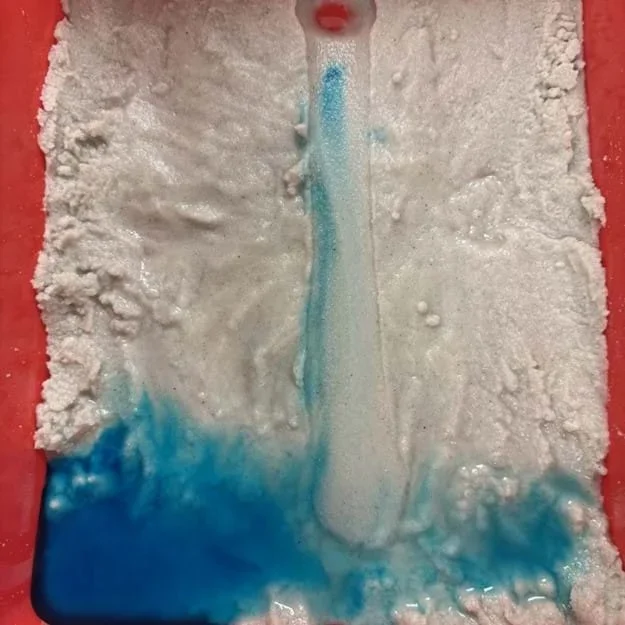
- Using food coloring, have one team member add a few drops where they started pouring the water. This will represent pollution moving along with the sediment. (See Image 1.)
- Have students watch how the sand moves along the channel and where it builds up.
- Instruct students to use a ruler to measure where sediment accumulates and record their findings in the table in Part A: Sediment Transport Activity Worksheet (PDF).
An illustration showing pollutant and sediment transport in a bayou ecosystem.Copyright Mila Taylor, Seven Lakes High School, Katy ISD, Texas
Reflection/Discussion:
- Give students time to answer the Reflection and Discussion questions in the Part A: Sediment Transport Activity Worksheet (PDF).
- Lead a class discussion covering the following:
- Discuss why sediment builds up in certain areas. (Answer: Sediment builds up in certain areas because the water slows down, losing the energy needed to carry the particles along. When the flow of water decreases—such as in wider, flatter, or more sheltered parts of a bayou—sediment settles out and accumulates on the bottom. Changes in the shape of the waterway, obstacles such as plants or debris, and bends in the bayou can also cause water to slow down, leading to more sediment buildup in those spots.)
- Explain how water flow causes erosion (picking up sediment) and deposition (dropping sediment). (Answer: Water flow causes erosion when moving water has enough energy to pick up and carry away soil, sand, and other particles from the land or the bed of a waterway. This process wears away the surface, breaking down soil and rock and transporting sediment downstream. Deposition happens when the water slows down and loses energy, causing it to drop the sediment it was carrying. The sediment settles and builds up in new locations, such as along the banks or bottom of a bayou. Together, erosion and deposition shape the land and waterways by constantly moving sediment from one place to another.)
- Discuss how sediment can clog bayous and reduce their capacity, leading to increased flood risk. (Answer: Sediment can clog bayous by settling and building up on the bottom and along the sides of these waterways. As sediment accumulates, it makes the bayous shallower and narrower, which reduces the amount of water they can hold and carry. When heavy rain falls, the clogged bayous cannot drain water quickly enough, causing water to overflow their banks. This overflow increases the risk of flooding in nearby neighborhoods, streets, and parks, putting people, homes, and infrastructure at risk.)
Part B: Bayou Engineering Design Challenge (45 minutes)
Ask, Research and Imagine
- Distribute the Part B: Bayou Engineering Design Challenge Worksheet (PDF) to each student.
- Discuss the unique challenges a city like Houston faces due to flat terrain, urbanization, and heavy rainfall.
- Flat Terrain: Houston is nearly flat, which means water doesn’t drain quickly after it rains. Instead of flowing away efficiently, water tends to pool and accumulate, increasing the risk of flooding.
- Urbanization: As the city grows, more land is covered with buildings, roads, and parking lots. These surfaces are impermeable, meaning rainwater cannot soak into the ground. This leads to more runoff, which can overwhelm drainage systems and bayous.
- Heavy Rainfall: Houston frequently experiences intense rainstorms and even hurricanes. When large amounts of rain fall in a short time, the flat terrain and developed land make it difficult for the water to drain properly, which can cause flash floods and long-term flooding in neighborhoods.
- Introduce the concept of flood control structures such as retention basins, levees, and sediment traps.To help manage and reduce flooding, cities like Houston use flood control structures such as retention basins, levees, and sediment traps. These structures work together to manage water flow, reduce flood damage, and protect communities from the impacts of heavy rainfall.
- Retention basins are man-made ponds or reservoirs that temporarily hold excess rainwater and release it slowly to prevent flooding downstream.
- Levees are raised barriers, often made of earth or concrete, built along rivers or bayous to keep rising water from spilling into nearby neighborhoods.
- Sediment traps are designed to catch and hold sediment—such as sand, silt, and debris—before it can build up in waterways and reduce their capacity to carry water.
Engineering Design Challenge
- Introduce or review the steps of the engineering design process.
Ask
- State the goal of the challenge: Each group must design and build a structure to reduce sediment transport in their bayou model.
Research
- Review what students already know from the previous activity.
Imagine:
- Show students the materials available to create barriers, sediment traps, or other features that slow water down and reduce erosion: sponges, popsicle sticks, straws, craft sticks, coffee filters, cotton balls, gravel, clay, or small rocks.
- Give students time to brainstorm ideas for reducing sediment transport using the available materials.
Plan
- Have each group draw a plan in the Design Plan section of their Part B: Bayou Engineering Design Challenge Worksheet (PDF).
- Remind students to label the components of their design and what materials their group plans to use.
- Have students answer the second question in the Design Plan section of their worksheet, explaining how their planned design will work to reduce sediment transport, and why.
- Each group should explain their design for your approval before they can move on to building their design.
- After each group’s plan is approved, have them answer the third question in the Design Plan section of their worksheet, predicting where they think the most sediment will accumulate in their model with their proposed design.
Create
- Give student groups time to build their planned design.
Test and Improve
- Instruct students to pour water again into their bayou model and observe how well each structure prevents the sediment from moving. (See Image 2)
- Remind students to measure and record how much sediment is deposited in different sections of the bayou in the Observation Table in their Part B: Bayou Engineering Design Challenge Worksheet (PDF).
- Have students answer the questions in the Analysis section of their worksheet, reflecting on their testing.
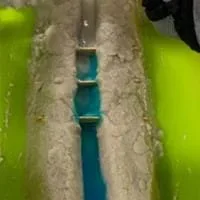 An illustration of pollutant and sediment transport in an engineered bayou system.Copyright Mila Taylor, Seven Lakes High School, Katy ISD, Texas
Review & Reflection:
- Have each group present their design and explain how it worked.
- Discuss what worked well and what could be improved.
- Relate this to real-world engineering—how engineers design flood control systems to manage sediment and prevent flooding.
Wrap-Up:
- Reiterate the importance of controlling sediment in bayous in cities such as Houston for flood prevention.
- Ask students how they might improve their designs or tackle larger-scale issues in the real world.
- sediment
- Small particles of rock, soil, and organic material that are carried by wind, water, or ice. These particles can vary in size, from tiny grains of sand to larger pebbles, and they are often deposited in rivers, lakes, and oceans.
- erosion
- The process by which natural forces such as wind, water, and ice wear away rocks and soil, gradually breaking them down and moving them from one place to another. Erosion can shape landscapes and create features such as valleys, cliffs, and shorelines.
- deposition
- The process where sediment, carried by water, wind, or ice, settles or is laid down in a new location. This can form land features such as deltas, sand dunes, and riverbanks as the transported material accumulates.
- bayou
- A slow-moving body of water, typically found in low-lying, flat areas. Bayous are common in the southeastern United States, and are often connected to rivers, lakes, or the Gulf of Mexico. Bayous are rich ecosystems that support diverse wildlife and vegetation.
- sediment transport
- The movement of sediment particles from one location to another, usually by water, wind, or ice. In rivers and bayous, sediment transport occurs as water flows, picking up particles and carrying them downstream. The speed of the water and the size of the particles determine how far and fast sediment travels.
Pre-Activity Assessment
Class Discussion: After showing the Bayou Design Challenge Presentation (PPTX), discussing how bayous serve as natural drainage systems, and explaining the problem of sediment buildup and how it can impact flooding, students answer the following questions: Why do you think sediment builds up in the bayous? How do you think this impacts flooding in the surrounding community?
Activity Embedded (Formative) Assessment
Sediment Transport Activity: After doing the Sediment Transport Activity, students complete the observation table and answer the reflection/discussion questions that follow in the Part A: Sediment Transport Activity Worksheet (PDF).
Post-Activity (Summative) Assessment
Bayou Engineering Design Challenge: After doing the Bayou Engineering Design Challenge, students complete the observation table and answer the reflection/discussion questions that follow in the Part B: Bayou Engineering Design Challenge Worksheet (PDF).
For high school, a field trip activity at a nearby bayou will provide a better understanding of the process of sediment transport.
Contributors
Mila Taylor; Dr. Mark Torres (Principal Investigator, Department of Earth, Environmental, & Planetary Sciences, Rice University); Dr. Will Larsen (Research Mentor, Department of Earth, Environmental, & Planetary Sciences, Rice University); Deborah Edwards (Lesson Peer Reviewer, Rice University RET Program); Isaias Cerda (Associate Director for Science Education, Rice Office of STEM Engagement); Mariana Quinn (Assistant Director for Science Education, Rice Office of STEM Engagement)
Supporting Program
The Nanotechnology Research Experience for Teachers at Rice University
Acknowledgements
This curriculum was developed under National Science Foundation - The Nanotechnology Research Experience for Teachers at Rice University Grant Number NSF EEC-2302127. Any opinions, findings, and conclusions or recommendations expressed in this material are those of the authors and do not necessarily reflect the views of the National Science Foundation.
Copyright
2025 by Regents of the University of Colorado; original © 2024 Rice University