
How Sweet Are You? Engineering Smarter Solutions for Diabetes with Data-Driven AI
Students collect data from a sugar-level simulation by categorizing different food and drink solutions and measuring their impact on glucose levels. They then use this data to train a machine learning model using the "Machine Learning for Kids" platform. By inputting and organizing their data, students train the model to predict blood sugar responses and classify meals as either healthy or unhealthy. They test their model’s accuracy with new inputs and make adjustments to improve its performance. Through this hands-on process, students gain an understanding of how machine learning works, the importance of high-quality data, and how these technologies can support real-world health applications, such as managing diabetes.
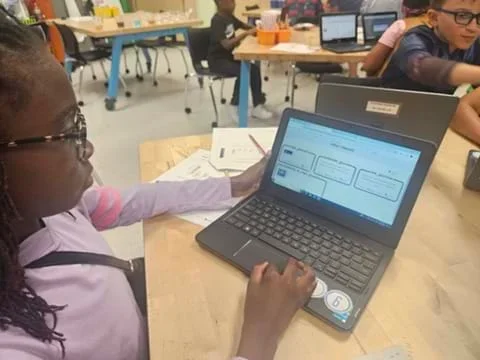 A student works on the machine learning portion of the activity.Copyright 2024 Adriana Sanchez
Biomedical engineers collect and analyze large amounts of data on blood sugar levels from sources such as continuous glucose monitors (CGMs) and electronic health records (EHRs). They use this data to develop predictive algorithms and machine learning models that forecast glucose fluctuations and recommend insulin doses or dietary changes. These engineers also design and prototype wearable devices—such as insulin pumps and smartwatches—that monitor and regulate blood sugar in real time. In parallel, software engineers may develop user-friendly apps that connect to medical devices, allowing patients to track glucose levels, receive alerts, and manage their diabetes more effectively. By combining data analysis, prototyping, and continuous improvement, engineers create innovative solutions that transform diabetes care.
After this activity, students should be able to:
- Demonstrate an understanding of how different foods affect blood sugar levels and the role of glucose and insulin in managing diabetes.
- Apply basic concepts of machine learning, such as data collection, model training, and testing, to predict blood sugar levels and classify meals as healthy or unhealthy.
- Analyze data collected from the sugar-level simulation, interpret results from machine learning models, and draw conclusions about effective dietary choices for managing blood sugar levels.
- CCSS.Math.Content.5.G.A.1 Use a pair of perpendicular number lines, called axes, to define a coordinate system, with the intersection of the lines (the origin) arranged to coincide with the 0 on each line and a given point in the plane located by using an ordered pair of numbers, called its coordinates. Understand that the first number indicates how far to travel from the origin in the direction of one axis, and the second number indicates how far to travel in the direction of the second axis, with the convention that the names of the two axes and the coordinates correspond (e.g., x-axis and x-coordinate, y-axis and y-coordinate).
Grade 5
Do you agree with this alignment? - CCSS.Math.Content.5.NBT.B.7 Add, subtract, multiply, and divide decimals to hundredths, using concrete models or drawings and strategies based on place value, properties of operations, and/or the relationship between addition and subtraction; relate the strategy to a written method and explain the reasoning used.
Grade 5
Do you agree with this alignment?
- 3-5-ETS1-1 Define a simple design problem reflecting a need or a want that includes specified criteria for success and constraints on materials, time, or cost.
Grades 3-5
This resource focuses on the following Three Dimensional Learning aspects of NGSS:
Science & Engineering Practices- Define a simple design problem that can be solved through the development of an object, tool, process, or system and includes several criteria for success and constraints on materials, time, or cost.Do you agree with this alignment?
Disciplinary Core Ideas- Possible solutions to a problem are limited by available materials and resources (constraints). The success of a designed solution is determined by considering the desired features of a solution (criteria). Different proposals for solutions can be compared on the basis of how well each one meets the specified criteria for success or how well each takes the constraints into account.Do you agree with this alignment?
Crosscutting Concepts- People's needs and wants change over time, as do their demands for new and improved technologies.Do you agree with this alignment?
Do you agree with this alignment? - Define a simple design problem that can be solved through the development of an object, tool, process, or system and includes several criteria for success and constraints on materials, time, or cost.
- 3-5-ETS1-2 Generate and compare multiple possible solutions to a problem based on how well each is likely to meet the criteria and constraints of the problem.
Grades 3-5
This resource focuses on the following Three Dimensional Learning aspects of NGSS:
Science & Engineering Practices- Generate and compare multiple solutions to a problem based on how well they meet the criteria and constraints of the design problem.Do you agree with this alignment?
Disciplinary Core Ideas- Research on a problem should be carried out before beginning to design a solution. Testing a solution involves investigating how well it performs under a range of likely conditions.Do you agree with this alignment?
- At whatever stage, communicating with peers about proposed solutions is an important part of the design process, and shared ideas can lead to improved designs.Do you agree with this alignment?
Crosscutting Concepts- Engineers improve existing technologies or develop new ones to increase their benefits, to decrease known risks, and to meet societal demands.Do you agree with this alignment?
Do you agree with this alignment? - Generate and compare multiple solutions to a problem based on how well they meet the criteria and constraints of the design problem.
- 3-5-ETS1-3 Plan and carry out fair tests in which variables are controlled and failure points are considered to identify aspects of a model or prototype that can be improved.
Grades 3-5
This resource focuses on the following Three Dimensional Learning aspects of NGSS:
Science & Engineering Practices- Plan and conduct an investigation collaboratively to produce data to serve as the basis for evidence, using fair tests in which variables are controlled and the number of trials considered.Do you agree with this alignment?
Disciplinary Core Ideas- Tests are often designed to identify failure points or difficulties, which suggest the elements of the design that need to be improved.Do you agree with this alignment?
- Different solutions need to be tested in order to determine which of them best solves the problem, given the criteria and the constraints.Do you agree with this alignment?
Do you agree with this alignment? - Plan and conduct an investigation collaboratively to produce data to serve as the basis for evidence, using fair tests in which variables are controlled and the number of trials considered.
- 4-LS1-1 Construct an argument that plants and animals have internal and external structures that function to support survival, growth, behavior, and reproduction.
Grade 4
This resource focuses on the following Three Dimensional Learning aspects of NGSS:
Science & Engineering Practices- Construct an argument with evidence, data, and/or a model.Do you agree with this alignment?
Disciplinary Core Ideas- Plants and animals have both internal and external structures that serve various functions in growth, survival, behavior, and reproduction.Do you agree with this alignment?
Crosscutting Concepts- A system can be described in terms of its components and their interactions.Do you agree with this alignment?
Do you agree with this alignment? - Construct an argument with evidence, data, and/or a model.
- 5-PS1-3 Make observations and measurements to identify materials based on their properties.
Grade 5
This resource focuses on the following Three Dimensional Learning aspects of NGSS:
Science & Engineering Practices- Make observations and measurements to produce data to serve as the basis for evidence for an explanation of a phenomenon.Do you agree with this alignment?
Disciplinary Core Ideas- Measurements of a variety of properties can be used to identify materials. (Boundary: At this grade level, mass and weight are not distinguished, and no attempt is made to define the unseen particles or explain the atomic-scale mechanism of evaporation and condensation.)Do you agree with this alignment?
Crosscutting Concepts- Standard units are used to measure and describe physical quantities such as weight, time, temperature, and volume.Do you agree with this alignment?
Do you agree with this alignment? - Make observations and measurements to produce data to serve as the basis for evidence for an explanation of a phenomenon.
- 5.7 Geometry and measurement. The student applies mathematical process standards to select appropriate units, strategies, and tools to solve problems involving measurement. The student is expected to solve problems by calculating conversions within a measurement system, customary or metric.
Grade 5
Do you agree with this alignment? - 5.9 Data analysis. The student applies mathematical process standards to solve problems by collecting, organizing, displaying, and interpreting data. The student is expected to:
Grade 5
Do you agree with this alignment? - 5.9.A represent categorical data with bar graphs or frequency tables and numerical data, including data sets of measurements in fractions or decimals, with dot plots or stem-and-leaf plots;
Grade 5
Do you agree with this alignment?
- 5.1.B use scientific practices to plan and conduct descriptive and simple experimental investigations and use engineering practices to design solutions to problems;
Grade 5
Do you agree with this alignment? - 5.6.B demonstrate and explain that some mixtures maintain physical properties of their substances such as iron filings and sand or sand and water;
Grade 5
Do you agree with this alignment?
For premade solutions:
- 8 plastic cups
- 1 150 mL graduated cylinder
- 1800 mL of distilled water
- stirring rod
- glucose powder
- 2 tbsp. of white sugar
- full sugar/calorie soda (e.g., Coca Cola or Pepsi)
- sports drink (e.g., Gatorade)
- 2 tbsp. of artificial sweetener (e.g., Stevia)
- masking tape (for labeling cups)
- marker (to label cups)
For each group:
- 1 laptop or device with internet access
- access to premade solutions
- 1 pair of plastic gloves or clothespin to handle the glucose testing strips
- 10 glucose test paper strips (Note: These strips can be cut in half to make more strips.)
- Data Recording Sheet (PDF)
- Sample Graph (PDF)
- Machine Learning Checklist (PDF)
- Machine Learning Pictures (PPTX)
- Machine Learning Tutorial for Kids (PPTX)
- 1 sheet of chart paper
- markers, colored pencils
- (optional) ruler
Each student needs:
- Pre-Assessment (PDF)
- Carbohydrates and Diabetes Article (PDF)
- STEM Journal (PPTX)
- Data Recording Sheet (PDF)
- Post Assessment (PDF)
- CER Worksheet (PDF)
For the whole class to share:
- 1 laptop or device with internet access and projector (to show PowerPoint presentations and YouTube videos)
- How Sweet Are You? Presentation (PPTX)
- Glycemic Index Food Guide table
- Glucose Index Search Database
- (optional) plastic cups
- (optional) other drinks, such as grape juice, coffee, or diet soda
- Carbohydrates and Diabetes Article (pdf)
- Data Recording Sheet (docx)
- Data Recording Sheet (pdf)
- Data Recording Sheet Answer Key (docx)
- Data Recording Sheet Answer Key (pdf)
- STEM Journal (pptx)
- STEM Journal (pdf)
- Pre-Assessment (docx)
- Pre-Assessment (pdf)
- Pre-Assessment Answer Key (docx)
- Pre-Assessment Answer Key (pdf)
- Post Assessment (docx)
- Post Assessment (pdf)
- Post Assessment Answer Key (docx)
- Post Assessment Answer Key (pdf)
- CER Worksheet (docx)
- CER Worksheet (pdf)
- CER Worksheet Answer Key (docx)
- CER Worksheet Answer Key (pdf)
- Machine Learning Checklist (docx)
- Machine Learning Checklist (pdf)
- Machine Learning Tutorial for Kids (pptx)
- Machine Learning Tutorial for Kids (pdf)
- ML4K Tutorial Sheet (docx)
- ML4K Tutorial Sheet (pdf)
- ML4K Recording (WEBM video)
- Glucose Index Datasheet (xlsx)
- Machine Learning Pictures (pptx)
- Machine Learning Pictures (pdf)
- Sample Graph (docx)
- Sample Graph (pdf)
- Sample Graph Answer Key (docx)
- Sample Graph Answer Key (pdf)
- How Sweet Are You? Presentation (pptx)
- How Sweet Are You? Presentation (pdf)
Students should have:
- a basic understanding of data collection, organization, and interpretation.
- a basic understanding of creating tables and graphs (such as line plots).
In addition, familiarity with using digital tools and applications such as spreadsheets for data organization, and a basic understanding of platforms such as SCRATCH, will enhance students’ ability to engage effectively with the activities.
Today, we are diving into an exciting activity where we get to explore how science and engineering can help us understand and manage diabetes. Diabetes is a condition that affects how our bodies handle sugar, and it is important for us to learn more about it.
Challenge: You are an assistant researcher, and your task is to help doctors predict how certain foods affect a person's blood sugar levels. This is exactly what scientists and engineers do in real life! They use tools and methods to gather data and make predictions that help people live healthier lives.
We are going to start by creating our own “glucose solutions.” These are scientific mixtures that will help us test how glucose test strips work. Think of them as our “magic potions” that will help us measure sugar levels in different liquids. But before we begin, let us think about some questions:
- What do you already know about diabetes? Have you heard of it before?
- How do you think food affects our bodies, especially when it comes to sugar?
- Can you think of any foods or drinks that might have a lot of sugar in them?
- Why do you think it is important for doctors and scientists to understand how different foods affect our bodies?
Let us take a moment to share our thoughts and ideas. Remember, there are no right or wrong answers! Your questions and ideas will guide us through our exploration today. Are you ready? Let’s get started!"
(For Teachers: Encourage students to think about how diabetes and dietary habits might differ across cultures and communities, fostering a broader perspective. Encourage curiosity by asking probing questions that prompt students to reflect on their own experiences and observations related to food, health, and diabetes. For example:
- "How does your family talk about food and health at home?"
- "Have you ever noticed how some foods make you feel different after eating them?"
- "What do you think happens inside our bodies when we eat something sweet?"
Background
What is diabetes? Diabetes affects approximately 10% of the U.S. population. People with type 1 diabetes don't make enough insulin, an important hormone produced by the pancreas. In type 2 diabetes, the more common form, the pancreas makes insulin, but the body doesn’t use it as it should. Diabetes is a significant health issue in the United States, affecting millions of people. It can lead to serious complications, such as cardiovascular disease, kidney damage, nerve damage, and vision loss, if not properly managed. Rates of diabetes have been rising due to factors such as sedentary lifestyles, unhealthy diets, and increasing obesity rates. Why is this relevant to the study? Managing diabetes involves monitoring blood sugar levels regularly, using tools such as glucose meters and test strips. Understanding how different foods affect blood sugar levels is crucial for individuals with diabetes to make informed dietary choices. What are glucose paper tests? These are small, disposable paper or plastic strips coated with enzymes that react with glucose in a solution. Enzymes are proteins that act as catalysts, speeding up chemical reactions without being consumed in the process. When a test strip is dipped into a liquid containing glucose, the enzyme on the strip catalyzes a reaction that produces a color change or an electrical signal, which can be measured and interpreted to indicate the concentration of glucose in the solution.
Machine Learning, or ML, is a type of artificial intelligence that allows computers to learn how to perform tasks without being given specific instructions every time. Instead of following a fixed set of commands, a computer is provided with large amounts of information—such as numbers, words, or images—and it analyzes that data to identify patterns. Once it learns from these patterns, the computer can begin to make its own predictions or decisions.
Machine learning is already a part of everyday life, even if it is not always noticeable. For example, when YouTube suggests videos based on previously watched content, or when online searches result in related ads, machine learning is at work. It also powers apps on smartphones, music streaming recommendations, and even driverless delivery services, helping these services run more efficiently and effectively.
Beyond entertainment and convenience, machine learning is making significant contributions to health and safety. Modern vehicles use ML for adaptive cruise control, helping cars to stay in their lanes and maintain safe distances from others. Airplanes rely on it for autopilot functions. In healthcare, ML helps to develop portable devices that scan the body like an X-ray or MRI, but are more compact and affordable—crucial for individuals living far from hospitals or without access to advanced medical equipment.
One of the most inspiring uses of ML is in supporting people with disabilities. Some advanced prosthetic limbs can now be controlled by a person’s thoughts through the interpretation of brain signals using ML. Additionally, ML is behind the development of communication tools for individuals who are unable to speak or move, providing them with new ways to connect with the world. While it may sound futuristic, machine learning is already deeply embedded in modern life, solving real-world problems in powerful and innovative ways.
Before the Activity
- Make copies of the following worksheets:
- Pre-Assessment (PDF) (one per student)
- Carbohydrates and Diabetes Article (PDF) (one per student)
- STEM Journal (PPTX)(one per student)
- Post Assessment (PDF)(one per student)
- CER Worksheet (PDF) (one per student)
- Data Recording Sheet (PDF) (one per group)
- Sample Graph (PDF)(one per group)
- Machine Learning Checklist (PPTX) (one per group)
- Make sure students will have access to the following:
- ML4K Tutorial Sheet (PDF)
- Machine Learning Tutorial for Kids (PPTX) PowerPoint presentation
- Machine Learning Pictures (PPTX) PowerPoint presentation
- Glycemic Index Food Guide table
- Glucose Index Search Database
- Prepare student groups and workstations.
- Assign students to small groups.
- Arrange desks/tables for group work.
- Ensure that each workstation has a set of glucose test strips, solutions to be tested, measuring tools, stirring rods, and labels.
- Optional: Assign group roles (materials manager, timekeeper, recorder, questioning, illustrator, etc.).
- Prepare solutions in advance and label the containers.
- 10% glucose solution: Add 10 grams of glucose powder to 100 mL of distilled water, stir until fully dissolved, and label cup.
- 20% glucose solution: Add 20 grams of glucose powder to 100 mL of distilled water, stir until fully dissolved, and label cup.
- 10% sugar solution: Add 10 grams of white sugar to 100 mL of distilled water, stir until fully dissolved, and label cup.
- 20% sugar solution: Add 20 grams of brown sugar to 100 mL of distilled water, stir until fully dissolved, and label cup.
- 10% artificial sweetener solution: Add 10 grams of artificial sweetener to 100 mL of distilled water, stir until fully dissolved, and label cup.
- 20% sports drink solution: Add 20 mL of a sports drink (e.g., Gatorade) to 80 mL of distilled water, stir until fully dissolved, and label cup.
- 20% soda solution: Add 20 mL of a full calorie soda (e.g., Coca Cola) to 80 mL of distilled water, stir until fully dissolved, and label cup.
- Optional 20% natural juice solution: Add 20 mL of a natural juice (e.g., grape or orange juice) to 80 mL of distilled water, stir until fully dissolved, and label cup.
- Review the manufacturer's instructions for the glucose test strips to understand how to use them accurately.
- Test a few strips yourself with prepared solutions to get a feel for the process and potential color changes or readings.
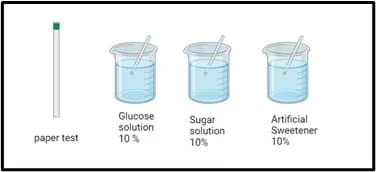 Testing glucose levels with a paper strip in 10% glucoseCopyright Image created with BioRendeer.com
https://app.biorender.com/illustrations/667a348a09b29e1c87c0d003?slideId=5a44676c-6ff4-4682-be17-aa8ad2200318
Testing glucose levels with a paper strip in 10% glucoseCopyright Image created with BioRendeer.com
https://app.biorender.com/illustrations/667a348a09b29e1c87c0d003?slideId=5a44676c-6ff4-4682-be17-aa8ad2200318
During the Activity
Day 1: Introduction to Diabetes and Carbohydrates
- Introduction and Videos (15 min)
- Show the How Sweet Are You? Presentation (PPTX).
- Show Slide 2 and pose the following: "You have been playing outside for 20 minutes. You are sweaty and thirsty. Which one of these beverages would you pick to drink? Why?”
- Give students a moment to think about their responses.
- Go over Slide 3: Did You Know?
- Show students the YouTube video “What is Sugar?” on Slide 4: https://www.youtube.com/watch?v=fddX3uEHRfY (3:12 minutes)
- Show students the YouTube video “What Causes Diabetes?” on Slide 5: https://www.youtube.com/watch?v=d86DofYpkrY(5:39 minutes)
- Think-Pair-Share (10 min)
- Distribute the Pre-Assessment (PDF).
- Give students time to write their answers independently.
- On Slide 6, have students pair up to discuss their responses to the following questions:
- What do you already know about diabetes? Have you heard of it before?
- How do you think food affects our bodies, especially when it comes to sugar?
- Can you think of any foods or drinks that might have a lot of sugar in them?
- Why do you think it is important for doctors and scientists to understand how different foods affect our bodies?
- Invite a few students to share either their own ideas or something interesting they heard from a partner.
- Challenge and Background Knowledge (10 min)
- Introduce the challenge to the students on Slide 7: Help doctors predict how certain foods affect a person's blood sugar levels.
- Hand out one STEM Journal (PPTX) to each student.
- Show Slide 8 and have students read the Carbohydrates and Diabetes Article (PDF). (Students can read independently or as a class.)
- After reading, highlight key takeaways and have students take notes in their STEM Journal (PPTX):
- Diabetes is a condition where the body has trouble using a sugar called glucose.
- Glucose gives our bodies energy, but it needs insulin to get into our cells.
- People with type 1 diabetes do not make insulin.
- People with type 2 diabetes make insulin, but their bodies do not use it well.
- Without insulin working right, too much sugar stays in the blood, which can make someone sick.
- Blood sugar refers to how much sugar is in your blood.
- Your body tries to keep your blood sugar just right—not too high or too low.
- When people with diabetes eat certain foods, their blood sugar can rise quickly.
- They may need medicine, insulin, or healthy eating to help keep blood sugar in balance.
- Carbohydrates (carbs) are foods that give your body energy.
- Carbs come in three types:
- Sugar (such as candy, cake, soda); makes blood sugar rise quickly.
- Starch (such as bread, rice, potatoes); is less processed (e.g., brown rice or oatmeal) and raises blood sugar more slowly.
- Fiber (such as fruits, veggies, whole grains); helps slow down how sugar enters the blood.
- Investigation Hypotheses (10 min)
- Divide students into small groups and have each group sit at assigned workstations.
- Show students the premade test solutions they will be investigating on Day 2 and describe what each solution is.
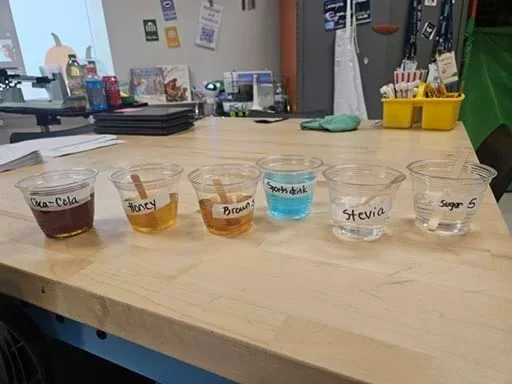 Testing various liquids.Copyright 2024 Adriana Sanchez
- Show Slide 9.
- Explain how glucose paper strips work.
- Glucose paper strips are small strips of paper that help test for sugar (glucose) in liquids such as urine or sometimes food. Here is how they work:
- The strip has a special chemical coating that changes color when it touches glucose.
- When the strip is dipped into a liquid that might have sugar in it, an enzyme on the strip reacts with the glucose.
- This reaction makes a color appear—usually from light to dark, depending on how much sugar there is in the liquid.
- By comparing the color on the strip to a color chart on the bottle or box, you can see how much sugar is in the liquid.
- Describe how students will use the glucose paper strips.
- Dip a glucose test strip into the 10% glucose solution (use gloves or a clothespin).
- Wait for the time specified by the test strip manufacturer.
- Observe and record the color change or digital reading on your group’s data sheet.
- Repeat the process with other solutions.
- Show Slide 10
- Give students the rest of the activity directions.
- In teams, have students use chart paper and markers to create a graph to represent the data gathered in their datasheet.
- Once done, have students do a gallery walk and make observations about the other graphs. What things are similar? What things are different?
- Have each group discuss and write down their hypotheses on Page 1 of their STEM Journal (PPTX) about how they think each solution will affect the glucose test strip readings.
Day 2: Investigating Glucose Solutions
- Data Collection (15 min)
- Give each group a Data Recording Sheet (PDF).
- Show Slide 9 as a reminder of how to use the glucose paper strips.
- Have groups test the premade solutions.
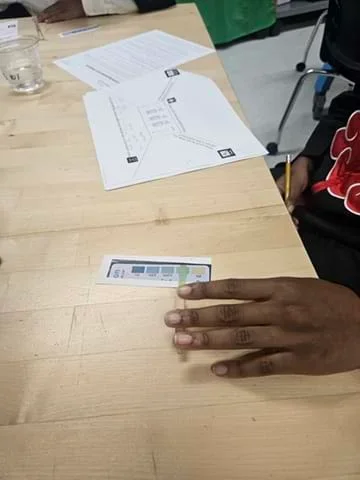 Students use glucose testing strips to test liquids and compare the resulting color.Copyright 2024 Adriana Sanchez
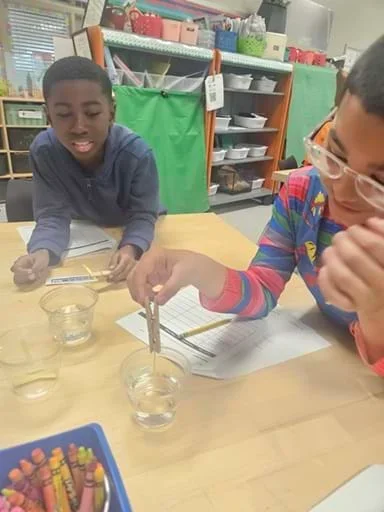 Students use glucose testing strips to test liquids and compare resulting color.Copyright 2024 Adriana Sanchez
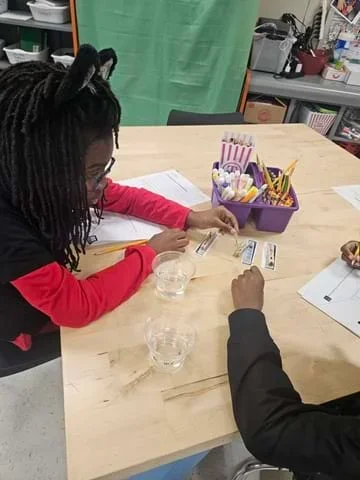 Students use glucose testing strips to test liquids and compare resulting color.Copyright 2024 Adriana Sanchez
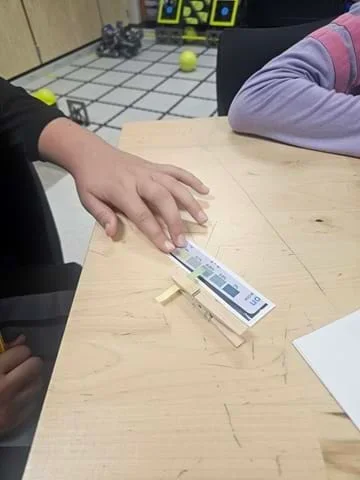 Student compares test strip held in a clothespin against color chart.Copyright 2024 Adriana Sanchez
- Have students record all findings in their STEM Journal (PPTX) on Page 2 and in their group’s Data Recording Sheet (PDF).
- Facilitate a class discussion where groups share their findings.
- Which solutions caused a change in the strip? Which did not?
- Why did the glucose solution register a result while the artificial sweetener did not?
- What conclusions can they draw about the relationship between types of sugars and glucose levels?
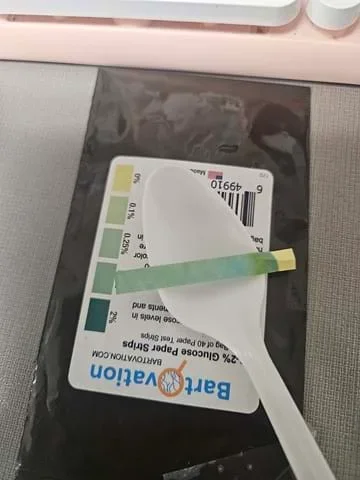 Glucose testing strip compared to color strip.Copyright 2024 Adriana Sanchez
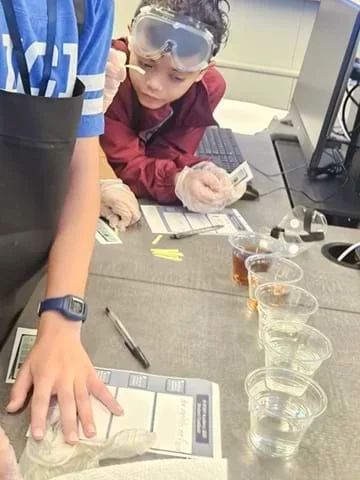 Students test glucose content of various liquids.Copyright 2024 Adriana Sanchez
- Data Graphing (10 min)
- Give each group chart paper and a copy of the Sample Graph (PDF).
- Using the provided chart paper, have students use a graph to represent the data they gathered in their datasheet. (Note: Students can create a bar graph that represents the numbers of the paper test on the y-axis, and the solutions they tested on the x-axis).
- In groups, have students work to create a bar graph or line graph that best depicts their data.
- Gallery Walk (10 min)
- Have students do a gallery walk to see other teams' graphs.
- As a class, discuss what trends they observe in the other teams’ graphs.
- Claim, Evidence, and Reasoning (10 min)
- Give each student a CER Worksheet (PDF).
- Have students work on the CER Worksheet (PDF) for the rest of the class period.
- Extension (if time allows)
- Introduce a “mystery” solution (e.g., made with zero-calorie soda and water).
- Have students test it and note that the test strip shows no glucose reading.
- Ask students to hypothesize what the mystery liquid could be, and why it did not affect the test strip.
Day 3: Introduction to Machine Learning and Tutorial
- Introduce Machine Learning (ML) and Connect ML to the Previous Activity (15 min)
- Start with a reflection prompt: “Let us think back to yesterday. You tested different solutions—like water, Gatorade, and juice—and saw how the glucose test strips changed color. What surprised you the most about what you saw?” (Let students share a few responses.)
- Make the real-world connection: “Some of you noticed that drinks like Gatorade, even though they are advertised as healthy, actually caused a strong reaction on the test strip. That means they have a lot of sugar!”
- Relate the test strips to real-world applications: “What do you think about the color change you saw?” (Let students offer answers.) “It is like a visual clue about what might be happening inside your body when you eat or drink sugar. Our blood sugar levels rise and fall depending on what we consume.”
- Point out the big picture: “Take a look around at all the graphs you made. Each group added to the data. Now imagine if we had hundreds or even thousands of graphs from classrooms all around the world. That is a LOT of information! This is where something called machine learning comes in.”
- Introduce ML: “Machine learning is part of something called artificial intelligence, or AI. It helps computers look at huge amounts of data and find patterns—like what you did with your bar graphs, but faster. Right now, researchers at universities are using machine learning to build tools that help track blood sugar levels—especially for people who do not live near a doctor or hospital.”
- Connect to today’s challenge: “So what can we do? Today, you are going to create your own mini version of this technology! You will build an app that looks at pictures of food and helps classify them by how much glucose they might have. It is like teaching the computer to “see” food and guess whether it’s high or low in sugar. You’ll use real data and images, just like real scientists and engineers do!”
- Show Slide 11 of the How Sweet Are You? Presentation (PPTX).
- Show the “What is Machine Learning?” video at https://www.youtube.com/watch?v=QghjaS0WQQU. (2:02 minutes)
- Machine Learning Tutorial (30 min)
- Show the “Machine Learning for Kids” video at https://www.youtube.com/watch?v=EjbHXMzeX4c. (22:34 minutes)
Day 4: Machine Learning Model
- Machine Learning Activity (45 min)
- Provide each group with a laptop or tablet with internet access.
- Optional: Guide students in collecting images of different foods. Students can refer to this Glycemic Index Food Guide table.
- Give students access to the Machine Learning Pictures (PDF) PowerPoint.
- Give students access to the Machine Learning Tutorial for Kids (PPTX) PowerPoint.
- Give each team one Machine Learning Checklist (PDF).
- Have students check the tasks they have completed.
- Have students follow the Machine Learning Tutorial for Kids (PPTX) PowerPoint and modify it to recognize food instead of books.
- Have students code their models and observe whether they have difficulties.
- Monitor the room to observe what students are doing and answer any questions.
- Have students code their models and observe whether they have difficulties.
- Have students use Page 3 of the STEM Journal (PPTX) to document the process and thinking while creating their ML model.
- For your reference: Scratch food classification example and ML4K Recording video (WEBM).
- Have students use Teachable Machine to add visual data, train their model, and test it.
- Students can also click "behind the machine" to see the Python coding, the confusion matrix, and other statistics. See the Machine Learning Tutorial for Kids (PPTX).
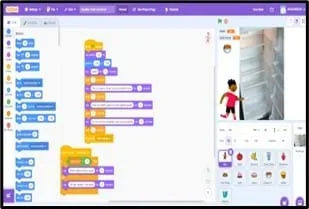 Screenshot of the healthy food classification game in Scratch.Copyright 2024 Adam Rasheed
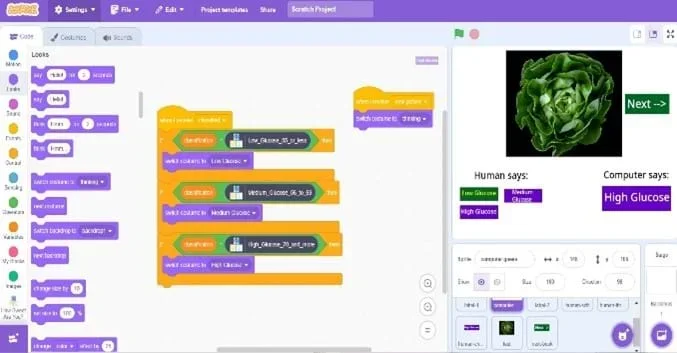 Screenshot of the Machine Learning for Kids project in Scratch.Copyright 2024 Adriana Sanchez
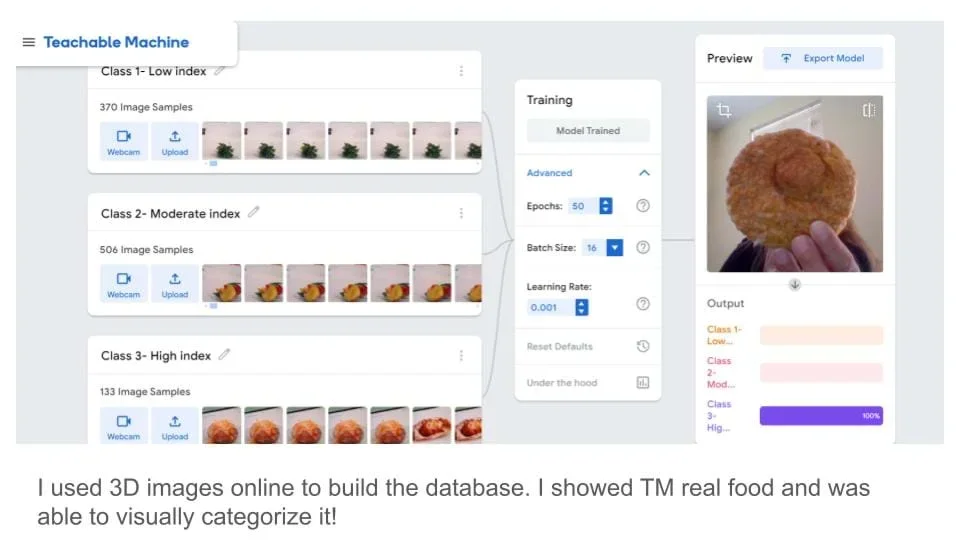 Screenshot of the Teachable Machine visual categorization project.Copyright 2024 Adriana Sanchez
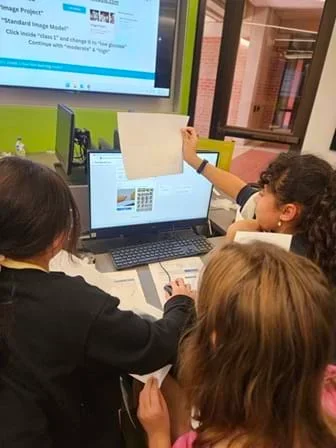 Students work together on the machine learning portion of the activity.Copyright 2024 Adriana SanchezA student works on the machine learning portion of the activity.Copyright 2024 Adriana Sanchez
Day 5: Machine Learning Model and Post Assessment
- Model Share Out (15 min)
- Have students share their model and coding with other teams, even if it is not finished. Having students stop and listen to other teams' solutions will help them clarify processes and ignite ideas to better their model.
- Complete Machine Learning Activity (20 min)
- Give groups time to improve or finish their machine learning model.
- Post Assessment (10 min)
- Give each student a Post Assessment (PDF).
- Give students 5 minutes to complete the Post Assessment (PDF).
- glucose
- Any of a group of metabolic diseases whereby a person (or other animal) has high blood sugar due to an inability to produce, or inability to metabolize, sufficient quantities of the hormone insulin.
- diabetes mellitus
- Any of a group of metabolic diseases whereby a person (or other animal) has high blood sugar due to an inability to produce, or inability to metabolize, sufficient quantities of the hormone insulin.
- insulin
- A protein pancreatic hormone secreted by the beta cells of the islets of Langerhans that is essential especially for the metabolism of carbohydrates and the regulation of glucose levels in the blood and that when insufficiently produced results in diabetes mellitus.
- test strip
- A strip of material containing chemicals that react to certain substances.
- concentration
- The amount of a component in a given area or volume.
- hypothesis
- A tentative assumption made in order to draw out and test its logical or empirical consequences.
- variable
- A quantity that may assume any one of a set of values.
- data
- Factual information (such as measurements or statistics) used as a basis for reasoning, discussion, or calculation.
- machine learning
- A computational method that is a subfield of artificial intelligence and that enables a computer to learn to perform tasks by analyzing a large dataset without being explicitly programmed.
Pre-Activity Assessment
Think-Pair-Share: Show the students pictures of different beverages in the Pre-Assessment (PDF) and then ask students: "You have been playing outside for 20 minutes. You are sweaty and thirsty. Which one of these beverages would you pick to drink? Why?” After students have a moment to think about their responses individually, students then pair up with a partner to discuss their thoughts and compare responses. Once students have shared with their partners, ask some students to share something they said or something they heard with the whole class.
Activity Embedded (Formative) Assessment
Data Collection: Students follow the glucose testing strip instructions and fill out the Data Recording Sheet (PDF). While they are doing that, stop by each station and ask students: "What are you doing now? How will this observation be placed on the table? What initial conclusions can you make?”
Gallery Walk: During the gallery walk, listen carefully to the students' explanations of the process they followed to transform a table into a Sample Graph (PDF), and the conclusions they reached.
Machine Learning Model: Have students share their model and coding with other team members, even if it is not finished. Having students stop and listen to other teams' solutions will help them clarify processes and ignite ideas to better their model.
Post-Activity (Summative) Assessment
Post Assessment: Students answer questions to demonstrate what they’ve learned about glucose and diabetes.
Solution CER Summary: Students complete the CER Worksheet (PDF), making a claim, supporting it with evidence, and explaining their reasoning. This format assesses depth of understanding and scientific thinking beyond memorization.
Machine Learning Model: Students use the Machine Learning Checklist (PDF) to track their progress and complete a model using tools such as Machine Learning Tutorial for Kids (PPTX) or Teachable Machine.
For Day 1, ensure that students use gloves and have paper towels available. Have the labels ready. Encourage teams to divide the work: Someone measures, someone attaches the labels, someone records in the journal, etc. You may want to have someone on the team taking pictures of the process.
Provide teams with enough space. If time is limited, have the solutions ready.
For Day 2, make sure the laptops are fully charged and that the internet is working. You may want to save the website in favorites or on the desktop for easy access.
If you lose the internet, have students try to code on paper, as a backup, until the internet service is restored.
Modifications for lower grades (3rd or 4th):
- Prepare and label the solutions beforehand.
- Print pictures of some foods found in the Glycemic Food Guide and add the index at the back.
- Have students classify the cards with the food pictures into categories (less sugary to more sugary).
- Provide students with an electronic folder with the pictures already saved.
- Follow the machine learning tutorial as a whole class, working together.
For advanced students (5th-6th):
- Have students create balanced meals to keep sugar levels in the body at an optimal level.
- Have students create a brochure using technology (Canva, PowerPoint, Google slides) to bring awareness to diabetes prevention.
- Have students dig deeper into ML by creating a picture recognition model for some other topic of their choice using Teachable Machine.
- Have students use Teachable Machine to create a model that can do voice recognition.
Collins English Dictionary, HarperCollins Publishers, https://www.collinsdictionary.com/us/dictionary/english/test-strip. Accessed 25 June 2024.
KidsHealth, Nemours Foundation, "Carbohydrates and Diabetes, https://kidshealth.org/en/kids/carbs-diabetes.html. Accessed 25 June 2024.
KidsHealth, Nemours Foundation, "What Is Diabetes?", https://kidshealth.org/en/kids/word-diabetes-mellitus.html. Accessed 25 June 2024.
KidsHealth, Nemours Foundation, "How to Manage Blood Sugars With Type I Diabetes?", https://kidshealth.org/en/kids/diabetes-control.html. Accessed 25 June 2024.
KidsHealth, Nemours Foundation, "What Is Type II Diabetes?", https://kidshealth.org/en/kids/type2.html. Accessed 25 June 2024.
Merriam-Webster.com Dictionary, Merriam-Webster, https://www.merriam-webster.com/dictionary/glucose. Accessed 25 June 2024.
Wiktionary, The Free Dictionary, Wikimedia Foundation, https://en.wiktionary.org/wiki/diabetes#References_5. Accessed 25 June 2024.
Contributors
Adriana Sanchez Cantu; Adam Rasheed
Supporting Program
Research Experience for Teachers Program, Rice University
Acknowledgements
This material was developed based upon work supported by the National Science Foundation under grant no.1648451 —the Precise Advanced Technology and Health Systems for Underserved Populations (PATHS-UP), NSF grant no 1730574 See Below the Skin, Research Experience for Teachers (RET), the Summer Web-Based Institute for Technologies in CompSci and Healthcare (SWITCH), and the Rice Office of STEM Engagement at Rice University, Houston, TX.
Special thanks to Brittany Templeton and Michael Oseguera from the SWITCH program.
Student Mentor, Tony Yu at Rice and Professor, Dr. Cote, at Texas A & M
Copyright
2025 by Regents of the University of Colorado; original © 2024 Rice University