
Preventing Microplastics from Getting into Humans
Students explore the environmental and human health impacts of microplastics while designing and testing their own filtration solutions. After learning about how microplastics enter the environment and human body through various pathways, potentially leading to serious health issues such as cancer, students work in teams to develop a practical solution to filter microplastics from water. Using readily available and cost-effective materials, students engage in the complete engineering design process: from initial research and brainstorming to prototyping, testing, and presenting their solutions. Students test their filters using water samples containing microplastic particles and evaluate the effectiveness of their designs through visual inspection or microscopic analysis.
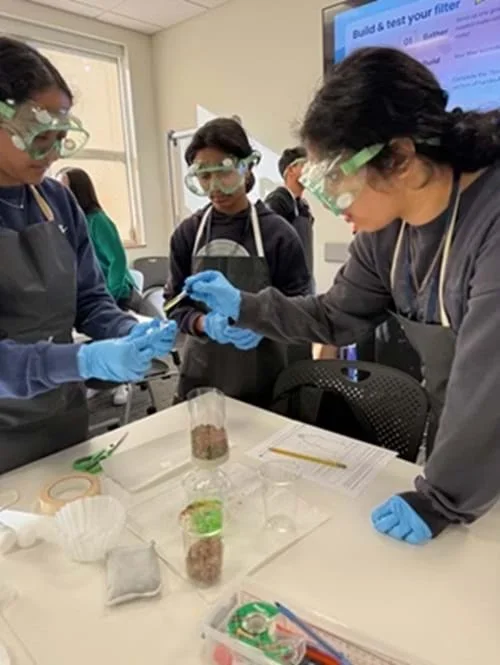 Students prepare wet mount for microscope viewing.Copyright Alexandra Hofferek 2025
Environmental engineers work to develop innovative solutions for removing microplastics from water systems to protect both human health and ecosystems. These engineers must understand how different materials and design approaches can effectively filter out particles of various sizes while maintaining water flow. Their work requires knowledge of how microplastics interact with biological systems, as these particles can disrupt cellular processes and potentially cause DNA damage. Engineers also need to consider cost-effectiveness and scalability when designing filtration systems for widespread implementation in water treatment facilities and consumer products.
After this activity, students should be able to:
- Explain how microplastics enter and impact human biological systems and the environment.
- Use the engineering design process to design and test a filtration device to remove microplastics from water.
- Evaluate filtration methods through microscopic examination and propose design improvements based on testing results and peer feedback.
- CCSS.Math.Content.HSS-ID.A.1 Represent data with plots on the real number line (dot plots, histograms, and box plots).
Grades 9-12
Do you agree with this alignment? - CCSS.Math.Content.HSS-ID.C.9 Distinguish between correlation and causation.
Grades 9-12
Do you agree with this alignment?
- HS-ETS1-2 Design a solution to a complex real-world problem by breaking it down into smaller, more manageable problems that can be solved through engineering.
Grades 9-12
This resource focuses on the following Three Dimensional Learning aspects of NGSS:
Science & Engineering Practices- Design a solution to a complex real-world problem, based on scientific knowledge, student-generated sources of evidence, prioritized criteria, and tradeoff considerations.Do you agree with this alignment?
Disciplinary Core Ideas- Criteria may need to be broken down into simpler ones that can be approached systematically, and decisions about the priority of certain criteria over others (trade-offs) may be needed.Do you agree with this alignment?
Do you agree with this alignment? - Design a solution to a complex real-world problem, based on scientific knowledge, student-generated sources of evidence, prioritized criteria, and tradeoff considerations.
- HS-LS2-7 Design, evaluate, and refine a solution for reducing the impacts of human activities on the environment and biodiversity.
Grades 9-12
This resource focuses on the following Three Dimensional Learning aspects of NGSS:
Science & Engineering Practices- Design, evaluate, and refine a solution to a complex real-world problem, based on scientific knowledge, student-generated sources of evidence, prioritized criteria, and tradeoff considerations.Do you agree with this alignment?
Disciplinary Core Ideas- When evaluating solutions it is important to take into account a range of constraints including cost, safety, reliability and aesthetics and to consider social, cultural and environmental impacts.Do you agree with this alignment?
- Moreover, anthropogenic changes (induced by human activity) in the environment—including habitat destruction, pollution, introduction of invasive species, overexploitation, and climate change—can disrupt an ecosystem and threaten the survival of some species.Do you agree with this alignment?
- Humans depend on the living world for the resources and other benefits provided by biodiversity. But human activity is also having adverse impacts on biodiversity through overpopulation, overexploitation, habitat destruction, pollution, introduction of invasive species, and climate change. Thus sustaining biodiversity so that ecosystem functioning and productivity are maintained is essential to supporting and enhancing life on Earth. Sustaining biodiversity also aids humanity by preserving landscapes of recreational or inspirational value.Do you agree with this alignment?
- Biodiversity is increased by the formation of new species (speciation) and decreased by the loss of species (extinction).Do you agree with this alignment?
Crosscutting Concepts- Much of science deals with constructing explanations of how things change and how they remain stable.Do you agree with this alignment?
Do you agree with this alignment? - Design, evaluate, and refine a solution to a complex real-world problem, based on scientific knowledge, student-generated sources of evidence, prioritized criteria, and tradeoff considerations.
- recognize that disruptions of the cell cycle lead to diseases such as cancer.
Grades 9-11
Do you agree with this alignment? - identify and illustrate changes in DNA and evaluate the significance of these changes;
Grades 9-11
Do you agree with this alignment? - describe how environmental change can impact ecosystem stability.
Grades 9-11
Do you agree with this alignment?
Each group needs:
- 1 clean plastic 2-liter bottle, cut in half horizontally (recycled works well)
- 1 coffee filter
- 500 mL clean gravel (approximately 1-2 cm diameter)
- 500 mL clean sand
- 250 mL activated charcoal (available at pet stores in aquarium section, ~$10/kg; alternatively, can just use additional sand layers if activated charcoal is not available)
- 1 rubber band
- 3-4 cotton balls
- 2 beakers or metric measuring cups (500 mL capacity)
- 1 stirring rod
- 1 standard classroom microscope (or 1 document camera)
- 2 microscope slides and cover slips
- safety equipment
- safety goggles (1 pair per student)
- disposable gloves (1 pair per student)
- lab aprons (1 per student)
For the entire class to share:
- laptop or tablet with projector (to show YouTube videos and display Microplastics Presentation (PPTX))
- microplastic sample solution (can be created using 5 g of finely ground plastic glitter in 1 L of water)
- 5 g plastic glitter
- 1 L water
- clear plastic or glass container
- stirring rod
- paper towels (for cleanup)
- metric measuring cups or beakers for distributing materials
Optional multimedia resources:
- video options:
- "How microplastics affect your health" by UNEP (1:56 minutes)
- “How dangerous are microplastics and how often do people ingest them?” by CBS News (6:15 minutes; stop at 4:15 minutes)
- digital camera or smartphone for documenting results
- laptop or tablet for research and documentation (1 per group)
- Microplastics Presentation (pptx)
- Microplastics Presentation (pdf)
- Design Planning Worksheet (docx)
- Design Planning Worksheet (pdf)
- Design Planning Worksheet Answer Key (docx)
- Design Planning Worksheet Answer Key (pdf)
- Exit Ticket (docx)
- Exit Ticket (pdf)
- Exit Ticket Answer Key (docx)
- Exit Ticket Answer Key (pdf)
- Final Presentation Rubric (docx)
- Final Presentation Rubric (pdf)
Students should have:
- A basic understanding of solutions and mixtures.
- A basic understanding of how cells function and how disruptions to cell cycles can lead to disease.
- Familiarity with environmental cycles and how substances can move through ecosystems.
- Basic microscope operation and wet mount preparation skills.
- An understanding of filtration as a method of physical separation.
Today, we are going to tackle a real environmental and health challenge that affects all of us, whether we realize it or not. As we watch this short video, I want you to pay attention to where microplastics come from and how they might end up in our bodies. (Show video(s): "How microplastics affect your health" by UNEP [1:56 minutes] and/or “How dangerous are microplastics and how often do people ingest them?” by CBS News; stop at 4:15 minutes.)
What surprised you most about what you just learned? (Wait for student responses. Possible answers: Microplastics are everywhere, they can cause cancer, they are in our food and water.)
Now, I have a question for you: How many of you drank water today? (Wait for hands to be raised.) Would it surprise you to know that researchers estimate we consume about 5 grams of plastic every week? That is about the weight of a credit card! Let’s think about this: Where do you think most of these microplastics in our water come from? (Write student responses on board. Possible answers: broken-down plastic bottles, synthetic clothing fibers, cosmetic products, industrial waste.)
Here is the challenge: As environmental engineers, we have been tasked with developing a solution to filter these harmful microplastics from water. (Hold up a water bottle with visible microplastic particles.) Before we start designing our filters, what questions should we ask ourselves about the problem? (Guide discussion. Possible questions: How small are microplastics? What materials could catch them? How can we tell if our filter works?)
In your groups, you will be designing and testing your own filtration systems. But first, let us consider: What makes a good filter? Think about filters you use in everyday life. (Pause for responses. Possible answers: coffee filters, water filters, air filters in cars or homes.)
Background
Microplastics are plastic particles smaller than 5 millimeters that enter our environment through various sources, including the breakdown of larger plastic debris, synthetic fibers released during laundry, microbeads in personal care products, and waste from industrial processes. Once in the environment, these tiny particles can accumulate in soil, waterways, and even the air, making them difficult to remove and easy for living organisms to ingest. Research shows that microplastics can disrupt cellular processes, cause inflammation, and potentially lead to DNA damage in animals and humans. As concern about their environmental and health impacts grows, developing effective methods to filter and remove microplastics has become a critical focus in environmental engineering.
Understanding filtration methods is crucial for environmental engineering solutions, as filtration plays a central role in protecting natural resources and public health. Effective filtration is essential in treating drinking water, cleaning wastewater, managing stormwater runoff, and reducing pollutants like microplastics, heavy metals, and pathogens. Environmental engineers must understand how different filtration techniques—such as physical, chemical, and biological—work, and how variables like particle size, flow rate, filter material, and pressure affect performance.
Before the Activity
- Prepare the microplastic solution: Mix 5 g of finely ground plastic glitter in 1L of water.
- Cut a 2-liter bottle horizontally for each group.
- Set up microscope stations.
- Make copies of the Design Planning Worksheet (PDF) (one per student).
- Optional: Make copies of the Exit Ticket (PDF) (one per student).
- Test water source to ensure it is clean, for control comparison.
- Prepare the Microplastics Presentation (PPTX) slides, or write key questions on the board.
- Queue up microplastics videos.
- Sort and distribute materials into group stations.
- Verify that all required safety equipment is available.
During the Activity
Day 1 (50 minutes)
Pre-Activity Assessment (10 minutes)
- Project and display the Microplastics Presentation (PPTX).
- Hand out one Design Planning Worksheet (PDF) to each student.
- Quick Write (Slide 2):
- Give students five minutes to write their response to the prompt "How might plastics affect human health?" in their Design Planning Worksheet (PDF).
- Lead a five-minute class discussion about student responses. (Example responses: Through food chain, drinking water contamination, toxic chemicals.)
Introduction (10 min)
- Read the Introduction and Motivation script and show the introduction video(s) about microplastics (Slide 4).
- Summarize basic microplastics facts (Slide 5).
- Optional: Review the steps of the engineering design process.
Problem Identification and Research (20 minutes)
- Present the challenge question (Slide 6): What can we do about microplastics?
- Review the current situation and problems of microplastics (Slide 7).
- Read the current filter types (Slide 8).
- Mechanical filters remove microplastics by physically trapping particles as water passes through a material with small openings, such as mesh, fabric, or membrane. These filters act like a sieve, blocking particles larger than the pore size while allowing clean water to flow through.
- A carbon or activated charcoal filter removes contaminants from water through a process called adsorption, where particles stick to the surface of the carbon. Activated charcoal is highly porous, which increases its surface area and makes it effective at capturing a wide range of pollutants.
- A reverse osmosis filter removes contaminants, including microplastics, from water by forcing it through a semipermeable membrane. This membrane has extremely tiny pores—typically around 0.0001 microns—that allow only water molecules to pass through, while blocking larger particles such as microplastics, bacteria, and many dissolved substances.
- Introduce the design challenge (Slide 9): Design a filter that can remove the microplastics from the provided plastic solution.
- Demonstrate the problem by showing the prepared microplastic solution. (Slide 10)
- Hold the container up to the light so students can see the suspended plastic particles. Ask guiding questions such as the following:
- "Where do you think this plastic will go if it's poured down the drain?"
- "What do you think happens to fish or other animals that live in water like this?"
- "Would you want to drink this water?"
- Use this demonstration to transition into a hands-on filtration challenge, asking students how they might remove the microplastics and what materials or techniques could work best.
- Divide class into groups of 3-4 students.
- Give each group a sample of the microplastics solution.
- Have each group examine a drop of contaminated water under a microscope to observe the microplastics.
- Guide students in documenting initial observations. They may observe some of the following:
- Tiny plastic particles: Small, irregularly shaped or glitter-like pieces suspended in the water. These may appear as colored, shiny, or translucent fragments.
- Non-uniform shapes and sizes: Microplastics typically vary in shape—some may look like flakes, fibers, or beads rather than uniform particles.
- Movement in water: Students may notice the particles drifting or floating, showing how microplastics remain suspended and do not easily settle.
- Lack of decomposition: Unlike natural materials, microplastics do not appear to break down or dissolve, highlighting their persistence in the environment.
Students prepare wet mount for microscope viewing.Copyright Alexandra Hofferek 2025
Research and Design (10 minutes)
- Read Slide 11 for the filter design steps.
- Review the materials available to each group to design their filter.
- Give students 10 minutes to brainstorm different filter designs.
- Direct groups to sketch their initial designs and make predictions in the “Design Your Filter” section of the Design Planning Worksheet (PDF).
- Walk around to provide guidance and ask probing questions such as:
- Why did you choose this layer order?
- How will you measure the effectiveness of your filter?
- Ensure that each group has you approve their filter design.
Day 2 (50 minutes)
Construction (10 minutes)
- Read Slide 12.
- Have groups construct their filters by:
- Placing a coffee filter at the bottom of their cut bottle.
- Securing the coffee filter with a rubber band.
- Layering their chosen filtering materials (gravel, sand, charcoal, cotton balls).
Testing and Analysis (20 minutes)
- Have groups test their filters by:
- Pouring microplastics-contaminated water through their filter.
- Collecting their filtered water in a clean beaker.
- Recording the time duration of their filtration process.
- Have groups analyze their results by:
- Examining their filtered water under a microscope.
- Comparing their filtered sample to their initial sample.
- Documenting their observations in the “Test Your Filter” section of their Design Planning Worksheet (PDF).
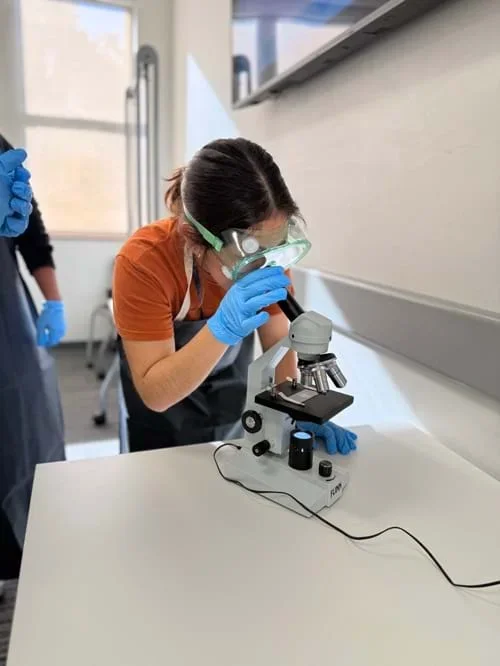 Student in protective gear views microplastics solution sample under microscope.Copyright Alexandra Hofferek, 2025
Improve (10 minutes)
- Ask students how they would improve their filter. Read slide 13.
- Have students answer how they would improve their filter in the “Improve Your Filter’ section of the Design Planning Worksheet (PDF).
- Optional: If time and extra materials are available, let each group improve their filter and retest.
Clean-up and Safety (10 minutes; slide 14)
- Ensure that students properly dispose of microplastics and filtered water.
- Have students clean all their equipment and return it to designated areas.
- Have students remove and put away their safety equipment.
- Make sure each group cleans their work area.
- Document any broken or depleted materials.
Day 3 (50 min)
Presentation and Conclusions (50 minutes)
- Hand out and/or review the Final Presentation Rubric (PDF) with the class.
- Give students 10 minutes to decide what they want to present for the following:
- Design explanation
- Data analysis
- Engineering design process
- Improvements
- Give each group time to share the following with the class:
- Brief description of their filter components and the layers
- Effectiveness of their filter
- Proposed improvements to their filter
- Lead a class discussion of the following:
- Compare different groups’ designs
- Identify effective filters and approaches
- Suggest potential improvements
- Discuss real-world applications
- Have students either:
- (Option 1) Answer the two final questions on the Design Planning Worksheet (PDF).
- (Option 2) Complete the Exit Ticket (PDF).
Note: Times are approximate and can be adjusted based on class period length. This activity can be extended over multiple sessions if needed. Ensure that proper safety protocols are followed throughout the activity, especially when handling water samples and microscope slides.
- microplastics
- Plastic particles less than 5 millimeters in length that can persist in the environment.
- filtration
- The process of passing a mixture through a device to remove solid particles from a fluid.
- engineering design process
- A series of steps used to solve problems and create solutions through design, testing, and improvement.
- prototype
- An early sample or model built to test a concept or process.
- control
- A standard of comparison for checking or verifying experimental results.
- cross-contamination
- The process by which bacteria or other microorganisms are unintentionally transferred from one substance or object to another.
- environmental impact
- The effect of human activities on the natural environment.
- water quality
- The chemical, physical, and biological characteristics of water, usually in respect to its suitability for a particular purpose.
Pre-Activity Assessment
(Option 1) Quick Write (10 minutes):
- Students respond to the prompt: "How might plastics affect human health?" in their Design Planning Worksheet (PDF). (5 minutes)
- Teacher leads a class discussion (5 minutes) (Example responses: Through food chain, drinking water contamination, toxic chemicals)
(Option 2) Think-Pair-Share Discussion (10 minutes):
- Teacher asks students: "What do you already know about plastics in the environment?"
- Students write individual responses (2 minutes).
- Students share with partner (3 minutes).
- Teacher leads a class discussion (5 minutes). (Expected responses: Plastics pollute oceans, take long time to decompose, harm animals)
Activity Embedded (Formative) Assessment
Engineering Design and Planning:
- Students document their initial filter design choices and reasoning in their Design Planning Worksheet (PDF), including a labeled diagram of the filter layers. They also explain material choices in their worksheet. (Teacher walks around to check understanding and provide feedback.)
Progress Monitoring Questions: Teacher circulates during the planning stage asking the following questions:
- Why did you choose this layer order?
- How will you measure effectiveness?
- What improvements could you make?
Post-Activity (Summative) Assessment
Final presentation: Student groups present and explain their filter design, data analysis, use of the engineering design process, and proposed improvements to the class. Teacher uses the Final Presentation Rubric (PDF) (100 points total) to assess student understanding.
(Optional) Exit Ticket: Students answer the following questions in their Exit Ticket (PDF):
- How do microplastics affect human health?
- Why is particle size important in filtration?
- What would you change about your design?
- Required safety equipment:
- Safety goggles must be always worn when handling water samples.
- Disposable gloves must be worn when handling materials and water samples.
- Lab aprons must be worn to protect clothing.
- Do not drink or taste any water samples (contaminated or filtered).
- Handle microscope slides and glassware carefully to prevent breakage.
- Clean up spills immediately to prevent slipping hazards.
- Wash your hands thoroughly after the activity.
Contributors
Alexandra Hofferek; Dr. Oara Neumann; Dr. Naomi Halas (Halas Lab Group, Rice University)
Supporting Program
Nanotechnology Research Experience for Teachers (Nano RET), Rice University
Acknowledgements
This curriculum was developed under National Science Foundation RET grant number NSF EEC-230212. Any opinions, findings, and conclusions or recommendations expressed in this material are those of the authors and do not necessarily reflect the views of the National Science Foundation.
Copyright
2025 by Regents of the University of Colorado; original © 2024 Rice University