
From Brain to Body: Engineering Body System Models
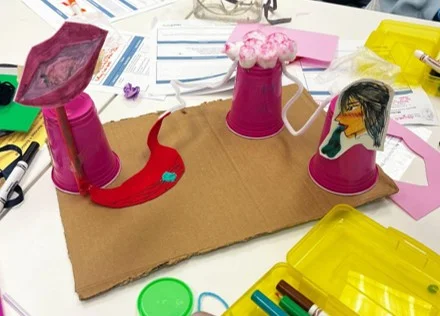 Creative student model showing how multiple body systems such as the digestive respond to a stimulus (spicy foods).Copyright Lizzie Gillespie
Students work in small groups to design and build a model illustrating how two or more body systems work together to detect and respond to a stimulus. Each group rolls dice to determine the body systems they will model and then selects a stimulus that involves those systems, such as stepping on a LEGO® brick, getting cold, or starting to run. Using simple materials such as paper, tape, string, and markers, students engineer a two- or three-dimensional model that demonstrates how signals travel between body systems to produce a response. Groups present their models to the class, explaining how the body systems communicate and interact. The activity promotes collaboration, creativity, systems thinking, and an understanding of how multiple body systems work together to maintain homeostasis.
Biomedical engineers apply engineering principles to understand how the body's systems work together and to develop technologies that improve human health. They study how the nervous system communicates with muscles, organs, and other body systems to sense stimuli and produce appropriate responses. Using this knowledge, biomedical engineers design devices such as prosthetic limbs, wearable health monitors, brain-computer interfaces, and rehabilitation robots that interact with the body's natural signaling pathways. Biomedical engineers analyze how information travels through the body and use that understanding to solve real-world medical and engineering challenges.
After this activity, students should be able to:
- Explain how two or more body systems work together to sense and respond to a specific stimulus to maintain homeostasis.
- Construct and communicate a physical model that illustrates system interactions and signal flow from detection to response.
- Apply the engineering design process to plan, build, and refine a model based on feedback and observed effectiveness.
- CCSS.Math.Content.HSF-IF.B Interpret functions that arise in applications in terms of the context
Grades 9-12
Do you agree with this alignment? - CCSS.Math.Content.HSF-IF.C.7 Graph functions expressed symbolically and show key features of the graph, by hand in simple cases and using technology for more complicated cases.
Grades 9-12
Do you agree with this alignment?
- STEL-7BB Implement the best possible solution to a design.
Grades 9-12
Do you agree with this alignment? - STEL-7Z Apply principles of human-centered design.
Grades 9-12
Do you agree with this alignment?
- HS-ETS1-2 Design a solution to a complex real-world problem by breaking it down into smaller, more manageable problems that can be solved through engineering.
Grades 9-12
This resource focuses on the following Three Dimensional Learning aspects of NGSS:
Science & Engineering Practices- Design a solution to a complex real-world problem, based on scientific knowledge, student-generated sources of evidence, prioritized criteria, and tradeoff considerations.Do you agree with this alignment?
Disciplinary Core Ideas- Criteria may need to be broken down into simpler ones that can be approached systematically, and decisions about the priority of certain criteria over others (trade-offs) may be needed.Do you agree with this alignment?
Do you agree with this alignment? - Design a solution to a complex real-world problem, based on scientific knowledge, student-generated sources of evidence, prioritized criteria, and tradeoff considerations.
- HS-LS1-3 Plan and conduct an investigation to provide evidence that feedback mechanisms maintain homeostasis.
Grades 9-12
This resource focuses on the following Three Dimensional Learning aspects of NGSS:
Science & Engineering Practices- Plan and conduct an investigation individually and collaboratively to produce data to serve as the basis for evidence, and in the design: decide on types, how much, and accuracy of data needed to produce reliable measurements and consider limitations on the precision of the data (e.g., number of trials, cost, risk, time), and refine the design accordingly.Do you agree with this alignment?
- Scientific inquiry is characterized by a common set of values that include: logical thinking, precision, open-mindedness, objectivity, skepticism, replicability of results, and honest and ethical reporting of findings.Do you agree with this alignment?
Disciplinary Core Ideas- Feedback mechanisms maintain a living system's internal conditions within certain limits and mediate behaviors, allowing it to remain alive and functional even as external conditions change within some range. Feedback mechanisms can encourage (through positive feedback) or discourage (negative feedback) what is going on inside the living system.Do you agree with this alignment?
Crosscutting Concepts- Feedback (negative or positive) can stabilize or destabilize a system.Do you agree with this alignment?
Do you agree with this alignment? - Plan and conduct an investigation individually and collaboratively to produce data to serve as the basis for evidence, and in the design: decide on types, how much, and accuracy of data needed to produce reliable measurements and consider limitations on the precision of the data (e.g., number of trials, cost, risk, time), and refine the design accordingly.
Each group needs:
- 5–10 sheets of paper (plain or colored, 21 × 29.7 cm / 8.5 × 11 in)
- 1 pair scissors
- 1 roll or bottle of tape or glue
- 6 ft. of string or yarn
- 2-4 markers or pen
- 2vdice of different colors
- Activity Worksheet (PDF), one per student
For the entire class to share:
- 1 laptop or tablet with projector to show Brain to Body Presentation (PDF)
- extra paper for brainstorming or sketches
- additional scissors and tape for backup
- whiteboard or chalkboard for modeling and discussion
- (optional) multimedia resources:
- YouTube video explaining body system interactions (8:49 minutes) https://youtu.be/BIH8Mof60wA?si=HKPBkDQ4NSxC0SPy
- Interactive diagram of human body systems (e.g., https://www.labxchange.org/library/items/lb:LabXchange:e40b2431:lx_simulation:1
Suggested building supplies available to the class:
- pom-poms
- cardstock paper
- sticky notes
- paperclips
- straws
- toothpicks
- binder clips
- balloons
- plastic cups
- aluminum foil
- pipe cleaners
- plastic baggie
- rubber bands
- cotton balls
- clothespins
Students should:
- Have a basic understanding of the major body systems, such as the nervous, muscular, circulatory, respiratory, and endocrine systems, as well as an understanding of how these systems work together to sense and respond to stimuli.
- Be familiar with feedback and response mechanisms such as reflexes and homeostasis.
- Be able to communicate their ideas clearly through drawing, labeling, or simple modeling, along with foundational engineering or design-thinking skills that allow them to plan and build models using simple materials to represent biological systems.
Today, we are going to explore how your body responds to the world around you by looking at how your body’s systems sense a change and then respond. But instead of just learning about these processes, you'll become engineers and build a model that demonstrates them.
Let’s start with something real. Think about a time when you stepped on a LEGO brick, accidentally touched a hot stove, or got really cold outside. What happened in your body? How did it react? What happened in your body? How did it react? (Ask students to share a few responses. Write key systems on the board: nervous, muscular, circulatory, etc.)
When something happened, your nervous system noticed the stimulus, sent signals, and then other systems, such as your muscles or skin, responded. That’s what we’re going to model today. You’ll work in groups to design a mini model showing two or more body systems responding to a stimulus.
Some responses happen automatically without thinking, like pulling your hand away from a hot stove. This is called a reflex. Other responses are voluntary, like deciding to pick something up or start running. Today, as you build your model, think about whether your response is reflexive or voluntary, and how that changes the pathway in the body. (Show example stimulus options: “You step on a LEGO brick,” “You start running,” “You get cold.”)
Each group will roll two dice, and the numbers rolled will correspond to specific body systems listed on Slide 16 of the Brain to Body Presentation. The two systems you land on will be the focus of your model. You will then create a stimulus of your choice that impacts both systems.
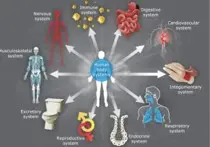 Figure shows 10 different body systems throughout the human body.Copyright ScienceLearn.org
(Show provided materials: paper, scissors, tape, string, markers.) Using only the provided materials, you will work in groups to design a model that demonstrates how the stimulus affects the two body systems and how signals are transmitted between them.
As we work, we want to ask ourselves: How does the body sense the stimulus? Which systems get involved? What is the response? Could your model show it clearly to someone else?
We also want to ask ourselves:
- If you touched something hot, how fast do you think the signal travels through your body?
- Which systems must work together to help you react safely?
- Have you noticed your body responding to something without thinking? Why might that happen?
- How could you represent this interaction in a simple model?
Remember, your model can be 2D or 3D, but the goal is to communicate clearly how the body senses and responds. Be creative, but also make sure it’s accurate!
You’ll have about 30 minutes to build your models. After that, each group will share their work in just 30 seconds. We’ll celebrate both accuracy and creativity. Let’s get ready to start thinking like biologists and engineers!
Background
This activity focuses on how body systems interact to sense and respond to environmental stimuli, illustrating the concept of systems working together to maintain homeostasis. Students model signal transmission between systems, such as the nervous system detecting a stimulus and the muscular system producing a response.
The Human Body as an Integrated System
The human body is composed of multiple organ systems that work together to maintain life and respond to changes in both the internal and external environment. Rather than functioning independently, body systems communicate continuously to maintain homeostasis.
Homeostasis
Homeostasis is the process by which the body maintains relatively stable internal conditions despite changes in the external environment. Examples include maintaining body temperature, blood glucose levels, hydration, and oxygen levels. Many body responses, including sweating, shivering, changes in heart rate, and changes in breathing rate, are homeostatic responses designed to keep the body functioning properly.
The Nervous System
The nervous system serves as the body's communication network. Specialized sensory receptors detect stimuli and convert them into electrical signals. These signals travel through sensory neurons to the spinal cord and brain, where the information is processed. The brain or spinal cord then sends signals through motor neurons to muscles or glands, producing a response. Most nerve impulses travel in milliseconds, allowing the body to react very quickly to changing conditions.
Reflexes Versus Voluntary Responses
A reflex is a rapid, automatic response to a stimulus that is coordinated primarily by the spinal cord rather than the brain. Reflexes help protect the body from injury by reducing reaction time. For example, when someone touches a hot surface, sensory neurons immediately send information to the spinal cord, which quickly activates motor neurons to pull the hand away before the brain fully processes what happened.
A voluntary response, on the other hand, requires the brain to process information before deciding how to act. Choosing to begin running after hearing a whistle or picking up an object are examples of voluntary responses.
Body Systems Working Together
Although the nervous system coordinates communication, successful responses require multiple body systems to work together. Examples include:
- Nervous + Muscular Systems: Detecting a painful stimulus and moving away.
- Nervous + Integumentary Systems: Detecting temperature, pressure, or pain through receptors in the skin.
- Nervous + Circulatory Systems: Adjusting blood flow to help regulate body temperature.
- Nervous + Respiratory Systems: Increasing breathing rate during exercise.
- Nervous + Endocrine Systems: Releasing hormones that help regulate longer-term body responses.
Students should recognize that many everyday actions involve several interacting systems rather than a single body system acting alone.
Before the Activity
- Gather materials for each group.
- Set up a display area for completed models to be shared.
- Ensure students have appropriate prior knowledge of body systems, signal pathways, and basic interactions.
- Optional: Prepare an Example Model: Before the activity, create a simple sample model using the provided materials (paper, string, markers, etc.) to demonstrate the type of representation students will create. For example, model the response to touching a hot stove by drawing and labeling the hand, spinal cord, and brain, and using string to represent the pathway of the nerve signal. The model should clearly illustrate the sequence stimulus → sensory input → signal transmission → response, and may indicate whether the response is reflexive or voluntary. Note: Keep the example simple and brief. Its purpose is to provide a visual reference that helps students understand expectations for accurate labeling, clear signal pathways, and how multiple body systems interact, rather than serving as a model for students to copy exactly.
During the Activity
Part 1: Introduction (20 minutes)
- Distribute one Activity Worksheet (PDF) to each student.
Think-Pair-Share
- Display the question on Slide 2 of the Brain to Body Presentation (PDF).
- Give students 2-3 minutes to answer the Warm-up Question on their worksheet: What sense (smell, taste, sight, touch, hearing) do you think warns you the fastest when something is dangerous? Defend your answer.
- Allow students 2-3 minutes to discuss their answers with their shoulder partners.
- Review the Think-Pair-Share question and responses as a class. Potential answers:
- Touch: Can warn you the fastest because skin receptors connect directly to the nervous system and can trigger a reflex. For example, touching a hot surface causes your hand to pull away before you consciously think.
- Sight: Helps detect danger before physical contact, such as seeing an approaching car or noticing a fire.
- Hearing: Alerts you to dangers you cannot see, such as a loud crash or someone shouting a warning.
Engage Students With Real-World Scenarios
- Present several real-world scenarios (e.g., stepping on a LEGO brick, touching a hot surface, feeling very cold) and for each scenario ask students:
- Which body systems are involved?
- How do the signals travel through your body?
- Guide the discussion using the following examples:
- Stepping on a LEGO brick: Skin receptors detect pain, sensory neurons send signals to the spinal cord and brain, and motor neurons activate muscles to pull the foot away (reflex followed by voluntary movement).
- Touching something hot: Heat receptors detect the stimulus and send signals to the spinal cord, which immediately activates muscles to withdraw the hand (reflex action).
- Feeling cold: Temperature receptors send signals to the brain, which triggers responses such as shivering (muscular system) and changes in blood flow (circulatory system) to maintain homeostasis.
Introduce the Challenge
- Display Slide 3 of the Brain to Body Presentation (PDF).
- Introduce the engineering challenge: Today, you will engineer a mini model that demonstrates how body systems work together to sense and respond to a stimulus.
- Briefly go over the learning objectives with the class.
- Introduce the available building materials.
- Explain that successful models should accurately represent body system interactions while demonstrating creativity. (Emphasize that the goal is accuracy and creativity.)
- Optional: Display an example model, pointing out the various components.
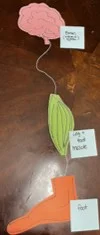 An example of the activity utilizing paper for organs.Copyright Elizabeth Gillespie
Part 2: Hand Slap Game (10 minutes)
- Pair each student with a nearby classmate.
- Distribute one sticky note to each pair and instruct students to crumple it into a small ball.
- Have students place the crumpled sticky note on a table or desk between them.
- Instruct each pair to decide who will use the upper hand and who will use the lower hand during the game.
- Demonstrate the activity before students begin. (See Slide 4 in the Brain to Body Presentation (PDF).)
- Allow students to play several rounds, encouraging them to switch hand positions after each round.
- Lead a class discussion by asking:
- Which hand position seemed to win more often?
- Why do you think the curved (upper) hand often has an advantage?
- What body systems were involved in this activity?
- Display Slide 5 and discuss how the game works.
(Optional) Part 3: Mini Body Systems Lecture (15 minutes)
- Using Slide 6-12 of the Brain to Body Presentation (PDF), explain:
- How messages travel through the nervous system (Slides 5-6).
- Homeostasis (Slide 8).
- Stimuli (Slide 9).
- Responses (Slide 10).
- Body systems (Slides 11-12).
- Show students examples of real-world scenarios (Slides 13-14).
Part 4: Model Construction (30 minutes)
- Display Slides 15 and 16.
- Divide the class into groups of three or four students.
- Have each group assign team roles (e.g., designer, builder, labeler, and presenter).
- Have each group answer the “Before You Build” question in their Activity Worksheet (PDF).
- Explain how the activity will work:
- Each group will roll both dice to determine the body systems they will include in their model (Slide 17).
- Each group will have 30 minutes to brainstorm, design, and construct a two-dimensional or three-dimensional model demonstrating how the selected body systems detect and respond to a stimulus.
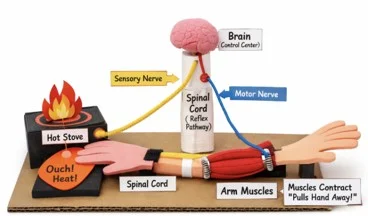 A model of the nervous and muscular system working together to respond to touching a hot stove.Copyright Elizabeth Gillespie
- Instruct students to begin by brainstorming ideas for their stimulus in the “Brainstorm the Model” section of their Activity Worksheet (PDF) (Slide 18).
- Once students complete the brainstorming section, have them create a simple sketch in the “Plan the Model” section of their Activity Worksheet (PDF).
- Instruct groups to build a model that:
- Represents the assigned body systems using labeled drawings or paper cutouts (e.g., the brain, muscles, lungs, or skin).
- Uses string or another material to illustrate the pathway of nerve signals between body systems.
- Clearly labels each body system and the direction of signal flow.
- Demonstrates the sequence stimulus → sensory input → signal transmission → response.
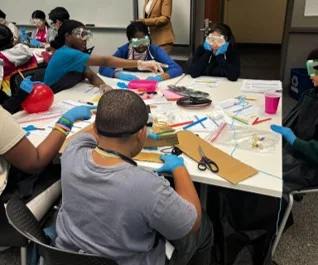 Students working in groups to design and construct body system response models.Copyright Lizzie Gillespie
- Circulate throughout the classroom, providing guidance and asking questions such as:
- Which body system first detects the stimulus?
- How does the signal travel through the body?
- Which body system produces the response?
- How could you improve your model to make the signal pathway clearer or more accurate?
- Distribute construction materials (paper, string, tape, markers, scissors, and other available supplies) when each group has a plan.
- Give groups the rest of the time to construct their model.
- Optional: If time allows, have students test their model and make improvements.
Creative student model showing how multiple body systems such as the digestive respond to a stimulus (spicy foods).Copyright Lizzie Gillespie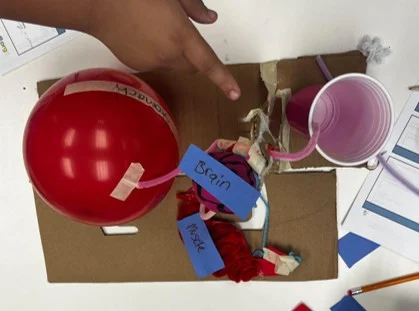 Example of a student-built model demonstrating system interaction and labeling.Copyright Lizzie Gillespie
Part 5: Model Presentations and Discussion (20 minutes)
- Invite each group to present its model in approximately 30–60 seconds (Slide 19).
- Instruct each group to:
- Identify the stimulus.
- Describe the body systems involved.
- Explain how signals travel between the systems.
- Describe the body's response.
- Explain how their model represents communication between body systems.
- Encourage classmates to ask questions and provide constructive feedback after each presentation (Slide 20).
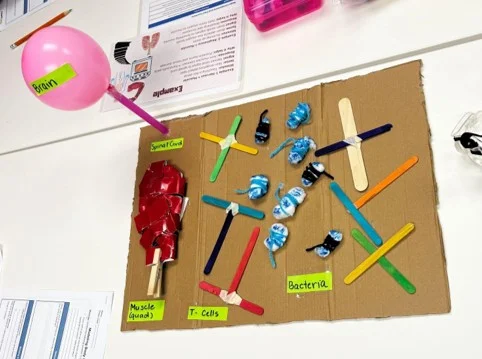 Student model illustrating interactions between the nervous, muscular, and immune systems in response to a stimulus.Copyright Lizzie Gillespie
- If desired, have students vote on categories such as:
- Most accurate model
- Most creative model
- Best overall representation
Part 6: Reflection and Wrap-Up (10 minutes)
- Lead a class discussion by asking the following questions (Slide 21).
- How did the model help your understanding?
- What surprised you?
- How is the body like an engineered system?
- Why are multiple systems needed?
- Direct students to complete the exit ticket on their Activity Worksheet (PDF) by answering the following prompt: Name two body systems that worked together in your model and explain how they responded to the stimulus.
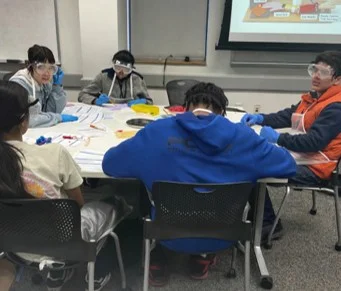 Students reflecting on the activity.Copyright Lizzie Gillespie
- Conclude the activity by emphasizing that the human body functions as an integrated system in which multiple body systems continuously communicate to detect stimuli, maintain homeostasis, and produce coordinated responses.
- nervous system
- The complex network of organs, tissues, and cells that controls and coordinates all bodily functions.
- muscular system
- The complex network of tissues and organs that work together to enable movement, maintain posture, and support bodily functions.
- circulatory system
- The system that circulates blood and lymph through the body.
- respiratory system
- The network of organs and tissues that work together to facilitate breathing and gas exchange.
- endocrine system
- The network of glands and organs that produce and secrete hormones, which are the body’s chemical messengers.
- integumentary system
- The body’s outer covering, consisting of the skin, hair, nails, and glands.
- digestive system
- A group of organs that break down food into nutrients for energy, growth, and repair, while also eliminating waste.
- stimulus
- A thing or event that evokes a specific functional reaction in an organ or tissue.
- response
- A reaction to something.
- signal
- An electrical impulse or radio wave transmitted or received.
- reflex
- An action that is performed as a response to a stimulus and without conscious thought.
- homeostasis
- The body's physical and emotional reaction to a perceived threat or pressure.
- organelle
- A specialized part of a cell that performs a specific function, like a tiny organ within the cell.
Pre-Activity Assessment
Body Systems Brainstorm: Begin the activity with a brief class discussion. Ask students to think about a time when their body reacted automatically, such as touching something hot, getting cold, or running. Which body systems were involved, and how did they work together? Have students list the systems they think were involved and explain briefly how they worked together. Record student responses on paper or a whiteboard; this allows you to quickly gauge understanding and clarify misconceptions before starting the activity.
Activity Embedded (Formative) Assessment
Model Checkpoints: As students brainstorm, design, and construct their models, circulate throughout the classroom and monitor their progress. Ask guiding questions such as:
- Which body systems are involved in your scenario?
- Which body system first detects the stimulus?
- How does the signal travel between the body systems?
- Which body system produces the response?
- How could you improve your model to make the signal pathway clearer?
Review students' planning sketches and partially completed models to ensure students are accurately representing system interactions before construction is complete.
Post-Activity (Summative) Assessment
Group Presentations: Each group has 30 seconds to explain their stimulus scenario, which systems responded, and how the model shows signal transmission. You and the students’ peers ask questions for clarification.
Note: The presentation is not scored in a particular way, just a scale of 1-10, depending on each student’s perspective of the other group’s project.
Exit Ticket: Students individually answer the following exit questions in their Activity Worksheet (PDF):
- Name two body systems that worked together in your model and explain how they responded to the stimulus.
- How did building a model help you understand how body systems interact?
Evaluate individual exit tickets to determine whether students can accurately explain how multiple body systems detect stimuli, communicate through the nervous system, and work together to produce coordinated responses.
- Students are unsure which body systems respond to the stimulus: Provide students with a body systems reference chart or diagram and ask guiding questions such as “Which system first detects the stimulus?” and “Which system produces the response?”
- Models become overly complex: Encourage groups to sketch a plan before building and focus on accurately representing two or three interacting body systems rather than including unnecessary details.
- Construction materials run low: Prepare extra supplies before the activity, including pre-cut pieces of string (approximately 6 ft long), paper, tape, and markers, to minimize interruptions.
- Groups struggle with collaboration: Assign or reinforce specific team roles (for example, designer, builder, labeler, and presenter) and periodically check in with groups to ensure all students are participating.
- Models are unstable or fall apart: Encourage students to securely attach components with tape or glue and periodically test that signal pathways and labels remain intact as construction progresses.
- The activity takes longer than expected: Set periodic time reminders during model construction. If necessary, shorten the presentation or discussion portion while ensuring each group has an opportunity to briefly explain its model.
- Have students compare how different stimuli (such as heat, cold, sound, or pressure) activate different combinations of body systems and explain the similarities and differences.
- Challenge students to investigate a disease or medical condition that disrupts communication between body systems (such as Parkinson's disease, multiple sclerosis, diabetes, or spinal cord injuries) and modify their models to demonstrate how the condition affects normal body function.
- Ask students to write a short engineering report describing their design process, explaining why they selected their model components, and justifying how their model accurately represents communication between body systems.
- Integrate mathematics by having students measure reaction times during the Hand Slap Game, calculate class averages, compare results, or determine the proportion of body systems involved in different stimulus-response scenarios.
- Extend the engineering connection by having students compare the human body's stimulus-response system with an engineered system, such as a robot, self-driving vehicle, or automated safety system, identifying similarities in sensing, signal processing, and response.
- Simplify the activity:
- Assign students a specific stimulus and body systems rather than having them roll the dice. Provide a partially completed model or template to help students focus on identifying the stimulus-response pathway.
- Assign fewer body systems or provide the stimulus rather than having students generate one.
- Provide pre-labeled organ or body system templates for students who need additional support with model construction.
- Allow additional brainstorming and planning time before students begin building their models.
- Pair groups that need extra support with stronger peer groups or provide more frequent guidance during the design process.
- Increase the challenge:
- Require students to model interactions among three or four body systems instead of two. Have students include signal timing (e.g., comparing a reflex response to a voluntary response) or illustrate multiple nerve signal pathways within their models.
- Add quantitative analysis: Have students collect and analyze simple data, such as measuring reaction times during the Hand Slap Game or recording the sequence of events from stimulus detection to response.
Marzvanyan A, Alhawaj AF. Physiology, Sensory Receptors. [Updated 2023 Aug 14]. In: StatPearls [Internet]. Treasure Island (FL): StatPearls Publishing; 2025 Jan-. Available from: https://www.ncbi.nlm.nih.gov/books/NBK539861.
“NCI Dictionary of Cancer Terms.” Comprehensive Cancer Information - NCI, www.cancer.gov/publications/dictionaries/cancer-terms/def/mitochondria. Accessed 17 Oct. 2025.
TeachShare, www.teachshare.com. Accessed 31 Oct. 2025.
Contributors
Lizzie Gillespie, Eric Barrett, Mariana Quinn, Isiasia Cerda, Tianyi Xie, Dr. Laura Segatori
Supporting Program
Research Experience for Teachers (RET), Rice University Office of STEM Engagement
Acknowledgements
This curriculum was developed under National Science Foundation RET grant number NSF EEC-2302127. Any opinions, findings, and conclusions or recommendations expressed in this material are those of the authors and do not necessarily reflect the views of the National Science Foundation.
Copyright
2026 by Regents of the University of Colorado; original © 2025 Rice University