
Are You Feeling Neutralized? Design a Neutralization Water Filter
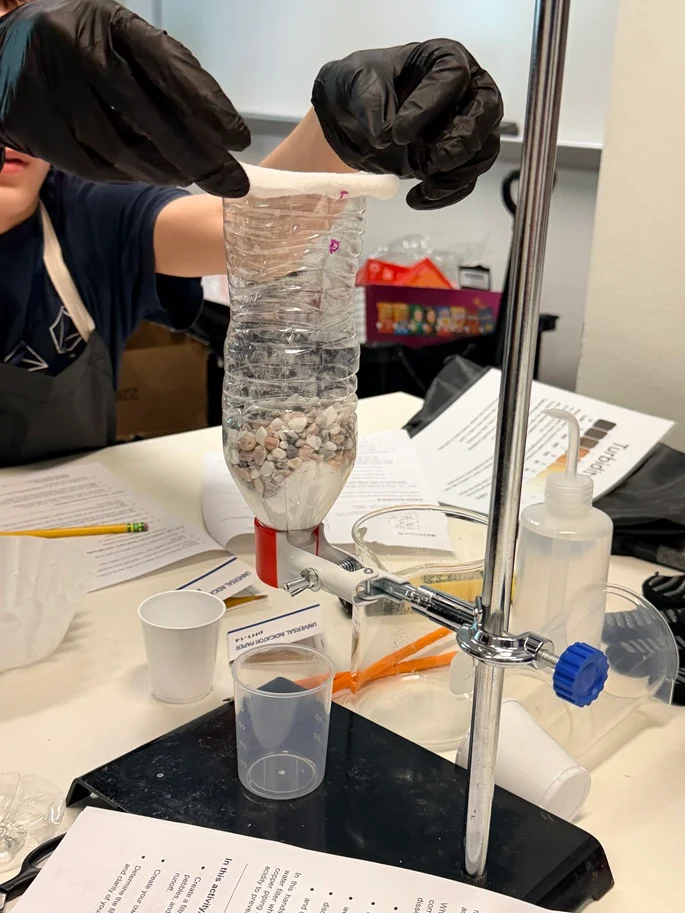 A student building their bottle filter.Copyright 2026 Duane Turner, R-STEM Academy, Rice University
Students act as environmental engineers to design and build a water filtration system that removes contaminants and neutralizes simulated acidic runoff. Working in teams, students plan and construct a filter using a variety of filtration and neutralizing materials. Students create simulated contaminated water to model acidic runoff and investigate its effects on water quality and copper corrosion. They evaluate the water before and after filtration by measuring pH and turbidity, calculating flow rate, and observing evidence of copper corrosion. Students use their results to determine how effectively their filters improve water quality, reduce acidity, maintain an acceptable flow rate, and potentially reduce corrosion. As time permits, students analyze their results, identify opportunities for improvement, redesign their filters, and conduct additional testing to evaluate their modifications.
Environmental, mechanical, chemical, and waste management engineers must consider pH when designing and managing water treatment and filtration systems to help prevent corrosion of pipes and plumbing caused by acidic water. Acidic water can corrode materials containing metals such as lead, copper, and zinc, potentially causing these metals to leach into the water supply. By incorporating neutralizing components into water treatment systems, engineers can help maintain appropriate pH levels, improve water quality, reduce corrosion, and extend the lifespan of pipes and other infrastructure.
After this activity, students should be able to:
- Describe how acid rain forms and explain how acidic water can affect the environment, water systems, and metal infrastructure.
- Explain how filtration materials can be used to remove contaminants and improve water clarity.
- Describe how acidic water can contribute to copper corrosion and identify observable evidence of corrosion.
- Explain how neutralization can change the pH of an acidic solution and apply this concept when designing a water filtration and neutralization system.
- CCSS.Math.Content.HSN-Q.A.1 Use units as a way to understand problems and to guide the solution of multi-step problems; choose and interpret units consistently in formulas; choose and interpret the scale and the origin in graphs and data displays.
Grades 9-12
Do you agree with this alignment? - CCSS.Math.Content.HSN-Q.A.2 Define appropriate quantities for the purpose of descriptive modeling.
Grades 9-12
Do you agree with this alignment? - CCSS.Math.Content.HSN-Q.A.3 Choose a level of accuracy appropriate to limitations on measurement when reporting quantities.
Grades 9-12
Do you agree with this alignment?
- STEL-7AA Illustrate principles, elements, and factors of design.
Grades 9-12
Do you agree with this alignment? - STEL-7CC Apply a broad range of design skills to their design process.
Grades 9-12
Do you agree with this alignment? - STEL-7Y Optimize a design by addressing desired qualities within criteria and constraints.
Grades 9-12
Do you agree with this alignment?
- HS-ETS1-2 Design a solution to a complex real-world problem by breaking it down into smaller, more manageable problems that can be solved through engineering.
Grades 9-12
This resource focuses on the following Three Dimensional Learning aspects of NGSS:
Science & Engineering Practices- Design a solution to a complex real-world problem, based on scientific knowledge, student-generated sources of evidence, prioritized criteria, and tradeoff considerations.Do you agree with this alignment?
Disciplinary Core Ideas- Criteria may need to be broken down into simpler ones that can be approached systematically, and decisions about the priority of certain criteria over others (trade-offs) may be needed.Do you agree with this alignment?
Do you agree with this alignment? - Design a solution to a complex real-world problem, based on scientific knowledge, student-generated sources of evidence, prioritized criteria, and tradeoff considerations.
- HS-ETS1-3 Evaluate a solution to a complex real-world problem based on prioritized criteria and trade-offs that account for a range of constraints, including cost, safety, reliability, and aesthetics, as well as possible social, cultural, and environmental impacts.
Grades 9-12
This resource focuses on the following Three Dimensional Learning aspects of NGSS:
Science & Engineering Practices- Evaluate a solution to a complex real-world problem, based on scientific knowledge, student-generated sources of evidence, prioritized criteria, and tradeoff considerations.Do you agree with this alignment?
Disciplinary Core Ideas- When evaluating solutions it is important to take into account a range of constraints including cost, safety, reliability and aesthetics and to consider social, cultural and environmental impacts.Do you agree with this alignment?
Crosscutting Concepts- New technologies can have deep impacts on society and the environment, including some that were not anticipated. Analysis of costs and benefits is a critical aspect of decisions about technology.Do you agree with this alignment?
Do you agree with this alignment? - Evaluate a solution to a complex real-world problem, based on scientific knowledge, student-generated sources of evidence, prioritized criteria, and tradeoff considerations.
- Science concepts. The student can quantify the changes that occur during chemical reactions. The student is expected to:
Grades 10-12
Do you agree with this alignment?
Each group needs:
- 1 internet-enabled computer or laptop
- 1 500 mL water bottle (label removed)
- 1 “small” beaker (100-150 ml)
- 1 “large” beaker (400-500 ml)
- 1 ring stand with clap (if not available, have partner hold bottle/filter device)
- 1 thermometer
- 1 ruler
- 1 pair of scissors
- 1 marker
- 6-7 small portion cups (for example, mouthwash or condiment cups)
- heat-mitts or beaker tongs
- 2 pennies
- 2-3 pH strips of universal pH paper (with pH color chart) or 1 pH meter (Note: pH meters are more accurate than pH paper to measure more specific pH values, but they are also more expensive to acquire in bulk. If pH meters are more desirable, an option could be to have multiple student pairs share.)
Class Shared Materials (Based on 10 pairs of students; 20 students total)
- 1 internet-enabled computer or laptop with projector
- 2 cups** of baking soda (amount should support each student pair getting up to 5 spoonfuls of each of these materials)
- 2 cups of antacid tablets (pre-crushed)
- 1.5 L of 5% citric acid solution (5% volume solution = 200 g dissolved in 1 gallon of distilled water)
- 1.5 L of 5% vinegar solution
- 1.5 L of 3% hydrogen peroxide
- 2 cups of organic material (twigs, leaves, soil)
- hot plates (at least one per two student pairs)
- heat mitts or beaker tongs
- pens (not only to write with, but to place holes in bottle cap)
- 8-10 plastic teaspoons (to be placed in the bowls where students can pick up spoonfuls (scoops) of selected material and place it in their small portion cups)
Filtration Materials for Entire Class to Choose From (Note: This is based on 10 pairs of students; 20 students total. List can be shortened or added to as desired or budgeted.)
- 10 coffee filters
- 10 pieces of cloth (up to 3 in x 3 in)
- 1 bag of cotton balls
- 10 pieces of gauze material (up to 3 in x 3 in)
- 10 pieces of sponge material (up to 3 in x 3 in)
- 2 cups** of large rocks (e.g., fish tank pebbles)
- 2 cups of small rocks (e.g., gravel size)
- 2 cups of activated charcoal
- 2 cups of sand
- 2 cups of rice
- 1 paper towel roll
** This amount should support each student pair getting up to 5 spoonfuls of each of these materials.
- Are You Feeling Neutralized? Presentation (pptx)
- Are You Feeling Neutralized? Presentation (pdf)
- Are You Feeling Neutralized? Activity Sheet (docx)
- Are You Feeling Neutralized? Activity Sheet
- Product Quality Rubric (docx)
- Product Quality Rubric (pdf)
- Product Quality Rubric Example Answers (docx)
- Product Quality Rubric Example Answers (pdf)
- Activity Follow-Up Questions (docx)
- Activity Follow-Up Questions (pdf)
- Activity Follow-Up Questions Answer Key (docx)
- Activity Follow-Up Questions Answer Key (pdf)
- Anticipatory Set: What Do You Know About Water, Pollution & Engineering (docx)
- Anticipatory Set: What Do You Know About Water, Pollution & Engineering? (pdf)
- Anticipatory Set: What Do You Know About Water, Pollution & Engineering Answer Key (docx)
- Anticipatory Set: What Do You Know About Water, Pollution & Engineering? Answer Key (pdf)
- Bottle Filter Sketch Diagram (docx)
- Bottle Filter Sketch Diagram (pdf)
- Turbidity Chart
Students should have prior knowledge of elements, the periodic table, and chemical compounds.
Imagine living in a small town in the northeastern United States that has suddenly begun to grow. New industrial plants and mining operations have brought in jobs, businesses, and new families. At first everything seems great, but then the complaints start rolling in. People are turning on their faucets and noticing that the water tastes metallic. Some say it has a strange color. Residents are beginning to wonder: What’s happening to our water?
Today, you will step into the role of engineers facing this real-world challenge. When a community’s water supply begins to change, there are many possible causes. Scientists and engineers investigate these problems by collecting evidence and measuring characteristics of the water to determine what might be happening.
One important measure of water quality is pH, which tells us how acidic or basic a solution is. If water becomes too acidic, it can react with metal pipes and plumbing. Over time, this corrosion can damage pipes and cause metals such as copper to enter the water. But what could cause water in the environment to become more acidic?
One possible source is acid rain. Air pollutants such as sulfur dioxide and nitrogen oxides can react with water and other substances in the atmosphere to form acids. When acidic precipitation reaches the ground, it can affect lakes, streams, soils, and other water systems.
So, how could engineers treat acidic, contaminated water while also reducing its potential to corrode metal pipes?
In this activity, you and your partner will work as a team of chemical and environmental engineers to design, build, and test a water filtration and neutralization system. Using common materials, you will create a filter designed to remove contaminants and reduce the acidity of simulated polluted water. You will also create a simulated contaminated acid rain (SCAR) water sample to test your design.
You will evaluate your filter by examining water clarity, measuring pH and flow rate, and observing whether the filtered water causes copper corrosion. Your challenge is to use the evidence you collect to determine how well your design works and how you could improve it.
Background
Understanding the Acidification Water (the Production of “Acid Rain”)
Industrial plant facilities can exhaust various waste gases such as sulfur dioxide, carbon dioxide, and nitrogen dioxide into the air. These gases can combine with moisture in the air to produce acidic vapor products. This moisture can then collect in rain clouds and precipitate back to the surface as rainwater, otherwise known as acid rain. In places where there are mountains, rivers, and large bodies of water, acid rain can produce runoff that contaminates natural waterways and local water supplies (see diagram below). It can also cause damage and death to plant life in a given area, further demonstrating the environmental concerns associated with acid rain.
Diagram 1: Acid Rain Formation
Industrial Emissions
(SO₂, NO₂, CO₂)
↑
| combine with moisture
|
Clouds with
acidic droplets
↓
Acid Rain
↓
Runoff into rivers
and water systems
As a specific health concern for communities encountering acid rain, acidic water can cause corrosion of certain types of metal piping. Acidic water can leach or remove copper (and other heavy metals) from pipes, which causes the water to develop a metallic taste and a bluish‑green discoloration. These conditions can create health risks such as nausea and stomach cramping when such water is consumed.
What Is an Acid?
Acids are formed by compounds that contain or release a large amount of hydrogen ions (H⁺) when dissolved in water. Acidic compounds are often noted for having a sour taste, reactivity with metals, and the ability to cause corrosion. Very strong acids can even dissolve organic materials. Common everyday acids include citric acid (found in oranges, lemons, and limes), vinegar (acetic acid), soda (carbonic and phosphoric acids), stomach acid (hydrochloric acid), and car battery acid (sulfuric acid).
The strength of an acid is determined using the pH scale, also known as the “power of hydrogen” scale. The pH scale is logarithmic, meaning each change of one unit represents a tenfold change in hydrogen ion concentration. Acids have pH values ranging from 0 to 6, with a pH of 7 considered neutral. For example, a solution with a pH of 4 contains 1,000 times more hydrogen ions than a solution with a pH of 7.
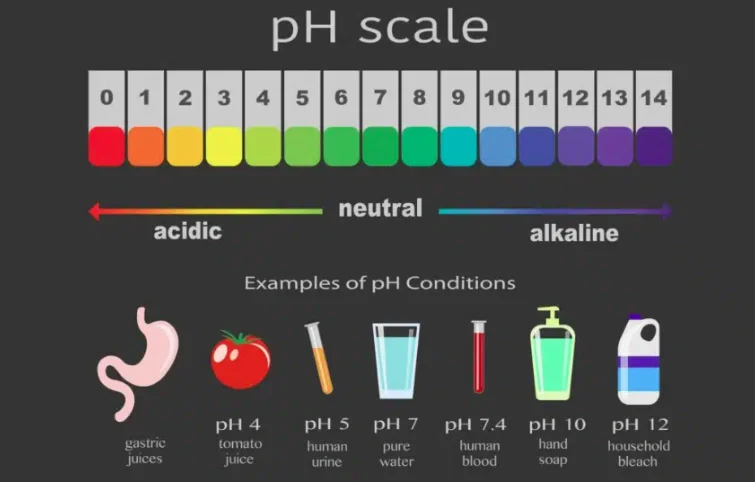 The pH scale and the pH values of common substances.Copyright 2003-2026 Shutterstock, Inc. https://www.shutterstock.com/image-vector/scale-ph-value-acid-alkaline-solutions-2041229438
What Is a Base?
While acids increase the concentration of hydrogen ions in a solution, bases reduce hydrogen ion concentration or release hydroxide ions (OH⁻). Bases are often described as alkaline substances and are known for their bitter taste and slippery feel. Bases occupy the opposite end of the pH scale from acids, with pH values ranging from 8 to 14.
Just like acids, the pH scale for bases is logarithmic. A solution with a pH of 10 is ten times more basic than a solution with a pH of 9. Common examples of bases in everyday life include baking soda (sodium bicarbonate), soap, detergents, bleach, ammonia‑based cleaners, and antacid tablets such as calcium carbonate. Natural basic materials include limestone, chalk, and crushed shells.
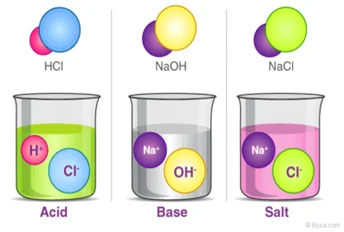 Basic molecular comparison of an acid, base, and salt.Copyright Byjus.com https://byjus.com/chemistry/acids-bases-salts
Acid–Base Neutralization
When an acid and a base come into contact, a chemical process called neutralization occurs. During this process, hydrogen ions (H⁺) from the acid react with hydroxide ions (OH⁻) from the base to form water (H₂O). This reaction reduces acidity and shifts the pH of the solution closer to neutral.
Example Neutralization Equation:
Acid + Base → Salt + Water
HCl (aq) + NaOH (aq) → NaCl (aq) + H₂O (l)
Neutralization at the Particle Level:
H⁺ + OH⁻ → H₂O
(acid) (base) (water)
In environmental systems, neutralization can occur naturally when acidic rainwater flows over basic rocks and soil. However, when acid levels are too high, engineered solutions are required to protect water quality.
Neutralization Filters
A neutralization filter is a system designed to raise the pH of acidic water by passing it through basic materials. These materials often include calcium carbonate, limestone, magnesium oxide, or similar alkaline substances. As acidic water flows through the filter, neutralization reactions occur, reducing the acidity of the water.
Engineers use neutralization filters in water treatment plants, industrial wastewater systems, and residential well systems. These filters help prevent corrosion in pipes, reduce the release of heavy metals, and improve overall water safety.
Engineering Connection: Water Filter Design
Environmental and chemical engineers design neutralization systems by considering factors such as flow rate, contact time, material cost, and effectiveness. The same principles apply to classroom engineering challenges, where students design filters to improve water quality.
Below is a simplified filtration diagram that aligns with a student water‑filter engineering activity:
Diagram 2: Example Neutralization Filter Concept
Acidic Water In
↓
-------------------
|Gravel Layer |
-------------------
|Filter Media | ← cloth / coffee filter
-------------------
|Neutralizing | ← limestone, chalk, baking soda
|Material |
-------------------
↓
Treated Water
(Higher pH, safer)
Before the Activity
Prepare Student Materials
- Make copies of the following student documents:
- Are You Feeling Neutralized? Activity Sheet (PDF)(1 per student pair)
- Anticipatory Set: What Do You Know About Water, Pollution & Engineering? (PDF) (1 per student)
- Bottle Filter Sketch Diagram (PDF) (1 per student pair)
- Product Quality Rubric (PDF) (1 per student pair).
- Activity Follow-Up Questions (PDF) (1 per student or as needed for student reflection and evaluation)
- Turbidity Chart (1 per student pair or several copies for groups to share.) Note: Print the Turbidity Chart in color, if possible, so students can distinguish subtle differences in turbidity. Consider laminating copies for repeated use.
- To reduce printing, consider printing the Bottle Filter Sketch Diagram (PDF) and Product Quality Rubric (PDF) two pages per sheet in landscape orientation.
Gather and Prepare Filter Materials
- Gather at least two 500 mL plastic water bottles with caps per student pair. Bottles should be approximately 8 in (20.3 cm) tall and 2.5 in (6.35 cm) in diameter. Alternatively, ask students to bring appropriate bottles from home.
- Gather the filtration materials listed in the Materials List. Materials may be modified based on availability, and additional filtration materials may be provided as desired.
- Place loose filtration materials in approximately 20 oz plastic or foam bowls at a central materials station (see Image 3).
- Label each filtration material using a notecard, label, or strip of tape.
- Place a plastic spoon in each container of granular material so students can measure their allotted quantities.
- Arrange continuous materials, such as cloth, gauze, coffee filters, and sponge pieces, in labeled stacks.
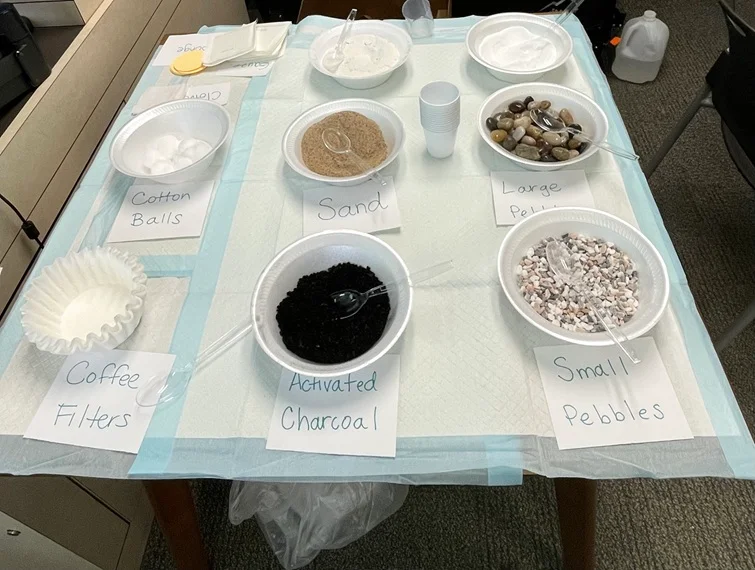 Various filter materialsCopyright 2026 Duane Turner, R-STEM Academy, Rice University
Prepare the Neutralizing Agents
- Place baking soda (sodium bicarbonate) in a labeled bowl or large beaker.
- Crush the antacid tablets containing calcium carbonate into a fine powder using a mortar and pestle. If a mortar and pestle is not available, crush the tablets in a durable container or bag using an appropriate blunt tool.
- Prepare enough crushed calcium carbonate for all groups. Approximately 2 cups of crushed antacid tablets should be sufficient for six groups, depending on the amount students are permitted to use.
- Place the crushed calcium carbonate in a labeled bowl or large beaker at the materials station.
Prepare the Simulated Acidic Runoff Materials
- Obtain 5% acetic acid (household vinegar), 3% hydrogen peroxide, and citric acid.
- Prepare the 5% citric acid solution before class by dissolving:
- 50 g citric acid in enough water to make 1 L of solution, or
- 25 g citric acid in enough water to make 500 mL of solution.
- Place the acidic runoff materials at a designated teacher-controlled station.
- Prepare organic material, such as store-bought potting soil or mulch, to simulate debris in runoff. Avoid using soil collected outdoors when possible because it may contain insects, microorganisms, or other contaminants.
- Create and test a sample batch of the simulated acidic runoff before conducting the activity to verify that the procedure produces the expected pH, appearance, and chemical reaction.
Prepare Group Workstations
- Set out or make available the equipment each student pair will need, including the following:
- Prepared plastic water bottle(s) and cap(s)
- Ring stand, support rod, and clamp, if available
- Large beaker
- Small collection beaker
- Ruler
- Scissors
- Thermometer
- pH paper and color chart or pH meter
- Bottle Filter Sketch Diagram (PDF)
- Turbidity Chart
- Pencils or pens
- Appropriate personal protective equipment (PPE)
- If ring stands and clamps are not available, determine how students will safely support their bottle filters during testing.
- Assemble one example apparatus showing how the bottle filter should be supported during testing. Do not construct the filter layers for students, so the filter design remains part of the engineering challenge.
Review Safety Procedures
- Review the handling requirements for all chemical solutions and materials before conducting the activity.
- Have students wear appropriate eye protection and gloves when handling the simulated runoff, chemical solutions, neutralizing agents, and organic materials.
- Use only 3% hydrogen peroxide for the student activity. Do not substitute concentrated hydrogen peroxide.
- Establish procedures for chemical spills, cleanup, and disposal of the simulated runoff and used filter materials.
- Remind students that the filtered water produced during the activity is not safe to drink.
During the Activity
Day 1: Introduction, Ask, Research, Imagine, and Plan (90 minutes)
Introduction, Ask and Activity Overview (30 minutes)
- Display the Are You Feeling Neutralized? Presentation (PPTX) to the class.
- Read the polluted water scenario to the class listed on Slides 2-3.
- Introduce the Ask step of the engineering design process.
- Display Slide 4 and ask students to consider what factors may be causing the polluted water problem presented in the scenario.
- Divide students into pairs and give them approximately 90 seconds to discuss their ideas.
- Ask two or three groups to briefly share their responses with the class. Invite other groups to share only if they identified a different cause. (Possible responses may include the chemical plant is polluting the water, the pollution is flowing into the river water, or the rain is carrying the pollution from the plant to the ground water/water supplies).
- Introduce acid rain as a contributor to the water pollution problem. Discuss:
- What acid rain is.
- What causes acid rain.
- How acid rain can affect structures and the environment.
- Ask students: How can we make contaminated water safer to drink? Allow students to share possible treatment methods.
- If students suggest boiling, explain that boiling can kill many biological contaminants, such as bacteria and viruses, but it does not necessarily remove chemical contaminants.
- If students suggest filtration, ask them to describe examples of filtration and how they think a filter removes contaminants from water.
- Distribute one Anticipatory Set: What Do You Know About Water, Pollution & Engineering? (PDF) to each student as a pre-assessment to what they may already know about engineering.
- Give students approximately 2 minutes to complete the pre-assessment individually or with their partners.
- Explain that students will revisit the anticipatory set after completing the activity to reflect on what they learned.
- Display the picture of a water filter (Slide 9) and discuss the basic characteristics of how a water filter works. Click on the picture on Slide 9 or click on this link Filtrate or Residue? Filtration Explained! (12:33 minutes) and show the video segment from 0:18–4:35 to give students a general understanding of the process.
- Go through the rest of the presentation with students to introduce:
- How filtration is used in water treatment.
- The pH scale and the characteristics of acidic, neutral, and alkaline solutions.
- The neutralization process.
- An example of the chemistry involved in copper corrosion.
- Divide students into pairs. (Alternatively, organize students into groups of four, with two students completing Part A and two students completing Part B.)
- Distribute one Are You Feeling Neutralized? Activity Sheet (PDF) to each student pair.
- Describe the design challenge: Students will work as engineers to design and create a filter using a water bottle and various materials to filter contaminants and reduce the acidity of water. Students will prepare a simulated contaminated acidic runoff (SCAR) water sample and use it to test and evaluate their filter’s effectiveness at improving water quality.
Part 1A: Research, Planning, and Creation of Water Neutralization Filter (60 minutes)
- Provide each student pair with a 500 mL plastic water bottle, ruler, scissors, and marker.
- Have students prepare the bottle for use as a filter according to the following specifications (see Image 4).
- A typical 500 mL bottle is approximately 8 in (20.3 cm) tall and 2.5 in (6.35 cm) in diameter.
- With the bottle positioned upside down, cut the bottle so that the filter is 7 in (17.8 cm) tall.
- Filter materials may extend no more than 6 in (15.2 cm) upward from the bottle opening, leaving approximately 1 in (2.5 cm) of empty space to help prevent overflow during the neutralization reaction.
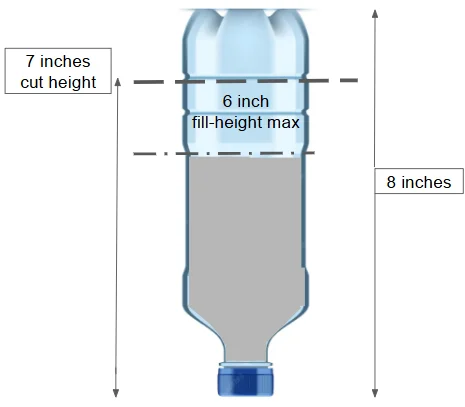 A diagram of a water bottle and specific dimensions for its use as a filter.Copyright VectorStock © 2007-2026 https://www.vectorstock.com/royalty-free-vector/3d-transparent-plastic-bottle-with-glossy-lights-vector-49692617
Research (15 minutes)
- Introduce the Research step of the engineering design process.
- Direct student pairs to review the available materials listed on their Are You Feeling Neutralized? Activity Sheet (PDF).
- If computers or other research resources are available, give student pairs 10–15 minutes to investigate the properties of the available filtration materials and consider how each might function in a water filter.
- Randomly assign each student pair a “neutralizing agent”:
- Baking soda (sodium bicarbonate)
- Crushed antacid tablets (calcium carbonate).
Note: If desired, use an online random-selection tool such as Wheel of Names to assign the neutralizing agents. Random assignment introduces variation among the filters and allows students to compare how different neutralizing agents affect filter performance.
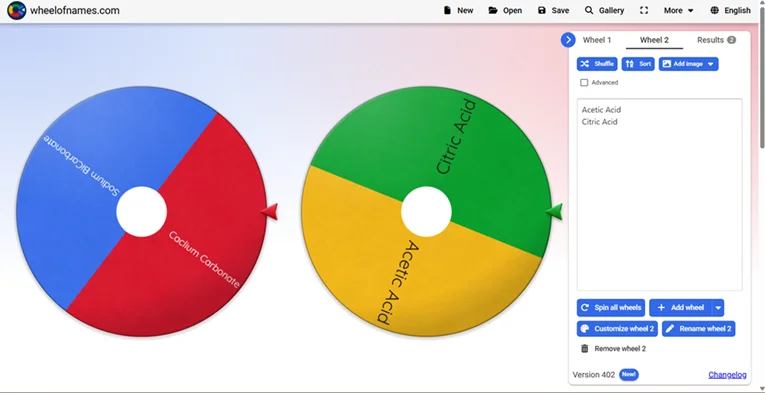 Picture of “Wheel of Names” Random Generator AppCopyright https://wheelofnames.com
- Have students record their assigned neutralizing agent on their Are You Feeling Neutralized? Activity Sheet (PDF).
Imagine and Plan (15 minutes)
19. Introduce the Imagine and Plan steps of the engineering design process.
20. Explain the following design and material constraints:
- Students may use up to five different filtration materials.
- Students may use no more than five level spoonfuls of any one granular material or their assigned neutralizing agent. One spoonful is approximately 1 teaspoon (5 mL), for a maximum of approximately 25 mL of any one granular material.
- For materials such as cloth, gauze, sponge, or paper towel, students may use one piece of each selected material, up to the size specified by you.
- The assigned neutralizing agent must be incorporated into the filter layers.
- Filter materials may extend no more than 6 in (15.2 cm) upward from the bottle opening.
21. Give student pairs a few minutes to discuss possible filter designs and select the filtration materials they think will work best.
- Distribute one Bottle Filter Sketch Diagram (PDF) to each student pair.
- Have student pairs sketch their filter design on their Bottle Filter Sketch Diagram (PDF) based on the filter materials they’ve selected. Remind students to identify the materials they plan to use and show the order of the filter layers.
- Review each student pair’s design and provide approval before students begin construction.
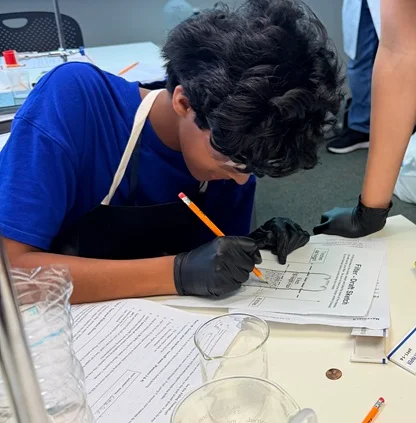 A student sketching a filter design.Copyright 2026 Duane Turner, R-STEM Academy, Rice University
- Once the filter design has been approved, allow student pairs to gather their materials in small portion cups.
Create (30 minutes)
- Introduce the Create step of the engineering design process.
- Have students layer their selected filtration materials and assigned neutralizing agent inside the bottle according to their approved designs (see Image 7).
A student building their bottle filter.Copyright 2026 Duane Turner, R-STEM Academy, Rice University- Have students determine how water will flow through the bottle opening. Students may either keep the bottle cap in place and create holes in it or remove the bottle cap.
- Explain that keeping the cap in place may help hold the filter materials in place. If students use the cap, have them consider how the number, size, and spacing of the holes may affect the water flow rate.
- Have students measure the height of their filter materials and verify that the materials extend no more than 6 in (15.2 cm) upward from the bottle opening. Have students remove excess material as necessary.
- Have students compare their completed filters to their approved designs and verify that the selected materials, layer order, and neutralizing agent match their plans.
Day 2: Test, Improve and Reflect (90 minutes)
Part 1B: Creation of Simulated Contaminated Acidic Runoff (SCAR) Water (30 minutes)
- Randomly assign each group an acid/pollution source of 5% vinegar (acetic acid) or 5% citric acid solution. If desired, use an online random-selection tool such as Wheel of Names to assign the acid sources.
- Have students put on personal protective equipment (PPE), including safety goggles, gloves, and a lab apron.
- Remind students to use appropriate heat-resistant gloves or beaker tongs when handling hot equipment or liquids.
- Direct students to follow the directions in Part 1B of their Are You Feeling Neutralized? Activity Sheet (PDF) to prepare their SCAR water solution.
- Remind students to observe the temperature increase until the temperature reaches between 50-70 degrees Celsius. Students should then turn off the hotplate and let the solutions cool for about 1 minute. Ensure the solution has cooled to a safe handling temperature before students continue.
- Have students measure the pH of their prepared SCAR water solution using universal pH paper or a pH meter.
- If using pH paper, have students follow the manufacturer's instructions and compare the resulting color with the provided pH chart.
- If using a pH meter, remind students to rinse the probe with distilled water between measurements to prevent contamination and inaccurate readings.
- Have students record the initial pH in Column B for Trial 1 on their Are You Feeling Neutralized? Activity Sheet (PDF).
- Direct students to add a specified volume of their prepared SCAR water solution to a small portion cup containing the copper material.
- Have students allow the copper to remain in the solution for 5 minutes, as specified in their Activity Sheet.
- Have students observe and record any changes to the copper material or solution, including changes in color or appearance.
- Remind students to add three spoonfuls of organic material to their SCAR water solution, as directed in Part 1B of their Activity Sheet.
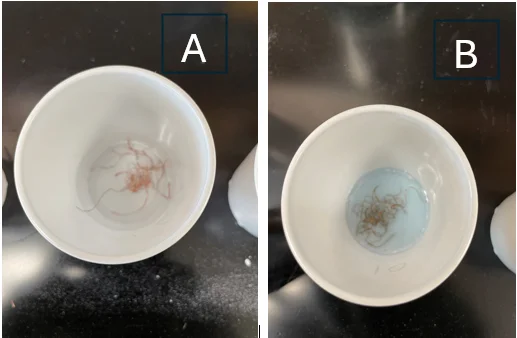 A) Copper in neutral water and B) Copper in acidic liquid.Copyright 2026 Duane Turner
- Provide student groups with a color copy of the Turbidity Chart (see Image 10) to evaluate the clarity of their SCAR water before and after filtration.
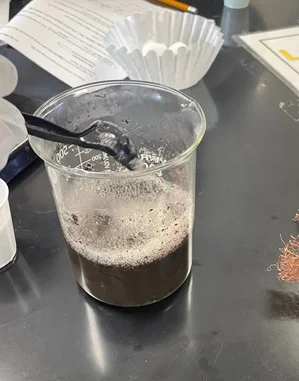 Simulated acid rain runoff/wastewater.Copyright 2026 Duane Turner
- Have students use the Turbidity Chart to determine the turbidity rating of their initial SCAR water solution based on its appearance and clarity and record their rating in Column A for Trial 1 on their Are You Feeling Neutralized? Activity Sheet (PDF).
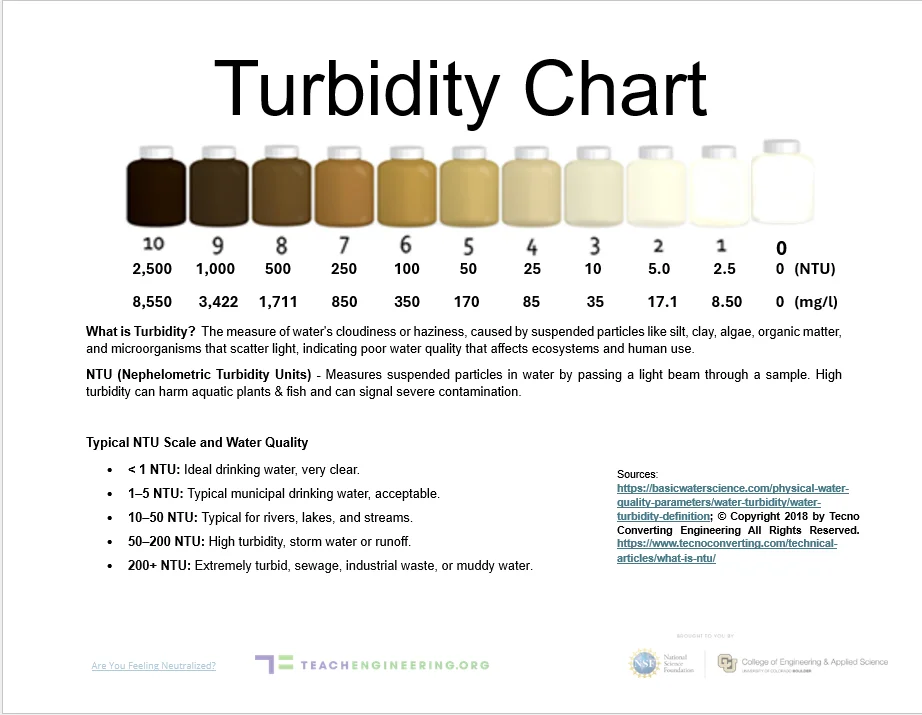 Turbidity chart.Copyright https://basicwaterscience.com/physical-water-quality-parameters/water-turbidity/water-turbidity-definition; © Copyright 2018 by Tecno Converting Engineering All Rights Reserved. https://www.tecnoconverting.com/technical-articles/what-is-ntu
Part 2: Testing the Water Neutralization Filter (30 minutes)
- Introduce the Test step of the engineering design process.
- Direct student teams to position their completed filters above a clean small beaker using a ring stand and clamp apparatus. If this equipment is not available, have one group member hold the bottle securely above the collection beaker while another pours the solution.
- Provide each group with a second piece of copper material for testing the filtered water. Have students set it aside until the filtered water has been collected to ensure consistent copper exposure times.
- Explain to student teams that they will test their water neutralization filters using the SCAR water solution created by their group and measure the following four characteristics:
- pH of the filtered solution
- Flow rate of the liquid
- Observable evidence of copper corrosion
- Turbidity (clarity) of the filtered water
- Remind students to record their data in the data table on their Are You Feeling Neutralized? Activity Sheet (PDF).
- Provide student groups with a stopwatch or other timing device, such as a classroom computer, Chromebook, or phone if permitted.
- Direct groups to slowly pour half of their SCAR water into their neutralization filter and measure the time required to collect up to 80 mL of filtered water. Remind students to pour the SCAR water slowly to prevent overflow, as foaming or bubbling may occur when the acidic solution reacts with the neutralizing material.
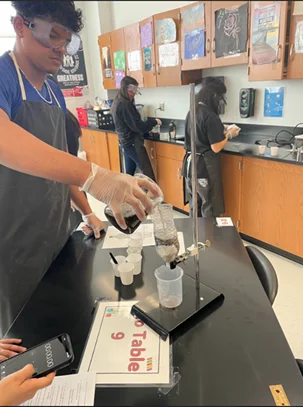 A student pouring their acidic solution into their water filter.Copyright 2026 Duane Turner
- Monitor groups and remind them to keep track of their stopwatch time.
- Accurate time recording is very important for measuring flow rate.
- Students should start their timers when the first drop of filtered water enters the collection beaker and stop when 80 mL has been collected or the established maximum testing time has elapsed, whichever occurs first.
- If their filter does not allow for water to flow through it at all, they’ve experienced a design fail and reconstruction is needed.
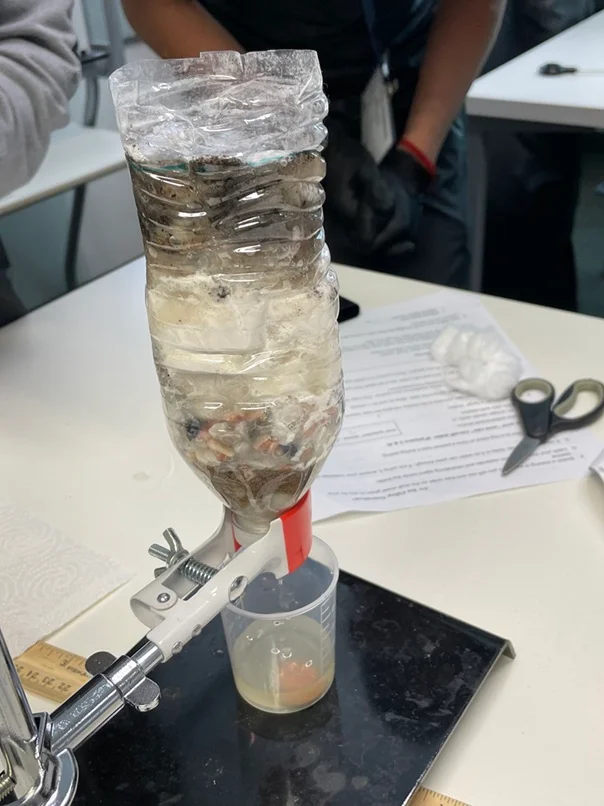 Neutralization filter collecting water.Copyright 2026 Duane Turner, R-STEM Academy, Rice University
- Remind students to measure and record the final volume of filtered water collected (mL) and the filtration time (seconds).
- Assist students in calculating the flow rate of their SCAR water filtrate using the following formula:
Flow Rate (mL/sec) = Volume of Filtered Water (mL) ÷ Filtration Time (sec)
- Remind students to convert their filtration time to seconds before calculating the flow rate and record their results in Column C for Trial 1.
- Remind students to measure the pH of their filtered water and record it in Column D for Trial 1. This allows them to compare the results with their unfiltered SCAR water and evaluate how effectively their filter neutralized acidity.
- Have students evaluate the turbidity of their filtered water using the Turbidity Chart and record their rating in Column E for Trial 1. Remind students to compare the turbidity before and after filtration.
- Have students transfer 10 mL of filtered water into a clean portion cup containing the second copper sample. Allow the copper to remain in the filtered water for the same amount of time used during the initial copper test. Have students observe and record any visible changes to the copper or solution in Column F for Trial 1. Note: The absence of visible color changes does not necessarily indicate that corrosion has been prevented.
- Explain to students that they will need to evaluate the quality of their filter by using the Product Quality Rubric (PDF). Show them where to place their data, and how to rate and assign points based on their values using the example score. Their combined score will indicate the design quality of their bottle filter.
- Introduce the Improve step of the engineering design process.
- Give student groups the opportunity to redesign their filters after reviewing their Trial 1 results. Students may select different materials, change the order of their filter layers, or modify the amount or placement of their neutralizing material within the established design constraints.
- An improvement in their design may be demonstrated by:
- Reduced turbidity and improved water clarity.
- A flow rate within the acceptable design range.
- A filtered-water pH closer to the established target range.
- Reduced observable evidence of copper corrosion.
- Have students record their proposed design changes and explain how they expect these modifications to improve their filter's performance.
- Have students modify their original filter designs and repeat the testing procedure for Trial 2. If sufficient SCAR water remains and its condition has not changed, students may use the remaining solution. Otherwise, have them prepare a fresh SCAR water sample using the same procedure.
- Remind students to maintain consistent testing conditions, including the volume of SCAR water, filtration procedures, and copper exposure time.
- Have students record their results in the Trial 2 row of their Are You Feeling Neutralized? Activity Sheet (PDF).
- Remind students to complete their evaluation of their values for their second trial on their Product Quality Rubric (PDF) for students to re-evaluate their second neutralization filter once their data has been gathered from their second trial tests. Afterward, they should calculate the average for both trials so they can determine the overall quality of their water bottle filter product.
- Have students complete the Product Quality Rubric (PDF) for Trial 2 and compare their Trial 1 and Trial 2 results, calculating the average for both trials so they can determine the overall quality of their water bottle filter product.
- Ask students to determine whether their design modifications improved filter performance and support their conclusions with evidence from their data.
- Have students complete Trial 2 and record their results.
Wrap-Up and Conclusions (30 minutes)
- Once students have completed their testing, distribute one Activity Follow-Up Questions (PDF) sheet to each student.
- Give students time to complete the follow-up questions.
- Facilitate a class discussion and ask each group to share two of their responses to the Activity Follow-Up Questions (PDF) as a check for understanding of water pollution, acid rain, filtration, neutralization, and the engineering design process. (See Activity Follow-Up Questions Answer Key (PDF) for answers.)
- Afterward, have students compare their initial and final responses to the Anticipatory Set: What Do You Know About Water, Pollution & Engineering? (PDF) and discuss how their understanding has changed throughout the activity. (See Anticipatory Set: What Do You Know About Water, Pollution & Engineering? Answer Key (PDF) for answers.)
- acidic
- A solution with a pH less than 7, indicating a higher concentration of hydrogen ions.
- acid rain
- Rainfall that has been made acidic by atmospheric pollution, typically containing sulfuric and nitric acids.
- alkaline (basic)
- A solution with a pH greater than 7, indicating a higher concentration of hydroxide ions.
- alkalinity
- The capacity of water to resist changes in pH, often associated with the presence of bicarbonates, carbonates, and hydroxides.
- calcite
- A crystalline form of calcium carbonate used as a neutralizing agent in filters.
- contaminants
- Substances that pollute or adulterate water, making it unsafe for use or consumption.
- chemical reactions
- A process that leads to the transformation of one set of chemical substances to another.
- dissolution
- The process of a solid becoming incorporated into a liquid to form a solution.
- filtration
- The mechanical or physical process of separating solids from liquids or gases using a filter medium.
- heavy metals
- Metallic elements with high density that can be toxic in low concentrations, such as lead, mercury, and cadmium.
- neutralization
- The process of making an acidic or basic solution neutral, typically by adding a substance that counteracts acidity or alkalinity.
- leaching
- The process whereby substances are removed from solid materials into a liquid phase.
- ph
- A scale used to measure how acidic or basic a solution is, ranging from 0 (very acidic) to 14 (very basic), with 7 being neutral.
- turbidity
- The cloudiness or haziness in water caused by suspended particles such as silt, clay, algae, and organic matter that scatter light, indicating poor water clarity and quality, measured in Nephelometric Turbidity Units (NTU).
- water quality
- The chemical, physical, and biological characteristics of water, often assessed to determine its safety and suitability for human use.
Pre-Activity Assessment
Introduction/Engage Questions: Using the Are You Feeling Neutralized? Presentation (PPTX), introduce the water pollution scenario (Slides 2–4). Ask students what they think might be causing the water supply problem. Have students consider possible sources of pollution and discuss their ideas in small groups. Invite groups to share their responses and record their ideas on the board. Guide the discussion using the following questions:
- What is pollution?
- What are some different types of pollution?
- How can pollution be reduced or removed?
- How might contaminated water be treated to improve its quality?
Anticipatory Set: Distribute the Anticipatory Set: What Do You Know About Water, Pollution & Engineering? (PDF) handout to assess students' prior knowledge of water pollution, acid rain, filtration, and engineering. Have students complete the assessment individually before introducing acid rain as a possible cause of the water quality problem. Explain that students will revisit the assessment at the end of the activity to reflect on what they learned.
Activity Embedded (Formative) Assessment
Check for Understanding/Design Questions: As students progress through the activity, assess their understanding of filtration, neutralization, and the engineering design process by asking questions about their designs, predictions, observations, and test results.
- Part 1A: Filter Design: As students present their Bottle Filter Sketch Diagram (PDF), ask them to explain why they selected their filtration materials and arranged them in a particular order. Ask students which materials they predict will remove the largest particles and which will remove the smallest particles. What is the purpose of including baking soda or calcium carbonate in their filters? What criteria and constraints must their filter designs meet?
- Part 1B: SCAR Water Preparation: Explain that students are not creating actual acid rain but are simulating some characteristics of acidic runoff using household acidic solutions, such as vinegar or citric acid. Organic materials, such as dirt or soil, represent debris and suspended contaminants that may be present in untreated water sources. Ask students: Why is it important to measure the pH before filtration? What does the pH tell you about your SCAR water? Why is copper placed in the SCAR water, and what observations might indicate corrosion?
- Part 2: Filter Testing: As students test their filters and collect the filtered SCAR water, ask: Why is flow rate an important measure of filter performance? What does turbidity indicate about water quality? Why is pH measured both before and after filtration? Why is copper placed in the filtered water? What evidence would indicate that your filter successfully reduced the acidity of the SCAR water?
Group Self-Evaluation: After completing each trial, have students use the Product Quality Rubric (PDF) to evaluate their filter's performance based on changes in pH, turbidity, flow rate, and observations of copper corrosion. Have students compare their results between trials, identify strengths and limitations of their designs, and explain how their modifications affected filter performance.
Post-Activity (Summative) Assessment
Activity Follow-Up Questions: Have students complete the Activity Follow-Up Questions (PDF) handout to evaluate their filter designs and reflect on their engineering experience. Questions address material selection, flow rate, neutralization and pH, data accuracy, design improvements, and real-world applications. (Refer to the Activity Follow-Up Questions Answer Key (PDF).)
Class Discussion: Facilitate a class discussion in which student groups share their results and reflect on the engineering design process. Guide the discussion using questions such as:
- What challenges does acidic runoff create for engineers who design water systems?
- Why are multiple trials important in engineering? If you had a third trial, what design change would you test?
- What trade-offs did you observe between water clarity, neutralization, and flow rate?
- Which measurement (flow rate, pH, turbidity, or corrosion) do you think is most important for evaluating your filter? Support your answer with evidence.
- How did this activity demonstrate the engineering design process (Ask, Imagine, Plan, Create, Test, Improve)?
Anticipatory Set Reflection: Return students' completed Anticipatory Set: What Do You Know About Water, Pollution & Engineering? (PDF) handouts. Have students revisit their initial responses and explain how their understanding of pollution, acid rain, water filtration, neutralization, and engineering has changed. (Refer to the Anticipatory Set: What Do You Know About Water, Pollution & Engineering? Answer Key (PDF).)
- Students should wear safety goggles, a laboratory apron, and gloves throughout the experiment.
- Although household vinegar (acetic acid) and the diluted citric acid solution are relatively low hazard, the resulting chemical mixtures may contain dissolved copper compounds that can be harmful if ingested.
- Students will also work with 3% hydrogen peroxide, which can irritate the skin and eyes. Students should never taste or consume any solutions used in the activity.
- The activity also involves heating an acid/hydrogen peroxide solution. Remind students not to touch the hot plate or heated containers directly. Students should use appropriate heat-resistant gloves or beaker tongs when handling hot equipment and allow solutions to cool to a safe temperature before proceeding.
- Caution students when handling copper pieces cut from scouring pads, as the edges may be sharp and could puncture or scratch the skin. Students should handle these materials carefully and follow your safety instructions.
Further Enrichment
- Investigate water hardness. Introduce the concept of hard water, which contains elevated concentrations of dissolved minerals, particularly calcium and magnesium ions. Have students research how water hardness differs from acidity and turbidity and investigate common water-softening methods.
- Design a water-softening solution. Challenge students to propose an additional water treatment process that could reduce hardness. Have students explain how they would test their proposed solution and evaluate its effectiveness.
Simplifying Experiments for Lower Grades
- Limit the number of chemical reactants. For example, use vinegar (acetic acid) and one neutralizing agent, such as baking soda (sodium bicarbonate), to demonstrate neutralization.
- Simplify filter construction. Provide a smaller selection of common filtration materials, such as cotton, sand, and gravel, along with one neutralizing agent to reduce design complexity.
- Focus on qualitative observations. Rather than measuring pH, flow rate, and copper corrosion, have students observe changes in water clarity before and after filtration. To focus exclusively on physical filtration, replace the acidic solution with water mixed with soil or other suspended materials and eliminate the neutralizing agent.
Increasing Challenge for Older Students
- Explore chemical reactions. Have students, particularly those studying chemistry, identify the chemical formulas of the reactants and products involved in neutralization and write balanced chemical equations.
- Explain the chemistry of corrosion prevention. Have students investigate how neutralization changes water chemistry and can reduce the potential for copper corrosion. Ask students to explain their findings to the class using chemical equations and experimental evidence.
Brown, Theodore L., et al. Chemistry: The Central Science. Pearson Education, 2018.
National Ground Water Association. “Acidic Water and Neutralizing Filters.” NGWA, www.ngwa.org/what-is-groundwater/About-groundwater/acidic-water.
U.S. Environmental Protection Agency. “Acid Rain.” EPA, www.epa.gov/acidrain.
U.S. Geological Survey. “pH and Water.” Water Science School, USGS, www.usgs.gov/special-topics/water-science-school/science/ph-and-water.
World Health Organization. “Water Quality and Health.” WHO, www.who.int/teams/environment-climate-change-and-health/water-sanitation-and-health.
This curriculum was developed under National Science Foundation RET grant number EEC-2302127. Any opinions, findings, and conclusions or recommendations expressed in this material are those of the authors and do not necessarily reflect the views of the National Science Foundation.
Contributors
Duane Turner, Jiaman Wang, and Dr. Bezawit Getachew
Supporting Program
NSF Research Experience for Teachers Program (RET), Rice University, Houston, Texas, USA
Copyright
2026 by Regents of the University of Colorado; original © 2025 Rice University