
The Water Around Us
In this engineering design activity, students build models of natural sources of water. As they move through the design process, students differentiate between natural sources of water (such as rivers or lakes) and human-made sources of water, such as reservoirs or canals. Students learn how engineers can study natural sources of water to create better water delivery systems that benefit society.
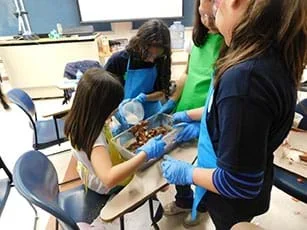 Students design natural water models as sources of drinking waterCopyright 2020 Frank Serna, Rice University RET
Engineers use their knowledge of natural water sources and the engineering design process to design and create structures for societal benefit. Providing water to a community might require the shifting of natural water patterns to accommodate for high and low water source fluctuations. Using models enables engineers to increase efficiency of their designs, so they can make water available for a variety of uses based on human needs, from irrigation in rural areas to plumbing and sewer systems in residential communities.
After this activity, students should be able to:
- Identify and compare freshwater and saltwater characteristics.
- Identify and compare freshwater and saltwater sources.
- Distinguish different water sources (natural versus human-made).
- Apply some steps of the engineering design process.
- Students will develop an understanding of the attributes of design.
Grades K-12
Do you agree with this alignment? - Students will develop an understanding of engineering design.
Grades K-12
Do you agree with this alignment? - STEL-1A Compare the natural world and human-made world.
Grades -1-2
Do you agree with this alignment?
- 2-ESS2-2 Develop a model to represent the shapes and kinds of land and bodies of water in an area.
Grade 2
This resource focuses on the following Three Dimensional Learning aspects of NGSS:
Science & Engineering Practices- Develop a model to represent patterns in the natural world.Do you agree with this alignment?
Disciplinary Core Ideas- Maps show where things are located. One can map the shapes and kinds of land and water in any area.Do you agree with this alignment?
Crosscutting Concepts- Patterns in the natural world can be observed.Do you agree with this alignment?
Do you agree with this alignment? - Develop a model to represent patterns in the natural world.
- 3-5-ETS1-1 Define a simple design problem reflecting a need or a want that includes specified criteria for success and constraints on materials, time, or cost.
Grades 3-5
This resource focuses on the following Three Dimensional Learning aspects of NGSS:
Science & Engineering Practices- Define a simple design problem that can be solved through the development of an object, tool, process, or system and includes several criteria for success and constraints on materials, time, or cost.Do you agree with this alignment?
Disciplinary Core Ideas- Possible solutions to a problem are limited by available materials and resources (constraints). The success of a designed solution is determined by considering the desired features of a solution (criteria). Different proposals for solutions can be compared on the basis of how well each one meets the specified criteria for success or how well each takes the constraints into account.Do you agree with this alignment?
Crosscutting Concepts- People's needs and wants change over time, as do their demands for new and improved technologies.Do you agree with this alignment?
Do you agree with this alignment? - Define a simple design problem that can be solved through the development of an object, tool, process, or system and includes several criteria for success and constraints on materials, time, or cost.
- identify and compare the properties of natural sources of freshwater and saltwater; and
Grade 2
Do you agree with this alignment? - distinguish between natural and manmade resources.
Grade 2
Do you agree with this alignment?
Each group needs:
- plastic tub (5.6L/6 quart) – 1 per group
- clay (tennis ball sized and brown in color)
- sand (500 mL)
- soil (500 mL)
- additional materials to use for making models, or students can bring their own
- water in plastic beaker (600 mL)
- salt (for creating a saltwater ocean model)
- safety glasses
- rubber gloves
- plastic beakers (600 mL)
- forest, animal toy figures, plastic trees, or similar model figures for decoration and illustrative purposes
Students should know locations of water in and outside of their homes. Students should be able to describe the physical properties of water (clarity, color, taste). Students should be able to describe natural bodies of water, such as lakes, ponds, rivers, streams, and oceans.
Have you ever seen water outside where you live or your school? What are some different places you have seen water outside? (As students share their thoughts, write their answers on the board. Potential answers include: lakes, ponds, rivers, oceans, reservoirs, swimming pools, rain puddles, etc.)
Some of the sources you shared were put there by people because it makes it easier to get water. We even build places to put water so we can have fun! Which water sources do you think they are? (Students should discuss which of the listed water sources were put there by people. For example, swimming pools or reservoirs.) We call these “human-made” water sources. (Write “human-made” next to those identified sources on the board and show students a few examples of human-made water sources.)
Some of the water sources you shared were not put there by people. Which water sources do you think they are? (Students should discuss in groups and then share with the class.) We call them natural water sources. What makes the various natural water sources different? (Students should discuss in groups and then share with the class the differences between rivers, lakes, ponds, streams, oceans, etc. Provide pictures of different natural water sources if students are unable to come up with their own examples.)
[Guide the class with a video, “The Basics of Freshwater” https://www.youtube.com/watch?v=oaQCiwzjnCM or pictures with the accompanying PowerPoint (PPTX)).]
Provide students with an opportunity to use their prior knowledge of water sources to differentiate between natural and human-made bodies of water.
Background
Water is necessary for the survival of all living things. While some animals and plants can thrive in salt water, many plants and mammals need fresh water to live. Freshwater is any naturally occurring water that does not contain a lot of salt. Freshwater generally has low amounts of dissolved salts and other minerals. Seawater, like that found in seas or oceans, has higher levels of salts.
It is important to note that freshwater is not necessarily drinkable (or potable) water. Much of the freshwater on Earth needs to be treated before it is safe to drink. Freshwater can become polluted by natural occurring processes, such as erosion, that deposit contaminants into the water and by human activities.
Natural sources of freshwater include lakes, marshes/bogs, ponds, rivers, streams, glaciers, ice sheets, ice caps, and ground water.
Oceans, seas, and saline lakes (like the Great Salt Lake in Utah) are also natural sources of water but they are not freshwater.
Human-made sources of freshwater include reservoirs, canals, swimming pools. Swimming pools, of course, are an example of undrinkable water because of the chemicals we use to keep them clean.
Provide students with some information about the engineering design process. Discuss the main steps and what part of the design process they will use today. 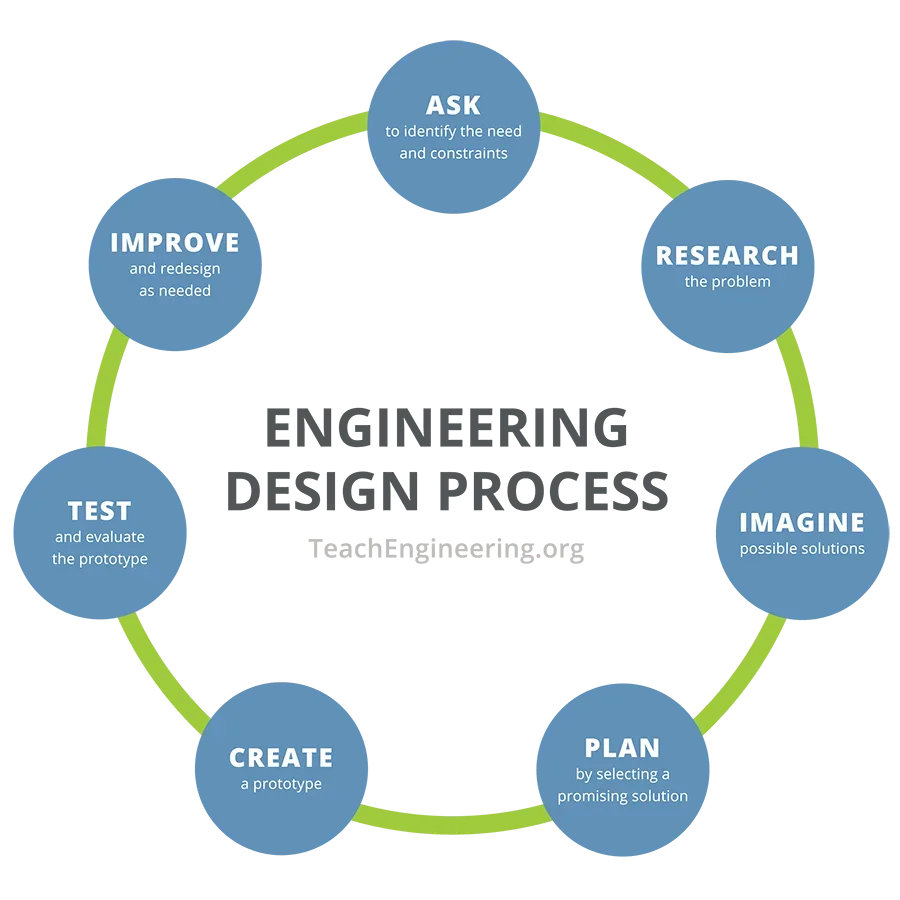
Before the Activity
- Organize all materials on a table for easy access.
With the Students
- Separate students into groups of three or four (depending on class size).
- Assign each group with a natural water source: pond, stream, river, lake, or ocean.
- Provide the engineering criteria and constraints for the students’ models; for example: they need to fit within the plastic container and not overflow, must hold so much water, etc. Explain to them that this is the first step of the engineering design process and engineers have to work within criteria and constraints for each project they work on.
- Give groups time to imagine possible solutions. Once each student has several designs, guide them to discuss the pros and cons of each design and how the design meets the criteria and constraints from before. Once they have selected their design, have them write out the materials that they need. (5-10 minutes, or longer depending on the class level). Encourage students to be creative and collaborative as they complete the third and fourth steps of the engineering design process.
- Allow each group time to collect their materials.
- Explain to the students that the fifth step of the engineering design process is where they create their prototype. Monitor and advise each group as you supervise construction of each group’s model.
- Instruct students to evaluate why they chose to build their model and what distinguishes it from the other models. Evaluating the prototype allows engineers to find flaws or ways to improve on their next design iteration.
- For example, if a student chooses to make a river, what are the characteristics that make it a river? The same goes for an “ocean” or “lake” model.
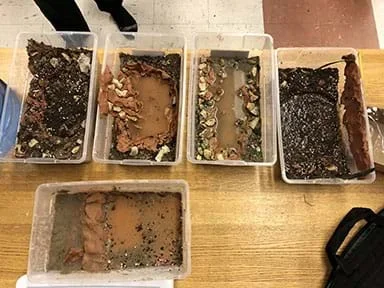 Models of ponds, streams, rivers, lakes, and oceans.Copyright 2020 Frank Serna, Rice University
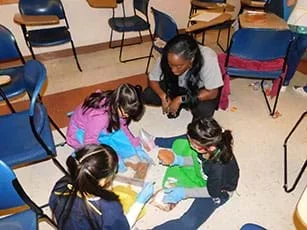 Students working together on their models.Copyright 2020 Frank Serna, Rice University
- freshwater
- Any naturally occurring body of water that does not contain salt.
- lake
- A body of water surrounded by land.
- human-made
- Resources made by humans; they do not occur naturally in the environment.
- natural
- Anything that comes from nature; not made or caused by humans.
- ocean
- A larger expanse of sea that stretches from continent to continent.
- pond
- A small body of still water.
- river
- A large stream of water that runs into a lake, sea or another river.
- saltwater
- Water containing salt.
- sea
- A body of saltwater that covers a large part of the Earth’s surface and surrounds its landmasses.
- stream
- A small body of moving water.
Pre-Activity Assessment
Discussion Questions: Ask students the following questions.
- In what ways are natural and human-made resources different?
Possible answers: Natural sources can be found outside, human-made is found in sinks, tubs, and fountains. Natural was already there before people. Human-made cannot occur by themselves without human assistance.
- What are some ways we can conserve (save) natural and human-made resources?
Possible answers: Collect natural water when it rains. Take shorter showers. Turn off faucets when not using them.
- Why is it important to know about and understand the natural world?
Possible answers: We need water to live. So we need natural resources like water.
- In what ways are the properties of freshwater and saltwater alike and different?
Possible answers: Both are water. One we use to make drinking water; the other, we do not. There is more saltwater than freshwater in the world.
Maps: Have students look at various maps to identify the different kinds of water in the area.
Activity Embedded Assessment
Models of water sources: ocean, lake, river, stream, and pond.
Informal assessment questions: What did you use for your model and why? Is it freshwater or saltwater? Could we drink from your water source? What patterns (if any) did you observe?
Post-Activity Assessment
Exit Ticket: Have students complete The Water Around Us Exit Ticket (PDF).
Making Sense: Have students reflect on the science concepts they explored and/or the science and engineering skills they used by completing the Making Sense Assessment (PDF).
- The presence of water is a potential slipping hazard. Have students clean up any water messes right away.
- Students should be cautious the building materials in order to prevent large messes (if possible).
- Providing safety glasses is encouraged.
- Distributing materials to the tables first is a possibility for students who need it. Clearly organizing and labeling materials will help students with their design.
- If there is not a sink available, keep a squirt bottle for washing out eyes in case of accidents.
- Include printed slides and photos of water sources for each table, in case of technical difficulties.
- Ensure there are cleaning supplies (wet wipes, broom/dustpan, mop) for spills and messes.
Field trip to a nearby water source (river, lake, etc.) or to a pool or water treatment facility.
Contributors
Frank Serna
Supporting Program
Nanotechnology Enabled Water Treatment Systems (NEWT) RET, Rice University
Acknowledgements
This curriculum was based upon work supported by the National Science Foundation under Rice University Engineering Research Center for Nanotechnology Enabled Water Treatment Systems (NEWT) RET grant # 1449500. Any opinions, findings and conclusions or recommendations expressed in this material are those of the authors and do not necessarily reflect the views of the National Science Foundation.
Special thanks to Dr. Juan Noveron, Luis Barrera, Dr. Carol Nichol and Christina Crawford.
Copyright
2020 by Regents of the University of Colorado; original © 2020 Rice University