
Lab Experiments in Rebuilding Soil with Biochar
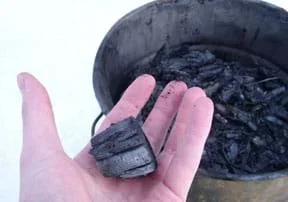 Copyright 2013 K.salo.85, Wikimedia Commons https://commons.wikimedia.org/wiki/File:Biochar.jpg
Students learn about soil properties and the effect biochar—charcoal used as a soil amendment—has on three soil types, sand, loam and clay. They test the soils’ water retention capability before and after the addition of biochar. During the activity, student teams prepare soil mixtures, make observations (including microscopic examinations), compare soil properties, conduct water retention tests, take and record measurements, and analyze their observations and data. They see how the physical properties of soils—color, texture, and particle size—can be indicators of nutrient content and water retention capabilities to support plant growth. From their findings, they consider biochar’s potential benefits for environmental and agricultural applications, especially in conditions of drought and depleted soils. An activity lab sheet is provided to guide experimental data collection and analysis.
Agricultural engineers design biochar soil applications as an inexpensive and effective means of improving water-holding capacity. Using biochar as a soil amendment has the potential to improve agriculture production in areas of prolonged drought, such as regions in California and Texas; however, limited studies exist in selecting different biochar to help sustain water retention levels, especially when the soil is drier than average. Using results from this activity and what they learn about biochar as an additive to alter soil properties, students determine a soil/biochar mixture that might be helpful for agricultural applications.
After this activity, students should be able to:
- Describe the significance of soil water retention.
- Compare and contrast different soil properties with the addition of biochar.
- Explain how biochar could be used for agricultural applications.
- Measure and record water retention data for different types of soil mixtures.
- STEL-1J Develop innovative products and systems that solve problems and extend capabilities based on individual or collective needs and wants.
Grades 6-8
Do you agree with this alignment?
- SEP.1.3-5.1 Analyze and interpret data to make sense of phenomena using logical reasoning.
Grades 3-4
Do you agree with this alignment? - SEP.4.3-5.3 Use a model to test interactions concerning the functioning of a natural system.
Grade 4
Do you agree with this alignment? - SEP.7.3-5.6 Make observations and measurements to produce data to serve as the basis for evidence for an explanation of a phenomenon.
Grade 5
Do you agree with this alignment? - CCC.3.3-5.3 Standard units are used to measure and describe physical quantities such as weight, time, temperature, and volume.
Grade 5
Do you agree with this alignment?
- collect, record, and analyze information using tools, including calculators, microscopes, cameras, computers, hand lenses, metric rulers, Celsius thermometers, mirrors, spring scales, pan balances, triple beam balances, graduated cylinders, beakers, hot plates, meter sticks, compasses, magnets, collecting nets, and notebooks; timing devices, including clocks and stopwatches; and materials to support observation of habitats of organisms such as terrariums and aquariums; and
Grade 4
Do you agree with this alignment? - examine properties of soils, including color and texture, capacity to retain water, and ability to support the growth of plants;
Grade 4
Do you agree with this alignment?
Each group needs:
- 6 10-oz. cups; cup sizes may vary, but must be large enough to hold 1 cup (8 oz.) of soil and be able to be punctured to create drainage holes in three of them; consider using plastic cups so that you can reuse them for activity Parts 1 and 2 as well as to run the activity with a different group of students
- scissors, or other cutting tool, to poke holes in the bottoms of three cups
- measuring cup, 8-oz. size
- natural clay, loam and sand, 12 oz. of each soil type per group; available at hardware and garden stores
- microscope with a minimum of 20x magnification
- spoon, or similar tool, to add biochar to soil (biochar tends to leave a black residue on hands)
- science notebook, one per student; alternative: numerous sheets of paper
- clear tape or white glue
- 100-ml graduated cylinder
- 600-ml beaker or other container to hold 600 ml of water for students to pour into graduated cylinders in 100-ml increments
- Soil and Biochar Mixture Lab Sheet (PDF), one per student
To share with the entire class:
- access to tap water
- ~3 quarts of biochar; typically, biochar is sold online or in gardening stores in larger quantities such as this 10-quart box at https://www.amazon.com/CoolTerra-Biochar-Improvement-10-Quarts/dp/B00WHB8AY8/ref=sr_1_1?s=lawn-garden&ie=UTF8&qid=1463079619&sr=1-1&keywords=biochar; 10 quarts is enough to run the activity a few times
- bucket or tub, to hold dirty water
- bucket or tub, to hold wet soil and soil/biochar mixtures
(As you present the following content to the class, also introduce the vocabulary terms and definitions.)
In many parts of the U.S., a great concern of farmers and agricultural engineers is our long-term impact on soils. After hundreds of years of poor farming practices and long periods of droughts (times of abnormally low rainfall), much of our soil has lost the nutrients needed to support crops. In many parts of Texas, California, Florida and Georgia, for example, what was once rich farmland for growing cotton, grains and vegetables, is today eroded and depleted of its nutrients.
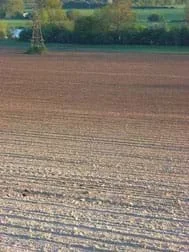 Copyright 2007 Andrew Smith, Wikimedia Commons https://commons.wikimedia.org/wiki/File:Farmland,_Mapledurham_-_geograph.org.uk_-_427150.jpg
How do we rebuild our soils? This is a question that many farmers, scientists and engineers are asking in the 21st century, and during the past decades researchers have gained interest in this question as well. One idea that agricultural engineers suggest as a solution is the application of biochar. Biochar looks similar to charcoal, but is produced from charring waste biomass in high heat without the use of oxygen. Some farmers and agricultural engineers believe that depositing biochar in soils could help heal our soil. This is an ancient technology, also known as “terra preta,” that dates back to Amazonian prehistory. Archeologists have found evidence of biochar in terra preta soils nearly 7,000 years old!
Introducing materials like biochar, manure and compost to soil helps to boost soil nutrients for plant growth, protect soil from erosion, and aid soil in recovering and rebuilding between periods of crop-growing.
Background
Soils form from the weathering of rock and the decomposition of plant and animal remains, and play an important role in the natural environment. In this activity, students learn that the properties of soils (such as their varying particle sizes) affect their ability to retain water. For example, sand permits water to pass quickly through its air spaces and therefore does not retain water very well. Water molecules get trapped in clay soils, which can become compact and retain too much water that does not drain. A mixture of sand, clay and humus is a soil combination called loam that permits drainage, yet retains nutrients and a desired amount of water. In this activity, students add biochar to each of these three soil types to see if it changes water retention levels.
Before the Activity
- Gather materials and make copies of the Soil and Biochar Mixture Lab Sheet (PDF).
- For each group, puncture five small drain holes in the bottoms of three cups and leave the other three cups with no holes; the cups with no drainage holes will be used to collect the drained water.
- (optional) To simplify one step of the Part 1 activity, prepare the cups in advance (instead of having students do it) by putting 8 oz. of each of the three soil types (sand, loam, clay) in each group’s cups with drainage holes.
With the Students—Part 1: Soil
- Present to the class the Introduction/Motivation content. Then give students a few minutes for reflection and to make some written predictions on the lab sheet, as described in the Assessment section.
- Have students tape or glue a sample of each one of the soil types into their science notebooks, as shown in Figure 1.
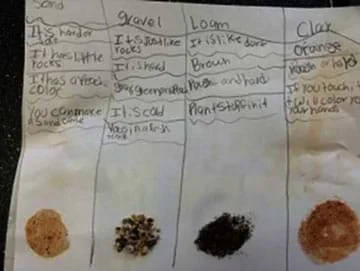 Figure 1. Soil samples: sand, gravel, loam, clay.Copyright 2015 Isaias Cerda, Office of Stem Engagement, Nanotechnology RET, Department of Earth Science, School Science and Technology, Rice University
- For each soil sample, have students write a brief description of its properties, including color and texture. Direct students to take a small sample and place it under the microscope to examine the particle size distribution, describing what they see on the sample sheet. (Expect students to observe that sand is more porous than loam [more space between each particle], and loam is more porous than clay.) Note: Later, students will repeat these steps after adding biochar to each soil type, and then compare the before and after properties for each soil mixture.
- For each soil type, direct students to put 8 oz. of soil in each of the three cups with drainage holes (or if the cups were prepared in advance, give each team three cups containing the three soil types).
- Point out to students that they need to keep track of water retention levels in the first table on the lab sheet.
- Water retention testing: Direct the students to complete the following steps:
- Measure 100 ml of water using the graduated cylinder.
- With the cup of sand held over an empty cup, slowly and carefully pour the water into the sand.
- Let the water drain out the bottom of the cup (into the empty cup) until it stops dripping.
- Pour the collected “drained water” into the graduated cylinder. Measure and record on the lab sheet the drained water volume.
- To calculate the amount of water retained by the sand, subtract the drained water volume from the original volume of water (100 ml). Record this in the lab sheet table.
- Repeat these steps for the cups of loam and clay.
- Have students consider their observations and measured results to determine which soil was the best at retaining water. (Expect that clay was best at retaining water.)
- Direct students to empty the wet soil from each cup into the collection bucket/tub provided for the class. Remind students to save their cups to reuse for Part 2 of the activity.
With the Students—Part 2: Soil/Biochar Mixtures
- Inform the class that in Part 2, they will repeat the same procedure as Part 1, but with biochar added to each soil type to see if/how it affects the water retention capabilities.
- Point out to students that they need to keep track of water retention levels for this part of the activity on the second table on the lab sheet.
- Direct students to use a spoon to mix one-half cup (4 oz.) of soil and one-half cup (4 oz.) of biochar in each of the three cups with the drainage holes.
- After the three soil/biochar mixtures are prepared, have students tape or glue a sample of each one into their science notebooks. As before, have them write a brief description on the sample sheet of each mixture’s observable properties, such as color and texture. Also, have them take a small sample and place it under the microscope to examine the particle size distribution, recording their observations on the sample sheet. Also ask them to note the differences they see between the original soil and the soil/biochar mixtures for each of the three soil types. (Expect students to observe that porosity levels changed between the different samples, as evidenced by the differences they saw in the open spaces between the soil particles.)
- Water retention testing: Direct the students to repeat the testing procedure they did before, but now with the soil/biochar mixtures, following these steps:
- Measure 100 ml of water using the graduated cylinder.
- With the cup of sand/biochar mixture held over an empty cup, slowly and carefully pour the water into the sand/biochar mixture.
- Let the water drain out the bottom of the cup (into the empty cup) until it stops dripping.
- Pour the collected “drained water” into the graduated cylinder. Measure and record on the lab sheet the drained water volume.
- To calculate the amount of water retained by the sand/biochar mixture, subtract the drained water volume from the original volume of water (100 ml). Record this in the lab sheet table.
- Repeat these steps for the cups of loam/biochar mixture and clay/biochar mixture.
- Have students consider their observations and measured results to determine which soil/biochar mixture worked best for retaining water. (Expect that the clay/biochar mixture was best at retaining water.) Have students answer the remaining analysis questions on their lab sheets.
- Conclude by leading a class discussion, as described in the Assessment section.
- biochar
- A charcoal used as a soil amendment. A solid material obtained from charring biomass in an oxygen-limited environment. Used for a range of applications such as an additive for soil improvement to improve soil water retention levels, protect against particular environmental pollution and reduce greenhouse gas.
- biomass
- Living (organic) matter, such as plant material and organisms.
- clay
- A soil type composed of small grains with small spaces between them that trap water, making it wet, heavy and hard for plant roots to grow through them.
- drought
- A long period of below-average rainfall that results in water shortages.
- erosion
- Weathering during which surface soil is worn away by natural processes like wind and water flow.
- loam
- A soil type composed mostly of sand, silt and a smaller amount of clay. Because it is a mixture of large and small grains of broken up rocks, minerals, and the remains of dead plants and animals, it is able to hold water and drain well.
- sand
- A soil type composed of broken shells and worn down rock and mineral bits. Its particles have so much space between each other that water readily drains out.
- soil water retention
- The ability of a soil to hold water.
- weathering
- Being broken down due to contact with the Earth’s atmospheric conditions, such as heat, water, ice, pressure and chemicals.
Pre-Activity Assessment
Predictions: After presenting the Introduction/Motivation content to the class, give students 2-5 minutes to reflect on and answer the following questions on their Soil and Biochar Mixture Lab Sheets (PDF):
- Might biochar affect each soil type’s ability to retain water? If so, would it increase or decrease water retention for each soil type?
- Which type of soil/biochar mixture do you expect to retain the most water?
Activity Embedded Assessment
Class Results: During the activity, students record on the Soil and Biochar Mixture Lab Sheets (PDF) their water retention measurements, examine their results to draw conclusions, answer analysis questions, and compare their findings with other groups. After they have finished comparing soil properties and retention levels, compile class data in order to more widely compare results and discuss as a class.
Post-Activity Assessment
Concluding Class Discussion: Lead a class discussion, prompted by the following questions:
- Revisit student predictions: How did biochar affect each soil type’s ability to retain water? Did it increase or decrease water retention for each soil type? (Answer: Students likely predicted that adding biochar increases water retention for all soil types. Adding biochar to soil does impact soil’s ability to retain water. But, from conducting this activity, we found that clay retains the most water whether or not biochar is added. The addition of biochar [at least in the proportions used for this activity] does not increase water retention for clay. But, the biochar does increase water retention for the sand and loam.)
- Revisit student predictions: Which type of soil/biochar mixture retained the most water? (Answer: Of the three soil mixtures, the clay/biochar mixture retained the most water. The amount of biochar used in this activity is not enough to change the water retention levels in clay, to give it a better balance of water retention capacity similar to the other soil types. Clay is too compact and sticky when wet.)
- Which type of soil retained the least amount of water? Why? (Answer: The sand/biochar mixture retained the least amount of water. The amount of biochar used in this activity changed the retention levels in sand. Before biochar was used, sand released most or all of its water. After biochar was added sand retained more water than before, and water retention levels nearly matched the loam/biochar mixture in terms of water retention capacity.)
- Based on our experiment results, in which soil type would it be best to plant seeds? Why? (Answer: The sand/biochar mixture and loam/biochar mixtures are better soils for plant growth. Loam alone is a better choice for seed growth over sand, but biochar added to sandy soils increases its water-holding capacity, making it able to retain greater amounts of water for crops for longer periods of time. Clay retains the most water either with or without the biochar addition, but it runs the risk of retaining too much water to make it suitable for growing some plants. It is important to point out to students that although increased water retention is an important soil property for successfully growing many plants and crops, too much water retention [as seen with the waterlogged clay] is also not ideal for growing conditions.)
- What are physical properties, and why are they important when observing soil? (Answer: Physical properties such as color, texture and particle size are important characteristics to consider when choosing the best soil for plant growth; darker soils often have more nutrient-rich humus, which helps seeds grow; gritty soils tend to release too much water, which is necessary for plant survival; particle size determines how much water is retained in soil.)
Biochar tends leave black residue on skin so have students use spoons or similar tools to add and mix biochar into the soil.
Tell students to imagine that they are agricultural engineers or farm owners in your community. Assign students to research the soil properties (texture, particle size, water retention capacity, color) that are typical and unique to your region (for example, clay-rich soils are common in Texas) and describe which flowers and vegetables they would choose to plant that would be a match for soil and climate conditions.
Have students research how engineers examine the soil before building large structures on land, and write a paper, create a poster or a presentation to relay their findings. Can students convince construction engineers that their soil/biochar mixture might help stabilize a building location in Texas?
- For younger students, the activity may be more effective as a teacher demonstration or by mixing biochar into the soil types in advance. Have students volunteer for assistant jobs as the teacher demonstrates the activity. Then move forward to analyze class data results instead of group results.
- Have older students work in pairs instead of groups of four. Require them to make bar graphs with water retained on the vertical axis and the soil/biochar mixture types on the horizontal axis.
Lehmann, Johannes. “A Handful of Carbon,” Nature. Vol. 447, May 10, 2007, p.144. http://garnautreview.org.au/CA25734E0016A131/WebObj/TimFlannery/$File/Tim%20Flannery.pdf
Lehmann, Johannes, and Joseph, Stephen. Biochar for Environmental Management: Science and Technology. February 23, 2009. Gateshead, UK: MapSet Ltd. ISBN 978-1-84407-658-1. http://www.biochar-international.org/projects/book
Renner, Rebecca. “Rethinking Biochar.” Published September 1, 2007. Technology Solutions, Environmental Science & Technology, American Chemical Society, pp. 5932-5933. DOI: 10.1021/es0726097. http://pubs.acs.org/doi/abs/10.1021/es0726097
Socolow, Robert H. and Pacala, Stephen W. “A Plan to Keep Carbo in Check.” Published September 2006. Scientific American, p.54. https://cmi.princeton.edu/resources/pdfs/carbon_plan.pdf
Sohi, Saran P. “Carbon Storage with Benefits.” Published November 23, 2012. Science, Vol. 338, issue 6110, pp. 1034-1035. DOI: 10.1126/science.1225987. http://science.sciencemag.org/content/338/6110/1034.full
Contributors
Isaias Cerda; C.A. Masiello; X. Gao; Carolyn Nichol
Supporting Program
Nanotechnology RET, Department of Earth Science, School Science and Technology, Rice University
Acknowledgements
This material was developed based upon work supported by the National Science Foundation under grant no. EEC 1406885—the Nanotechnology Research Experience for Teachers at the Rice University School Science and Technology in Houston, TX. Any opinions, findings and conclusions or recommendations expressed in this material are those of the authors and do not necessarily reflect the views of the National Science Foundation.
Copyright
2016 by Regents of the University of Colorado; original © 2015 Rice University