
Measurement Certainty: How Certain Are You?
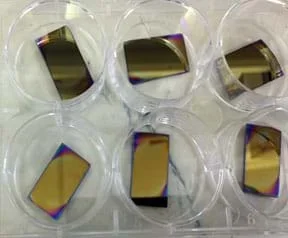 Polymer film with thickness variation.Copyright 2014 Ralph Cox, Rice University
Students learn about the statistical analysis of measurements and error propagation, reviewing concepts of precision, accuracy and error types. This is done through calculations related to the concept of density. Students work in teams to each measure the dimensions and mass of five identical cubes, compile the measurements into small data sets, calculate statistics including the mean and standard deviation of these measurements, and use the mean values of the measurements to calculate density of the cubes. Then they use this calculated density to determine the mass of a new object made of the same material. This is done by measuring the appropriate dimensions of the new object, calculating its volume, and then calculating its mass using the density value. Next, the mass of the new object is measured by each student group and the standard deviation of the measurements is calculated. Finally, students determine the accuracy of the calculated mass by comparing it to the measured mass, determining whether the difference in the measurements is more or less than the standard deviation.
Measurement, and the ability to determine the accuracy and precision of any given measurement, is the basis of all science, technology and engineering. For instance, the ability to measure and produce mass market goods that precisely reproduce specific measurements enables the availability of inexpensive cables that reliably connect computers to printers. It also results in the manufacture of memory devices that plug easily into sockets of a motherboard. In this activity, students learn how to determine the certainty of their measurements, and then use the measurements to compute various variables. The statistics used in this activity form the basis for applications used across various fields of engineering and science, from determining whether a population has a higher rate of a certain illness, to proving that a photon can act like a particle. For many engineers, the accuracy and precision of the measurements in their designs affects public safety. For example, civil engineers who design structures such as buildings and bridges and mechanical and aerospace engineers who design vehicles such as cars, planes and spacecraft must ensure that all measurements are accurate so that their finished designs function correctly and safely.
After this activity, students should be able to:
- Demonstrate that a measurement is accurate and precise by citing specific proof from procedures and instruments used.
- Describe the difference between random and systematic errors, giving several examples of systematic errors and what can be done to avoid such errors.
- Calculate a random error using standard deviation, assuming that the measurements are normally distributed.
- Explain the difference between calculated and measured values.
- Students will develop an understanding of the role of troubleshooting, research and development, invention and innovation, and experimentation in problem solving.
Grades K-12
Do you agree with this alignment?
- HS-ETS1-2 Design a solution to a complex real-world problem by breaking it down into smaller, more manageable problems that can be solved through engineering.
Grades 9-12
This resource focuses on the following Three Dimensional Learning aspects of NGSS:
Science & Engineering Practices- Design a solution to a complex real-world problem, based on scientific knowledge, student-generated sources of evidence, prioritized criteria, and tradeoff considerations.Do you agree with this alignment?
Disciplinary Core Ideas- Criteria may need to be broken down into simpler ones that can be approached systematically, and decisions about the priority of certain criteria over others (trade-offs) may be needed.Do you agree with this alignment?
Do you agree with this alignment? - Design a solution to a complex real-world problem, based on scientific knowledge, student-generated sources of evidence, prioritized criteria, and tradeoff considerations.
- make measurements with accuracy and precision and record data using scientific notation and International System (SI) units;
Grades 9-12
Do you agree with this alignment? - identify and quantify causes and effects of uncertainties in measured data;
Grades 9-12
Do you agree with this alignment? - communicate valid conclusions supported by the data through various methods such as lab reports, labeled drawings, graphic organizers, journals, summaries, oral reports, and technology-based reports; and
Grades 9-12
Do you agree with this alignment? - collect data and make measurements with accuracy and precision;
Grades 10-12
Do you agree with this alignment? - organize and evaluate data and make inferences from data, including the use of tables, charts, and graphs;
Grades 9-12
Do you agree with this alignment?
Each group needs:
- caliper (or other tool to measure linear dimensions, such as a ruler)
- electronic scale (or a balance)
- 5 identical cubes*
- 5 identical rectangular prisms*
- (optional, for advanced students) 5 identical pyramids*
- calculator with statistical functions
- lab notebooks (or other paper for documenting measurements and making calculations)
- materials for final product deliverable (determined by the teacher; might include paper and markers, computer and software, etc.)
- Density and Statistics Practice Sheet (PDF), one per student
- Activity Rubric (PDF), one per group
* Note about the blocks: Have available a supply of small cubes, rectangular prisms and (optional) pyramids made of the same material, such as wood; for example, this kit of 96 wooden geosolid shapes https://www.hand2mind.com/item/wooden-geosolids-classroom-kit-set-of-96
Students must be able to measure length and mass, collect data and make calculations in lab notebooks, and be familiar with the use of a calculator's statistical functions. Students should also be familiar with the following statistics concepts—the center and spread, mean, median, mode, and standard deviation—and know how to calculate each statistical measure for a given set of data.
If you are framing a house, you need to measure the wood and cut it so that it fits together in such a way that the house can be built. If you want to hang curtains in a window, you need to measure the width and length of the window and buy or make curtains that fit in that space. If you want a new bed for your room, how do you make sure the bed fits in the space?
Accurately and precisely measuring objects is important in science, engineering and life in general. While the ability to take an accurate measurement is important, the ability to know whether the measurement is good or not matters the most. In science, for instance, everything you do must be reproducible, that is, someone else must be able to conduct the same experiment or research exactly as you did and get the same results. The same reproducibility is true for manufacturing the cables used in your video game system or computer. For example, any USB cable you purchase is expected to fit in the USB port.
As another example, suppose you prepared a solution that, when the solvent is evaporated, would leave a uniform film on a surface, say a protective film on a car. In order to ensure that the film is always of the same thickness, you would need to measure the solvent and solute within a certain level of accuracy. This is one way that science is different from everyday life. In an everyday life example of making a flavored drink, you might just add about a cup of flavored powder to a glass of water and the result is a nice fruit flavored water. By contrast, in a science experiment, you must know exactly how much of each ingredient is used so someone else can reproduce the exact same result.
In this activity, you will engage in a multi-step process to solve a basic problem. Specifically, you will collect data and then use the data to predict a result. To do this, you will practice measuring accurately. You will learn how we can calculate how precise a measurement is, and how to precisely calculate how accurate values are. You will learn to use data to make predictions, and determine if those predication fall within the collected data.
Teacher Background
Even though measurement is the basis of science, engineering and even math, we seldom have enough time to teach measurement, much less how we know if a measurement is valid. While students are often introduced to the concepts of precision, accuracy, center and spread, they often do not know how these concepts relate to real measurements in terms of systematic and random error, or how spread can be a measure of precision and, if the measurement has been carefully done.
In addition, random error is expected in many applications and that expectation must be built into the problem analysis. For instance, when performing calculations on a computer using floating point, that is, a number represented in scientific notation, the result cannot be expected to be an exact value. That is, one seldom asks if the result of a calculation is equal to some desired value. Rather, one asks if the value is within a range, or truncates the value so that the random error is not an issue.
In this fun, hands-on activity, students discover why measurement is important and that consequences exist for poor measurements. This activity is ideal as a beginning-of-the-year team building activity for advanced students or an end-of-year review. The physics and chemistry concepts taught are basic, while the general science concepts are seldom tested.
Once a measurement is taken, the next step is to know how certain we are in that measurement. The certainty of a single measurement, of course, is zero. If we have several accurate measurements, we can assume that they form a normal distribution and calculate a standard deviation for the average. The standard deviation indicates the range of values in which we expect about 2/3 of the measurements to fall, and is an indication of the random error, assuming that all systematic errors have been eliminated.
Measured values are often used to determine a calculated value. In this case, we determine the error for the calculated value. For simplicity, we just substitute the standard deviations into the equation we use for whatever we want to calculate. For instance, in this activity we calculate density, which is mass divided by volume. If we have previously calculated a 0.001 kg error in the mass measurement, and a 0.01 m3 error in the volume measurement, then the error in our density calculated value is expected to be:
error in density = error in mass/error in volume = 0.001 kg/0.01 m3=0.1 kg/m3.
Then the calculated value can be used to determine some other value, which in turn can be used to validate the measurements.
Calipers and electronic scales are the recommended tools for this activity. If not available, then use any measurement tools.
This activity requires a set of blocks made of a common material. Make sure the blocks are big enough so accurate measurements can be made using the tools available. The first part of the activity assumes that cubes are used, while the second part uses any shapes, but rectangular prisms (as opposed to cubes) are the simplest. Advanced students may appreciate pyramids.
The final product for this activity is at the teacher's discretion. For example, all data and calculations may be documented in lab notebooks; alternatively, final products might be posters, full lab reports or group presentations. If requiring a deliverable, supply students with the necessary supplies and technologies, such as paper and markers and/or computer applications (spreadsheet and slide presentation software).
Review of statistics concepts and how to calculate them:
- mean = sum of all data divided by the total number of data points
- median = the middle value when all data is ordered from smallest to largest in value; if an even number of data points exists, the median is found by taking the mean of the two middle values
- mode = the value that occurs the most frequently in the data
- range = the difference between the largest data value and the smallest value
- standard deviation = the square root of the mean of the squared distance between each data point and the mean of the data; see the Additional Multimedia Support section for a good video help reference
Suggested timing: A total of 135 minutes divided into the following segments: inquiry: 35 minutes; data collection: 30 minutes; analysis: 20 minutes; application: 30 minutes; synthesis: 20 minutes.
Before the Activity
- Gather materials and make copies of the Density and Statistics Practice Sheet (PDF) and Activity Rubric (PDF).
- Each group needs a calculator, caliper or ruler, and five identical cubes.
- (optional) If you also want students to create box and whisker plots, provide instructions for them on how to do this. See the Additional Multimedia Support section for a good video help reference.
- In advance of the first (inquiry) portion of the activity, write on the classroom board an example of five measurements; any set of measurements will suffice. For instance, if we measured the edge dimensions of various 1 cm cubes, we might get results of 0.95 cm, 1.02 cm, 0.98 cm, 0.93 cm, 1.01 cm.
- If desired or necessary, review the following statistics concepts with students: the center and spread, mean, median, mode and standard deviation.
With the Students—Inquiry (35 minutes)
- Administer the practice calculations sheet, as described in the Assessment section.
- Present the Introduction/Motivation content to the class.
- Divide the class into groups of four students each.
- Have students write the data (the example five measurements written on the classroom board) in their lab notebooks and using their prior knowledge, calculate the center and spread, which can be an average and range. Then, direct students to work together in their small groups to discuss their solutions for the center and spread of this data set.
- Simultaneously, give each group an object and ask them to measure its length, defined as the longest dimension, using whatever instrument is supplied.
- After everyone has had time to calculate and measure, lead a class discussion to define the mean as a measurement of the center of the data and standard deviation as a measure of spread.
- Have one student come up and show how to use the calculator to determine the mean and standard deviation of the five measurements written on the board. Give everyone a chance to obtain the correct values and take notes on calculating the mean and standard deviation, if needed.
- Within their groups, direct students to compare their measurements for the length of their objects. If they are different, direct them to brainstorm why they might be different and decide if the differences are real or are measurement mistakes. Ask: What does the activity indicate about the nature of measurements?
- Discuss systematic error and have students write down in their notebooks the kinds of mistakes they might have made, noting them as systematic errors. Systematic errors are preventable errors, such as mistakes in measurement. For example, they occur if a balance scale is not set to zero or if graduated cylinders are not read level at the bottom of the meniscus.
- Discuss random error. These are not mistakes in measurement, but natural variation in the objects being measured or the instruments used. Small variations in measurement are to be expected, which is why it is best to take several measurements in order to compensate for random error.
- Discuss the concepts of accuracy and precision. An accurate reading is as free as possible of systematic error. A precise reading is based on the closeness of measurements to each other. A precise reading is not necessarily accurate.
- Have students decide if the measurements are accurate and precise. If not, have them make new measurements. Then have students calculate the mean and standard deviation using the best data measured by each student in the group.
- Have each group present its findings. Require students in each group to state how they minimized systematic error, for instance by zeroing the instrument or using the same procedure for each measurement. You may want to write a list of words on the board and require students to correctly use them their presentations. The presentation may include a box and whisker chart using the standard deviation as the half width of the box.
- Next, inform the class that they are going to calculate density of cubes. Ask: What is the equation for density? (Answer: d = m/v)
- Working together in their groups, direct students to identify the meaning and units for each variable in the density equation. Have them also think of two or three methods to measure each variable.
With the Students—Data Collection (30 minutes)
- Have students group into the same teams as before. Give each team five nominally identical cubes.
- Direct the teams to practice taking measurements of the cubes. After the practice and discussion of the measurements, have teams each develop and agree upon a procedure to minimize systematic errors and maximize accuracy and precision. Direct them to record the procedure in their notebooks so it is consistently used for all measurements.
- Ask every member of the team to measure and record, in their notebooks, a single dimension of each of the five cubes. That means that each student records at least five measurements.
- Have each team use all values collected within the team to individually calculate the mean and standard deviation of the lengths. In the notebooks, record the results as <l> ± σ.
- Then have each student use his or her results to calculate the cube volume: V = l 3. Use the standard deviation of the measured values to calculate the standard deviation for the volume. Again, document the calculation in the notebook and report the value as <V> ± σ.
- Have each student take two cubes and measure the mass of the cubes, recording it in their notebooks.
- Again, as a team, have students use all the measured masses to calculate the mean and standard deviation of the object mass, recording the results as <m>± σ in their individual notebooks.
With the Students—Analysis (20 minutes)
- Direct each team to calculate density, showing all work in their individual notebooks, along with a calculation of error using the error calculated for the volume and the standard deviation of the mass. Record the results in the notebook as <p>± σ.
- Have each team present to the class the detail of its chain of data and calculations. Direct the class to critique their work and make suggestions to improve the process.
- In all cases, expect students to discuss and write in their notebooks the methods used to reduce systematic error in their measurements, why the random error in the density may be higher or lower than in the parts (you may introduce the idea of manufacturing variability) and what the calculated error means in terms of the confidence in the calculated value. In particular, expect students to correlate a lower error to a higher confidence.
With the Students—Application (30 minutes)
- At this stage, direct teams to each use the density calculated for the material to calculate mass for a new block. Each member receives an identical block and the team decides which dimensions need to be measured to calculate the volume of the block. You can scaffold for each team by providing a rectangular prism requiring two or three dimensions, or even a pyramid. Each student measures his or her own block and records the data in his/her notebook. Then each student copies the data from other notebooks for one dimension and independently calculates the mean and standard deviation. The team must decide if the means and standard deviation agree, and if the standard deviation is reasonable, write a sentence to justify it. If they cannot, then they either re-measure and/or re-calculate.
- Next, the volume is calculated, along with the error.
- Once the volume is known, direct the team to use algebra or unit analysis to solve for the mass. They must use the volume and density to calculate the mass. Then they do the same for the error, showing all work in their notebooks, and reporting the value as <m> ±σ.
- Finally, groups weigh each block and determine a mean and standard deviation, recording all data and calculations in their notebooks.
With the Students—Synthesis (20 minutes)
- Have students compare this measured value to the calculated value and report if the two values fall within the error. If it does not, the team must write a statement describing systematic or random error that explains the discrepancy.
- Conclude by have students each write a paragraph in the lab notebook stating the results and explaining why it is important that the mass fall within a range of values rather than requiring an "exact" value.
- calculated value
- A value that is calculated based on physical measured data.
- density
- The mass of an object divided by its volume.
- mean (average)
- The expected central value for a set of data.
- measured value
- A physical quantity that is directly measured.
- random error
- An error that occurs due to variation in instruments and/or other random effects that cannot reasonably be eliminated.
- standard deviation
- The expected spread from the mean for a set of data.
- systematic error
- An error that occurs due to mistakes in using instruments or other protocol errors that can and should be eliminated.
Pre-Activity Assessment
Practice Calculations: Before starting the lesson, use the eight-question Density and Statistics Practice Sheet (PDF) to assess students on their ability to calculate densities, given mass and volume. Have them use calculators to determine mean and standard deviation. The sheet is set up for the instructor to use the odd-numbered problems for class demonstration, while even-numbered problems are completed by students on their own. Students need not fill out all boxes—just enough to indicate that they understand the process to solve the problem.
Activity Embedded Assessment
Calculations: At each step, each student must calculate a mean and standard deviation as well as an error for any calculated values. Students must document the data and work in their notebooks to support the conclusions. Check these calculations to assess student understanding and progress.
Post-Activity Assessment
Activity Results: Review student work to gauge their engagement and depth of comprehension. Each student must have a set of mass and volume data. They must have calculated the mean and standard deviation. If students have drawn box and whisker plots for the mass and volume, expect them to have reflected on the meaning of the plot in terms of the reasonableness of the data.
Questioning: To support the final product, discuss as a class the following questions:
- Why can we only have one value for each dimension even though we have several values that may vary? (Answer: For each dimension, only one nominal value can exist.)
- State several causes of the variation in the measurements. (Example answers: Error in measurement, variation in manufacturing, variation in the instrument, variable zero offset on the instruments.)
- If one was to take 10 measurements and all were the same, would those measurements be considered accurate or precise? Justify your conclusion. (Answer: If the 10 measurements were all the same, we would consider the measurements to be precise. Unless we know the true value for what is being measured, we cannot determine if the measurements are accurate.)
- Suppose your measurements had three times the variation (range) of your neighbor's measurements. What could that variation mean in terms of accuracy and systematic error? (Answer: Assuming that both groups are using similar instruments and similar objects, the group with the greater variation likely has additional systematic error and thus their measurements are not accurate.)
- How does the variation in your measurements affect your confidence in your measurements? (Answer: A higher variation in measurements typically indicates a lower confidence that results in a lower precision.)
- For your set of measurements, do you think that the variation could have been reduced? Justify your answer. (Answer: Expect students to generally answer yes, the variation could have been reduced, and give suggestions on how to reduce error in the measurements.)
- Why may your average measurement be different from another person's measurement of the same dimension, yet both be accurate measurements? (Answer: The average is a center, while the standard deviation defines reasonable values around that center. Specifically, if two stated values are within three times the standard deviation, then the values are considered statistically equal. For instance a value of 1±0.1 and 1.1±0.05 are consistent, the latter with a greater precision.)
- Consider the manufacture of a 1 cm cube. Why might it be better to specify a range of values for the manufacture of the cube, say 1±0.05 cm, rather than just 1 cm? (Answer: It would be expensive, if not impossible, to make a 1 cm cube to an arbitrary precision. By specifying a tolerance, a machinist knows that 1.05 cm is acceptable and 0.95 cm is acceptable, as well as any length in between.)
Rubric: Use the Activity Rubric (PDF) to grade this activity on a 1-13 scale. The rubric includes the notebook as well as a product, lab report, presentation or other "final product" required by the teacher. In general, a grade of "13" exceeds all expectation, while an "8" or below does not meet the activity requirements.
Calipers can be very sharp and delicate so handle them with care.
- Make sure students know how to "zero" each instrument.
- Make sure the blocks you provide are manufactured to result in some variation in their dimensions. For instance, LEGO® blocks are manufactured to tight specifications and show little variation even when using calipers to take measurements. In other words, buy inexpensive blocks.
- One objective of this activity is to reinforce precise measurements. Expect some students to obtain results like "2 cm" or simply measure once and write down the result five times. Do not accept this. Particularly when rulers are used, require students to estimate to the last decimal; that is, look between the scale lines. This activity only works if students are encouraged to take measurements more seriously than they have, perhaps, been required to in the past.
- If each group has computer access, set up the mean and standard deviation in a spreadsheet. This makes troubleshooting the calculations easier and provides a visual reference for the data.
- For middle and ninth grade (younger) students, it may be necessary to go into great detail about what is expected in a lab notebook.
- For higher grades, it may be sufficient to just state that the data is expected to be organized, calculations to be legible, and that the process detailed in the notebook will be graded.
- Have advanced students use pyramid-shaped blocks.
- Have advanced students determine the value of their second set of blocks and compare that volume to calculated values. They can calculate the error in the volume and decide if the values match to one standard deviation.
For support on teaching students how to create box and whisker plots, see Constructing a Box and Whisker Plot at https://www.khanacademy.org/math/probability/descriptive-statistics/box-and-whisker-plots/v/constructing-a-box-and-whisker-plot (8:17 minutes)
For additional review of calculating the standard deviation, see Population Standard Deviation at https://www.khanacademy.org/math/probability/descriptive-statistics/variance_std_deviation/v/population-standard-deviation (8:05 minutes); note this is population standard deviation as opposed to sample standard deviation
Contributors
Ralph Cox
Supporting Program
Nanotechnology RET, School Science and Technology, Rice University
Acknowledgements
This material was developed based upon work supported by the National Science Foundation under grant no. EEC 1406885—the Nanotechnology Research Experience for Teachers at the Rice University School Science and Technology in Houston, TX. Any opinions, findings and conclusions or recommendations expressed in this material are those of the authors and do not necessarily reflect the views of the National Science Foundation.
Copyright
2015 by Regents of the University of Colorado; original © 2014 Rice University