
Light-Up Plush Pals
Students make their own design decisions about controlling the LEDs in a light-up, e-textile circuit, plush toy project that they make using LilyPad ProtoSnap components and conductive thread. They follow step-by-step instructions to assemble a product while applying their own creativity to customize it. They first learn about the switches—an on/off switch and a button—exploring these two ways of controlling the flow of electric current to LEDs and showing them the difference between closed and open circuits. Additionally, students learn how microcontrollers can be programmed to manage LED patterns, using simple coding concepts that let them personalize light sequences. Then they craft their creative light-up plush pals made from sewn and stuffed felt pieces (template provided) that include sewn electric circuits. Through this sewable electronics project, students gain a familiarity with microcontrollers, circuits, switches and LEDs—everyday items in today’s world and the components used in so many engineered devices.
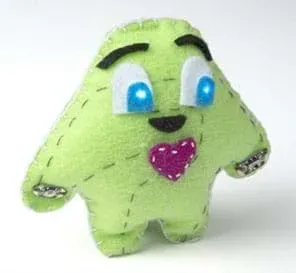 Light-up plush pals can be personalized and creative!Copyright 2016 SparkFun Education CC BY-SA 4.0 https://cdn.sparkfun.com/assets/learn_tutorials/4/7/1/Examples_Green.jpg
E-textiles are a progressively significant contributor to the wearable electronics industry and a further evolution in the use of microcontrollers. Engineers design soft and flexible e-textiles that do not get too hot to wear or malfunction in the rain. E-textiles are made possible through contributions from computer and electrical engineers who design the components, such as current-controlling switches, and circuitry, as well as fashion designers and artists who make attractive and thematic products. The LilyPad microcontroller used in this activity is specifically designed to be sewn into fabrics like clothing and toys by using conductive thread rather than conventional metallic wires. Computer scientists work with e-textile engineers to program microcontrollers that manage light sequences, interactive effects, and even sensors in smart fabrics.
After this activity, students should be able to:
- Describe how buttons and switches operate in circuits.
- Explain the difference between closed and open circuits.
- Demonstrate basic sewing skills.
- Energy comes in many forms such as light, heat, sound, magnetic, chemical, and electrical
Grade 4
Do you agree with this alignment? - Show that electricity in circuits requires a complete loop through which current can pass
Grade 4
Do you agree with this alignment? - Describe the energy transformation that takes place in electrical circuits where light, heat, sound, and magnetic effects are produced
Grade 4
Do you agree with this alignment?
- Energy comes in different forms.
Grades 3-5
Do you agree with this alignment? - Tools, machines, products, and systems use energy in order to do work.
Grades 3-5
Do you agree with this alignment? - STEL-1L Explain how technology and engineering are closely linked to creativity, which can result in both intended and unintended innovations.
Grades 6-8
Do you agree with this alignment? - STEL-8D Follow directions to complete a technological task.
Grades 3-5
Do you agree with this alignment?
- 4-PS3-4 Apply scientific ideas to design, test, and refine a device that converts energy from one form to another.
Grade 4
This resource focuses on the following Three Dimensional Learning aspects of NGSS:
Science & Engineering Practices- Apply scientific ideas to solve design problems.Do you agree with this alignment?
Disciplinary Core Ideas- Possible solutions to a problem are limited by available materials and resources (constraints). The success of a designed solution is determined by considering the desired features of a solution (criteria). Different proposals for solutions can be compared on the basis of how well each one meets the specified criteria for success or how well each takes the constraints into account.Do you agree with this alignment?
- Energy can also be transferred from place to place by electric currents, which can then be used locally to produce motion, sound, heat, or light. The currents may have been produced to begin with by transforming the energy of motion into electrical energy.Do you agree with this alignment?
- The expression "produce energy" typically refers to the conversion of stored energy into a desired form for practical use.Do you agree with this alignment?
Crosscutting Concepts- Science affects everyday life.Do you agree with this alignment?
- Energy can be transferred in various ways and between objects.Do you agree with this alignment?
- Engineers improve existing technologies or develop new ones.Do you agree with this alignment?
- Most scientists and engineers work in teams.Do you agree with this alignment?
Do you agree with this alignment? - Apply scientific ideas to solve design problems.
Each student/plush needs:
- ProtoSnap - LilyPad E-Sewing Kit, such as at Seed Studio; includes a pre-wired coin cell battery holder, button board, slide switch and five white LEDs, plus a needle set, bobbin of conductive thread, 20mm coin cell battery
- 3 LEDs (use 3 of the 5 LEDs included in e-sewing kit)
- 3V coin cell battery, AKA a 20mm coil cell battery (included in e-sewing kit)
- sewing needle (included in e-sewing kit)
- conductive thread 3+ feet per plush toy (included in e-sewing kit)
- 1+ craft felt sheet, one 9 x 12-inch piece makes one plush; (optional) some students may want an extra half-sheet of craft felt to adhere/sew to the plush and cover the stitching
- Light-Up Plush Pals Template (PDF)
To share with the entire class:
- sewing or embroidery thread, for sewing together the plush and adding decorations
- pens, markers or chalk
- stuffing for plush pal, such as fiberfill, cotton batting, cotton balls, fabric scraps
- hot glue guns and hot glue sticks, for placement of components
- scissors
- (optional) craft supplies for decoration, such as additional colored felt, feathers, sequins, beads, buttons, faux fur, adhesive Velcro dots
Knowledge of basic circuitry, namely current flow. Ability to stitch with a needle and thread.
Have you ever ridden your bike at night? Did you wear reflective clothes or put flashing lights on your backpack or bike? Do you think it would be easier if you had lights built into your clothes? Not just regular lights, but LEDs that flash colors in different patterns. LED patterns are often controlled by code that runs on a microcontroller—similar to how engineers create patterns in smart fabrics and wearable tech. LEDs produce light electronically. They convert electrical energy into light. They don’t get hot like the light bulbs used in many lamps and they have a longer lifetime of use.
Engineers designed LEDs and light–up clothes are just one way that engineers use electronic textiles, also called e-textiles. A textile is a fabric or cloth. What are some other examples of e-textiles you can think of? (Listen to some student ideas.)
We are going to make our own e-textiles with different LEDs that turn on and off when we press a button or slide a switch. Using the E-Sewing ProtoSnap, we’ll examine how buttons and switches behave differently, then snap the pieces apart and design them into a plush pal with light-up features.
Buttons and switches are electronic components that control the flow of electricity through a circuit. The circuit is closed when current is permitted through by turning on a switch or pressing a button. When a piece of the circuit is disconnected by turning off a switch or button, it is an open circuit. Let’s take a look at the E-Sewing ProtoSnap!
Background
Provide students with more info on LEDs using this link: https://www.energystar.gov/products/lighting_fans/light_bulbs/learn_about_led_bulbs
If unfamiliar with sewable electronics, take a look at these SparkFun tutorials:
Before the Activity
- It is beneficial if the teacher completes a light-up plush pal him/herself prior to guiding the activity.
- Gather materials and make copies of the Light-Up Plush Pals Template (PDF), one per student.
- Cut the conductive thread to length for each student.
With the Students
- Open with the Introduction/Motivation section
- Conduct a pre-activity assessment to guide students to explore the two types of switches (on/off-maintained, button-momentary) and verify their understanding of open/closed circuits. To avoid premature disassembly, before distributing the LilyPad ProtoSnap panels, direct students to keep them intact at this point.
- LilyPad Slide Switch: Let students examine the slide switch labeled ON/OFF (see Figure 1). What happens when the toggle is moved to ON? (Answer: When the toggle is moved to the ON position, the two sew tabs on the switch are connected, allowing current to flow through and close the circuit.) What happens when the toggle is moved to OFF? (Answer: When moved to OFF, parts inside the switch move away from each other and open the circuit, disconnecting it.) Visualize switches as drawbridges for electricity—when the bridge is up (open), nothing can cross over. When it is down (closed), the pathway is reconnected, and electricity can flow along the original path—when the bridge is down (closed), cars can drive across the bridge. This switch is an example of a maintained switch—it remains in the same state until changed.
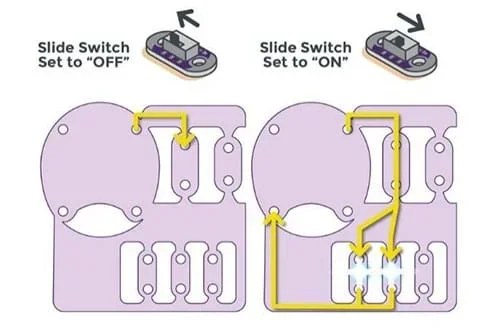 Figure 1. The LilyPad ProtoSnap components are wired together and include an ON/OFF switch.Copyright 2016 SparkFun Education CC BY-SA 4.0 https://cdn.sparkfun.com/assets/learn_tutorials/4/7/1/ProtoSnapSwitch.jpg
- LilyPad Button Board: The LilyPad button board is another type of switch. Try pressing the button on the ProtoSnap to see how it controls the LED (see Figure 2). What happens when you press the button in the middle of the board? (Answer: When you press the button in the middle of the board, it connects the two sew tabs and allows current to flow through.) What happens when you let go of the button? (Answer: When you let go of the button, the connection is opened again, and the button springs back into place.) This button is an example of a momentary switch—it is only active when an action is applied.
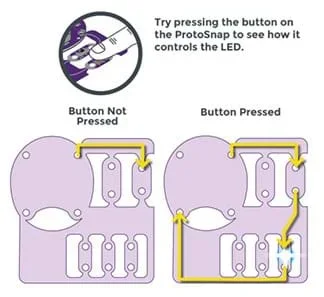 Figure 2. The wired-together LilyPad ProtoSnap components include a button board switch.Copyright 2016 SparkFun Education CC BY-SA 4.0 https://cdn.sparkfun.com/r/600-600/assets/learn_tutorials/4/7/1/ProtoSnapButton.jpg
- Direct students to trace and cut out the plush template shape on a piece of felt.
- Next, direct students to carefully snap apart the connected components on the E-Sewing ProtoSnap panel (see Figure 3). Doing this leaves them each with six LilyPad pieces: battery holder with battery, three LEDs, button, and switch. Discard the non-sewable pieces and scraps.
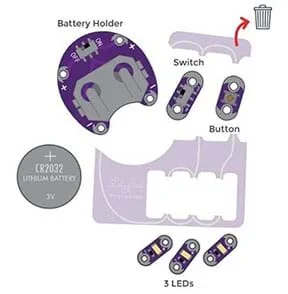 Figure 3. Use the components from the panel and discard the scraps.Copyright 2016 SparkFun Education CC BY-SA 4.0 https://cdn.sparkfun.com/assets/learn_tutorials/4/7/1/ProtoSnapBreak.jpg
- Direct students to arrange the pieces on the cutout felt shape according to the template and trace the circuit from the template onto the felt. Then, use dabs of hot glue to attach the components to the felt for easier sewing. Before gluing, remind them to make sure to check the orientation of the LEDs before they stitch them together: the positive tabs of the LED connect to the button or switch, and the negative tabs connect to the negative tab on the battery holder.
- Positive connections: Follow these steps to sew the positive connections, which start with the positive + tab of the battery holder, and include the switch, two LEDs near the top (positive tabs), button, and end with the last LED (positive tab) in the middle of the felt shape. Refer to Figure 4 and the template for the sewing path and positive/negative orientation of components.
- Direct students to each thread a needle with the conductive thread and tie a knot at the end. It is recommended that they begin sewing at the positive sew tab on the battery holder closest to the fold or “feet” on the felt cutout, as shown in Figure 4. As they sew, advise students to use three to four loops around each tab.
- With a new piece of thread, have students follow the sewing path to connect the other side of the switch to the positive sew tabs of the top two LEDs and end with three to four loops on the closest tab of the button. Tie and cut.
- With a new piece of thread, begin at the other side of the button and stitch three to four loops around the sew tab. Continue stitching to the positive side of the last LED (the one in the middle of the felt shape), ending with three to four loops. Tie and cut.
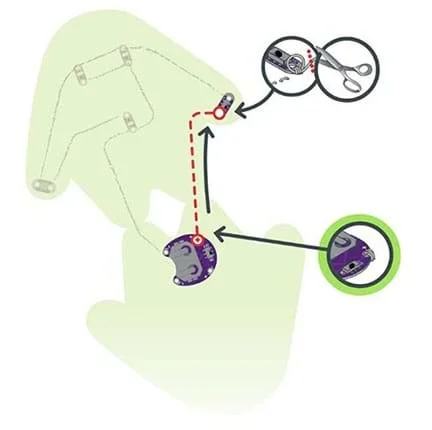 Figure 4. To make the positive connections, begin by sewing from the + tab of the battery holder to the switch.Copyright 2016 SparkFun Education CC BY-SA 4.0 https://cdn.sparkfun.com/assets/learn_tutorials/4/7/1/PlushSwitchStitch.jpg
- Negative connections: Continue with the conductive sewing by directing students to next stitch together the negative connections by following the circuit they traced onto the felt. With a new piece of thread that is at least 2 feet long, stitch three to four loops on the negative (–) sew tab of the first LED and connect to the negative tabs on the other LEDs, ending at the negative tab of the battery holder (see Figure 5). Again, remind students to make sure to loop three to four times on each connection.
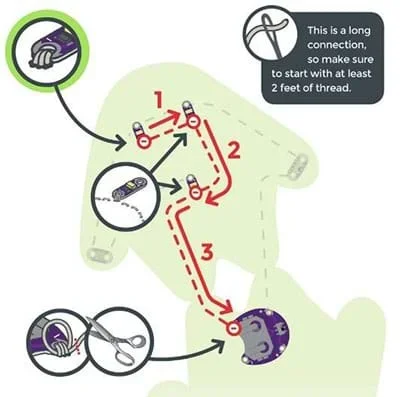 Figure 5. To connect the negative connections of the circuit, sew along the red dashed line that connects the various negative tabs.Copyright 2016 SparkFun Education CC BY-SA 4.0 https://cdn.sparkfun.com/assets/learn_tutorials/4/7/1/PlushNegative.jpg
- When the conductive sewing is done to create the circuit, direct students to turn over the felt cutouts and trim any loose thread tails before testing the circuits with batteries.
- Insert the coin cell battery into the battery holder with the positive (+) side facing up. Press the button and slide the switch to verify that the LEDs light up. If they do, remove the battery and move on to personalize the light-up plush pal with finishing decorating touches.
- As a finishing decorating option to hide the conductive thread stitches entirely, students may want to cut out from an extra half-sheet of felt the shape of half of the template to place on top of their finished plushes. If they do this, advise them to make cutouts for the LEDs, button and switch to make sure the LEDs shine through the top layer and the button and switch remain accessible.
- With the battery removed, direct students to fold the felt at the connected points (feet) at the bottom so the LilyPad components are on the outside. Using non-conductive sewing or embroidery thread (or a glue gun), direct students to seal all but two inches at the top of the plush, which gives them an opening to push in the stuffing.
- Have students push fiberfill stuffing into the top hole to fill the plush and give it a plump shape. Then direct them to stitch closed the opening using regular sewing or embroidery thread to wrap up the project.
- Then, encourage students to creatively customize their individual plush pals using any available decorations. One idea is to make a small flap of Velcro and felt to hide/protect the battery holder.
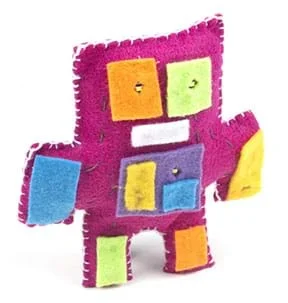 The customizing possibilities are endless!Copyright 2016 SparkFun Education CC BY-SA 4.0 https://cdn.sparkfun.com/assets/learn_tutorials/4/7/1/Example_Robot.jpg
- Conclude by having students individually show and share their plush pals to the class, as described in the Assessment section.
- conductive thread
- Thread spun of stainless steel (or silver-coated nylon) that carries current just like wires so that it can be used to create circuits that are flexible and require no soldering and thus are suitable for textile-based projects that use embedded electronics. Conductive thread tends to be more “twisty,” and so more difficult to sew with than non-conductive (regular) thread.
- electric current
- The flow of electrons in a circuit.
- electrical circuit
- A path that facilitates electrical flow.
- light-emitting diode
- A type of semiconductor diode that converts electrical energy into light. Because they produce light electronically, they do not get as hot as regular light bulbs and last a long time. Abbreviated as LED.
- maintained switch
- An electrical switch that remains in the same state until changed.
- momentary switch
- An electrical switch that is only active when an action is applied.
Pre-Activity Assessment
Circuit Understanding: Guide students to explore the LilyPad slide switch and button board using the suggested prompts in the Procedure section. During the exploration, assess and amend students’ understanding of the switches and circuit functionality before moving on.
Activity Embedded Assessment
Helping Hand: As students construct their circuits, see who needs help with sewing or understanding the circuit. Explain that when creating e-textile circuits, both the electrical properties of a working circuit and aesthetic decisions for the finished product are entwined as part of the design process. Observing students’ work and listening to their questions gives you the opportunity to gauge their depth of understanding of the circuitry, components and overall project.
Energy Conversion: Have students discuss the energy conversion that takes place in an LED.
Post-Activity Assessment
Show and Share: Give each student a few minutes to present his/her final plush creation to the rest of the class, explaining the choices made with the circuit switches. Who has designed a plush pal that is different from the rest? Does it perform the same as the others? Is the design deviation an advantage?
- Needles can cause injury if used carelessly. Advise students to use them with intention and be especially careful around their faces and eyes.
- Hot glue and the hot glue gun tip can cause minor burns so advise students to be deliberate and careful when using hot glue guns.
- Breaking apart the LilyPad ProtoSnap panel can result in sharp pieces so advise students to be mindful of this and assist them as needed to prevent injury.
- Always remove the battery when working on the circuit to avoid damaging the components.
- If the circuit does not light up (or is dim), try a new battery and/or check that the project is switched on.
- Check sewing for any loose threads or ends that may be touching other parts of the circuit and causing a short circuit.
Have students create new plush pals without the provided template. Student-made templates reveal their comprehension of circuits and open up the project for more creativity.
- For lower grades, save time by pre-cutting felt into the template shape and let students customize their plush pals. If circuitry concepts are too elevated for the students, focus on explaining how current flows when the circuit is open versus closed. Relate the flow of electricity to water through a dam with a plugged or unplugged hole. Have students trace with their fingers the current flow on the microcontroller when the circuit is closed and open. Also, have an adult break apart the LilyPad Protosnap panels.
- For higher grades, disregard the provided template and have students design their own plush pal shapes and circuit designs. Before they begin sewing, check to make sure current will flow through their customized circuits.
Activity adapted from SparkFun’s Light-Up Plush activity at https://learn.sparkfun.com/tutorials/light-up-plush.
Contributors
Angela Sheehan; Morgan Ulrich
Supporting Program
SparkFun Education
Copyright
2017 by Regents of the University of Colorado; original © 2016 SparkFun Education