
What Is the Best Insulator: Air, Styrofoam, Foil or Cotton?
That heat flows from hot to cold is an unavoidable truth of life. People have put a lot of effort into stopping this natural physical behavior, however all they have been able to do is slow the process. Student teams investigate the properties of insulators in their attempts to keep cups of water from freezing, and once frozen, to keep them from melting.
 Ice coolers work as insulators to keep drinks and food cold so that family picnics can be enjoyedCopyright U.S. Department of Agriculture http://snap.nal.usda.gov/family-having-picnic-park
Temperature regulation is important in many aspects of engineering. Packaging engineers design containers and systems to be able to reliably ship items at specific temperatures. Mechanical engineers make sure that working engines do not overheat, and electrical and computer engineers design electronics so that they do not overheat. Civil engineers specify the most suitable insulating materials for the climates where their structures reside. Temperature regulation applies an understanding of the principles of heat transfer, which is relevant in almost all engineering disciplines.
After this activity, students should be able to:
- Explain what "insulate" means and its implications in keeping things cold or warm.
- Conduct basic experimental processes.
- Describe how natural materials differ from human-made materials in terms of insulation.
- CCSS.Math.Content.3.MD.A.1 Tell and write time to the nearest minute and measure time intervals in minutes. Solve word problems involving addition and subtraction of time intervals in minutes, e.g., by representing the problem on a number line diagram.
Grade 3
Do you agree with this alignment? - CCSS.Math.Content.3.MD.B.3 Draw a scaled picture graph and a scaled bar graph to represent a data set with several categories. Solve one- and two-step "how many more" and "how many less" problems using information presented in scaled bar graphs.
Grade 3
Do you agree with this alignment?
- Identify and collect information about everyday problems that can be solved by technology, and generate ideas and requirements for solving a problem.
Grades 3-5
Do you agree with this alignment? - Compare, contrast, and classify collected information in order to identify patterns.
Grades 3-5
Do you agree with this alignment? - STEL-2I Describe the properties of different materials.
Grades 3-5
Do you agree with this alignment? - STEL-7J Evaluate designs based on criteria, constraints, and standards.
Grades 3-5
Do you agree with this alignment?
- 3.MD.A.1 Tell and write time to the nearest minute and measure time intervals in minutes. Solve word problems involving addition and subtraction of time intervals in minutes, e.g., by representing the problem on a number line diagram.
Grade 3
Do you agree with this alignment? - 3.MD.B.3 Draw a scaled picture graph and a scaled bar graph to represent a data set with several categories. Solve one- and two-step "how many more" and "how many less" problems using information presented in scaled bar graphs.
Grade 3
Do you agree with this alignment?
- Describe how water can be changed from one state to another by adding or taking away heat.
Grades 3-5
Do you agree with this alignment? - Give examples of how energy can be transferred from one form to another.
Grades 3-5
Do you agree with this alignment? - Identify materials used to accomplish a design task based on a specific property, e.g., strength, hardness, and flexibility.
Grades 3-5
Do you agree with this alignment?
- 4-PS3-2 Make observations to provide evidence that energy can be transferred from place to place by sound, light, heat, and electric currents.
Grade 4
This resource focuses on the following Three Dimensional Learning aspects of NGSS:
Science & Engineering Practices- Make observations to produce data to serve as the basis for evidence for an explanation of a phenomenon or test a design solution.Do you agree with this alignment?
Disciplinary Core Ideas- Energy can be moved from place to place by moving objects or through sound, light, or electric currents.Do you agree with this alignment?
- Energy is present whenever there are moving objects, sound, light, or heat. When objects collide, energy can be transferred from one object to another, thereby changing their motion. In such collisions, some energy is typically also transferred to the surrounding air; as a result, the air gets heated and sound is produced.Do you agree with this alignment?
- Light also transfers energy from place to place.Do you agree with this alignment?
- Energy can also be transferred from place to place by electric currents, which can then be used locally to produce motion, sound, heat, or light. The currents may have been produced to begin with by transforming the energy of motion into electrical energy.Do you agree with this alignment?
Crosscutting Concepts- Energy can be transferred in various ways and between objects.Do you agree with this alignment?
Do you agree with this alignment? - Make observations to produce data to serve as the basis for evidence for an explanation of a phenomenon or test a design solution.
- 5-PS1-3 Make observations and measurements to identify materials based on their properties.
Grade 5
This resource focuses on the following Three Dimensional Learning aspects of NGSS:
Science & Engineering Practices- Make observations and measurements to produce data to serve as the basis for evidence for an explanation of a phenomenon.Do you agree with this alignment?
Disciplinary Core Ideas- Measurements of a variety of properties can be used to identify materials. (Boundary: At this grade level, mass and weight are not distinguished, and no attempt is made to define the unseen particles or explain the atomic-scale mechanism of evaporation and condensation.)Do you agree with this alignment?
Crosscutting Concepts- Standard units are used to measure and describe physical quantities such as weight, time, temperature, and volume.Do you agree with this alignment?
Do you agree with this alignment? - Make observations and measurements to produce data to serve as the basis for evidence for an explanation of a phenomenon.
Each group needs:
- 4 3 oz. plastic cups
- 4 larger clear plastic cups
- 3 Styrofoam cups
- aluminum foil, 8½-in x 11-in piece
- 20 cotton balls
- teaspoon-sized spoon
- 4 rubber bands
- Data Chart (PDF), one per student, to be filled in during the experiment
- Results Chart (PDF), one per student, to be filled in after the experiment
To share with the entire class:
- pitcher of warm water
- plastic wrap
- baking pan
- large book or magazine
- freezer
 Copyright U.S. Department of Veterans Affairs http://www.milwaukee.va.gov/articles/dietician1.asp
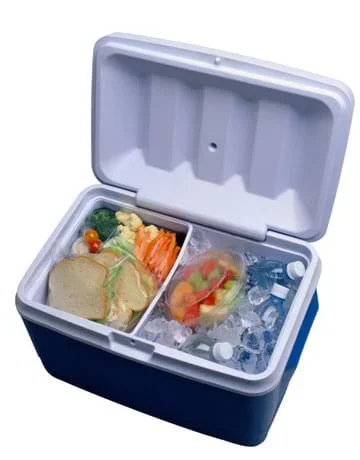
When you go to a summer picnic at a beach, in the mountains or at a lake, why do you put your cold drinks and ice in a cooler? What would happen if you put them in a backpack instead? (Listen to student ideas.) Yes, that's right, you would end up with a wet backpack and warm drinks. The cooler helps to keep the drinks cold because it acts as an insulator and slows the transfer of energy from one source to another, meaning it helps keeps the inside of the cooler cold and the heat out.
The opposite of an insulator is a conductor. What do you think a conductor does? (Listen to student ideas.) Yes, that's right, a conductor speeds up the transfer of energy from one source to another. You may have experienced this if you ever removed the lid to a pot cooking on the stove. A metal pot is a conductor and heats up quickly on the stove so that it cooks food or boils water faster. Just be careful before touching a metal pot because you could get burned.
What would happen if you designed a cooler using a material that acts as a conductor? Or a cooking pot with a material that acts as an insulator? (Listen to student ideas.)
Background
Insulation helps keep cold things from warming up and warm things from cooling down. Insulators do this by slowing down the loss of heat from warm things and the gaining of heat by cool things. Plastics and rubber are usually good insulators. It is for this reason that electrical wires are coated to make them more safe to handle. Metals, on the other hand, usually make good conductors. In fact, copper is used in most electrical wires and circuit boards for this reason.
Before the Activity
- Gather materials and make copies of the Data Chart (PDF) and Results Chart (PDF), one each per student.
- To minimize the time spent in the classroom, prepare the insulating materials (although students CAN do this!!).
- Break up the foam cups into small pieces.
- Tear the aluminum foil into pieces and loosely crunch up the pieces.
- Pull the cotton balls apart a little and flatten them so that they resemble pancakes.
With the Students
- Present the Introduction/Motivation content. As a class, discuss what types of devices students have seen or used to keep things warm or cold. Talk about the materials from which they think these devices are made.
- Divide the class into groups of two to four students each.
- Have students examine the insulating materials they are going to be given and have groups make predictions about which they think will work best.
- Hand out the materials and blank charts to each group.
- Give each team its supply of three different insulating materials: Styrofoam, aluminum foil and cotton balls. Air is the fourth insulating material. Have students place enough of each insulating material in each large plastic cup so that it covers the bottom of the cup. Put nothing in the fourth large cup because air will serve as the insulator for that cup.
- Place a small 3 oz. cup in the center of each large cup.
- Have students fill the space between the cups with the same insulating material they used on the bottom.
- Place 3 teaspoons of warm tap water in each small cup.
- Have each group cover each of its large cups with plastic wrap held on by a rubber band.
- Place the cups in the freezer. Check the cups every 15 minutes to see which cup forms ice first. Record observations in the data chart. Keep checking until you see ice form in all four cups.
- Let the cups sit in the freezer until the ice is frozen solid in all cups.
- Remove the cups from the freezer and place them in a baking pan.
- Place a book or a magazine on top of the cups to keep them from tipping or floating.
- Pour very warm tap water into the pan.
- Have teams check their cups every few minutes to see which seems to be melting first, second, third and fourth. Record observations in the data chart.
- Conclude with a class discussion to share and compare results and findings. Ask the Investigating Questions. Use the attached rubric to gauge student accomplishments.
- insulate
- To prevent or slow the transfer of electricity, heat or sound from one environment to another.
- conductor
- A substance or body that can allow electricity, heat or sound to pass through it.
- insulator
- A substance that resists the flow of heat, electricity or sound through it.
- heat
- A form of energy that causes substances to rise in temperature or go through associated changes (melting, evaporation or expansion).
- energy
- The capacity for doing work; can be in many forms such as electrical, mechanical, chemical, sound, light and heat.
- conservation of energy
- A physics principle that states that energy can neither be created nor destroyed and that the total energy of a system by itself remains constant.
- melt
- The process of changing from a solid to a liquid state through heat gain.
- freeze
- The process of changing from a liquid to a solid (as ice) by loss of heat.
Pre-Activity Prediction: Have students feel and examine the test insulating materials (Styrofoam, aluminum foil, cotton, air), and have groups make predictions about which they think will work best. Their predictions give some indication of their understanding of heat transfer and insulation concepts.
Embedded Assessment: Observe students during the experimental process. Evaluate their comprehension of the subject matter and activity engagement using the criteria provided in the Rubric for Performance Assessment (PDF), which considers their understanding of insulating materials and teamwork.
Homework: Ask students to write paragraph-long answers to the two following questions, to turn in the next day or share in a class discussion. Review their answers to gauge their comprehension of the activity content.
- Would you rather have gloves made of fabric or aluminum foil? Explain your choice using what you know about the properties of heat transfer. (Example answer: Fabric gloves would keep my hands warmer than foil gloves because fabric insulates our bodies, slowing down the time it takes for our hands to become cold. On the other hand, metals speed up the transfer of heat so any warmth in my hands prior to putting on "aluminum gloves" would quickly escape through the foil, leaving me with very cold hands.)
- List at least three different products, devices or structures for which engineers applied their understanding of heat transfer principles in designing systems or choosing materials for the purpose of temperature regulation. (Tip: Think what might be designed by packaging, mechanical, electrical, computer and civil engineers, maybe items you use every day for comfort, life-saving necessity and entertainment.) (Example answers: thermos beverage containers, ice cream cart coolers, refrigerated trucks to ship foods at specific temperatures, coolers used to store and transport donated blood and body parts to patients, insulating materials in house walls and roofs to keep the inside cool or warm, special materials and weaves of fabrics used for clothing designed for specific weather conditions, wires made of metal and coated in plastic, fans and the liquids in radiators to keep electronics and motors from overheating. Specific example: If the casing that surrounds a tablet computer or pocket computer was made of rubber, the device would become hot very fast, and too uncomfortable to hold.)
Graphing: Have each student create a bar graph of the time taken to freeze/melt water for each insulator used. Use data obtained from the Data Chart for the bar graph.
So students can experience first hand that foil is not a good insulator, extend the activity with this quick hands-on demonstration:
- Have each student wrap a cup with aluminum foil and another cup with paper.
- Pour ice water into the cups.
- Have students hold the cups in their hands to judge which material is the best insulator.
Kessler, James H. and Andrea Bennett. The Best of WonderScience: Elementary Science Activities. Boston, MA: Delmar Publishers, 1997. pp 207, 210-211. ISBN: 0827380941
Supporting Program
Center for Engineering Educational Outreach, Tufts University
Acknowledgements
The contents of this digital library curriculum were developed under a National Science Foundation GK-12 grant. However, these contents do not necessarily represent the policies of the National Science Foundation, and you should not assume endorsement by the federal government.
Copyright
2013 by Regents of the University of Colorado; original © 2004 Worcester Polytechnic Institute