
Designing Harmonic Timing Devices: Ready, Set, Escape
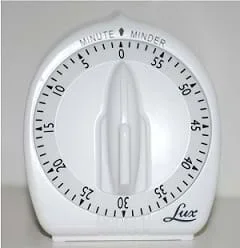 Students design timing devicesCopyright Wikimedia Commons http://upload.wikimedia.org/wikipedia/commons/e/e8/Lux_Products_Long_Ring_Timer.jpg
Students are asked to design simple yet accurate timing devices using limited supplies. The challenge is to create a device that measures out a time period of exactly three minutes in order to enable a hypothetical prison escape. Student groups brainstorm ideas using the different materials provided. They observe and explain the effects of conservation of energy.
Engineers continually challenge themselves to make better and more accurate devices, tools, systems and processes, including timing devices. Typically, engineering projects also must consider design constraints, which are requirements and limitations unique to the challenge.
After this activity, students should be able to:
- Describe the steps of the engineering design process.
- Explain the concept of conservation of energy in relationship to kinetic and potential energy.
- Describe simple harmonic motion.
- The design needs to be continually checked and critiqued, and the ideas of the design must be redefined and improved.
Grades 9-12
Do you agree with this alignment? - Energy cannot be created nor destroyed; however, it can be converted from one form to another.
Grades 9-12
Do you agree with this alignment? - STEL-1R Develop a plan that incorporates knowledge from science, mathematics, and other disciplines to design or improve a technological product or system.
Grades 9-12
Do you agree with this alignment? - STEL-2X Cite examples of the criteria and constraints of a product or system and how they affect the final design.
Grades 9-12
Do you agree with this alignment? - STEL-4R Assess a technology that minimizes resource use and resulting waste to achieve a goal.
Grades 9-12
Do you agree with this alignment? - STEL-7AA Illustrate principles, elements, and factors of design.
Grades 9-12
Do you agree with this alignment? - STEL-7CC Apply a broad range of design skills to their design process.
Grades 9-12
Do you agree with this alignment? - STEL-7DD Apply a broad range of making skills to their design process.
Grades 9-12
Do you agree with this alignment? - STEL-7W Determine the best approach by evaluating the purpose of the design.
Grades 9-12
Do you agree with this alignment? - STEL-7Y Optimize a design by addressing desired qualities within criteria and constraints.
Grades 9-12
Do you agree with this alignment? - STEL-8Q Synthesize data and analyze trends to make decisions about technological products, systems, or processes.
Grades 9-12
Do you agree with this alignment?
- Interpret and provide examples that illustrate the law of conservation of energy.
Grades 9-12
Do you agree with this alignment? - Interpret and provide examples of how energy can be converted from gravitational potential energy to kinetic energy and vice versa.
Grades 9-12
Do you agree with this alignment? - Describe the measurable properties of waves (velocity, frequency, wavelength, amplitude, period) and explain the relationships among them. Recognize examples of simple harmonic motion.
Grades 9-12
Do you agree with this alignment? - Identify and explain the steps of the engineering design process, i.e., identify the need or problem, research the problem, develop possible solutions, select the best possible solution(s), construct a prototype, test and evaluate, communicate the solution(s), and redesign.
Grades 6-8
Do you agree with this alignment?
- HS-ETS1-2 Design a solution to a complex real-world problem by breaking it down into smaller, more manageable problems that can be solved through engineering.
Grades 9-12
This resource focuses on the following Three Dimensional Learning aspects of NGSS:
Science & Engineering Practices- Design a solution to a complex real-world problem, based on scientific knowledge, student-generated sources of evidence, prioritized criteria, and tradeoff considerations.Do you agree with this alignment?
Disciplinary Core Ideas- Criteria may need to be broken down into simpler ones that can be approached systematically, and decisions about the priority of certain criteria over others (trade-offs) may be needed.Do you agree with this alignment?
Do you agree with this alignment? - Design a solution to a complex real-world problem, based on scientific knowledge, student-generated sources of evidence, prioritized criteria, and tradeoff considerations.
- string or shoelaces
- paper
- cardboard
- paperclips
- soap
- glue
- coins
- paper cups
- soda bottles
- stopwatch, for testing purposes only
- Pre-Activity Vocabulary Quiz (PDF)
- Student Handout (PDF)
Permit students to bring from home up to three additional simple items. Do not allow clocks, watches or any other devices that include pre-made timers.
Your Engineering Design Challenge: You have been taken prisoner in a foreign country. You are going to try to escape from the prison. In order to escape, you must time the movements of the guards exactly! You have to design a method of timing three minutes, which is the time it takes the guards to change posts, so you can make your break.
You will be able to use a timing device to check the accuracy of the device. No clock/watch may be used in the device itself. You will be graded on how close you come to the three minutes. Good Luck!
Before the Activity
- Gather materials and make copies of the Pre-Activity Vocabulary Quiz (PDF)and Student Handout (PDF).
- Administer the quiz; glance at student answers.
- Divide the class into groups of four students each.
- Distribute the materials and handouts.
With the Students
Read aloud to the class the design challenge (the Introduction/Motivation section). Remind students of the steps of the engineering design process. Then have groups proceed with the activity, as described on the handout.
- In groups, brainstorm ideas to complete the task (record all ideas).
- Make a list of three materials you would like to bring from home (may not include any timing devices).
- Choose the best solution.
- Get approval from your teacher on additional materials being brought in.
- Explain why that solution was chosen.
- Sketch your solution.
- Build a prototype.
- Test the prototype (record time).
- Redesign to get a more accurate time.
- engineering design process
- A series of steps used by engineering teams to guide them as they solve problems: define the problem, come up with ideas (brainstorming), select the most promising design, plan and communicate the design, create and test the design, and evaluate and revise the design. Also called the design-build-test loop.
- kinetic energy
- The energy of a moving body.
- potential energy
- The energy stored in a system.
- conservation of energy
- Energy can neither be created nor destroyed.
- simple harmonic motion
- A repeated motion around a central equilibrium position.
- pendulum
- A device with a mass attached to a fixed that oscillates around an equilibrium position.
- amplitude
- Maximum displacement from the equilibrium position.
- period
- The time it takes to complete one cycle of motion (back and forth).
Pre-Activity Assessment
Quiz: Before beginning the activity, administer the Pre-Activity Vocabulary Quiz (PDF) to gauge students' initial understanding of the vocabulary terms and concepts.
Activity Embedded Assessment
- Observe teamwork.
- Observe brainstorming and decision making processes.
- Note students' ability to observe and understand when the existence of kinetic and potential energy is in the system.
- See how students fill in the Student Handout (PDF) blanks and questions to gauge their depth of comprehension.
- Base the grades for the devices on how close to three minutes groups are able to measure time with the devices. Refer to the Example Grading Scale (PDF) for a suggestion on how to assign points.
Post-Activity Assessment
Homework Questions: Assign students to answer for homework the concluding questions at the end of the Student Handout (PDF). As a class, teview their answers the next day.
- When did your system have potential energy and when did it have kinetic energy?
- Were you able to observe conservation of energy in your system? If not, explain how it was conserved.
- Did your device follow simple harmonic motion? Explain.
- Do not permit use of candles or any type of open flame due to the fire hazard.
- Check that student designs do not include materials that might be safety hazards, such as falling objects, splashing water, etc.
Ask students to analyze the reasons for success or failure of their devices.
Discuss possible ways to improve accuracy of the devices.
Provide time for 2-3 redesigns.
- For lower grades, use a grading rubric that is more lenient to timing errors.
- For higher grades, permit fewer errors in timing.
Supporting Program
K-12 Outreach Office, Worcester Polytechnic Institute
Copyright
2013 by Regents of the University of Colorado; original © 2005 Worcester Polytechnic Institute