
Introduction to Biomimicry: Airborne Transport Design
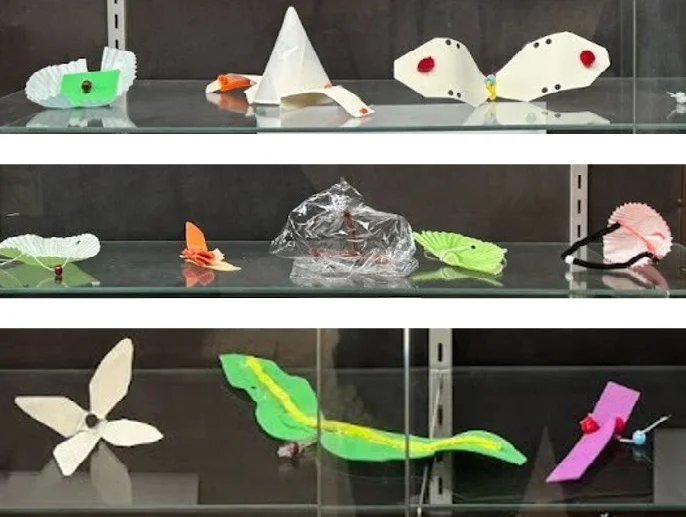 Examples of students’ biomimetic airborne transport devices.Copyright Tufts University Center for Engineering Education and Outreach and TERC
Students are introduced to biomimicry through an airborne transport design challenge inspired by wind-dispersed seeds and pollen. Students analyze the structures, properties, and actions of five plants adapted for wind dispersal. Working in teams, students apply their observations to design and build a nature-inspired device that carries a small payload through the air for at least 5 seconds and at least 2 feet from the drop location. Students test their prototypes, analyze their performance, exchange peer feedback, revisit their biological inspirations, and use evidence from testing and biological analysis to redesign and retest their devices.
When developing solutions, engineers may use biomimicry, a design approach that studies structures, functions, and processes found in nature and applies those insights to human challenges. Rather than simply copying an organism’s appearance, engineers investigate how biological structures perform specific functions. They can then translate useful characteristics, such as shape, size, flexibility, or surface features, into engineering designs. Biomimicry provides engineers with nature-inspired strategies for developing, testing, and improving innovative solutions to problems.
After this activity, students should be able to:
- Apply the concept of structure and function to analyze how seeds and pollen get carried through the air.
- Implement a biomimetic design process.
- Investigate the strengths and weaknesses of different nature-inspired design ideas.
- STEL-1J Develop innovative products and systems that solve problems and extend capabilities based on individual or collective needs and wants.
Grades 6-8
Do you agree with this alignment? - STEL-7U Evaluate the strengths and weaknesses of different design solutions.
Grades 6-8
Do you agree with this alignment?
- CCC.6.6-8.4 Complex and microscopic structures and systems can be visualized, modeled, and used to describe how their function depends on the relationships among its parts, therefore complex natural structures/systems can be analyzed to determine how they function.
Grades 6-8
Do you agree with this alignment? - MS-ETS1-1 Define the criteria and constraints of a design problem with sufficient precision to ensure a successful solution, taking into account relevant scientific principles and potential impacts on people and the natural environment that may limit possible solutions.
Grades 6-8
This resource focuses on the following Three Dimensional Learning aspects of NGSS:
Science & Engineering Practices- Define a design problem that can be solved through the development of an object, tool, process or system and includes multiple criteria and constraints, including scientific knowledge that may limit possible solutions.Do you agree with this alignment?
Disciplinary Core Ideas- The more precisely a design task's criteria and constraints can be defined, the more likely it is that the designed solution will be successful. Specification of constraints includes consideration of scientific principles and other relevant knowledge that is likely to limit possible solutions.Do you agree with this alignment?
Crosscutting Concepts- The uses of technologies and any limitations on their use are driven by individual or societal needs, desires, and values; by the findings of scientific research; and by differences in such factors as climate, natural resources, and economic conditions.Do you agree with this alignment?
- All human activity draws on natural resources and has both short and long-term consequences, positive as well as negative, for the health of people and the natural environment.Do you agree with this alignment?
Do you agree with this alignment? - Define a design problem that can be solved through the development of an object, tool, process or system and includes multiple criteria and constraints, including scientific knowledge that may limit possible solutions.
- MS-ETS1-3 Analyze data from tests to determine similarities and differences among several design solutions to identify the best characteristics of each that can be combined into a new solution to better meet the criteria for success.
Grades 6-8
This resource focuses on the following Three Dimensional Learning aspects of NGSS:
Science & Engineering Practices- Analyze and interpret data to determine similarities and differences in findings.Do you agree with this alignment?
Disciplinary Core Ideas- There are systematic processes for evaluating solutions with respect to how well they meet the criteria and constraints of a problem.Do you agree with this alignment?
- Sometimes parts of different solutions can be combined to create a solution that is better than any of its predecessors.Do you agree with this alignment?
- Although one design may not perform the best across all tests, identifying the characteristics of the design that performed the best in each test can provide useful information for the redesign process—that is, some of the characteristics may be incorporated into the new design.Do you agree with this alignment?
Do you agree with this alignment? - Analyze and interpret data to determine similarities and differences in findings.
Each group needs:
- 1 internet-enabled laptop or computer
- access to the Padlet site with plant and animal inspirations: https://padlet.com/TuftsCEEO/wind-dispersal-z5g2eu1x37xq4p1b
- Biomimetic Airborne Transport Design Challenge Brief (PDF) (1 per group)
- Structure/Function Analysis Worksheet (PDF) (1 per student)
- Design Planning Worksheet (PDF) (1 per student)
- Progress Report (PDF) (1 per student)
- Revisiting Structure/Function Analysis Worksheet (PDF) (1 per student)
- Updated Design Worksheet (PDF) (1 per student)
- Final Reflection Worksheet (PDF) (1 per student)
- 1 plastic pony bead or felt pom-pom
For the entire class to share:
- 1 internet-enabled laptop or computer with projector (for watching videos)
- 1 yard/meter stick
- 1 stopwatch (or cell phone timer)
- 1 electric fan (optional, but useful for testing)
- video about biomimicry: “The world is poorly designed. But copying nature helps.” (6:49 minutes; from Vox)
- (optional) video: “Seed Dispersal” (2:02 minutes; useful video to introduce seed dispersal to students)
- assorted building materials and tools; see list below
Non-exhaustive list of possible building and crafting materials:
- construction paper
- cardstock, file folders, or index cards
- cardboard
- tissue or tracing paper
- zip ties
- paper clips
- craft sticks
- pipe cleaners
- florist wire
- tape
- balloons
- rubber bands
- foil
- paper cups
- binder clips
- hole puncher
- scissors
- hot glue gun
- glue sticks
- ruler
- tape measure
- Biomimetic Airborne Transport Design Challenge Brief (pdf)
- Structure/Function Analysis Worksheet (docx)
- Structure/Function Analysis Worksheet (pdf)
- Structure/Function Analysis Worksheet Answer Key (docx)
- Structure/Function Analysis Worksheet Answer Key (pdf)
- Design Planning Worksheet (docx)
- Design Planning Worksheet (pdf)
- Progress Report (docx)
- Progress Report (pdf)
- Revisiting Structure/Function Analysis Worksheet (docx)
- Revisiting Structure/Function Analysis Worksheet (pdf)
- Updated Design Worksheet (docx)
- Updated Design Worksheet (pdf)
- Final Reflection Worksheet (docx)
- Final Reflection Worksheet (pdf)
Students should be familiar with using basic tools such as scissors and common craft materials such as cardstock, tape, and paper clips.
Imagine that scientists are studying a remote population of endangered birds that is having difficulty finding enough food. The scientists want to investigate whether providing an additional food source could help the birds, but first they need a way to deliver food to areas that may be difficult for people to reach. They have proposed transporting small capsules filled with insects through the air. Your job as an engineering team is to design a device that could help transport one of these capsules.
We cannot test our designs with real insects or endangered birds in the classroom, so we will use a small plastic bead or pom-pom to represent the food capsule. Your challenge is to design and build a prototype that can carry this payload through the air. A successful design should keep the payload airborne for at least 5 seconds and transport it at least 2 feet from its original location.
To help solve this challenge, we are going to look to nature for inspiration using an engineering approach called biomimicry. Biomimicry involves studying how organisms accomplish particular functions and using what we learn to inspire engineering solutions. Nature already has some interesting examples of structures that transport small objects through the air. Many plants, for example, have structures that allow their seeds or pollen to be carried by the wind.
We will investigate five examples of wind dispersal: Anisoptera winged fruits, dandelion seeds, maple tree seeds, pine tree pollen grains, and clematis seeds. Rather than just seeing what these structures look like, we will conduct a structure/function analysis to investigate how they work. We will identify important parts of each example and examine the properties and actions that help those parts perform the function of wind dispersal. For example, we might consider a structure’s shape, size, arrangement, or flexibility and how those characteristics affect the way it moves through the air.
Then you will think like engineers and translate what you learned from nature into ideas for your own airborne transport device. You will plan and build a prototype, test how long it remains airborne and how far it travels, and analyze what worked well and what could be improved. You will also compare ideas and receive feedback from other teams.
But your first design does not have to be your final design. After testing, you will return to the biological examples and consider whether there are structures, properties, or actions that could help solve problems you observed in your prototype. You will use what you learned from nature, your test results, and peer feedback to redesign and retest your device. Like engineers, your goal is not simply to make something that works on the first try—it is to use evidence to understand why it works and how you can make it better.
Background
Biomimicry
Biomimicry is an engineering and design approach that involves studying nature to inspire solutions to human problems. Plants, animals, and other organisms have structures, materials, and processes that help them survive and function in their environments. By examining how these biological systems accomplish particular functions, engineers can identify ideas that may be adapted for human-made designs. Biomimicry does not necessarily mean copying nature exactly. Instead, engineers identify useful biological strategies and translate them into design features that perform similar functions. For example, studying how burrs attach to animal fur helped inspire hook-and-loop fasteners, while studying the shape of bird wings has informed aircraft design.
Structure and Function
A key concept in this activity is the relationship between structure and function. A structure is a physical part or feature of an organism, while a function describes what that structure helps the organism accomplish. Students examine each plant inspiration by considering three types of observations:
- Parts (nouns): What structures are present?
- Properties or characteristics (adjectives): What are those structures like?
- Actions (verbs): What do those structures do?
For example, rather than simply observing that a maple seed "flies," students might identify its wing as a part, describe the wing as thin, lightweight, elongated, and curved, and observe that it rotates or spins as the seed falls. Connecting these observations helps students reason about why a particular biological structure performs its function.
Wind Dispersal and Biomimicry
Plants have evolved many strategies for dispersing seeds and pollen away from the parent plant. Dispersal is important because it can help plants reproduce, reach new locations, and reduce competition for resources such as sunlight, water, nutrients, and space. Although animals and water can contribute to dispersal, this activity focuses on wind dispersal, in which moving air carries seeds or pollen from one location to another.
For wind dispersal to be effective, plant structures often have characteristics that help them interact with moving air. These may include low mass, large surface areas, wing-like structures, fine hairs, or shapes that create spinning, floating, or gliding motions. These adaptations can slow the rate at which a seed falls or allow it to be carried horizontally by air currents. The relationship between a plant structure and what it enables the plant to do provides an accessible example of the biological concept of structure and function.
This activity explores five examples of plant structures that use wind for seed or pollen dispersal:
- Anisoptera tree seeds: Anisoptera trees produce winged fruits or seeds with long, lightweight structures extending outward from the center. As they fall, their shape allows them to rotate through the air. This spinning motion can slow their descent, increasing the amount of time they remain airborne and providing more opportunity for wind to move them away from the parent tree. Students might identify structures and properties such as long wings, low mass, thin material, and a distributed shape, as well as actions such as spinning, rotating, and slowing descent.
- Dandelion seeds: Each dandelion seed is attached to a structure called a pappus, which consists of many fine, hair-like filaments arranged in a circular pattern. The pappus greatly increases the seed's interaction with the surrounding air while adding very little mass. This structure creates aerodynamic drag that slows the seed's descent and allows air currents to carry it considerable distances. Students may describe the pappus as lightweight, feathery, thin, spread out, or parachute-like, with actions such as floating, drifting, and slowing descent.
- Maple tree seeds: Maple trees produce winged fruits called samaras, commonly known as "helicopter seeds." A samara has a seed at one end and a thin, elongated wing extending from it. As the samara falls, its shape and uneven distribution of mass cause it to rotate. This autorotation slows its downward movement, allowing it to remain airborne longer and giving wind more time to carry it horizontally. Students might observe properties such as lightweight, thin, curved, winged, and asymmetrical, along with actions such as spinning, rotating, and gliding.
- Pine tree pollen grains: Pine trees use wind to transport pollen rather than relying on animals such as insects. Pine pollen grains are extremely small and lightweight. Many pine species produce pollen grains with two air-filled, sac-like structures that increase their interaction with moving air and can help them remain airborne. Because pollen is so small and light, wind can transport it away from the tree to other trees, where it may contribute to reproduction. Students may identify properties such as tiny, lightweight, and air-filled and actions such as floating, drifting, and being carried by air currents.
- Clematis seeds: Clematis seeds develop long, feathery or hair-covered structures that help them interact with moving air. The fine hairs increase surface area without adding much mass, creating drag and slowing the seed as it falls. This allows wind to carry the seed away from the parent plant. Students may identify characteristics such as lightweight, feathery, hairy, long, and flexible, with actions such as floating, drifting, and slowing descent.
Although these plants use different structures, they demonstrate several common strategies for wind dispersal. Some structures increase surface area and drag, slowing the rate of descent. Others produce rotation or autorotation, which also slows falling. Very low mass makes it easier for moving air to influence an object's motion. These characteristics can work together to increase airtime, giving wind more opportunity to transport a seed or pollen grain horizontally.
Before the Activity
- Print copies of worksheets:
- Biomimetic Airborne Transport Design Challenge Brief (PDF) (1 per group)
- Structure/Function Analysis Worksheet (PDF) (1 per student)
- Design Planning Worksheet (PDF) (1 per student)
- Progress Report (PDF) (1 per student)
- Revisiting Structure/Function Analysis Worksheet (PDF) (1 per student)
- Updated Design Worksheet (PDF) (1 per student)
- Final Reflection Worksheet (PDF) (1 per student)
- Make sure students can access the curated Padlet site of photos, videos, and text about plants that conduct wind dispersal: https://padlet.com/TuftsCEEO/wind-dispersal-z5g2eu1x37xq4p1b
- To prepare to guide students in investigating these plant inspirations (curated on the Padlet site), review the provided sample answers on the Structure/Function Analysis Worksheet Answer Key (PDF).
- Gather building materials for students.
- Optional: Assign a designated table for materials display, exploration, and pick-up.
- Optional: If preferred, you can instead keep the materials stowed and allocate them according to students’ design plans with lists of materials.
- Set up a designated testing area. If using a fan, determine its location and setting in advance. Establish a consistent release point, drop height, and procedure so all prototypes are tested under the same conditions. (Recommendation: Do not let students throw or propel the device. Release each prototype from the designated height without adding forward or upward force. If using a fan, use the same fan position and speed for every test.)
During the Activity
Day 1: Pre-Assessment, Ask and Research (60 minutes)
Pre-Assessment Brainstorm
- Ask students to brainstorm different plants they know and create a short list.
- Invite students to share some of their plants with the class.
- Ask students to consider how those plants might have gotten to the places where they grew. (Potential answers: carried by the wind, fell from a parent tree or plant, attached to animal fur or bird feathers, eaten by animals and deposited elsewhere, carried by water, planted or moved by people, carried on clothing or shoes, released or ejected by the parent plant.)
- Use students’ responses to introduce the idea that plants disperse their seeds in different ways, including by wind, and emphasize that seed dispersal helps plants spread to new locations. Explain that students will investigate how the structures of wind-dispersed plants support this function.
Introduce Biomimicry and the Engineering Design Process
- Display the word ‘biomimicry’ and ask students to predict what it means based on the smaller words contained within it.
- After hearing students’ ideas, help them define the ‘bio’ and ‘mimicry’ parts of the word, and then combine the definitions to develop a class definition of biomimicry.
- Show the video “The World is Poorly Designed. But Copying Nature Helps.” (6:49 minutes) to explain biomimicry and illustrate what it looks like when engineers use it to design solutions.
- Review the steps of the engineering design process.
Introduce Design Challenge
- Divide the class into groups of two to three students.
- Distribute one Biomimetic Airborne Transport Design Challenge Brief (PDF) to each group or display Image 1 for students to view. (See Image 1.)
- Explain that students will use biomimicry to design and build an airborne transport device inspired by plant seed or pollen dispersal.
- Review the design challenge: Design and build a prototype that keeps a small payload (such as a bead or pom-pom) airborne for at least 5 seconds while transporting it at least 2 feet from the drop point.
- Review the design criteria, constraints, available materials, and testing procedures.
- Explain that successful designs should intentionally incorporate structural features observed in one or more of the plant inspirations.
- If using a fan or designated testing area, demonstrate the testing setup.
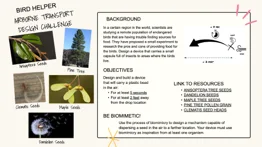 Airborne transport design challenge brief.Copyright Tufts University Center for Engineering Education and Outreach and TERC
Introduce and Model Structure/Function Analysis
- Explain that before engineers imitate nature, they first study how organisms solve problems.
- Introduce structure/function analysis as a strategy biologists use to understand how an organism's structures enable it to perform specific functions.
- Explain that students will identify the key structures (parts) that help each plant perform the function of seed or pollen dispersal.
- When biologists conduct structure/function analysis, they notice and describe the "properties" (adjectives or characteristics) and "actions" (verbs or activities) of each important structure.
- For each plant, biologists identify and describe the parts, properties, and actions that support seed or pollen dispersal.
- Organizing observations into these three categories of descriptors (Parts, Properties or Characteristics, and Actions) helps students explain how structure determines function.
- As a whole-class example, model a structure/function analysis using one plant (such as a dandelion seed):
- Guide students in identifying the structures (parts) that contribute to the function of seed or pollen dispersal.
- Prompt students to describe the physical properties of each structure and explain how those properties enable the structure to contribute to seed or pollen dispersal.
- Record observations on a three-column anchor chart (like the one shown in Image 2) with the headings:
- Parts (nouns)
- Properties or characteristics (adjectives)
- Actions (verbs)
- Discuss how identifying a structure's parts, properties, and actions helps explain how structure determines function. Emphasize that engineers can use these observations to identify biological features that may inspire engineering designs.
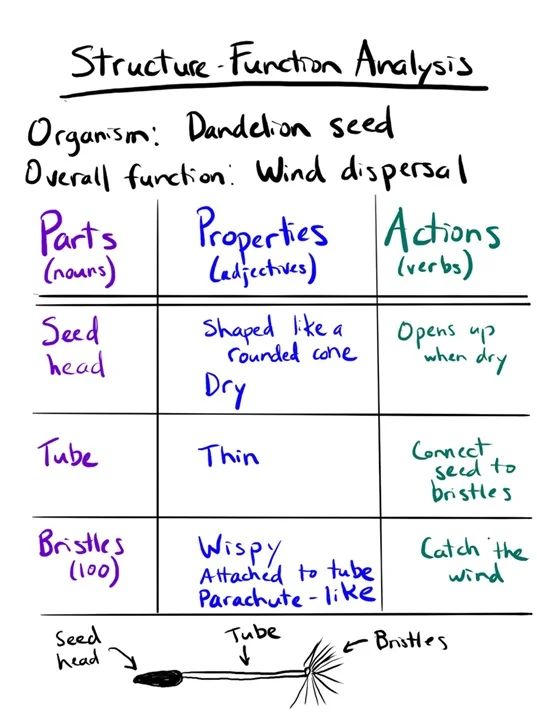 Anchor chart displaying a structure-function analysis of a dandelion seed. It summarizes the parts, properties, and actions that enable a dandelion seed to be dispersed by the wind.Copyright Tufts University Center for Engineering Education and Outreach and TERC
Plant Investigation
- Distribute one Structure/Function Analysis Worksheet (PDF) to each student.
- Assign each group one of the remaining plants: Anisoptera tree seeds, maple tree seeds, pine tree pollen grains, or clematis seeds.
- Direct students to use the photos, videos, and texts provided on the Padlet site to investigate their assigned plant and complete the Structure/Function Analysis Worksheet (PDF). (Sample answers are included in the Structure/Function Analysis Worksheet Answer Key (PDF).)
- Have students share their structure/function analyses with the class. As students share, consider creating a whole-class structure/function anchor chart, similar to Image 2, for each plant inspiration.
Day 2: Imagine, Plan, Create, and Test (60 minutes)
Brainstorm and Sketch
- Re-display Image 1 and review the design challenge criteria and constraints with students (Image 1.)
- Distribute one Design Planning Worksheet (PDF) to each student.
- Introduce students to the materials available for their design prototypes.
- Give students 5-10 minutes to brainstorm and then plan out their design ideas for their airborne transport devices on their Design Planning Worksheet (PDF).
- Direct students to label the features inspired by their plant examples and the materials they plan to use.
If desired, have students create a materials list before building and distribute materials based on their lists. Explain that planning materials in advance can help reduce waste and encourage students to think carefully about which materials are best suited for different parts of their designs.
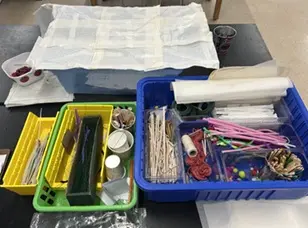 Building materials made available to students for the Airborne Transport challenge.Copyright Tufts University Center for Engineering Education and Outreach and TERC
Build Initial Prototype
- Have students build initial prototypes of their airborne transport devices using the available materials.
- Circulate as students build, asking questions that encourage them to connect their design decisions to the structures and functions observed in their plant inspirations. Consider asking:
- Which plant or plants inspired your design?
- Which features of the plant did you incorporate into your prototype?
- How does this part of your design help with wind dispersal?
- How does this feature relate to the structure and function you observed in your plant inspiration?
Conduct Initial Testing
- Have each group conduct an initial formal test of its prototype.
- Have students observe and record how their devices perform, including whether they remain airborne for at least 5 seconds and travel at least 2 feet from the drop point.
- Ensure that all groups have completed at least one test with approximately 15 minutes remaining in the session.
Analyze, Document Progress, and Gather Feedback
- Distribute one Progress Report (PDF) to each student.
- Have students use their observations and test results to document the performance of their prototypes and identify features that worked well and features that could be improved.
- Have students share their prototypes and test results with another group and compare the strengths and weaknesses of their different nature-inspired design approaches.
- Encourage students to give and receive constructive feedback about how their designs might be improved.
- Have students add relevant peer feedback to their Progress Report (PDF).
Day 3: Analyze, Improve and Iterate (60 minutes)
Revisit Structure/Function Analysis
- Distribute one Revisiting Structure/Function Analysis Worksheet (PDF) to each student.
- Have students return to the plant inspirations they investigated on Day 1 and reconsider their structures, properties, and actions in light of what they learned from their initial prototype testing.
- Encourage students to identify biological features that could help address problems observed during testing. Prompt students to consider questions such as:
- Is there a plant structure or property that your initial design did not incorporate?
- How does your prototype behave differently from the plant seed or pollen it was inspired by?
- Could another plant inspiration provide a useful feature for your redesign?
- How could you better imitate a biological structure, property, or action in your improved design?
- Have students complete the Revisiting Structure/Function Analysis Worksheet (PDF) to document how their developing understanding of the biological system can inform their redesign.
Plan the Redesign
- Distribute one Updated Design Worksheet (PDF) to each student.
- Have students use evidence from their initial tests, peer feedback, and revisited structure/function analyses to identify changes they want to make to their prototypes.
- Have students document their planned changes on the Updated Design Worksheet (PDF), including which features they will change and why they expect those changes to improve performance.
Build the Redesign
- Have students modify their airborne transport devices according to their redesign plans.
- Circulate as students work and encourage them to explain how their modifications are based on testing evidence, peer feedback, and the structures and functions of their biological inspirations.
Conduct Final Testing
- Have groups conduct final tests of their redesigned prototypes using the same testing procedures used for their initial tests.
- Have students determine whether their redesigned prototypes:
- remain airborne for at least 5 seconds, and
- travel at least 2 feet from the drop point.
- Have students compare the performance of their initial and redesigned prototypes, including airtime and distance traveled, and determine whether their modifications improved performance.
Day 4: Present and Reflect (60 minutes)
- Have students share their final airborne transport devices with the class.
- As students present, have them identify the plant or plants that inspired their designs and explain how specific structures, properties, and actions from those plants influenced their design choices.
- Have students describe what worked well, what did not work as expected, and how they modified their designs based on testing.
- Facilitate a class discussion about the relationship between the biological structures students observed and the engineered structures they created.
- Distribute one Final Reflection Worksheet (PDF) to each student.
- Have students complete the Final Reflection Worksheet (PDF) to reflect on their use of biomimicry, the performance of their designs, and the changes they made during the engineering design process.
Examples of students’ biomimetic airborne transport devices.Copyright Tufts University Center for Engineering Education and Outreach and TERC- biomimicry (noun)
- A practice that learns from and mimics the strategies used by living organisms to solve challenges faced by individuals and societies.
- dispersal (noun)
- The process or result of the spreading something from one place to another.
- disperse (verb)
- To spread out or scatter in different directions.
- mechanism (noun)
- A system of parts that work together to do something.
Pre-Activity Assessment
Brainstorming: Have students come up with different plants that they know about prior to the activity. After students have created a short list of plants, ask them how they think those plants got to the place where they had grown.
Activity Embedded (Formative) Assessment
Structure/Function Analysis Worksheet: Have students complete the Structure/Function Analysis Worksheet (PDF). Review students’ worksheets to assess their ability to identify important plant structures and describe the properties and actions that enable seed or pollen dispersal. Listen to group and class discussions for evidence that students can connect structure to function.
Design Planning Worksheet: Review students’ design plans and sketches in their Design Planning Worksheet (PDF) to assess whether they intentionally incorporate structures, properties, or actions observed in their biological inspirations into their prototype designs.
Prototype Observations: While students are working on their prototypes, go around the classroom and check out their progress. As you go to different groups, ask students questions about their design (i.e. ‘Which plant(s) did you take inspiration from?’, ‘how does this part of your design help with wind dispersal?’).
Peer Feedback: Encourage students to share their prototypes and test results with one another and then give and receive constructive feedback about ways their designs could be improved. Have students complete the Progress Report (PDF) to document their test results, identify features that worked well and features that could be improved, and record relevant peer feedback.
Post-Activity (Summative) Assessment
Final Presentation: During presentations, assess students’ ability to explain how specific structures, properties, and actions from their biological inspirations influenced their engineering designs and how testing informed their redesign decisions.
Reflection: Have students complete the Final Reflection Worksheet (PDF) for evidence that students understand structure and function, biomimicry, and the iterative nature of the engineering design process.
- When using hot glue guns, remind students not to touch the heated tip or hot glue. Monitor students during use and unplug hot glue guns when they are not actively being used. Place hot glue guns in a secure location where they cannot fall or be accidentally touched.
- Monitor students when they are cutting cardboard or other materials. Review proper use of scissors and other cutting tools, and make sure students always cut away from their bodies. If box cutters or other sharp cutting tools are used, provide close adult supervision.
- Have students investigate additional examples of seeds, pollen, or fruits that use wind dispersal and conduct a structure/function analysis to determine how their adaptations support movement through the air.
- Have students research real-world examples of biomimicry and identify the biological structures, properties, or processes that inspired each engineered solution.
- Have students test their prototypes under different environmental conditions, such as different fan speeds or release heights, and analyze how changing the conditions affects performance.
- For students who have difficulty meeting both performance criteria, reduce the required airtime and/or distance traveled. Alternatively, have students focus on meeting one criterion: keeping the payload airborne for at least 5 seconds or transporting it at least 2 feet from the drop location.
- For students who are newer to building three-dimensional structures with craft materials, provide additional building time or extend the activity by one day.
- For students who have difficulty cutting cardboard or other materials, provide pre-cut materials in a variety of shapes and sizes or have an adult assist with cutting.
- For students who need additional support with biomimicry, provide a smaller selection of plant inspirations or have them focus on one specific plant structure, property, or action to incorporate into their design.
‘Seed Dispersal’ by Next Generation Science (July 5, 2023)
“The world is poorly designed. But copying nature helps.” by Vox (November 9, 2017)
https://www.sciencedirect.com/science/article/abs/pii/S0006320721004468
- Framework for evaluating "if", "how/feasibility", and "impact" of supplementary feeding
https://esajournals.onlinelibrary.wiley.com/doi/10.1002/fee.1257
- Supplementary feeding stations for scavenger birds -- "Vulture Restaurants"
https://feederwatch.org/research-news/impacts-supplemental-feeding-bird-populations
- monitoring the potential impacts of supplementary feeding of birds is an active research area
Contributors
William Church, Debra Bernstein, Mike Cassidy, Kristen Wendell, Geling (Jazz) Xu, Tyrine Pangan, Ethan Danahy, Pragyee Shrestha
Supporting Program
Tufts University Center for Engineering Education and Outreach (CEEO) in Medford, Massachusetts; Technical Education Research Centers (TERC) in Cambridge, Massachusetts.
Acknowledgements
This material is based upon work supported by the National Science Foundation (NSF) under Grant No. 2300433. Any opinions, findings, conclusions, or recommendations expressed in this material are those of the author(s) and do not necessarily reflect the views of the National Science Foundation.
Copyright
2026 by Regents of the University of Colorado; original © 2025 Tufts University Center for Engineering Education and Outreach