
Mmm Cupcakes: What's Their Life Cycle Impact?
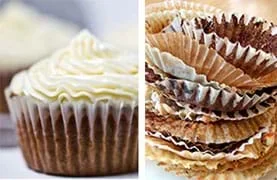 Cupcakes are a favorite snack that are usually baked in paper liners that end up in landfills.Copyright 2008 Kim Siciliano, Wikimedia Commons CC BY-SA 2.0; 2009 Joyosity, Flickr CC BY-SA 2.0 https://commons.wikimedia.org/wiki/File:Chai_white_chocolate_cupcakes_(2).jpg
https://www.flickr.com/photos/joyosity/3412198095
Cupcakes are a favorite snack that are usually baked in paper liners that end up in landfills.Copyright 2008 Kim Siciliano, Wikimedia Commons CC BY-SA 2.0; 2009 Joyosity, Flickr CC BY-SA 2.0 https://commons.wikimedia.org/wiki/File:Chai_white_chocolate_cupcakes_(2).jpg
https://www.flickr.com/photos/joyosity/3412198095
Students learn about life-cycle assessment and how engineers use this technique to determine the environmental impact of everyday products and processes. As they examine what’s involved in making and consuming cupcakes, a snack enjoyed by millions of people every year, students learn about the production, use and disposal phases of an object’s life cycle. With the class organized into six teams, students calculate data for each phase of a cupcake’s life cycle—wet ingredients, dry ingredients, baking materials, oven baking, frosting, liner disposal—and calculate energy usage and greenhouse gases emitted from making one cupcake. They use ratios and fractions, and compare options for some of the life-cycle stages, such as different paper wrapper endings (disposal to landfills or composting) in order to make a life-cycle plan with a lower environmental impact. This activity opens students’ eyes to see the energy use in the cradle-to-grave lives of everyday products. Pre/post-quizzes, worksheets, activity cards, Excel® workbook and visual aids are provided.
Engineers use a tool called the life-cycle assessment (LCA) to determine the environmental impact of products and systems. They examine and assign costs to all the steps in the life cycle of an object—from raw material extraction, to manufacturing and distribution, to waste disposal. Life-cycle analysis reveals the environmental consequences of a product’s production, use and disposal methods and practices. LCA critiques inform redesign decisions to aid engineers in meeting the design objective to minimize the environmental burdens of products and systems, such as by reducing the amount of energy used and amount of greenhouse gases emitted.
After this activity, students should be able to:
- Define a product “life cycle.”
- Identify and differentiate parts of a life cycle.
- Identify and differentiate components of a life-cycle assessment.
- Describe the importance and value of the life-cycle assessment technique.
- Calculate the energy use and emissions for a specific life-cycle using dimensional analysis.
- 5.G.2 Represent real world and mathematical problems by graphing points in the first quadrant of the coordinate plane, and interpret coordinate values of points in the context of the situation.
Grade 5
Do you agree with this alignment? - 5.MD.A Convert like measurement units within a given measurement system.
Grade 5
Do you agree with this alignment? - 6.NS.3 Fluently add, subtract, multiply, and divide multi-digit decimals using the standard algorithm for each operation.
Grade 6
Do you agree with this alignment? - 6.RP.A Understand ratio concepts and use ratio reasoning to solve problems.
Grade 6
Do you agree with this alignment? - 6.SP.5 Summarize numerical data sets in relation to their context, such as by:
Grade 6
Do you agree with this alignment? - MP.2 Reason abstractly and quantitatively.
Grades K-12
Do you agree with this alignment? - MP.4 Model with mathematics.
Grades K-12
Do you agree with this alignment?
- MS-ESS3-3 Apply scientific principles to design a method for monitoring and minimizing a human impact on the environment.
Grades 6-8
Do you agree with this alignment? - MS-LS2-3 Develop a model to describe the cycling of matter and flow of energy among living and nonliving parts of an ecosystem.
Grades 6-8
Do you agree with this alignment?
- CCSS.Math.Content.5.G.A.2 Represent real world and mathematical problems by graphing points in the first quadrant of the coordinate plane, and interpret coordinate values of points in the context of the situation.
Grade 5
Do you agree with this alignment? - CCSS.Math.Content.5.MD.A Convert like measurement units within a given measurement system.
Grade 5
Do you agree with this alignment? - CCSS.Math.Content.6.NS.B.3 Fluently add, subtract, multiply, and divide multi-digit decimals using the standard algorithm for each operation.
Grade 6
Do you agree with this alignment? - CCSS.Math.Content.6.RP.A Understand ratio concepts and use ratio reasoning to solve problems.
Grade 6
Do you agree with this alignment? - CCSS.Math.Content.6.SP.B.5 Summarize numerical data sets in relation to their context, such as by:
Grade 6
Do you agree with this alignment? - CCSS.Math.Practice.MP2 Reason abstractly and quantitatively.
Grades K-12
Do you agree with this alignment? - CCSS.Math.Practice.MP4 Model with mathematics.
Grades K-12
Do you agree with this alignment?
- Students will develop abilities to assess the impact of products and systems.
Grades K-12
Do you agree with this alignment? - There is no perfect design.
Grades 6-8
Do you agree with this alignment?
- MS-ESS3-3 Apply scientific principles to design a method for monitoring and minimizing a human impact on the environment.
Grades 6-8
This resource focuses on the following Three Dimensional Learning aspects of NGSS:
Science & Engineering Practices- Apply scientific principles to design an object, tool, process or system.Do you agree with this alignment?
Disciplinary Core Ideas- Human activities have significantly altered the biosphere, sometimes damaging or destroying natural habitats and causing the extinction of other species. But changes to Earth's environments can have different impacts (negative and positive) for different living things.Do you agree with this alignment?
Crosscutting Concepts- The uses of technologies and any limitations on their use are driven by individual or societal needs, desires, and values; by the findings of scientific research; and by differences in such factors as climate, natural resources, and economic conditions. Thus technology use varies from region to region and over time.Do you agree with this alignment?
- Relationships can be classified as causal or correlational, and correlation does not necessarily imply causation.Do you agree with this alignment?
Do you agree with this alignment? - Apply scientific principles to design an object, tool, process or system.
- MS-LS2-3 Develop a model to describe the cycling of matter and flow of energy among living and nonliving parts of an ecosystem.
Grades 6-8
This resource focuses on the following Three Dimensional Learning aspects of NGSS:
Science & Engineering Practices- Develop a model to describe phenomena.Do you agree with this alignment?
Disciplinary Core Ideas- Food webs are models that demonstrate how matter and energy is transferred between producers, consumers, and decomposers as the three groups interact within an ecosystem. Transfers of matter into and out of the physical environment occur at every level. Decomposers recycle nutrients from dead plant or animal matter back to the soil in terrestrial environments or to the water in aquatic environments. The atoms that make up the organisms in an ecosystem are cycled repeatedly between the living and nonliving parts of the ecosystem.Do you agree with this alignment?
Crosscutting Concepts- The transfer of energy can be tracked as energy flows through a natural system.Do you agree with this alignment?
- Science assumes that objects and events in natural systems occur in consistent patterns that are understandable through measurement and observation.Do you agree with this alignment?
Do you agree with this alignment? - Develop a model to describe phenomena.
Each group needs:
- Life-Cycle Assessment Pre-Activity Quiz (PDF), one per student
- 1 envelope containing 1 of 6 sets of paper printouts—a cupcake life-cycle “recipe card” and its ingredient cards; see below
- 1 corresponding page of the Life-Cycle Assessment Group Worksheet (PDF) (see below)
- Life-Cycle Assessment Individual Worksheet (PDF), one per student
- Life-Cycle Assessment Post-Activity Quiz (PDF), one per student
- pencils, to make calculations and complete quizzes and worksheets
- calculator(s)
- (optional) graph paper
- (optional) computer with Microsoft® Excel® for using the Group Analysis Excel Sheets (XLSX)
To share with the entire class:
- Life-Cycle Assessment Group Worksheet (PDF), one copy per class; composed of six sub-worksheets
- LCA Activity Cards (PDF), print the PDF and cut out its 27 cards, sorting them into six sets (each with a cupcake life-cycle “recipe card” and its ingredient cards) that go into six envelopes, one per group
- 6 envelopes, to hold each of the six sets of cards, one set per team
- a large blank table written on the classroom board, for students to fill out (see Table 1)
- (optional) LCA Visual Aids (PDF)
- Life-Cycle Assessment Pre-Quiz (docx)
- Life-Cycle Assessment Pre-Quiz (pdf)
- Life-Cycle Assessment Pre-Quiz Answer Key (docx)
- Life-Cycle Assessment Pre-Quiz Answer Key (pdf)
- LCA Activity Cards (pptx)
- LCA Activity Cards (pdf)
- LCA Visual Aids (pptx)
- LCA Visual Aids (pdf)
- Life-Cycle Assessment Group Worksheets (docx)
- Life-Cycle Assessment Group Worksheets (pdf)
- Life-Cycle Assessment Group Worksheets Answer Key (docx)
- Life-Cycle Assessment Group Worksheets Answer Key (pdf)
- Life-Cycle Assessment Individual Worksheet (docx)
- Life-Cycle Assessment Individual Worksheet (pdf)
- Life-Cycle Assessment Individual Worksheet Answer Key (docx)
- Life-Cycle Assessment Individual Worksheet Answer Key (pdf)
- Group Analysis Excel Sheets (xlsx)
- Life-Cycle Assessment Post-Quiz (docx)
- Life-Cycle Assessment Post-Quiz (pdf)
- Life-Cycle Assessment Post-Quiz Answer Key (docx)
- Life-Cycle Assessment Post-Quiz Answer Key (pdf)
A familiarity with greenhouse gases, energy, climate change, and dimensional analysis.
What is your favorite type of birthday dessert? (Listen to some student answers.) My favorite is cupcakes! Why do you think I like cupcakes? (Listen to some answers.) I like them because they are delicious, they come in so many flavors, and they’re a personal-sized dessert that everyone can have. Since they have wrappers, it’s easy to carry them around without needing a plate or fork! And the best part is, all you have to do is peel the wrapper off, eat them, and then throw away the wrapper. There’s very little to clean up! That’s probably one reason why cupcakes are so popular.
Did you know that more than 770 million cupcakes are eaten in the U.S. each year? (IdealBite, 2012) That means that, on average, every person in the U.S. ate 2.4 cupcakes during one year. Now, imagine that every cupcake had a liner (a wrapper) that was thrown away in the trash. If we stacked all those liners on top of each other, it would be about 250 miles tall, which is the distance from the Earth to the International Space Station. That is a LOT of wrappers thrown away! And that is just in one year! Do you think that is a lot of trash to put in the landfill? (See how students respond.)
Do you think other parts of the cupcake might impact or affect our natural environment and its resources? Let’s think about what we need to make cupcakes. (Listen to student ideas. Refer to Figure 1.) We need eggs, flour, sugar, vanilla, butter and other ingredients.
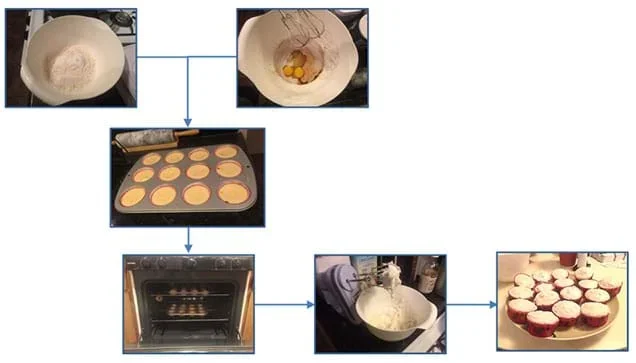 Figure 1. A photo flow diagram shows the six stages of making cupcakes.Copyright 2016 Sara Pace, University of California Davis
Do you think it takes energy to produce these ingredients? Most definitely! Think of how we get flour, We require energy to grow the crops, harvest them, grind the wheat into flour, package the flour, and then ship the packages to grocery stores for us to buy. These steps—planting, harvesting, processing, packaging and shipping—are part of each ingredients’ life cycle (see Figure 2). What do we mean by “life cycle”? A life cycle is the various stages something passes through in its lifetime, and it includes the production (planting/harvesting/processing/packaging), use (mixing the ingredient into a batter and cooking), and disposal phases (throwing away the packaging and leftovers). And, in turn, every ingredient that is used for making cupcakes has its own unique life cycle.
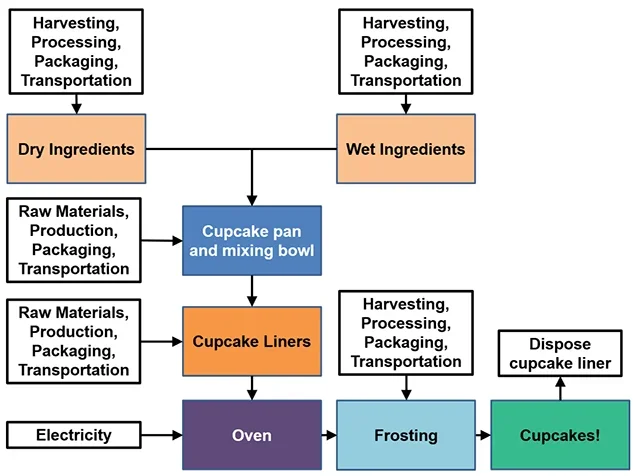 Figure 2. Cupcake life-cycle flow diagram for LCA.Copyright 2016 Sara Pace, University of California Davis
Each ingredient needed to make a cupcake makes demands on the environment or affects it in some way. And this is the same for everything you own, for everything around you, for everything that exists on Earth—especially the products that humans make. It can be really complicated to keep track of everything that might affect the environment, so engineers created a tool called the life-cycle assessment. This tool helps engineers figure out what type of impact things have on the environment. The life-cycle assessment (LCA) is used to help engineers make decisions on how to change the way something is made in order to reduce its impact on the environment—perhaps so it doesn’t use as many fossil fuels or emit as many greenhouse gases.
The nickname of the LCA is “cradle to grave.” Why do you think engineers call it that? (Listen to student answers.) It’s because the LCA looks at the beginning of the life of an object, like when a baby is born (cradle, think “production” phase), then when it grows up (think “use” phase) and finally when it dies (grave, think “disposal” phase).
Today we are going to use this tool to look at the life cycle of one cupcake to find out how much of an impact it has on the environment. We are going to calculate the energy use and greenhouse gas emissions for the cupcake based on a cupcake recipe using ratios and fractions. Our results will help us determine how much impact cupcakes have on the environment and ways we can reduce the impact, such as other disposal methods for the cupcake liners, instead of throwing them in the landfill.
Activity Overview
Students are challenged to use life-cycle assessment to determine the environmental impact of one vanilla cupcake. With the class organized into six groups, each team focuses on one stage of the cupcake life cycle (see Figure 2), using the information provided in six information sets (each composed of a “recipe card” and its ingredient cards, provided in the LCA Activity Cards (PDF)). Students work in their teams and then on their own to calculate the energy use and greenhouse gas emissions for each stage. They determine the environmental impact of cupcakes if the paper cupcake liner is disposed of in a landfill or by composting—in order to figure out which disposal method has a smaller environmental impact. As if they are engineers, they examine the results from their calculations and make recommendations on how to reduce the environmental impact of cupcakes.
Background
To analyze a product, engineers complete three main LCA stages: inventory analysis, impact analysis, and improvement analysis (see Figure 3). These stages are done sequentially starting with the inventory analysis. During inventory analysis, all the numerical data for materials, tools, labor, transportation, energy use and greenhouse gas emissions are collected from researchers, companies and/or databases, either exact or estimated numbers for each life-cycle phase. These are the inputs and outputs. Because so much data is collected and so many calculations are made during this stage to keep track of all the values that compose all parts of a life cycle, it is also referred to as the accounting stage.
 Figure 3. Three main stages of a life-cycle assessment.Copyright 2017 Denise W. Carlson, ITL Program, College of Engineering and Applied Science, University of Colorado Boulder
After all data are collected and tallied, engineers move on to the impact analysis stage. They determine the environmental impact by evaluating the totals for energy use and greenhouse gas (GHG) emissions. For instance, calculating the total carbon dioxide, methane and NO2 gases can be combined into something called carbon dioxide equivalents, or CO2e, to determine the global warming potential of an object. This activity has already accounted for this by tabulating all the greenhouse gases together and referring to them as CO2e. The impact analysis stage is sometimes also used to compare two or more alternate inputs/processes to see if their environmental impacts are different.
Based on the results of the impact analysis, engineers move on to the improvement analysis stage during which they interpret the results and provide recommendations on ways to alter the life-cycle stages to reduce an object’s environmental impact. For example, if engineers find that one process has less environmental impact than another or that one part of the life cycle uses significantly more energy or releases a significant amount of greenhouse gas emissions, engineers might advise manufacturers to choose one process over another or suggest changing something in one part of the process to reduce its emissions or energy consumption. For instance, if the cupcake frosting has a really high energy use because it uses vanilla sourced from Madagascar and it takes a lot of energy to transport that ingredient to the U.S., an engineer might recommend sourcing the vanilla from a place that is less far away from the cupcake-making location. Finding a more local source might greatly reduce the energy use and GHG emissions of the transportation related to the vanilla’s life cycle.
When determining what to include in the use phase, great questions to ask are, “For what will I use this object? What is this object’s purpose?” The answers to these questions help to distinguish between the production and disposal phases.
One way to reduce the environmental impact of the waste disposal stage is to compost paper products and food waste instead of putting them in landfills, which always have space limitations. When organic materials, such as paper products, food waste and yard waste, are discarded in landfills, they decompose and take up less space over time, but usually take a long time to decompose because landfills are not ideal environments for efficient decomposition. During decomposition in landfills, as these materials break down and emit greenhouse gases into the atmosphere (in some cases the gases are captured for energy use), which is what we want to avoid because doing this alters the atmospheric composition, which is related to global warming and climate change.
By contrast, if organic waste materials are composted instead of added to landfills, they quickly decompose because they are in an environment that supports their breakdown into organic matter, which serves as a soil amendment that promotes plant growth on farms and in gardens. Growing plants require carbon dioxide during respiration, which also has the advantage of using the excess carbon dioxide (a greenhouse gas) that exists in our atmosphere.
Before the Activity
- Gather materials.
- Make one copy of the Life-Cycle Assessment Group Worksheet (PDF), which is composed of six sub-worksheets—one for each stage of the cupcake-making process (see Figure 2). Each group gets a different page of the worksheet—the specific one for its assigned cupcake life-cycle stage.
- Make copies of the Life-Cycle Assessment Pre-Quiz (PDF), Life-Cycle Assessment Individual Worksheet (PDF), and Life-Cycle Assessment Post-Quiz (PDF), one each per student.
- Make one copy of the PDF version of the LCA Activity Cards (PDF). Cut out its 27 cards, organizing them into six sets; each set has a “recipe card” and its associated ingredient cards. Place each set into a different envelope, labeled to match the six stages of the cupcake-making process: 1) wet ingredients, 2) dry ingredients, 3) baking materials, 4) oven baking, 5) frosting and 6) disposal. Each of the six groups in the class get one envelope.
- Notice that many of the card sets include options for that life-cycle stage, which provides alternative production or disposal approaches to compare for their impact. The calculation of the energy usage and gas emissions from these different options, gives the teams and class the information needed to design a cupcake life-cycle plan with the lowest environmental impact. Decide in advance how complex you want to make the activity by removing or leaving in these options from the card sets.
- Disposal: landfill paper cupcake liners vs. compost paper cupcake liners (default to keep; since supported by the worksheets
- Baking materials: paper cupcake liners vs. aluminum foil cupcake liners
- Oven baking: baking in electric oven vs. gas oven
- Disposal: landfill aluminum cupcake liners vs. recycle aluminum cupcake liners
- On the classroom board, draw a data table similar to Table 1 where groups will share their calculations with the class. Alter as necessary to reflect any additional life-cycle stage options being compared.
- (optional) Decide if you will make time and computers available for students to use the Group Analysis Excel Sheets (XLSX) to determine energy usage and emissions release. Details about this Excel® workbook are provided in the Additional Multimedia Support section.
- (optional) Decide if you want to use the four-slide LCA Visual Aids (PDF), perhaps as a slide presentation or handouts. The visual aids include Figures 1, 2 and 3, and Table 1.
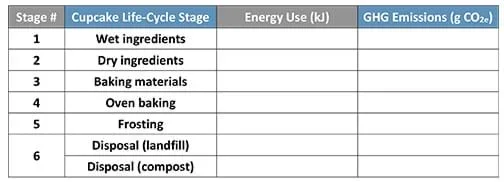 Table 1. Draw a table on the classroom board for groups to share their calculations.Copyright 2016 Sara Pace, University of California Davis
With the Students
- Administer the pre-activity quiz, as described in the Assessment section.
- Present the Introduction/Motivation content to the class.
- Divide the class into six groups of two to six students each. Refer to the recommended group size suggestions provided in the Troubleshooting Tips section.
- Assign each group a stage of the cupcake life cycle: 1) wet ingredients, 2) dry ingredients, 3) baking materials, 4) oven baking, 5) frosting, and 6) disposal. Refer to Figures 1 and 2.
- Have each team determine a representative for its group. This person is responsible for sharing the group’s findings with the class in the table drawn on the classroom board.
- Hand out the group worksheets, which means each team gets the worksheet page for its assigned life-cycle stage.
- Inform the class that they are going to calculate the energy used and greenhouse gases emitted for each ingredient needed to make cupcakes. The goal is to determine the total amount of energy used and greenhouse gases emitted during the making and eating of one cupcake—and to provide recommendations on how to reduce either the greenhouse gases or energy used in the cupcake life cycle. This is what we call a life-cycle assessment. (As desired, present to the class additional LCA information, as provided in the Background section.)
- Explain to the class that in their groups, they will determine the amount of energy used and the amount of greenhouse gases emitted for one stage (including any alternative options provided in the cards). Then they will use the class calculations as prepared by the other groups to determine the energy use and greenhouse gas emissions for the other stages in order to determine the impact of the entire life cycle of one cupcake.
- With the class, review the worksheet instructions to make sure they understand what they need to do. It may help to have students read aloud the worksheet instructions.
- With the class, do an example calculation for the energy required to “make” 2 eggs. If it takes 2000 kJ to produce 1 egg and deliver it to your kitchen, how much energy is needed for 2 eggs? (Answer: 2 eggs x 2000 kJ/egg = 4000 kJ)
- Next, hand out to each group its cupcake life-cycle stage envelope, containing its “recipe card” and associated ingredient cards.
- Inventory Analysis: Once each group has its envelope, students begin calculating the energy use and GHG emissions for their life-cycle stages. During this “accounting” stage of LCA, they are collecting and calculating information and data about the material and energy inputs, as well as any waste and pollution outputs.
- Circulate the room, checking that students are working together and making correct calculations.
- Once all groups have completed their calculations, have group representatives record their findings in the class table (see Table 1).
- Hand out the individual worksheets to each student.
- Impact Analysis: Next, students use the data calculated from the other groups to determine energy and GHG emissions for 12 cupcakes and 1 cupcake based on whether the paper liners are thrown into landfills or composted. During this LCA stage, they are evaluating the impacts associated with the life-cycle inputs and outputs. Have students generate graphs of the various results to help them visualize the differences between disposal methods. Have students work in groups or on their own.
If having students calculate additional life-cycle stage options (more than the paper wrapper disposal options), expand the table and have teams also share that data with the class, so everyone can compare the impacts of various options in order to design an optimum cupcake life-cycle plan—the one with the lowest environmental impact. Additional options that may be considers:
- Baking materials: paper cupcake liners vs. aluminum foil cupcake liners
- Oven baking: baking in electric oven vs. gas oven
- Disposal: landfilling aluminum cupcake liners vs. recycling aluminum cupcake liners
- If time and resources allow, have students use the Group Analysis Excel Sheets (XLSX) to determine energy and GHG emissions for 12 cupcakes and 1 cupcake based on whether the paper liners are thrown into landfills or composted. Have them compare their hand calculations with the Excel® calculations.
- Improvement Analysis: Have students answer the worksheet questions on how the cupcake life-cycle inputs and process could be changed to reduce the environmental burden, citing evidence in their explanations. This is the time to critique (look carefully at) the life-cycle process to discover what could be done to reduce energy use, reduce greenhouse gas emissions, or reduce both. During this LCA stage, they are interpreting the results so as to make informed decisions about the life-cycle inputs and outputs.
- Conclude with a class discussion to review what students learned, their findings, and the types of changes/improvements they suggest be put in place to reduce the environmental impact of cupcakes. Ask the students, “As an engineer, what is your recommendation for improving the process?” Refer back to real-world examples as mentioned in the Introduction/Motivation section to help students extrapolate the importance and value of LCA.
- Administer the post-activity quiz.
- impact analysis
- The second stage of life-cycle assessment, which looks at the inventory analysis to determine the environmental impact of the life cycle.
- improvement analysis
- The last stage of life-cycle assessment, during which engineers make recommendations on how to improve the life cycle to lower its environmental impact, based on the impact analysis.
- inventory analysis
- The first stage of life-cycle assessment, when input/output data for all stages of the life cycle are collected. Also called the accounting stage.
- product life cycle
- The various stages a product, process or system passes through in its lifetime—including its production, use and disposal.
- life-cycle assessment
- A technique to determine all the environmental effects of something during its entire life cycle. Resulting environmental impacts might include energy use and emissions. LCA has three main steps: inventory analysis, impact analysis, and improvement analysis. Abbreviated as LCA. Also called life-cycle analysis or cradle-to-grave analysis.
Pre-Activity Assessment
Pre-Quiz: Before starting the activity, administer the four-question Life-Cycle Assessment Pre-Activity Quiz (PDF) to gauge students’ depth of prior knowledge about life cycles and the life-cycle assessment tool used by engineers to determine a product’s environmental impact. Students answer short-answer, fill-in-the-blank, and calculation-based questions related to the activity’s learning objectives.
Activity Embedded Assessment
Group Worksheets: During the first part of the activity, have students work in groups to complete the Life-Cycle Assessment Group Worksheet (PDF) to determine how much energy is used and GHG is emitted during each group’s assigned cupcake life-cycle stage. Review the group worksheets to make sure the calculations are correct.
Individual Worksheets: After students complete the group worksheet and post in the class table their calculated answers for every stage, have students complete the Life-Cycle Assessment Individual Worksheet (PDF) to record in its tables the data from each group to determine the total energy use and GHG emitted for the entire cupcake life-cycle, cradle to grave. Make sure students record the data for landfill disposal on the page 1 worksheet table and record the data for compost disposal on the page 2 worksheet table. Students answer questions related to LCA impact and improvement analysis using evidence from their tables. Students compare the paper liner disposal methods to determine which has less environmental impact. Have students generate graphs of the different results to help them visualize the differences. Emphasize that what we mean by “improving the environmental impact” of an object, is reducing its energy use and/or GHG emissions. Review students’ worksheets to assess their comprehension.
Post-Activity Assessment
Post-Quiz: At activity end, administer the eight-question Life-Cycle Assessment Post-Activity Quiz (PDF) to determine how well students learned and are able to meet the activity learning objectives. Students answer short-answer, fill-in-the-blank, and calculation-based questions; half of the questions are the same as the pre-activity quiz. Compare students’ pre/post answers to assess changes in comprehension of the activity topics, as well as identifying life-cycle stages and more calculation practice for determining greenhouse gas emissions for a specified amount of an ingredient used in the cupcake recipe.
Have students work together in their groups to complete their calculations. Suggest that students check each other’s work and help one another to make sure everyone is able to complete the calculations correctly. If students still have trouble calculating energy use and greenhouse gas emissions for their stages, provide individual guidance.
Since the workload required for each cupcake life-cycle stage is not equal, consider dividing the class into six groups with varying number of members so as to better match group size to the amount of work necessary for each stage. Suggested group sizes:
Stage 1: wet ingredients > 4-6 people
Stage 2: dry ingredients > 3-5 people
Stage 3: baking materials > 3-5 people
Stage 4: oven baking > 2-3 people
Stage 5: frosting > 4-6 people
Stage 6: disposal > 2-3 people
Incorporate some technology into the classroom by using GoogleSheets to calculate all the data and collaborate amongst groups.
- For lower grades, spend more time introducing the activity and reviewing calculations for scaling numbers and multiplying with ratios. Also, spend more time with each group checking calculations and discussing as a class how they might reduce energy use or greenhouse gas emissions. Keep the life-cycle assessment simple by only calculating and comparing the paper liner disposal option.
- For higher grades, expect students to explore all the various life-cycle stage options provided in the card sets (and be able to think of their own additional suggestions for improvements) besides just evaluating the paper wrapper disposal option. Also have students practice writing equations and calculations using the Group Analysis Excel Sheets (XLSX), as well as graphing results.
An Excel® workbook, Group Analysis Excel Sheets (XLSX), is provided for use in GoogleSheets or another server to share among students. The file is comprised of eight sheets:
- The first sheet, labeled “Master Sheet,” is intended for students who are comfortable calculating numbers in Excel® and wish to get more practice by completing all the calculations themselves.
- The second sheet, labeled “Master Sheet Compile,” references all of the subsequent sheets (six cupcake life-cycle stages) to automatically tabulate the total energy use and greenhouse gas emissions for 12 cupcakes and 1 cupcake based on how the cupcake liners are disposed of.
- One sheet is provided for each of the six defined stages of the cupcake life cycle (wet ingredients, dry ingredients, baking materials, oven baking, frosting, and disposal).
- In all sheets, cells highlighted in yellow are locations for students to insert equations to calculate the total energy or greenhouse gas emissions based on the raw data provided and their recipes.
Life-cycle assessment. Last revised May 15, 2017. Wikipedia, The Free Encyclopedia. Accessed May 18, 2017. https://en.wikipedia.org/w/index.php?title=Life-cycle_assessment&oldid=780492614
Rainey, Sarah. “Bite-Sized Treats Taste All the Sweeter.” Published June 11, 2013. The Telegraph. (source of statistic: 770 million cupcakes eaten in the US in 2012) Accessed May 2017. http://www.telegraph.co.uk/foodanddrink/10113139/Bite-sized-treats-taste-all-the-sweeter.html
“The Rise of the Cupcake (Infographic).” Published November 29, 2012. IdealBite. (source of statistic: 770 million cupcakes eaten in the US in 2012) Accessed May 2017. http://idealbite.com/the-rise-of-the-cupcake/
Contributors
Sara Pace
Supporting Program
RESOURCE GK-12 Program, College of Engineering, University of California Davis
Acknowledgements
The contents of this digital library curriculum were developed by the Renewable Energy Systems Opportunity for Unified Research Collaboration and Education (RESOURCE) project in the College of Engineering under National Science Foundation GK-12 grant no. DGE 0948021. However, these contents do not necessarily represent the policies of the National Science Foundation, and you should not assume endorsement by the federal government.
Special thanks to Jean S. VanderGheynst, Alisa Lee, and the RESOURCE fellows for their contributions, leadership, continual guidance, and support throughout every step.
Copyright
2017 by Regents of the University of Colorado; original © 2016 University of California Davis