
Maximum Mentos Fountain
Students make sense of the energy transfer that takes place in Mentos fountains. Students play the role of engineers as they test, design and build Mentos® fountains—a dramatic example of how potential energy (stored energy) can be converted to kinetic energy (motion). They are challenged to work together as a class to optimize the design of the basic soda/candy geyser made by the teacher. To do this, three research teams each investigate how a different variable—nozzle shape, soda temperature, number of candies—affects fountain height. They devise and run experimental tests to determine the best variable values. Then they combine their results to design the highest fountain to compete head-to-head with the teacher's geyser design.
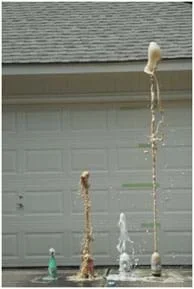 Students build Mentos fountainsCopyright 2007 K. Shimada Wikimedia Commons http://commons.wikimedia.org/wiki/File:ShimadaK2007Sept09-MentosGeyser_DSC_3294%2B%2B.JPG
Through this activity, students gain experience with two tasks that are vital to many real world engineering projects: 1) systematically testing, evaluating and optimizing a design, and 2) collaborating with other engineers or research groups.
After this activity, students should be able to:
- Explain the energy process that takes place in a Mentos fountain.
- Collect and interpret experimental data.
- Collaborate with other groups.
- Revise a design based on test results.
- MS-ETS1-2 Evaluate competing design solutions using a systematic process to determine how well they meet the criteria and constraints of the problem.
Grades 6-8
Do you agree with this alignment? - MS-ETS1-4 Develop a model to generate data for iterative testing and modification of a proposed object, tool, or process such that an optimal design can be achieved.
Grades 6-8
Do you agree with this alignment? - MS-PS3-5 Construct, use, and present arguments to support the claim that when the kinetic energy of an object changes, energy is transferred to or from the object.
Grades 6-8
Do you agree with this alignment?
- Students will develop an understanding of the attributes of design.
Grades K-12
Do you agree with this alignment? - Students will develop an understanding of engineering design.
Grades K-12
Do you agree with this alignment? - Modeling, testing, evaluating, and modifying are used to transform ideas into practical solutions.
Grades 6-8
Do you agree with this alignment? - STEL-7X Document trade-offs in the technology and engineering design process to produce the optimal design.
Grades 9-12
Do you agree with this alignment?
- MS-ETS1-2 Evaluate competing design solutions using a systematic process to determine how well they meet the criteria and constraints of the problem.
Grades 6-8
This resource focuses on the following Three Dimensional Learning aspects of NGSS:
Science & Engineering Practices- Evaluate competing design solutions based on jointly developed and agreed-upon design criteria.Do you agree with this alignment?
Disciplinary Core Ideas- There are systematic processes for evaluating solutions with respect to how well they meet the criteria and constraints of a problem.Do you agree with this alignment?
Do you agree with this alignment? - Evaluate competing design solutions based on jointly developed and agreed-upon design criteria.
- MS-ETS1-4 Develop a model to generate data for iterative testing and modification of a proposed object, tool, or process such that an optimal design can be achieved.
Grades 6-8
This resource focuses on the following Three Dimensional Learning aspects of NGSS:
Science & Engineering Practices- Develop a model to generate data to test ideas about designed systems, including those representing inputs and outputs.Do you agree with this alignment?
Disciplinary Core Ideas- Models of all kinds are important for testing solutions.Do you agree with this alignment?
- The iterative process of testing the most promising solutions and modifying what is proposed on the basis of the test results leads to greater refinement and ultimately to an optimal solution.Do you agree with this alignment?
Crosscutting Concepts- Models can be used to represent systems and their interactions.Do you agree with this alignment?
Do you agree with this alignment? - Develop a model to generate data to test ideas about designed systems, including those representing inputs and outputs.
- MS-PS3-5 Construct, use, and present arguments to support the claim that when the kinetic energy of an object changes, energy is transferred to or from the object.
Grades 6-8
This resource focuses on the following Three Dimensional Learning aspects of NGSS:
Science & Engineering Practices- Science knowledge is based upon logical and conceptual connections between evidence and explanations.Do you agree with this alignment?
Disciplinary Core Ideas- When the motion energy of an object changes, there is inevitably some other change in energy at the same time.Do you agree with this alignment?
Crosscutting Concepts- Energy may take different forms (e.g. energy in fields, thermal energy, energy of motion).Do you agree with this alignment?
Do you agree with this alignment? - Science knowledge is based upon logical and conceptual connections between evidence and explanations.
Each group needs:
- several 2-liter bottles of Diet Coke®
- 2 packages of Mentos® candy
- 1 Mentos® fountain, such as a "geyser loading tube" with multiple nozzles at http://www.stevespanglerscience.com/geyser-tube-fountain-fan-run.html
- Mentos Fountain Worksheet (PDF), one per student
- (optional) height-o-meter; learn about them at http://lhsgems.org/GEM306.html, including a design for a simple cardboard clinometer
For the entire class to share:
- capability to show an online video
Today I have a design challenge for you. You are going to work together as a class to optimize the design of a Mentos® fountain. Before we get started let's watch a video.
(Show students the following two-minute video explaining the science behind Mentos® fountains: https://www.discovery.com/tv-shows/mythbusters/videos/diet-coke-and-mentos-minimyth.)
Now we know how Mentos® fountains work. Who can explain the process in terms of energy? (Listen to responses.) We are going to test it out and see for ourselves!
Before the Activity
- Gather materials and make copies of the Mentos Fountain Worksheet (PDF).
- If desired, purchase or make a height-o-meter (clinometer) to measure the geyser heights.
- Arrange for a place to conduct the (messy) activity, preferably outside.
- Be ready to show students a two-minute online video explaining the science behind Mentos® fountains, MythBusters' Diet Coke and Mentos MiniMyth at https://www.discovery.com/tv-shows/mythbusters/videos/diet-coke-and-mentos-minimyth.
With the Students
- Present the Introduction/Motivation content to the class, including showing the MythBusters' video explaining the science behind the soda/candies geysers.
- Divide the class into three research groups and hand out the worksheets.
- Explain that you have designed a Mentos® fountain, and that the design challenge for the class is to design a Mentos® fountain that will go higher than yours. Your design uses an x-shaped nozzle, room temperature soda, and 5 Mentos® candies (as indicated on the worksheet). This design is the baseline for the class optimization effort.
- Assign a different variable to each group. The variable choices, as listed on the worksheet, are nozzle shape, soda temperature (room temperature vs. cold), and number of Mentos® candies. Other variables could be used, such as soda type.
- Explain that each research group is responsible to determine the best value for its variable. They are to run several tests using different values for the variable, while all other variables match the base design.
- Direct the groups to work together to make a plan, guided by the worksheet, completing the worksheet up to the results column in the big table.
- Outside, have the research groups carry out the tests they have designed and record the results. The results may be descriptive ("about as high as a classroom, higher than run 1, least high of all," height compared to some landmark like a flagpole or playground equipment, etc.) or use a height-o-meter to measure the height. Tips: Set off only one fountain at a time. Carefully inspect the fountain before pulling the pin to make sure everything is set up correctly.
- After testing is completed, have each research team confer to determine the best option for the variable they tested.
- Next, direct all three research groups to get together and decide what final fountain design they think will go the highest. Tips: More Mentos® are better than fewer. Room temperature soda is better than cold.
- Do a side-by-side test with the Mentos® fountain you designed (the baseline design on the worksheet) and the fountain design based on the collaborative class research. If the student experiments went well, expect their fountain to be higher.
- Now that students had the opportunity to test their fountains, ask students to explain what energy transfer takes place in Mentos fountains. Ask them to use the terms potential energy, kinetic energy and energy transfer in their explanations. (Expect students to explain that the process is an energy transfer from potential energy to kinetic energy and that the movement of the soda is how we can tell that kinetic energy is present. In addition, students should identify that the energy is originally stored in the carbonation as chemical potential energy. Further, students can explain that as the soda goes up, its kinetic energy is transferred to gravitational potential energy, which converts back to kinetic energy as the soda falls back down.)
- Conclude by leading a class discussion, as described in the Assessment section. Also have students complete and turn in their worksheets.
- energy
- The ability to make things happen. More advanced definition: The ability to do work.
- energy conversion
- The change of energy from one form to another.
- kinetic energy
- The energy of moving objects. Anything in motion has kinetic energy. The faster an object moves, the more kinetic energy it has.
- optimize
- To balance many (often competing) requirements to achieve the best design for the circumstances.
- potential energy
- Energy that is stored and can be used when needed. Energy can be stored in chemicals (food, batteries), height (gravitational), elastic stretching, etc.
Pre-Activity Assessment
Review Questions: Have students answer the two fill-in-the-blank review questions at the top of the Mentos Fountain Worksheet (PDF). The answers are: 1) potential, chemical, or chemical potential, and 2) kinetic.
Activity Embedded Assessment
Observations: While students are working in their research teams, observe how they plan and carry out the experiments. Notice their logic, how they interpret their results and how they collaborate with the other groups. Ask students how they chose their test cases and what they concluded from their results. Review their Mentos Fountain Worksheets (PDF) for thoroughness and accuracy.
Post-Activity Assessment
Project Reflection: As a class, review and discuss the activity. Pay particular attention to the process and reasoning that students followed to determine the class' final fountain design. This process is similar to the scientific method and to engineering design practices. Discuss whether their predictions were correct or incorrect and why. Discuss anything students observed that surprised them.
Worksheets: Collect students' completed Mentos Fountain Worksheets (PDF). Examine them to see if they followed the process outlined on the worksheet and collected reasonable and accurate data.
Making Sense: Have students reflect on the science concepts they explored and/or the science and engineering skills they used by completing the Making Sense Assessment (PDF).
Homework
Report: Assign students to individually write short reports about the activity. Require them to explain how a Mentos® fountain works in terms of energy and describe the design optimization process they went through to achieve the maximum height geyser.
This activity is messy so conduct it outside in a location that can be easily washed afterwards.
For safety, make sure students stand back when triggering Mentos® fountains.
Contributors
Eric Anderson; Jeff Kessler; Irene Zhao
Supporting Program
RESOURCE GK-12 Program, College of Engineering, University of California Davis
Acknowledgements
The contents of this digital library curriculum were developed by the Renewable Energy Systems Opportunity for Unified Research Collaboration and Education (RESOURCE) project in the College of Engineering under National Science Foundation GK-12 grant no. DGE 0948021. However, these contents do not necessarily represent the policies of the National Science Foundation, and you should not assume endorsement by the federal government.
Copyright
2014 by Regents of the University of Colorado; original © 2013 University of California Davis