
Name That Metal!
Given an assortment of unknown metals to identify, student pairs consider what unique intrinsic (aka intensive) metal properties (such as density, viscosity, boiling or melting point) could be tested. For the provided activity materials (copper, aluminum, zinc, iron or brass), density is the only property that can be measured so groups experimentally determine the density of the "mystery" metal objects. They devise an experimental procedure to measure mass and volume in order to calculate density. They calculate average density of all the pieces (also via the graphing method if computer tools area available). Then students analyze their own data compared to class data and perform error analysis. Through this inquiry-based activity, students design their own experiments, thus experiencing scientific investigation and experimentation first hand. A provided PowerPoint® file and information sheet helps to introduce the five metals, including information on their history, properties and uses.
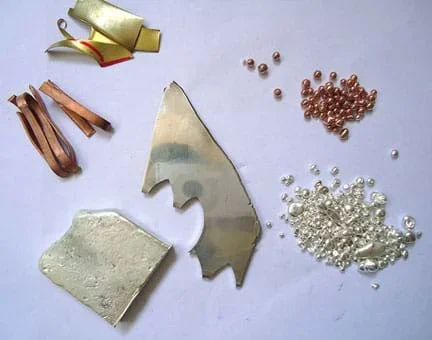 Assorted metals: copper, brass, silver, germanium.Copyright 2010 Mauro Cateb, Wikimedia Commons http://commons.wikimedia.org/wiki/File:Metals_for_jewellery.jpg
Before designing and specifying materials to solve technical problems, engineers must have an understanding of the materials, including a familiarity with their properties. Density is one fundamental physical property. Across all fields—civil to biomedical to electrical engineering—engineers often develop their own procedures for testing materials so as to ensure a particular material fits the needs of a design. In this activity, students act as engineers to develop procedures for measuring a materials property and use that acquired knowledge to identify unknown materials.
After this activity, students should be able to:
- Utilize the scientific method to design experiments.
- Select an appropriate apparatus to measure an object's volume.
- Determine the density of an object.
- (optional) Use data to obtain density via graphical methods.
- Identify inconsistent results and sources of error.
- 7.G.B Solve real-life and mathematical problems involving angle measure, area, surface area, and volume.
Grade 7
Do you agree with this alignment? - 8.SP.1 Construct and interpret scatter plots for bivariate measurement data to investigate patterns of association between two quantities. Describe patterns such as clustering, outliers, positive or negative association, linear association, and nonlinear association.
Grade 8
Do you agree with this alignment? - 8.SP.3 Use the equation of a linear model to solve problems in the context of bivariate measurement data, interpreting the slope and intercept.
Grade 8
Do you agree with this alignment? - G.MG.1 Use geometric shapes, their measures, and their properties to describe objects (e.g., modeling a tree trunk or a human torso as a cylinder).
Grades 9-12
Do you agree with this alignment? - G.MG.2 Apply concepts of density based on area and volume in modeling situations (e.g., persons per square mile, BTUs per cubic foot).
Grades 9-12
Do you agree with this alignment? - MP.2 Reason abstractly and quantitatively.
Grades K-12
Do you agree with this alignment? - 8.SP.A Investigate patterns of association in bivariate data.
Grade 8
Do you agree with this alignment? - HSG.GMD.B Visualize relationships between two-dimensional and three-dimensional objects
Grades 9-12
Do you agree with this alignment?
- CCSS.Math.Content.7.G.B Solve real-life and mathematical problems involving angle measure, area, surface area, and volume.
Grade 7
Do you agree with this alignment? - CCSS.Math.Content.8.SP.A Investigate patterns of association in bivariate data.
Grade 8
Do you agree with this alignment? - CCSS.Math.Content.8.SP.A.1 Construct and interpret scatter plots for bivariate measurement data to investigate patterns of association between two quantities. Describe patterns such as clustering, outliers, positive or negative association, linear association, and nonlinear association.
Grade 8
Do you agree with this alignment? - CCSS.Math.Content.8.SP.A.3 Use the equation of a linear model to solve problems in the context of bivariate measurement data, interpreting the slope and intercept.
Grade 8
Do you agree with this alignment? - CCSS.Math.Content.HSG-GMD.B Visualize relationships between two-dimensional and three-dimensional objects
Grades 9-12
Do you agree with this alignment? - CCSS.Math.Content.HSG-MG.A.1 Use geometric shapes, their measures, and their properties to describe objects (e.g., modeling a tree trunk or a human torso as a cylinder).
Grades 9-12
Do you agree with this alignment? - CCSS.Math.Content.HSG-MG.A.2 Apply concepts of density based on area and volume in modeling situations (e.g., persons per square mile, BTUs per cubic foot).
Grades 9-12
Do you agree with this alignment? - CCSS.Math.Practice.MP2 Reason abstractly and quantitatively.
Grades K-12
Do you agree with this alignment?
- STEL-3G Explain how knowledge gained from other content areas affects the development of technological products and systems.
Grades 6-8
Do you agree with this alignment?
- SEP.12.6-8.1 Use mathematical representations to describe and/or support scientific conclusions and design solutions.
Grades 6-8
Do you agree with this alignment? - SEP.7.6-8.3 Conduct an investigation to produce data to serve as the basis for evidence that meet the goals of an investigation.
Grades 6-8
Do you agree with this alignment?
Each group needs:
- 10-15 pieces each of copper, aluminum, zinc, iron or brass (one type per group) in a variety of shapes and forms, such as iron, aluminum and copper nails, solid brass grommets, aluminum washers and/or spacers, zinc metal rings (such as these 5-in zinc rings at https://www.amazon.com/Zinc-Metal-Rings-5-4-Pkg/dp/B00DG8VAYS), etc.; see the note below for additional suggestions and tips
- (optional, recommended) black spray paint
- small cardboard box, such as a shoebox or similar/smaller box, to hold the metal pieces
- electronic balance (digital scale)
- calculator
- Name That Metal! Information Sheet (PDF), one per student
- (optional) computer with Microsoft Excel® or similar software with graphing capabilities
Suggestions and tips about the metal samples:
- Make sure each metal piece is entirely one type of metal, for example, made of solid brass, not brass coated.
- Ask for help at hardware and jewelry stores to find a good variety of small, inexpensive pieces of copper, aluminum, zinc, iron and brass with different masses, shapes, densities and colors.
- Make sure the metal pieces have no dangerously sharp edges. You can warn students to be careful about pointed nails and screws.
- It is recommended that you paint all the metal pieces black, so students are unable to identify them by color, especially the copper and brass.
- Other types of metals may be used for this activity, but the facts provided on the Name That Metal! Information Sheet (PDF) pertain to only the five metals suggested in the Materials List.
To share with the entire class:
- rulers
- graduated cylinders, various sizes
- (optional) magnets
- access to water
- Name That Metal! Presentation (PPTX), a Microsoft PowerPoint® file
- projector, to show the presentation to the class
- Name That Metal! Pre-Lab Questions (docx)
- Name That Metal! Pre-Lab Questions (pdf)
- Name That Metal! Information Sheet (docx)
- Name That Metal! Information Sheet (pdf)
- Name That Metal! Presentation (pptx)
- Name That Metal! Presentation (pdf)
- Name That Metal! Post-Lab Questions (docx)
- Name That Metal! Post-Lab Questions (pdf)
Students should know how to graph data and be familiar with making measurements with a ruler, graduated cylinder and balance.
Have you ever considered how metals affect your everyday lives? Metals are used in cell phones, iPods, computers, bicycles, cars, radios, TVs, appliances, rocket engines, as well as the generation and storage of electricity (such as batteries). It is important for engineers who design all of the technology and products we depend upon every day to understand the properties of different metals and how they can be used. Engineers must be able to identify various metals based on their properties. How do we first identify most things we interact with? (Answer: Typically by using our eyesight. Students might mention other senses, such as feel, sound, smell, taste.)
With atoms too small to be seen, engineers must have methods to distinguish metals that look alike. They must take advantage of the unique measurable properties of each metal. With your eyes closed, carefully feel through your group's box of metals and see if you can determine the material for each object. Go slowly and be careful with your fingers, so you don't get cut or poked. (Give students some time to explore.) How is it going? What are you discovering? (Listen to student responses.) This is rather difficult because each feels nearly the same. So how can we differentiate the metals?
Let's say that you just came back from a jewelry store after spending $10,000 on a gold ring. How can you be sure that the ring is solid gold and not painted gold? What can you do to verify that you purchased a quality product?
(Hand out the Name That Metal! Information Sheet (PDF). Show the class the Name That Metal! Presentation (PPTX).)
This sheet and the presentation provide useful information and facts about the metals we will be identifying today: copper, aluminum, zinc, iron and brass. The properties that are described are all what we call intrinsic properties, meaning they do not depend on the amount or size of the material. Extrinsic properties are the opposite—properties that depend on the amount of material or size of the object.
In order to determine each object's metal type, do you think we should consider extrinsic or intrinsic properties? (Listen to student responses.) The answer is intrinsic properties, because we are concerned with what type of metal the object is made of—the object could be any size. Take some time to look around the classroom and think about how you might go about measuring any of these properties of the metal objects in your box.
Before the Activity
- Gather materials and make copies of the Name That Metal! Pre-Lab Questions (PDF) and Name That Metal! Information Sheet (PDF).
- Prepare one box for each group. Put only one type of metal in each box; for example, one group might get a box with five pieces of iron in it.
- (optional, recommended) So that the metals, especially copper and brass, won't be recognizable by color, paint all the metal pieces black. To do this, spray the pieces with black paint, using as light a coating as possible to minimize its effect on the density of the metal pieces.
- The day before the activity, hand out the pre-lab questions and assign students to complete them and hand them in before the activity.
- (optional) Make available computers with Microsoft Excel®, or a similar graphing program.
- Set up a projector to show the Name That Metal! Presentation (PPTX).
With the Students
- Divide class into groups of two students each.
- Hand out to each group a box of metal pieces and an information sheet. Tell the groups that each box contains one type of metal.
- Present the Introduction/Motivation section content, including handing out the information sheet and showing the presentation.
- Give groups time to think and brainstorm about how they might go about identifying the metal type of the objects in their boxes. Refer them to the information sheet for useful information about the metal properties.
- Regroup for a class discussion. Ask groups to share their ideas with the class. During the course of the discussion, expect students to come to realize that they do not have the necessary equipment to measure the melting or boiling points of any of the metal objects. Expect them to realize that they could use a magnet to determine if any of the materials are ferromagnetic, but that only works for iron. Also expect students to realize that they have enough materials to determine the density of each object, which involves first measuring each object's volume and mass.
- Having made the above realizations, guide students to determine an experimental procedure (such as the following procedure) and have them follow it in order to identify the material of the "mystery" objects.
- Inform students that they are also responsible to prepare lab reports for the experiment and its results (see details in the Assessment section) at the activity conclusion, so they are advised to take adequate notes during the experiment.
With the Students—Experimental Procedure
- Determine the mass of the object:
- Use the digital scale to measure the masses of the objects in the box. Record mass in grams.
- Determine the volume of the object:
- Determine volume by calculation or volume displacement.
- If any of the metal pieces are in shapes for which an equation exists to calculate the volume (cube, rectangular prism, cylinder, etc.), use the materials available to measure the dimensions and then calculate the volume. Advise students to measure dimensions in centimeters.
- If the metal pieces are irregularly shaped, use a volume displacement method to measure the volume. To do this, add water to a graduated cylinder that has enough water to completely cover the metal object. Carefully measure the volume of water in the graduated cylinder. Then, add the metal object and measure the volume of the water with the submerged metal object in the graduated cylinder. The difference between the new volume and the original volume is the volume of the metal object because that is how much water it displaced. Using the volume displacement method, students end up with a volume measurement in ml, which they must convert to cubic centimeters. (Hint: 1 ml = 1 cubic centimeter)
- For each metal object in the box, record the volume in cubic centimeters.
- Calculate average density of all the pieces:
- Calculate the density for each metal piece by dividing the mass by the volume.
- Finally, calculate the average density for all the metal pieces in the box by adding together the densities of all the pieces and dividing by the number of pieces.
- (optional) Calculate average density of all the pieces by graphing method:
- In Microsoft Excel®, or a similar program, create two columns of data for each object—the volume in cm3 and the mass in grams.
- Highlight the data in the two columns and insert a scatterplot. This displays the data where the x-axis is volume in cubic centimeters and the y-axis is mass in grams. This results in a plotted point on the graph for each metal object in the box—in the form of (x = volume, y = mass).
- Add a trend line, displaying the equation for that line. Ask students: What do you notice about the equation for the trend line (best-fit line)? What might the slope of the line represent? (Answer: The slope of a line is equal to the "rise over run" or y/x. In this case, the slope is equal to the mass/volume or the average density of the metal objects plotted on the graph.) Have students compare the slope to the average density they calculated.
- Determine the type of metal in the box:
- Have each group compare the average density of the metal objects in its box to the densities listed on the information sheet. Based on this, each group decides what type of metal objects are in its box.
- (optional) If any group believes its box contains iron objects, have them use the magnet to see if the metal objects are attracted to the magnet.
- Check with each group to see if the team determined the correct type of metal for the pieces in its box.
- Hold a class discussion to determine how many groups were correct, and for those that were not correct, discuss what might have gone wrong (for example, measurement errors, the paint affected the mass or volume measurements too much, throwing off the calculated density, etc.).
- extrinsic (extensive) property
- A property that depends on the amount or size of a material or object.
- ferromagnetic
- A material that can be magnetized to create a magnetic field; an object that is attracted to a magnet.
- intrinsic (intensive) property
- A property that does not depend on the amount or size of a material or object; a property that depends on the type of material.
Pre-Activity Assessment
Pre-Lab Questions: The day before the activity, assign students to answer the five Name That Metal! Pre-Lab Questions (PDF), which are also listed below, along with their answers. Review students' answers to gauge their base knowledge of the activity subject matter.
- Convert 5.27 kilograms to grams. (Answer: 1000 grams = 1 kilogram, thus, 5.27 kg [1000 g / 1 kg] = 5270 g.)
- Convert 0.0038 liters to cubic centimeters. (Answer: 1000 cubic centimeters = 1 liter, thus, 0.0038 liters [1000 cm3 / 1 liter] = 3.8 cm3.)
- What is an extrinsic (or extensive) property? List examples. (Answer: An extrinsic property is one that depends on material amount or size. For example, mass, weight volume, length, height, thickness.)
- What is an intrinsic (or intensive) property? List examples. (Answer: An intrinsic property is one that does not depend on material amount or size; it is a property that depends on the material type. For example, density, odor, taste, hardness, boiling point, melting point, electrical conductivity, color, metallic luster.)
- Which of these property types is used to identify a substance? (Answer: Intrinsic properties can be used to identify substances.)
Activity Embedded Assessment
Graphical Exercise: During the activity, students collect the physical measurements (mass and volume) necessary to calculate density so that they can identify the type of metal objects in their group boxes. Look for evidence that students understand and are able to demonstrate that mass divided by volume, and/or slope of the graph line, is equal to the object's density.
Post-Activity Assessment
Lab Report: Assign students to individually write full lab reports for the activity. Require the reports to include a problem statement, materials list, procedure, data and results section (including graphs if applicable) and a conclusion section. Review their final lab reports to assess their overall comprehension.
Post-Lab Questions: A day after the activity, assign students to answer the three Name That Metal! Post-Lab Questions (PDF), which are also listed below, along with their answers. Review students' answers to gauge their understanding of the activity subject matter. As a class, discuss the answers to clarify any misconceptions and ensure comprehension.
- Apart from calculating density, what other method could be used to determine the identity of a metal? (Answer: The metal objects could be tested for ferromagnetism by seeing if they are attracted to a magnet. If the necessary equipment were available, the materials could be heated to determine their melting and boiling points.)
- Did you find any inconsistent results or variability among your measurements? What might be the cause of these errors? (Answer: Expect that students may say that their measurements were not accurate enough; for example, they might have struggled to get precise readings on the graduated cylinders. Or, perhaps the digital scales were not tared before measuring the masses of objects, leading to incorrect measurements. The densities for iron and zinc are very similar, and densities for copper and brass are very similar, so students may have had difficulty distinguishing between these metals, especially if the calculated density for some objects was closer to the known density of one metal, while the calculated density for other objects was closer to the known density of a different metal. Sometimes the result for one mystery object is widely different from all the other mystery object results; in this case, discuss how sometimes scientists and engineers determine that an error in the measurements for that case must have occurred, and thus remove that data; by doing so, students may end up with a more accurate average density.)
- What, if any, measurements could you make if the mystery objects were liquid? (Answer: If objects are liquid, their masses and volumes could still be measured, and thus, their densities could still be calculated. If the objects were liquid at room temperature, you could heat them to measure boiling points. In addition, you could measure the relative viscosities of the liquid objects.)
Have students work independently for the first 10 minutes and then permit collaboration between partners thereafter. Ensure that only students within groups work together.
Due to the level of inquiry, students may become frustrated with the lack of information. Encourage each group to think about a practical way to identify the materials based on knowledge they already have.
Solids, liquids and gases have measurable densities. Have students identify densities of unknown liquids and investigate how the densities of solids relate to densities of liquids.
Hi-Res Images of Chemical Elements: A Virtual Museum at http://images-of-elements.com/
Contributors
Azim Laiwalla; Ann McCabe; Karen McCleary; Dua Naim Chaker; Carleigh Samson
Supporting Program
Science and Engineering of the Environment of Los Angeles (SEE-LA) GK-12 Program, UCLA
Acknowledgements
This digital library content was developed by the University of California's SEE-LA GK-12 program under National Science Foundation grant number DGE 0742410. However, these contents do not necessarily represent the policies of the National Science Foundation, and you should not assume endorsement by the federal government.
Copyright
2013 by Regents of the University of Colorado; original © 2009 University of California, Los Angeles