
How High Can a Super Ball Bounce?
Students determine the coefficient of restitution (or the elasticity) for super balls. Working in pairs, they drop balls from a meter height and determine how high they bounce. They measure, record and repeat the process to gather data to calculate average bounce heights and coefficients of elasticity. Then they use data analysis and extrapolate to determine the height the ball would bounce if dropped from much higher heights.
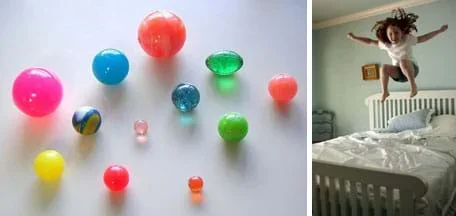 Elasticity is a materials property we find in super balls and mattresses.Copyright (left) Wikimedia and (right) 2004 Microsoft Corporation, One Microsoft Way, Redmond, WA 98052-6399 USA. All rights reserved. http://commons.wikimedia.org/wiki/File:Colorful_Super_ball.jpg
Mechanical engineers select materials that meet their design needs based on their properties, which might include coefficient of friction, restitution, elasticity, structural strength, melting point, etc. Scientists and engineers also need standardized ways to describe material properties and carry out repeatable experiments that take into account real-world variability that can come into play for specific measurement attempts. Scientists and engineers often need to use data analysis to extrapolate their measurements to make a prediction of what would happen under more extreme conditions. They use known patterns to make predictions (not random guesses).
After this activity, students should be able to:
- Use a ruler to measure length to the nearest cm.
- Describe that the unit of length is m and cm.
- Extrapolate using a simple number pattern (0.6 m is to 1 m as 6 m is to 10 m).
- 2.MD.1 Measure the length of an object by selecting and using appropriate tools such as rulers, yardsticks, meter sticks, and measuring tapes.
Grade 2
Do you agree with this alignment? - 2.MD.2 Measure the length of an object twice, using length units of different lengths for the two measurements; describe how the two measurements relate to the size of the unit chosen.
Grade 2
Do you agree with this alignment? - 2.MD.3 Estimate lengths using units of inches, feet, centimeters, and meters.
Grade 2
Do you agree with this alignment? - 2.MD.9 Generate measurement data by measuring lengths of several objects to the nearest whole unit, or by making repeated measurements of the same object. Show the measurements by making a line plot, where the horizontal scale is marked off in whole-number units.
Grade 2
Do you agree with this alignment? - 2.NBT.5 Fluently add and subtract within 100 using strategies based on place value, properties of operations, and/or the relationship between addition and subtraction.
Grade 2
Do you agree with this alignment? - 2.OA.A Represent and solve problems involving addition and subtraction.
Grade 2
Do you agree with this alignment? - 3.OA.C Multiply and divide within 100.
Grade 3
Do you agree with this alignment? - MP.2 Reason abstractly and quantitatively.
Grades K-12
Do you agree with this alignment? - MP.5 Use appropriate tools strategically.
Grades K-12
Do you agree with this alignment? - 2.MD.D Represent and interpret data.
Grade 2
Do you agree with this alignment? - 2.MD.A Measure and estimate lengths in standard units.
Grade 2
Do you agree with this alignment?
- 3-PS2-2 Make observations and/or measurements of an object's motion to provide evidence that a pattern can be used to predict future motion.
Grade 3
Do you agree with this alignment?
- CCSS.Math.Content.2.MD.A Measure and estimate lengths in standard units.
Grade 2
Do you agree with this alignment? - CCSS.Math.Content.2.MD.A.1 Measure the length of an object by selecting and using appropriate tools such as rulers, yardsticks, meter sticks, and measuring tapes.
Grade 2
Do you agree with this alignment? - CCSS.Math.Content.2.MD.A.3 Estimate lengths using units of inches, feet, centimeters, and meters.
Grade 2
Do you agree with this alignment? - CCSS.Math.Content.2.MD.D Represent and interpret data.
Grade 2
Do you agree with this alignment? - CCSS.Math.Content.2.MD.D.9 Generate measurement data by measuring lengths of several objects to the nearest whole unit, or by making repeated measurements of the same object. Show the measurements by making a line plot, where the horizontal scale is marked off in whole-number units.
Grade 2
Do you agree with this alignment? - CCSS.Math.Content.2.NBT.B.5 Fluently add and subtract within 100 using strategies based on place value, properties of operations, and/or the relationship between addition and subtraction.
Grade 2
Do you agree with this alignment? - CCSS.Math.Content.2.OA.A Represent and solve problems involving addition and subtraction.
Grade 2
Do you agree with this alignment? - CCSS.Math.Content.3.OA.C Multiply and divide within 100.
Grade 3
Do you agree with this alignment? - CCSS.Math.Practice.MP2 Reason abstractly and quantitatively.
Grades K-12
Do you agree with this alignment? - CCSS.Math.Practice.MP5 Use appropriate tools strategically.
Grades K-12
Do you agree with this alignment?
- STEL-2C Explain that materials are selected for use because they possess desirable properties and characteristics.
Grades -1-2
Do you agree with this alignment? - STEL-2I Describe the properties of different materials.
Grades 3-5
Do you agree with this alignment?
- 3-PS2-2 Make observations and/or measurements of an object's motion to provide evidence that a pattern can be used to predict future motion.
Grade 3
This resource focuses on the following Three Dimensional Learning aspects of NGSS:
Science & Engineering Practices- Make observations and/or measurements to produce data to serve as the basis for evidence for an explanation of a phenomenon or test a design solution.Do you agree with this alignment?
- Science findings are based on recognizing patterns.Do you agree with this alignment?
Disciplinary Core Ideas- The patterns of an object's motion in various situations can be observed and measured; when that past motion exhibits a regular pattern, future motion can be predicted from it. (Boundary: Technical terms, such as magnitude, velocity, momentum, and vector quantity, are not introduced at this level, but the concept that some quantities need both size and direction to be described is developed.)Do you agree with this alignment?
Crosscutting Concepts- Patterns of change can be used to make predictions.Do you agree with this alignment?
Do you agree with this alignment? - Make observations and/or measurements to produce data to serve as the basis for evidence for an explanation of a phenomenon or test a design solution.
Each group needs:
- paper and pencil
- meter stick
- super ball (online source: 144 super balls for $16.29 from Oriental Trading; see https://www.orientaltrading.com/bright-neon-bouncy-ball-assortment-a2-39_1109.fltr?categoryId=552883&rd=super%20ball )
Students should know how to read rulers and calculate averages.
How high do you think a super ball can bounce? (Listen to suggestions from students.) To find out, if we were limited to only experiment in a classroom with a standard ceiling height, how could we determine how bouncy a super ball is?
Scientists and engineers have measured the properties of many materials — some materials are hard, some soft, some bounce, some are magnetic, some are solids or liquids, etc. One property of sports balls (such as tennis balls or basketballs) is how high they bounce. The height a ball bounces compared to the height it is dropped is called the rebound height. Different balls are more or less bouncy depending on the material and its construction. Different sports use many different balls with different sizes, weights, materials, shapes and construction (hollow or solid) that give the specific sport its main character. Can you imagine playing soccer with a bowling ball? Or a baseball? How would that change the nature of the game?
Part of the design of a ball game is to determine what type of ball fits the objective of the game, and the size of the playing field. Measuring the elasticity (or bounciness) of a material is just one of the important properties needed to make the best engineering design decision.
Scientists and engineers describe how bouncy something is by measuring how high the material bounces compared to how high it was dropped. You will measure this by dropping a super ball from a 1 meter height? How can we be sure we are dropping the ball exactly 1 meter? How would we measure how high it bounced? (See if students suggest using a meter stick.) Once the "bounciness" is determined, how can we figure out a simple number series to determine how high it would bounce if dropped from 10 m, 100 m?
The bounciness is related to the elasticity of the material or how much it deforms under pressure. Every sport usually uses a different type of ball (tennis ball, basketball, volleyball, golf ball, baseball, ping pong ball). In addition to the ball size, its materials and construction (hollow or solid) determine how bouncy it is. In athletic competitions, each sport has defined the properties of its ball and manufacturers must make "regulation" balls that meet those criteria. Therefore, the engineers who design the balls and their fabrication processes must be able to accurately measure the raw materials as well as the final properties of the balls they make to ensure that they meet the sports' specifications.
Background
In this activity, students gain first-hand experience with measurement, data analysis, ratios and materials properties. They learn about the coefficient of restitution (or elasticity), which is a fancy name for how bouncy a ball is. Specifically, it is proportional to the fraction of the height that the ball bounces compared to the height that the ball is dropped. The students drop balls from a meter height and determine how high they bounce. They record and repeat the process five (or 10) times, rounding to the nearest cm (or 5 cm depending on the resolution desired). Then they calculate the average heights of the bounces and the coefficients of elasticity (or the ratio of the bounce to the drop height). They analyze their data and extrapolate the height the ball would bounce if dropped from 10 m, 100 m, etc.
Because the cost of a gross of super balls is relatively low, the teacher can promise students that they can take their bouncy balls home after the activity IF the class performs the experiments well — that means no balls bouncing around or thrown around the room — and every team completes the measurements and calculations.
Before the Activity
- Gather materials.
- Divide the class into groups of two students each.
With the Students
- In groups or as a class, have students brainstorm how they might determine how bouncy a super ball can be. How will they measure how high the ball bounces? (See more brainstorming questions in the Assessment section.) Discuss their answers as a class.
- Demonstrate how each team could complete the experiment. Example: One student drops the ball (do not throw it) from a height of 1 m. A second student attempts to measure/estimate the height of the ball after one bounce.
- Have students measure their desks to the nearest cm. Have them become familiar with the layout of a meter stick, how the cm and decimeters are marked. Have them practice a few times to determine the best position they should be to measure/estimate the height of the ball.
- Have the student teams bounce their balls and record the measured heights of the bounces, repeating the process five (or 10) times. Round the measurements to the nearest cm (or 5 cm depending on the resolution desired). Direct them to record their answers on sheets of paper.
- Have the students calculate the average heights of the bounces and then the coefficients of elasticity (or the ratio of the bounce to the drop height). Compare and discuss answers as a class.
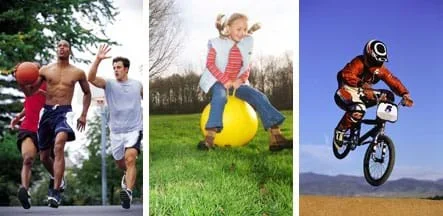 For what products would measuring the elasticity of a material be important to design engineers?Copyright 2004 Microsoft Corporation, One Microsoft Way, Redmond, WA 98052-6399 USA. All rights reserved.
- Have students brainstorm ideas to extrapolate the height their balls would bounce if dropped from 10 m, 100 m, etc. Can they analyze their measurements/observations to see a pattern that can be used to predict future motion? Discuss and explain answers as a class.
- Have students discuss in their groups examples of when measuring the elasticity (bounciness) of a material might be important in designing something. What do you want to be very elastic? What do you want to be NOT very elastic? Create a list of their ideas on the classroom board or in the front of the room. (Examples: Shoes, tires, rubber bands, elastic bands [for hair, clothes, underwear], basketballs [all kinds of balls and toys], bow string, trampolines, automatic door sensor mats, cushions, pillows, balloons, air bags, etc.)
- Conclude with a class discussion to review what students learned, and help them extrapolate to real-world examples, as described in the Assessment section.
- coefficient of restitution
- The ratio of the bounce height to the drop height.
- elasticity
- The property of a material that describes how springy, bouncy, or how easily it returns to its original shape after deformation.
Pre-Activity Assessment
Height Estimation: Lead a class brainstorming session, asking the students:
- What is the height of your textbook? How would you measure the height?
- How high can you jump (how high your feet come off the floor)? How would you measure how high you can jump?
Activity Embedded Assessment
Bounciness: Lead a class brainstorming session, asking the students:
- What property describes if a ball is a bouncy ball?
- Do different balls have different bounciness?
- What does it mean to be bouncy?
- Can you measure a ball's bounciness?
- What would be a good bouncy ball in terms of coefficient of elasticity?
- Think of all the types of balls and order them in terms of bounciness.
Post-Activity Assessment
Summary and Extrapolation: Lead a class discussion to review what students have learned and test their understanding with extrapolation to real-world applications. Ask the students:
- What can you measure in the classroom using a meter stick?
- Describe those measurements to me in a variety of ways? (For example: Halfway to the ceiling or 2 m high.)
- What determines how high a ball bounces? (Answer: The force at which it is dropped and the elasticity of its material.)
- Describe quantitatively the bounciness of another ball, such as a tennis ball, ping pong ball, marble, etc., and compare it to a super ball. What is different about the balls?
- Why is it important to have a correct measurement of the elasticity of a material?
- What are some engineered products that use elasticity or elastic (bouncy) materials in their designs (Possible answers: Tires, balloons, shoes, elastic bands, air bags, basketballs, trampolines, etc.)
- How else might engineers use the bounciness of a material in the design of new products?
- What might happen if the material an engineer uses for a design that needs elasticity is not bouncy enough?
- Pretend you are an engineer that has been asked to design a new bouncing ball that can be used as a fun transportation device for children. What would your design look like? Make a sketch of your design.
- How would you describe the measurement of bounciness in your above product to an engineer in another city?
- If your school bans super balls, use ping pong (aka table tennis) balls instead. They are slightly more expensive and can be crushed or broken. Atafa Sporting Goods sells a gross for $22; see: http://www.atafa.com/products/Gogo-Multi-Color-Table-Tennis-Balls-434766.html
Inevitably, some students will lose their super balls. Determine your response to this prior to distributing the balls.
Some balls may not bounce very true and therefore bounce far from the meter stick, resulting in a wide variety of bounce heights. As part of the pre-activity guidance, suggest to student groups a policy to only include bounces for which they are able to make good measurements (those that bounce close to the meter stick). Or, you can reduce the original drop height to 20 or 50 cm. The coefficient determined is relatively independent of initial drop height, but depending on the accuracy of the bounce height determination, very different ratios could be found due to round-off errors.
Have students measure the coefficient of elasticity of a variety of balls.
Have students measure the height of the first, second, third, etc., bounces. Have them plot these heights on a graph.
Have students vary the initial drop heights to determine if the coefficient of elasticity changes.
Use this activity to explore fractions, ratios and/or percentages.
- For lower grades, do not introduce the coefficient of elasticity terminology.
- For upper grades, have students calculate the average speed of the ball from the 1 m height to the ground and up to its maximum height. This requires stopwatches, recording the time it takes to bounce, and using the total distance traveled to estimate the average speed.
Contributors
Mark Moldwin (University of Michigan, Atmospheric, Oceanic and Space Sciences)
Supporting Program
Science and Engineering of the Environment of Los Angeles (SEE-LA) GK-12 Program, UCLA
Acknowledgements
This digital library content was developed by the University of California's SEE-LA GK-12 program under National Science Foundation grant number DGE 0742410. However, these contents do not necessarily represent the policies of the National Science Foundation, and you should not assume endorsement by the federal government.
Copyright
2013 by Regents of the University of Colorado; original © 2009 University of California, Los Angeles