
Take a Seat! Minimizing Pressure and Optimizing Comfort in School Chairs
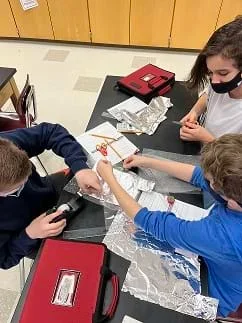 Students working together to assemble their sensor.Copyright 2022 Ashley LaPane, UConn Joule Fellows Program
Students build and use a simple capacitance sensor as they learn how capacity relates to pressure. As they learn more about how capacitance changes as pressure is applied to the sensor, they explore how to measure the pressure of sitting in a school seat. This will lead to the exploration of the problem of uncomfortable school seats and then the task of designing a cushion to be used to lessen the pressure of sitting in a school chair. Student groups can measure the effectiveness of their cushions and compare the success of different designs and materials by measuring the change in pressure using the capacitance sensors they built.
Engineers use sensors in a wide variety of situations. Sensors help detect changes in physical quantities, and oftentimes are utilized to identify changes before problems arise on a large or small scale. When selecting or designing a sensor, engineers must take into account what they are measuring and how they are measuring the quantity. For example, wearable sensors can detect changes in or on the body, so they must be flexible and not cumbersome to the wearer. The use of sensors is pivotal to understanding more about our world – so we must use the right sensor for the task!
After this activity, students should be able to:
- Explain the relationship between capacitance, force, and pressure.
- Calculate the change in capacitance when pressure is applied to a capacitance sensor.
- Discuss the success of their seat cushion in the context of how much their cushion was able to decrease the pressure/capacitance felt by the sitting individual.
- Compare the success of different seat cushion designs by comparing change in capacitance.
- CCSS.Math.Practice.MP2 Reason abstractly and quantitatively.
Grades K-12
Do you agree with this alignment?
- MS-ETS1-2 Evaluate competing design solutions using a systematic process to determine how well they meet the criteria and constraints of the problem.
Grades 6-8
This resource focuses on the following Three Dimensional Learning aspects of NGSS:
Science & Engineering Practices- Evaluate competing design solutions based on jointly developed and agreed-upon design criteria.Do you agree with this alignment?
Disciplinary Core Ideas- There are systematic processes for evaluating solutions with respect to how well they meet the criteria and constraints of a problem.Do you agree with this alignment?
Do you agree with this alignment? - Evaluate competing design solutions based on jointly developed and agreed-upon design criteria.
- MS-ETS1-3 Analyze data from tests to determine similarities and differences among several design solutions to identify the best characteristics of each that can be combined into a new solution to better meet the criteria for success.
Grades 6-8
This resource focuses on the following Three Dimensional Learning aspects of NGSS:
Science & Engineering Practices- Analyze and interpret data to determine similarities and differences in findings.Do you agree with this alignment?
Disciplinary Core Ideas- There are systematic processes for evaluating solutions with respect to how well they meet the criteria and constraints of a problem.Do you agree with this alignment?
- Sometimes parts of different solutions can be combined to create a solution that is better than any of its predecessors.Do you agree with this alignment?
- Although one design may not perform the best across all tests, identifying the characteristics of the design that performed the best in each test can provide useful information for the redesign process—that is, some of the characteristics may be incorporated into the new design.Do you agree with this alignment?
Do you agree with this alignment? - Analyze and interpret data to determine similarities and differences in findings.
For teacher demonstrations (optional):
- touch-screen phone or tablet
- thin winter gloves
- 2 balloons, one small and one large
- wax paper and foil capacitance sensor
To make a capacitance sensor, each group needs:
- 3 pieces of wax paper, each cut into a roughly 29 cm x 21.5 cm (11.5 in x 8.5 in) rectangle (Link)
- piece of foil cut into a roughly 25 cm x 18 cm (10 in x 7 in) rectangle
- 2 pieces of foil cut into a rectangle with a tail, roughly 25 cm x 18 cm (10 in x 7 in) with a tail that sticks out about 4 cm (1.5 in) from the rectangle (Link)
- 2 pairs of scissors
- clear tape
- clear sheet protector (Link)
- 2 paper clips
- 2 rulers
- marker
To test a capacitance sensor (teacher can choose to have 1 set up for sensor testing or multiple), you will need:
- set of red and black alligator clips to banana plugs that have 1 meter wires (Link)
- capacitance tester OR digital multimeter that can measure capacitance in nanofarads (nF) (Link)
To make a seat cushion, groups can share:
- scissors
- gallon large Ziploc bags
- Any squishy materials that you can find including:
- foam
- packing peanuts
- cotton balls
- fabric
- cardboard
- packing materials like bubble mailers
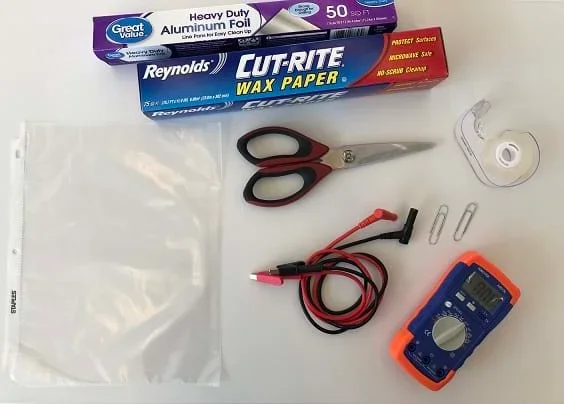 Materials needed to construct the capacitance seat sensor.Copyright 2022 Ashley LaPane, UConn Joule Fellows Program
- Practice Measuring Capacitance/Testing Your Sensor Sheet (docx)
- Practice Measuring Capacitance/Testing Your Sensor Sheet (pdf)
- Practice Measuring Capacitance/Testing Your Sensor Sheet Answer Key (pdf)
- Step-By-Step How to Build the Sensor Guide (docx)
- Step-By-Step How to Build the Sensor Guide (pdf)
- Step-By-Step How to Build the Sensor PowerPoint Presentation (pptx)
- Step-By-Step How to Build the Sensor PowerPoint Presentation (pdf)
- The Comfiest Seat Design Challenge PowerPoint Presentation (pptx)
- The Comfiest Seat Design Challenge PowerPoint Presentation (pdf)
- Class Cushion Data Sheet (docx)
- Class Cushion Data Sheet (pdf)
- Cushions and Capacitance Exit Ticket (docx)
- Cushions and Capacitance Exit Ticket (pdf)
- Cushions and Capacitance Exit Ticket Answer Key (docx)
- Cushions and Capacitance Exit Ticket Answer Key (pdf)
- Small Group Cushion Comparison Sheet (docx)
- Small Group Cushion Comparison Sheet (pdf)
Before this activity, students should have: the ability to measure using a ruler in inches, a firm understanding of how to find the difference between two numbers, and the ability to use data to compare and contrast.
How do you think touch screens on laptops and cell phones work? If you are wearing gloves during the winter, why are we unable to use a touch screen? Write down what you wonder and what questions you have about this.
What comes to your mind when you think of the word pressure? What everyday objects have pressure? Do you feel pressure in your life? We can think about pressure as how much force is acting in a given area. Now, what is force? What does it mean when something is forceful? Force is a push or a pull. Pressure and force are directly related! What happens when you apply more force to something? Do you think there will be more or less pressure? The more force you apply, the more pressure there will be.
Our bodies experience pressure every day from all the activities that we do from walking, to playing sports, to dancing, and even sitting. Many types of engineers including biomedical engineers and biological engineers continue to research and design different sensors to monitor human activity. A sensor is a device that measures a physical property like temperature and sends that information to other electronics, like a computer processor. Depending on the type of cell phone, most phones have close to twenty different tiny sensors in them! Today, your group will be building a sensor of your own that you can use to measure capacitance.
Did you know that the average student spends 15,000 hours sitting down during their school life? If so many students are uncomfortable, we must think like engineers to solve this problem. We will be creating a sensor that can be sat on to measure the “pressure” of sitting, and we will later create a cushion to potentially lessen the impact of sitting in these school seats.
Engineers use sensors just like ours to monitor behaviors and changes all of the time. They have to think about what they are measuring and how they are going to measure, so they have to use or create the right sensor for the job. For example, a team of biological engineers are designing a pressure sensor to be worn on the bottom of the foot while walking. This sensor must be flat and lightweight so that the user can still walk.
How does a capacitance sensor work? Let’s find out more about the materials we will use and how we will measure the pressure of sitting.
We will be using tin foil and wax paper to build our sensor. The tin foil is a conductor, which means electricity can flow through it easily. The wax paper is an insulator, and electricity will not flow through it easily. We will make a sandwich, with two pieces of tin foil on the outside and an insulator in between the tin foil. This tin foil and wax paper sandwich creates a capacitor, which is a device that stores electricity. Notice that there is space between both pieces of tin foil, and the capacitance will increase the closer together the pieces of tin foil are.
It is important to note that the sensor we create doesn’t measure pressure, but it does measure capacitance which is directly related to the pressure. This means that if we sit on this sensor, we are pushing the pieces of tin foil closer and closer together, increasing the pressure and the capacitance.
Are you ready to think like engineers and solve the problem of uncomfortable school chairs? Let’s get started!
Background
A capacitance sensor works best if the insulator between the tin foil is thin, therefore we see more dramatic results when wax paper is utilized rather than regular paper. For the capacitance sensor to work, no part of the tin foil panels can touch, therefore it is pivotal that the wax paper completely separates the tin foil.
To measure the capacitance, the sensor will need to be connected to a digital multimeter. The capacitance sensor measures the natural capacitance of the tin foil and does not require a power source, therefore you will need a sensitive multimeter that can measure a very small capacitance. A multimeter that measures capacitance only, linked here, is an affordable option that can measure very small capacitance levels. If using a standard digital multimeter that measures capacitance, your multimeter will need to be able to read nanoFarad (nF) capacitance values. A multimeter that uses microFarads (µF) is not sensitive enough and typically does not give any reading.
Part 1 – Building the Capacitance Sensor
Before the Activity
- Gather materials to build the capacitance sensor – tin foil, wax paper, tape, scissors, paper clips, and sheet protectors and set aside.
- Optional: Create an example capacitance sensor to demonstrate.
- Print out the Practicing Measuring Capacitance Worksheet/Testing Your Sensor Sheet (PDF) and Step-By-Step How to Build the Sensor Guide (PDF).
- There is also a Step-By-Step How to Build the Sensor PowerPoint (PPTX) to share/project, if preferred.
- Display materials and measurements on white board, chalk board, or projector for students to reference as they are measuring and cutting out the pieces for their sensor.
With the Students
Day 1
- Divide the class into teams of 2 or 3 students each and hand out the Practicing Measuring Capacitance Worksheet (PDF). While handing out the supplies below, have students complete the worksheet.
- Hand out just the wax paper, rulers, and scissors for now. Distribute copies of the Step-By-Step How to Build the Sensor Guide (PDF) or show the Step-By-Step How to Build the Sensor PowerPoint (PPTX)
- Direct the groups to use the ruler to first measure and mark a roughly 29 cm x 21.5 cm (11.5 in x 8.5 in) rectangle on each piece of wax paper using a marker. Then cut out each rectangle and set to the side.
- Go over the Practicing Measuring Capacitance Worksheet (PDF). Have students put their wax paper into a folder (or other safe space) to continue building the sensor on Day 2.
Day 2
- Hand out one piece of tin foil and direct groups to use the ruler to first measure and mark a roughly 25 cm x 18 cm (10 in x 7 in) rectangle. Then cut out the rectangle and set to the side.
- Hand out two pieces of tin foil and direct groups to use the ruler to first measure and mark each piece of tin foil in the shape of a “rectangle with a tail” that measures roughly 25 cm x 18 cm (10 in x 7 in) with the tail sticking out about 4 cm (1.5 in) from the rectangle (see Figure 1). Cut out both shapes and set to the side.
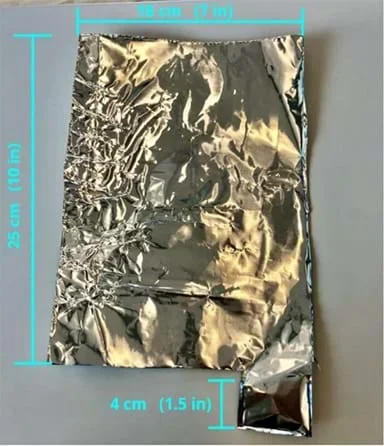 Figure 1. Dimensions and shape of tin foil “with tail”.Copyright 2022 Ashley LaPane, UConn Joule Fellows Program
 - Place first piece of tin foil with a tail in the middle of one of the pieces of wax paper. Use about 12 cm (about 5 inches) of tape to tape down the 3 sides that do NOT have the tail (see Figure 2).
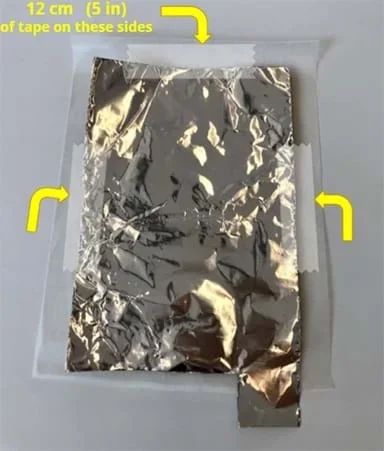 Figure 2. Placement and orientation of clear tape placed on three sides of the tin foil.Copyright 2022 Ashley LaPane, UConn Joule Fellows Program
 - Place rectangular piece of tin foil in the middle of one of the pieces of wax paper. Use about 12 cm (about 5 inches) of tape to tape down 3 of the sides, leaving one side untapped.
- Place second piece of tin foil with a tail in the middle of one of the other pieces of wax paper. The tail should be on the opposite side of the other piece of tin foil with the tail (see Figure 3). Use another 12 cm (about 5 inches) of tape to tape down the 3 sides that do NOT have the tail.
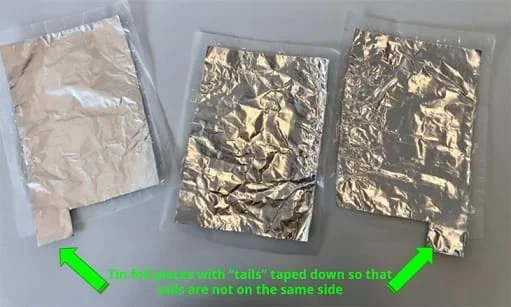 Figure 3. Orientation of each of the pieces of tin foil on wax paper, with tin foil tails taped on opposite sides.Copyright 2022 Ashley LaPane, UConn Joule Fellows Program
 - Next, stack each tin foil/wax paper onto each other as such: On the bottom should be one of the pieces of tin foil with the tail, in the middle should be the rectangular piece of tin foil, on the top should be the other piece of tin foil with the tail (see Figure 4).
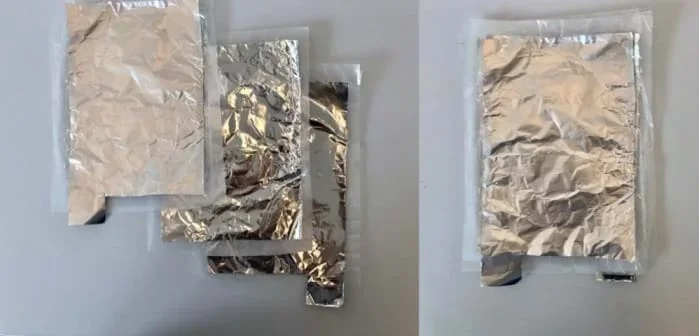 Figure 4. Orientation of the tin foil/wax paper sheets stacked on top of one another.Copyright 2022 Ashley LaPane, UConn Joule Fellows Program
 - Place a paper clip on each of the tails of the tin foil only.
- Place all the sheets of tin foil and wax paper into the clear sheet protector, with the tin foil tails sticking out of the slot at the top (see Figure 5).
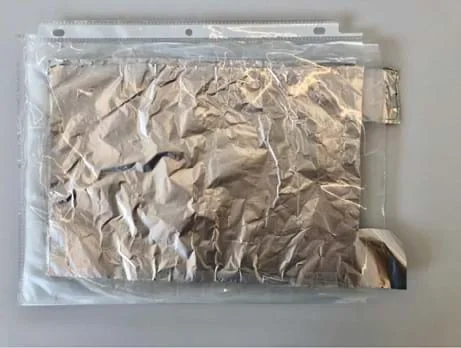 Figure 5. Placement of tin foil/wax paper sheets in the clear sheet protector, with tin foil tails sticking out.Copyright 2022 Ashley LaPane, UConn Joule Fellows Program
Day 3
- Plug your alligator clips into your digital multimeter and turn the multimeter on to read capacitance in nanofarads (nF). If using the capacitance meter attached here, you can utilize the 20 nF setting for more specific readings to the hundredths place and the 200 nF setting for less specific readings to the tenths place.
- Attach one alligator clip to one paper clip and the other alligator clip to the other paper clip (See Figure 6).
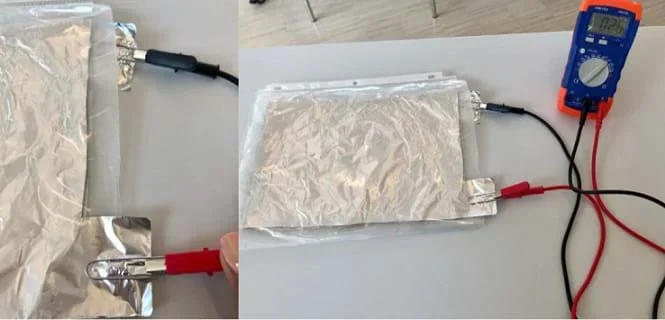 Figure 6. Placement of paper clips and method of attaching alligator clips to paper clips and capacitance meter.Copyright 2022 Ashley LaPane, UConn Joule Fellows ProgramYou will likely see a reading in the 0.3 – 0.8 nF range. This value includes the capacitance in the wires and the meter. If you place an object onto the sensor you will see the reading increase. Therefore, to find the capacitance, we will subtract the final reading – initial reading.
 - If enough capacitance multimeters are available for multiple groups, groups will independent test a few different objects on their capacitance sensor and record them in the Practicing Measuring Capacitance Worksheet/Testing Your Sensor Sheet (PDF). If few capacitance multimeters are available, use one group’s sensor as a model while the whole class records data in the Practicing Measuring Capacitance Worksheet/Testing Your Sensor Sheet (PDF).
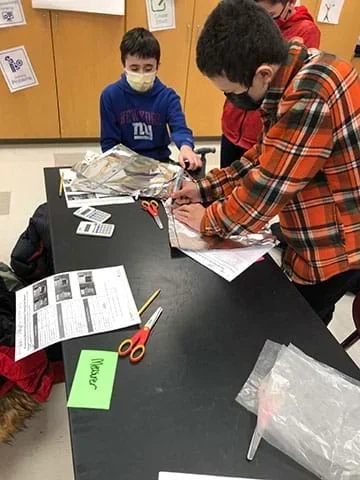 Students building their sensor.Copyright 2022 Ashley LaPane, UConn Joule Fellows Program
Part 2 – Building the Cushion
Before the Activity
- Gather materials to build the cushions – Scissors, large gallon Ziploc bags, any squishy materials that you can find including foam, packing peanuts, cotton balls, fabric, cardboard, etc.
- Print out the Small Group Cushion Comparison Sheets (PDF) and Class Cushion Datasheets (PDF) for students
- Project The Comfiest Seat Design Challenge PowerPoint (PPTX) on the board
With the Students
Day 4
- Students should assemble in the same team of 2 or 3 students they previously built their capacitance sensor with. Distribute copies of the Small Group Cushion Comparison Sheets (PDF) and Class Cushion Datasheet (PDF) and ensure that The Comfiest Seat Design Challenge PowerPoint (PPTX) is visible.
- Introduce the design challenge to students and groups should begin sketching their design while coming up with a list of required materials.
- If students complete a firm sketch and accurate list of materials, have students begin to gather the materials they will need. Alternatively, students can gather materials on Day 5.
Day 5
- Have students finish gathering the materials they will need based on their sketches and lists of materials.
- Each group will then assemble their cushions with the criteria of fitting on the seat and being portable using only the materials provided by the teacher.
- Once each group has finished their cushion, each group will test their design and record their data on the Small Group Cushion Comparison Sheet (PDF). They will perform tests as follows: One group will first sit on the sensor and calculate the change in capacitance for their “control” test. Then, they will place their cushion on the sensor and calculate the change in capacitance for their “experimental” test. To find how successful their cushion is, they will subtract the capacitance of their “experimental” test – “control” test. If time allows, students will design, assemble, and test a second cushion, recording their data on the Small Group Cushion Comparison Sheet (PDF). Students will have time to continue testing their designs on Day 6.
Day 6
- Have students finish testing their designs and recording their data on the Small Group Cushion Comparison Sheet (PDF).
- Groups will record each other’s readings and perform calculations to analyze the most successful material using their Class Cushion Datasheet (PDF). The teacher can ask students how to correctly identify the most successful cushion, which would be to find the cushion that has the largest negative change in capacitance (see Figure 7). Students will also use this discussion as a springboard to answering the data analysis questions on their Class Cushion Datasheet (PDF).
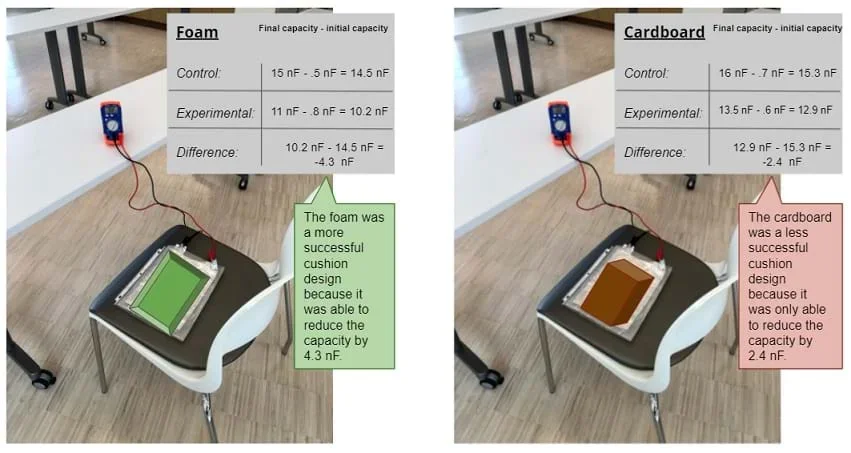 Figure 7. Example calculations and comparison between two cushion materials.Copyright 2022 Ashley LaPane, UConn Joule Fellows Program
- capacitance
- The amount of storage in a capacitor.
- capacitor
- A device that stores electricity and is made of two metal plates separated by an insulator.
- conductor
- A material that conducts electricity well, like metal.
- force
- A push or pull applied to an object.
- insulator
- A material that does not conduct electricity well, like paper.
- pressure
- The amount of force acting on a given area.
- sensor
- A device that detects or measures a physical property like temperature in its environment and sends to information to other electronics, like a computer processor.
Pre-Activity Assessment
Quick Poll: Before beginning the activity, ask the class several questions to introduce seat comfort. Poll questions are included in The Comfiest Seat Design Challenge PowerPoint (PPTX).
Activity Embedded (Formative) Assessment
One – Minute Essay/Share: Before beginning a discussion of pressure and capacitance, ask students to write or draw what comes to mind when they think of the words “pressure” and “capacitance”. This one-minute essay can be written on paper, typed, or written on a white board. After the one minute, the teacher can choose to have students share with the class or share in pairs.
Post-Activity (Summative) Assessment
Exit Ticket: After the completion of the activity, the teacher can decide to have students complete the Cushions and Capacitance Exit Ticket (PDF) in order to determine their knowledge of the structure/function of the parts of the sensor, relationship between capacitance and pressure, as well as how to calculate and interpret the capacitance of objects.
Making Sense Assessment: Have students reflect on the science concepts they explored and/or the science and engineering skills they used by completing the Making Sense Assessment (PDF).
Analysis & Reflection: At the end of the Class Cushion Data Sheet (PDF), there are analysis questions that involve students interpreting data and reflecting on their engineering process. These questions should be done independently to allow for each student to reflect on the activity as a whole and their feats/struggles.
When using the digital multimeter, suggest that students follow these safety precautions:
- Be careful with the digital multimeter – do not drop it or play around with it.
- Do not tamper with the meter by pulling any parts off.
- Never switch settings (for example, voltage to current) while the probes are connected to circuit.
- At times, students have created sensors that do not work very well. I recommend having several pre-made examples ready for them to use instead if time is limited. If students have more time, you can choose to have them compare their sensor to the example to determine where the error lies.
- Masking tape also works in place of clear tape if supplies are limited.
Students could continue to use their capacitance sensor in the future and perform different tasks. They could use the sensor to identify which sitting position lessens the pressure on their sensor. They could also convert this sensor into a wearable capacitance sensor and test different things such as the pressure of a backpack on a back or backpack strap on a shoulder.
- For higher grade levels or computer science classes, there is a method of connecting the capacitance sensor created to an Arduino to receive capacitance readings on a graph. Here is a YouTube video from Student Builds titled “How To Make a Capacitive Sensor for $1 with Arduino for more information: https://www.youtube.com/watch?v=a4mt-gApxiw. Here is the code included with the video to allow for the capacitance sensor to communicate with the Arduino: https://drive.google.com/drive/folders/0B8mHzFjXm-RRZ0h1WkNyR21Fb0U?resourcekey=0-TWZZ1_1CR1j3FtubgolDbg&usp=sharing
- For more advanced students, you could have them practice metric conversions by asking them to convert their capacitance measurements from nanofarads (nF) to the SI unit for capacitance farads (F).
Friedman, Gerald, et al. 4.1 Capacitors and Capacitance. Retrieved July 27, 2021, from https://openpress.usask.ca/physics155/chapter/4-1-capacitors-and-capacitance/.
Pfifer, Brian. Multimeters 101: Basic operation, care and maintenance and advanced troubleshooting for the skilled trades. Retrieved July 28, 2021, from https://ecampusontario.pressbooks.pub/multimeters101/chapter/1-1-use-and-storage-of-multimeters/
[Ramaswamy, Chitra]. Is your child sitting uncomfortably? Then we’ll begin. Posted 19, 2015. Accessed July 27, 2021. The Guardian. https://www.theguardian.com/lifeandstyle/shortcuts/2015/apr/19/children-bad-backs-uncomfortable-school-chairs-campaign?CMP=share_btn_link
[Yavilevich, Arik]. 40 Cent DIY Pressure Sensor Based on a Capacitive Principle. Posted October 20, 2017. Accessed July 28, 2021. Arik Yavilevich. blog.yavilevich.com/2017/10/40-cent-diy-pressure-sensor-based-on-a-capacitive-principle
Contributors
Ashley LaPane; Ian Heck; Dr. Yi Zheng; Diane Walsh
Supporting Program
Joule Fellows Program, School of Engineering, University of Connecticut
Acknowledgements
This curriculum was developed under National Science Foundation Joule Fellows Program at the University of Connecticut, School of Engineering, RET Award no. 1711706. However, these contents do not necessarily represent the policies of the NSF, and you should not assume endorsement by the federal government.
Copyright
2023 by Regents of the University of Colorado; original © 2022 University of Connecticut